Where God Went Wrong—Chapter 8: The Quiet Believers
Posted on Wed 22 April 2026 in Fiction

Where God Went Wrong
Chapter 8: The Quiet Believers
The transit from Oglaroon to Allosimanius Syneca was fourteen hours, which Colluphid spent in the shuttle's rear compartment with the draft of Part Four open in front of him and the Arvanthi note in a separate document he was not quite working on.
The Part Four paragraphs were good. He had read them three times on departure and was satisfied each time, which was unusual—he normally read his own work with the tolerant contempt of a surgeon reviewing an outdated textbook. The suffering-substrate argument was tight, the transitions were earning their keep, and the section on the mathematics of extinction had a line he was genuinely pleased with, which was a different category of pleased from the one he'd felt at the Institute when Tanoor had admired his cellular respiration argument. This pleased was interior. Quiet. The difference between being told you're right and knowing it.
He was thinking about this distinction when Hurkel appeared in the doorway with a cup of something and said, without preamble, "What's on Allosimanius Syneca?"
"Community of believers," Colluphid said. "Personal faith practitioners. No institutional support, no ceremony structure, no organized doctrine."
"So what are they, then?"
"A data point."
Hurkel waited. He had a quality of waiting that Colluphid had noted in the early weeks of their collaboration and had mostly learned to work around: he did not fill silence with sound, which made the silence feel like a question.
"Religion in the post-God galaxy survives through institutional momentum," Colluphid said. "Inertia rather than conviction. Strip away the ceremony and the hierarchy and the social function, and what remains isn't faith—it's habit. These people are the exception I intend to incorporate."
"Incorporate as support for the argument, or as evidence against it?"
"As data. I don't decide what it is until I see it."
Hurkel went back to his seat. Colluphid reopened Part Four and then, without meaning to, opened the Arvanthi note. He read it: Arvanthi. Last testimony. Library ref.
He had still not done anything about this.
The Hitchhiker's Guide to the Galaxy has this to say about ALLOSIMANIUS SYNECA:
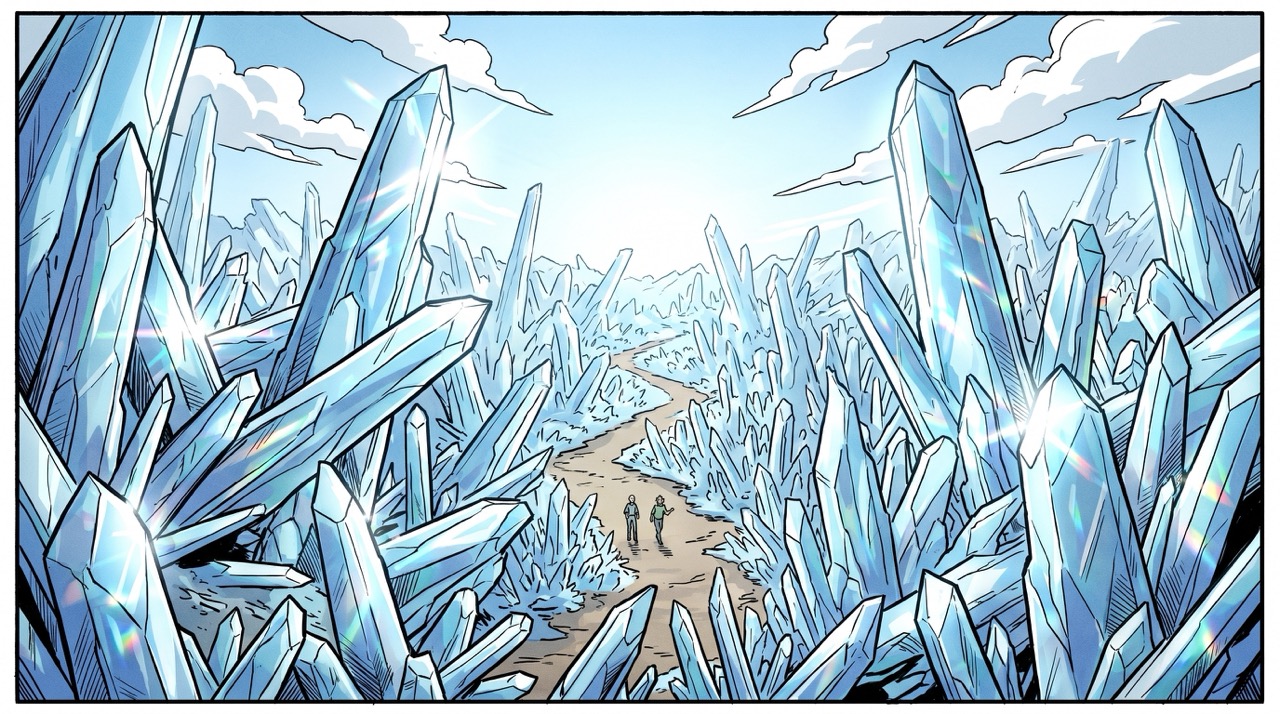
Allosimanius Syneca is a planet of ice and light in the outer reaches of the Galactic Northeast, distinguished primarily by its extreme beauty—a beauty of the specific type that causes philosophical difficulty rather than resolving it.
The planet's surface is covered in ranges of white ice mountains and valleys of deep blue crystal that catch and refract the light of its star in ways that have been described as: transcendent (by the seventeen distinct religious traditions that consider it sacred), aesthetically significant (by the university departments that have studied it), statistically inevitable (by the university departments that want to seem hard-headed about it), and deeply suspicious (by no one on record, though the Guide suspects someone has thought it and then thought better of saying so).
Allosimanius Syneca has a small, stable population of somewhere between thirty and forty thousand individuals, depending on the season and how generously one defines the concept of residing. It has no temples. It has no mosques, cathedrals, shrines, sanctified natural features, or designated holy sites. What it has, in considerable abundance, is people who believe in God in the quiet and particular way that very beautiful places sometimes produce—not as a theological conclusion but as a response, the way one might say thank you upon finding, after a long search, exactly what one was looking for.
Whether this counts as religion is a question the Guide declines to resolve, on the grounds that the people who live there have never asked for an external opinion on the matter and the Guide, for once, considers this a reasonable position.
The planet was exactly as advertised. This was itself unusual—guide descriptions tended toward optimism, and the reality of tourist destinations generally carried the particular disappointment of a photograph processed by someone with strong opinions about color saturation. Allosimanius Syneca did not have this problem. It looked, if anything, as though the photograph had been toned down for fear of being believed.
The ice mountains in the distance were the white of something that has never been touched. The crystal formations in the near valleys caught the low light and scattered it in every direction at once, so that the ground sparkled and the air sparkled and even the shadows seemed to be reconsidering their position on illumination. The temperature was several degrees below what should have been comfortable, and was comfortable anyway, the way cold air sometimes is when the light is exactly right.
Colluphid stood at the edge of the landing area and looked at it.
"This proves nothing," he said.
"I didn't say it did," said Hurkel.
"It's aesthetically striking. Aesthetically striking planets are not theological evidence. There are any number of explanatory frameworks for planetary beauty that don't require a designer."
"Right," said Hurkel.
"The anthropic selection bias alone—"
"Yes," said Hurkel, in the tone of someone who has agreed and would like to continue walking.
Colluphid walked. The crystals crunched faintly underfoot, not unpleasantly.
The community they'd come to see was an hour's walk from the landing point—or possibly scattered across a wider area, the coordinates having been provided by a Maximegalon colleague who described his source as "field notes, some years old, I think the settlement has moved." Colluphid had flagged this under Logistical Uncertainty in his research plan. He had flagged many things. The difference between his research plan and his actual research was, at this point, a document management problem.
They found Essa not by following the coordinates but because Hurkel stopped.
They had been walking for forty minutes across a landscape of crystalline formations and occasional low-growing things—plants of a silver-green that caught the light the way the crystals did, which seemed improbable from an evolutionary standpoint but which Allosimanius Syneca appeared to have declined to care about—when Colluphid looked back and discovered he was walking alone.
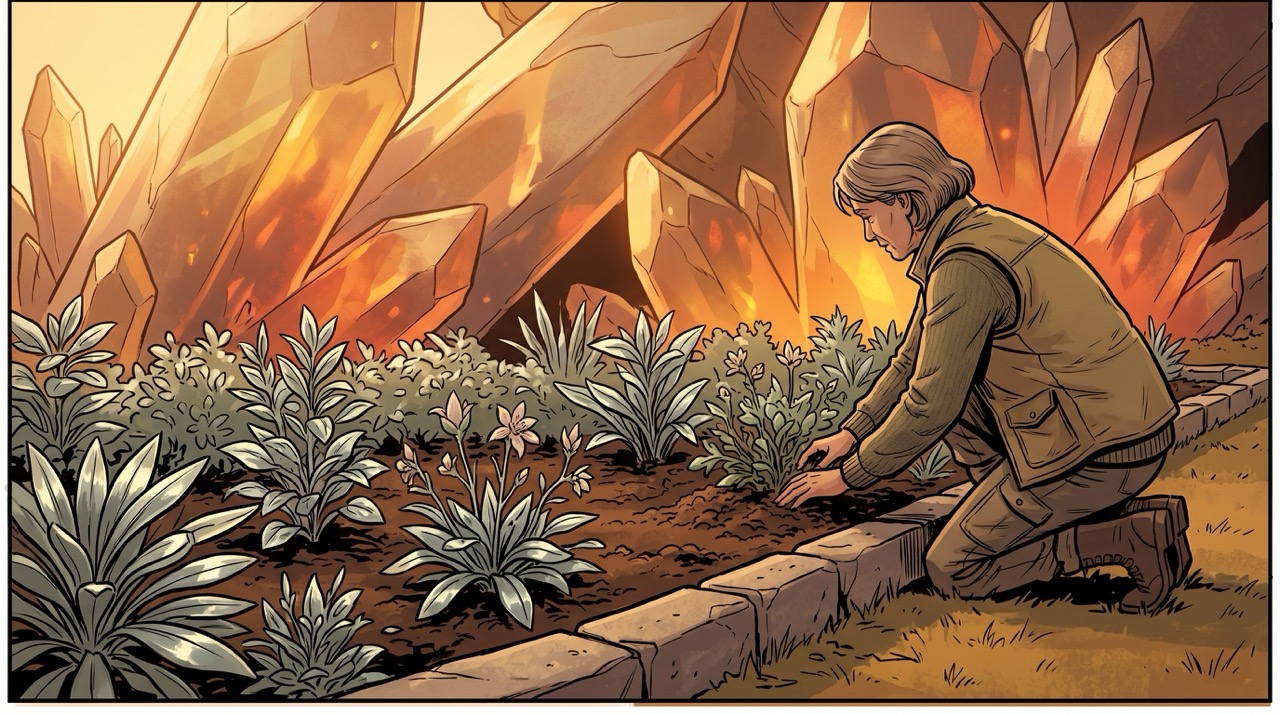
Hurkel had stopped twenty meters behind him, off the path, at the edge of a cultivated area of ground that Colluphid had not noticed. It was not large—thirty meters in diameter, roughly circular, bordered by a low arrangement of stones. Someone had been working in it. The turned earth was darker than the crystalline ground around it and smelled, incongruously, of somewhere much warmer: wet soil and green growing things and the particular vegetable determination of life that has decided to be alive.
A woman was working at the far edge of the plot, her back to them, doing something to the base of a plant that involved both hands and her full attention.
"There's someone here," Hurkel said.
"The settlement is another kilometer," Colluphid said. "She's probably a resident we can ask directions from."
"She has a garden."
"I can see that."
Hurkel walked toward the garden. Colluphid did not immediately follow. He stood for a moment on the path, calculating something he couldn't quite name, and then followed, because the settlement could wait and this, apparently, was what Hurkel was doing.
The woman's name was Essa. She was perhaps sixty years old, with the particular quality of someone who has spent most of their life outdoors—not weathered, exactly, but layered, like something that has been added to by exposure rather than reduced by it. Her hands, when she stood to acknowledge them, were darkened with the soil she'd been working.
She took their presence with the equanimity of someone who is occasionally walked up on by strangers and has made peace with this. She indicated the low stone wall, which was wide enough to sit on, and Colluphid sat, and Hurkel sat, and she returned to what she was doing.
Colluphid had prepared questions. He had a structured interview framework—adapted from a sociological methodology paper, modified for theological fieldwork—that he had used successfully at three prior field sites and would have employed here if the person in front of him had seemed like someone who answered structured questions. She did not. She seemed like someone who answered the question you asked, without negotiating what you meant by it. Which is a different thing entirely.
"You live here?" Colluphid said.
"Yes," she said.
"And you believe in God?"
A pause. Not the pause of someone forming a position—the pause of someone deciding whether the question required a formal answer or whether a more efficient one was available.
"I suppose I do," she said, with the air of someone confirming a fact about themselves they haven't examined closely because it has never occurred to them to dispute it.
"Why?" Colluphid said.
She looked up from the plant. She had mild eyes, brown, not particularly analytical—not the quality Colluphid had been expecting from the first person on his itinerary who was not, in some formal or informal sense, a colleague.
"I haven't thought about it much," she said.
"You mean you haven't thought about why you believe? Or that you don't find the question interesting?"
"I mean I don't think about it much." She returned her hands to the base of the plant. "The same way I don't think about whether the sun will come up. It does. I work around when it does."
This was where Hurkel began asking questions.
Colluphid had expected the theological framework questions to be his—he had built them, he had the structured interview form, he had been doing this for four months. But Hurkel asked questions without a framework. He just asked what he wanted to know.
"How long have you been here?" Hurkel said.
"Forty years," Essa said.
"Forty years in this spot?"
"In this general region. The garden's been in this location for about twelve."
"It's very—" He looked at the plants, silver-green and low to the ground, doing something elaborate with the available light. "Deliberate-looking."
"Yes," she said. "That's what a garden is."
"Most things here aren't. Most of this is just what it is." He gestured at the crystals, the formations, the landscape generally.
"Yes," she said. "It is."
"So the garden is the outlier. Something you decided."
"Everything in a garden is something you decided. Which one to plant. Which one to move. Which one to let go." She shook her head slightly at something she was examining in the soil—a small private gesture, half conversation with herself. "Most of them don't produce what you expected. But something always comes up."
Hurkel was quiet for a moment. "Is that a metaphor?"
Essa looked up at him. "It's a garden," she said.
Colluphid had been taking notes. His notes were thorough and largely useless.
The problem was one he had not encountered in the field before. In every previous encounter—Tanoor, Wress, even Divna—the person in front of him had a position. They had premises, and conclusions that followed from premises, and those premises could be examined for the quality of their foundation. The theological argument was present in the conversation even when it wasn't explicit, visible in the architecture of the thinking, in the choices about what to defend and what to concede.
Essa didn't have a position. Or rather—he found himself sitting with this, turning it—she had a position the way the planet had ice mountains. It was simply there, the background condition against which everything else happened. Not something she'd arrived at by argument, and not something that had ever required defense, because it had never occurred to her that it might need one.
He watched her work and cast, again, for the lever. The logical inconsistency. The undefended premise. The thing that, once examined, would prove itself hollow. The tool he'd been using since Maximegalon, refined across four months and three field sites.
He could not find it. Not because it wasn't there—he was certain, at some level, that it was—but because to use it, he needed something to push against, and Essa did not push back. There was no argument to dismantle. There was a woman tending a garden in the afternoon light on a planet that was too beautiful to be an accident and too indifferent to be an argument.
You couldn't debate the weather. You could describe it, document it, analyze the atmospheric conditions that produced it, and be completely correct, and the weather would continue, indifferent to your conclusions.
He wrote: Hedging or precision? He studied what he'd written. He was not sure.
"Do you know about the Babel fish?" Colluphid said.
He had not intended to say this—it was off his interview framework—but it had arrived as the sharpest version of the available tools.
Essa looked up. "Yes."
"The existence of the Babel fish proved that God existed. Then it proved God didn't exist. God, having been disproved, promptly vanished in a puff of logic."
"I've heard this."
"The logical conclusion: there is no God. Disproven. Confirmed absent by the vanishing itself. And yet here you are, believing."
"The fish argument is very clever," she said—without inflection, neither dismissal nor agreement, the way you might describe a tool as well-made before explaining why it doesn't fit the fastening. "But I'm not sure it's about the same thing I believe in."
"God," Colluphid said. "You said you believe in God."
"I believe there's something that made all this." She indicated the landscape generally—including, apparently, herself and both of them and the garden and the crystals and whatever the light was doing this afternoon, which had shifted since their arrival and was doing something different now. "I don't know that I believe it has a name."
Colluphid wrote something in his notes. Then looked at what he'd written and did not know which column to put it in.
Hurkel asked whether she had always believed this.
Essa said she thought so—she couldn't remember a time without the sense of the universe as given rather than accidental. She hadn't been taught to believe it. She hadn't argued herself into it. It was simply the quality the world had always had for her, the way some people see depth in two dimensions and others don't.
"Does it make a difference?" Hurkel said. "Believing?"
"To what?"
He thought about it. "To how you live."
Essa knelt down to look at something close to the ground—a pale new growth emerging from the dark soil. She watched it for a moment with the focused attention of someone who has learned that plants require witness, not just care.
"I don't know how to answer that," she said. "It's not as though I have another way of living to compare it to."
"If you found out tomorrow you were wrong—that there was nothing, that it all just happened—"
"That's difficult to imagine. But yes, all right."
"Would you stop?" He gestured at the garden.
She looked at him. The afternoon light came off the crystals at a low angle and touched the side of her face and the turned earth and the silver-green plants, and for a moment the scene had the quality of something arranged—though arranged by what, Colluphid could not say, and noting it in his research log would not improve his situation.
"No," she said. "But I think I'd be sadder about it." She went back to the soil. "There's a difference between making something because you want to and making something because you're the only one paying attention."
Colluphid sat on the low stone wall and looked at his seventeen pages of notes.
He had demographic data, location information, an estimate of the community's size and distribution, historical context, the absence-of-institutional-support observation fully documented. He had everything he'd come for.
He had nothing he could use.
He looked up at the garden: the turned earth, the silver-green plants, Essa moving with practiced unhurry from one section to another, Hurkel crouched at the near edge, watching, his notebook closed.
Then it arrived, not as a conclusion but as a recognition—the difference between naming something and finding out what it is called.
What was bothering him was that Essa's faith looked less like faith than like professional competence. Like someone who had learned, over forty years and twelve years of this specific garden, what to plant and when to move it and which one to let go. Someone who made decisions and observed outcomes and adjusted accordingly. Someone who was good at what they were doing, in the particular way that genuine competence looks when it has become invisible: not a performance of knowing, just the quiet application of it.
Her belief in God and her knowledge of this garden were the same thing. They had the same texture—practised, specific, attentive to evidence. She wasn't believing instead of thinking. She was believing while thinking, the two things so woven together that you couldn't find the seam.
He could argue that it was confirmation bias. He could argue that it was the anthropomorphization of neutral conditions. He could argue it at length and with full scholarly apparatus and be completely right. He sat on the low stone wall in the afternoon light and did not argue anything.
They stayed until the light began its long, slow change—the planet tilting away from its star, the crystals shifting through their spectrum of scattered color as the angle shifted, the garden going amber at the edges. Essa worked without apparent urgency.
Hurkel, at some point, had stopped sitting on the wall and was crouching at the near edge of the plot, watching Essa work. He had closed his notebook forty minutes ago. This was, in Colluphid's experience, unprecedented.
When they finally stood to leave, Essa straightened and looked at them both with the same mild attention she'd given the garden all afternoon.
"Thank you for coming," she said.
Colluphid was momentarily wrong-footed. He had thanked field contacts. He was not accustomed to being thanked by them. "We should thank you," he said. "We've taken your time."
"I like talking to people who think about things," she said. "Not everyone does."
She looked at Hurkel. Hurkel looked at her. Neither said anything for a moment that was measurably longer than social convention strictly required.
"The garden will look different in summer," Essa said. "If either of you come back."
"I'm not sure our research schedule—" Colluphid began.
"I might," Hurkel said.
They walked back to the landing area in the amber late light, the crystals now scattering something warmer than they'd managed at midday, as though the planet were making an additional argument nobody had asked for.
Colluphid walked. Hurkel walked slightly behind him and said nothing.
After ten minutes of silence—companionable on Hurkel's side, processing on Colluphid's—Colluphid said: "You can't build an argument on her."
"I know," said Hurkel.
"She doesn't have a theological position. She has an attitude. There's no epistemological content to engage with. The entire conversation was phenomenological description with zero propositional structure."
"Yes," said Hurkel.
"Which means it's not useful data for the book."
Hurkel walked. The crystals caught the low light. Somewhere behind them, Essa's garden was doing whatever it did in the evening.
"Probably not," Hurkel said.
Colluphid walked in silence for another half-minute.
"Why did you say you might come back?"
Hurkel thought about this with the quality of genuine consideration rather than the assembly of a pre-formed answer.
"I have more questions," he said.
"About theology?"
"About the garden. The plant she was looking at when she said the thing about being sad. I wanted to ask what kind it was."
Colluphid looked at him. This was not actually about the plant. He was also fairly certain that saying so would not advance the conversation, and possibly would not be accurate.
"If you say so," he said.
The shuttle took off at second dark—Allosimanius Syneca had a brief period of near-dark after sunset before the crystals began their own faint ambient scatter, which was its own category of infuriating—and Colluphid used the first hour to write notes in the format he'd adopted since Oglaroon: not the structured interview form, which had not served him well today, but the looser document he was not yet acknowledging was the beginning of something else.
The problem with quiet faith, as a category, he wrote, is that it is not vulnerable to the same arguments as institutional faith.
Then: This is because quiet faith is not a claim.
Then: It is a relationship to the world.
He stopped, because he had written something he did not immediately know what to do with, and because he had been retrieving things from the trash too frequently on this trip and was beginning to worry about the pattern.
He looked at his notes from the conversation. He read through them once, carefully—Essa's hands in the soil, the garden going amber, Hurkel's closed notebook, the plant she'd been examining when she said I think I'd be sadder about it. He turned to a new page in the printed research notes he used for annotation and found, in the upper corner of the blank page, a note in handwriting that was not his.
She's not wrong.
He looked at the note.
He looked at the page around it. The page was otherwise blank. He had printed the document himself that morning, from the same template he used every day since Maximegalon.
He sat for a moment in the shuttle's rear compartment with the research notes in his hands and thought about the first note—Yes, but—which he had attributed to a misplaced archive photocopy and believed, sufficiently, to stop thinking about. And the second note—Be careful—in the margin of a TRA form he had printed himself on his own device. He had attributed that one to archive contamination as well, on the grounds that the same handwriting appeared in materials that had passed through the Cathedral's collection, and contamination was a coherent explanation, and coherent explanations were worth preserving.
This note he could not attribute to archive contamination. It referred to a conversation that had occurred this afternoon, in a printed document prepared this morning, on a planet several hours from any archive.
He considered this for approximately thirty seconds.
Then he closed the notebook and did not think about it for the rest of the flight—through a process of sustained mental discipline that was, he recognized privately, the most strenuous thing he had done all day.
Essa's garden would still be there the following spring. The pale new growth she had been watching when she spoke about sadness would become, by midsummer, something with narrow silver leaves and small flowers in a color the locals called, in a term that translated imprecisely, "the color of almost enough." It would bloom for six weeks and then recede, and she would plant it again the following year, because some things you plant again regardless of what they produce, because the act of planting is itself the point. The notes in Colluphid's research file would not describe this, as he had not asked; nor would they describe the garden's summer form, as he had not returned. Hurkel would.
-
Allosimanius Syneca's crystal formations are composed of a silicate structure unique to the planet's geological history, formed over approximately four billion years under conditions that planetary geologists describe as "deeply improbable" and religious scholars describe as "suggestive." The two communities have declined to resolve this difference in framing, which may be because neither party has found the other's central argument incorrect so much as insufficient. ↩
-
The distinction between faith as a claim and faith as a relationship to the world was not one Colluphid had previously made in his published work. It would not appear in Where God Went Wrong as published, which addressed faith claims rather than faith postures. The gap between these two categories—and what it means to have built a book arguing against the former while leaving the latter entirely unexamined—is a question Colluphid would not address in print until And Another Thing God Got Wrong, Book 3. ↩