Where God Went Wrong—Chapter 9: The Problem of Pain (A Lecture in Three Parts)
Posted on Sat 25 April 2026 in Fiction
Where God Went Wrong
Chapter 9: The Problem of Pain (A Lecture in Three Parts)
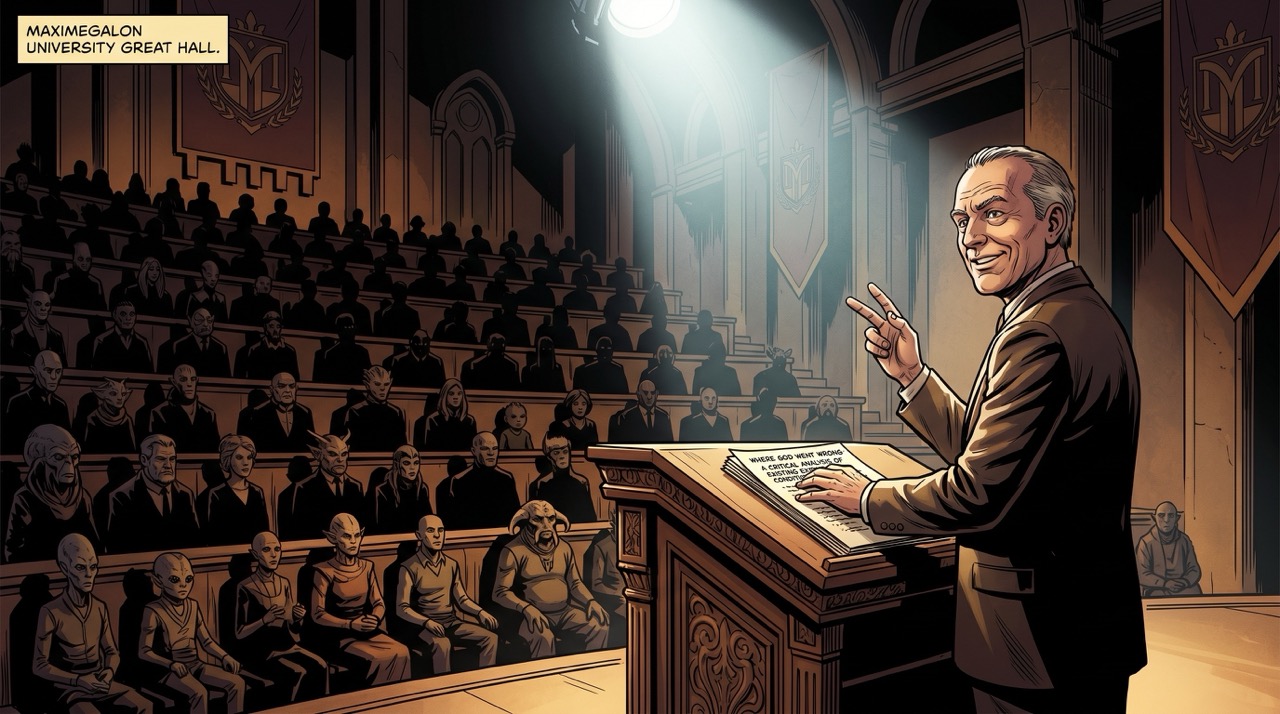
The Maximegalon University Great Hall held twelve hundred beings at capacity and, on the evening of Colluphid's Problem of Pain lecture, held fourteen hundred and a great deal of resentment about fire safety codes. The extra two hundred had been admitted through a variety of mechanisms that the event's organizers had eventually decided to stop counting. Colluphid's two complimentary tickets had gone, in accordance with his standard practice, to Hurkel (who was in the third row with the particular expression of a man who is successfully pretending not to know the individuals he had sold five of his six allocated tickets to) and to Professor Divna Allay of the Cathedral of the Conditions on Brontitall, who had arrived two hours early and was seated in the seventh row with a notepad.
Colluphid, backstage, was reviewing the opening three paragraphs of his lecture for the twenty-third time.
He did not need to review them. He had written the lecture over six days following his return from Allosimanius Syneca, in the focused and almost serene state that good writing sometimes produced—a state that had nothing to do with confidence and everything to do with the satisfying click of an argument in which all the load-bearing elements were where they were supposed to be. The Problem of Pain was the oldest argument in the theology-critic's toolkit, deployed by fifty thousand writers before him in fifty thousand approximately identical ways. What Colluphid had done was reconstruct it from the ground up using everything he'd gathered in four months of fieldwork, the updated catalog, and the newly refined incompetence-malice-intent framework that Hurkel had accidentally generated in a bar on Oglaroon. The result felt, to him, like a piece of engineering: sound, efficient, and correct.
He was reviewing the opening three paragraphs because reviewing the opening three paragraphs was what he did before a lecture, in the same way that certain professionals checked their instruments before an operation. Not because anything was likely to be wrong. Because the checking was itself a form of preparation.
"You look fine," said Hurkel, appearing briefly in the corridor outside the green room with a cup of something and the expression of a man who has just successfully not made eye contact with five separate people in the third row. "The audience is—" He appeared to search for a word. "Expecting things."
"They always are."
"These ones have formed opinions about what the things will be. Several are wearing the ceremonial regalia of competing religious traditions, which seems like an unusual choice for an atheist lecture."
"They're here to hear their position dismantled."
"Some of them seem quite enthusiastic about it."
Colluphid did not find this observation useful and returned to the opening three paragraphs.
The Hitchhiker's Guide to the Galaxy has this to say about THE PROBLEM OF PAIN:
The Problem of Pain is arguably the galaxy's oldest running theological dispute, predating formal writing by several civilizations and organized thought by at least one.
The argument, in its standard formulation, runs as follows: if God is omnipotent (can do anything), omniscient (knows everything), and benevolent (wishes good for all creation), then suffering should not exist. Since suffering demonstrably does exist—at a scale, variety, and creativity that some theologians describe as "impressive" in the way one uses that word about a crime scene—one of three possibilities must be true: God is not omnipotent, God is not omniscient, or God is not benevolent. Alternatively, God does not exist; or God exists but finds the problem as baffling as everyone else; or the word "benevolent" is doing more rhetorical work than its etymological origins ever intended.
The counter-arguments are numerous, well-tested, and only occasionally convincing. They include: (1) suffering builds character, (2) suffering is necessary for free will, (3) suffering is a judgment, (4) suffering is a test, (5) suffering is a lesson, (6) suffering is a mystery, and (7) that which does not kill you makes you stronger, which is both demonstrably false in a significant proportion of documented cases and, if true, raises additional questions about the curriculum.
The Problem of Pain has generated more philosophical careers than any other theological question, with the possible exception of Why is there something rather than nothing, which generates comparable prestige but considerably less empirical starting material. Scholars of the latter question are forced to maintain, as a professional requirement, an expression of genuine ongoing uncertainty. Scholars of the former can at least point at suffering, which exists, and argue from there. Where the argument goes is another matter.
The lecture was called The Problem of Pain: A Systematic Examination of Divine Design Decisions, Their Consequences, and What This Tells Us About the Designer—a title Colluphid had chosen with care, as it was long enough to establish academic credibility and short enough not to discourage people who had already purchased tickets.
He opened without preamble. This was a technique he'd learned from the best lecturers at Maximegalon, who had all understood that the most expensive thing you can spend in a public lecture is the audience's initial goodwill.
Part One: The Physical Universe
"Fourteen billion years ago," he said, "give or take—I invite the cosmologists in the audience to take a moment and decide whether to spend the next thirty seconds being annoyed at my imprecision or listening—the universe began. It has been going ever since." He paused. "This is, in some respects, impressive. In other respects—and I would ask you to hold your applause for the omniscience—it has not gone well."
The laugh was immediate and came from fourteen hundred beings in the slightly different register of an audience that is relieved to confirm the speaker is as good as advertised. Colluphid moved on before the laugh had fully resolved.
He opened with heat death, because heat death was simultaneously the most devastating and the most abstract: the universe, as designed, would eventually reach a state of maximum entropy in which no information could exist, no complexity could persist, and nothing that had ever occurred—every thought, every relationship, every act of love or cruelty—would vanish without trace. Not as a side effect. As an architectural feature. The universe had been built with its own deletion function already included. If this was intentional, it raised one set of questions. If it wasn't, it raised a different set. Neither set was encouraging.
He followed with dark matter. Dark matter and dark energy constituted, by current estimates, ninety-five percent of the universe's total mass-energy content. The visible universe—everything seen, measured, mapped, and named—was five percent. "If I gave you a meal," Colluphid said, "and ninety-five percent of it was undetectable and serving no identified nutritional function, I might forgive you for not feeling grateful for the sandwich."
The laugh from this one was more complex. Part of it was the image. Part of it was the accumulated weight of what had come before.
Part Two: The Biological Record
This section opened with the parasitic wasp—the same argument that had stopped Darwin cold, the same diorama he'd stood in front of at the Temple of Failures on Oglaroon. Not the most extreme example in the biological record. The most useful, because it combined the mechanical precision of a well-designed system with an outcome that was, from any available moral standpoint, appalling.

He ran through eight further examples—selected for variety, escalation, and the specific quality of making an audience feel that they wanted the section to end and were also unable to look away—and concluded with a comparative table: suffering distribution across the biological record, set against what one would predict from a randomly assembled universe versus a deliberately designed one.
The designed-universe column was, by a comfortable margin, worse.
In the seventh row, Divna Allay wrote something in her notebook with the focused attention of someone who has found the precise passage she'd been waiting for.
Part Three: The Moral Problem
The third section had no subtitle. Colluphid had considered several and rejected them all for being either too precise or not precise enough.
This section was about sentience.
The physical universe's suffering was a design problem. The biological record's suffering was the same problem at greater scale and closer range. But sentient suffering—suffering by beings capable of knowing they suffered, remembering past suffering, anticipating future suffering, and suffering on behalf of others whose pain they could do nothing about—was a different category entirely. This was not a design flaw. This was a design choice.
The capacity for grief required specific neural architecture. The capacity to remember loss required specific cognitive structures. The capacity to love something you would lose—to build your interior life around something inherently temporary—required a very particular kind of brain, and there was no physical law that demanded it. Alternative configurations were possible. Simpler. Less self-aware. You could construct a universe full of beings with every functional capacity for civilization—memory, communication, tool use, social structure—without including the specific machinery for heartbreak.
Someone had included it anyway.
"The question is not whether suffering could have been designed away," Colluphid said. "Of course it could have been. The question is why it wasn't." He paused. "The answer the evidence supports is that we were not designed for comfort. We were designed for something else. Something that requires the full apparatus of loss, and grief, and the capacity to suffer on behalf of others." Another pause. "I have not been able to identify what that something is. I have been able to identify what it implies about the designer: either profound indifference, or a negligence that makes the word 'omniscient' functionally meaningless, or a third option I find more disturbing than either."
The room was quiet in a way that large rooms are rarely quiet.
"What if it was intentional?" he said. "Not as an oversight. Not as the byproduct of some greater end. What if the architect of the universe included grief, and loss, and the specific mechanism of watching something you love diminish—because the designer wanted to see what we'd do with it?"
He let it sit.
"That is not a benevolent God," he said. "That is something considerably more unsettling. That is a God who is curious."
The reception afterwards was well-attended, loud, and full of people who wanted to tell Colluphid how right he was. He was very right. Everyone agreed. Fourteen hundred beings had watched him construct the argument, found it airtight, and were now drinking the university's wine and saying so at volume. Several religious scholars had departed before the third section, which was itself a form of tribute.
Colluphid stood with a glass of something adequate and accepted the assessments of the evening with the practiced grace of someone who does not want to appear to be seeking compliments, which is to say he appeared modestly pleased while experiencing an internal sensation that was probably what a structural engineer feels upon watching the bridge not collapse. The lecture was excellent. He had known it would be excellent. Knowing a thing was true and experiencing the confirmation of it were, he had noticed over the years, surprisingly different sensations—the second richer, louder, and substantially harder to be rational about.
He was fielding a question from a philosophy emeritus about the third section's epistemological commitments when he became aware that Divna Allay was standing three meters away. She was holding a glass she hadn't touched and his annotated lecture program, which had been annotated considerably further than he had annotated it. She was waiting with the patience of someone who has been doing so for some time and is prepared to continue.
The restaurant was the kind of place faculty members went when they wanted to be in a faculty restaurant without any faculty in it—a configuration managed by its location three streets from the university and its menu's principled refusal to name any dish in a way that implied it considered itself remarkable. Colluphid had been going there for eleven years. It smelled of serious cooking and ten years of the same wine supplier and the particular settled quality of a kitchen that has been making the same things excellently for a very long time and sees no reason to revise this policy.
They ordered. The tea arrived before the food, as it should. Divna poured for both of them without making a gesture of it, and Colluphid noted this and said nothing.
"The lecture was excellent," she said.
"Thank you."
"The physical universe section was very good. The biological section was better."
"And the third section?"
She looked at him over her cup—brown eyes, neither particularly warm nor particularly cold. The expression of someone who has organized their thoughts in a specific order and is now deploying them.
"Tell me about the third section," she said.
This was not a compliment. He recognized it by the texture of the silence before it.
"I made the case," he said carefully, "that sentient suffering cannot be accounted for by accident. That it requires explanation."
"Yes."
"And I proposed that the available explanations—indifference, negligence, or intentionality—all reflect badly on the designer."
"You proposed that, yes."
She had her notepad on the table beside her cup. Several pages were covered in the shorthand she used when she was working rather than simply recording.
"Your third section rests on an assumption," she said. "It's been accumulating since Part One, so it's well embedded. But it's there."
"Which is?"
"That God's primary obligation was to prevent suffering."
He set his cup down. "That's not an assumption. It's a definition. An omnipotent, omniscient, benevolent creator who permits suffering is, by the conventional meanings of those terms—"
"By whose definition of benevolent?"
"By the—" He stopped.
"By what standard? You've spent forty minutes assuming that comfort is the highest good. That a correctly designed universe is one with less pain. That we can identify what God should have done because we can identify what we would prefer."
"I'm defining benevolence as what a compassionate, rational being would recognize as beneficial to its creations."
"You're defining benevolence as what you would choose if you were in charge." Her voice remained the same—precise, not hostile, with the specific quality of someone who considers accuracy a form of respect rather than a weapon. "That's not atheism, Oolon. That's competitive theology."
The restaurant continued around them. Someone to their left was celebrating something. The sound of it was warm and distant, like light seen through a window in the rain.
"Competitive theology," he said.
"You're not arguing that God doesn't exist. You're arguing that you'd have designed the universe better. Which requires you to know what the universe is for." She tilted her head slightly. "I asked about the blueprint. On Brontitall, the first afternoon. You said you'd need to think about how to answer that."
He had been thinking about it for three months and writing around the thinking.
"The blueprint is implicit in the argument," he said, knowing as he said it that this was the weakest sentence he had produced all evening.
"It isn't." She said it without satisfaction. "The argument is brilliant—the best version of this argument I've heard, and I've heard most of the versions. But its foundation is the unargued premise that suffering has no value. That a universe with less suffering is unambiguously better. That requires a position on what the universe is for, what sentient life is for, whether safety and comfort are actually the highest goods available to a conscious being." She turned a page in her notebook. "You never establish any of that. You use it."
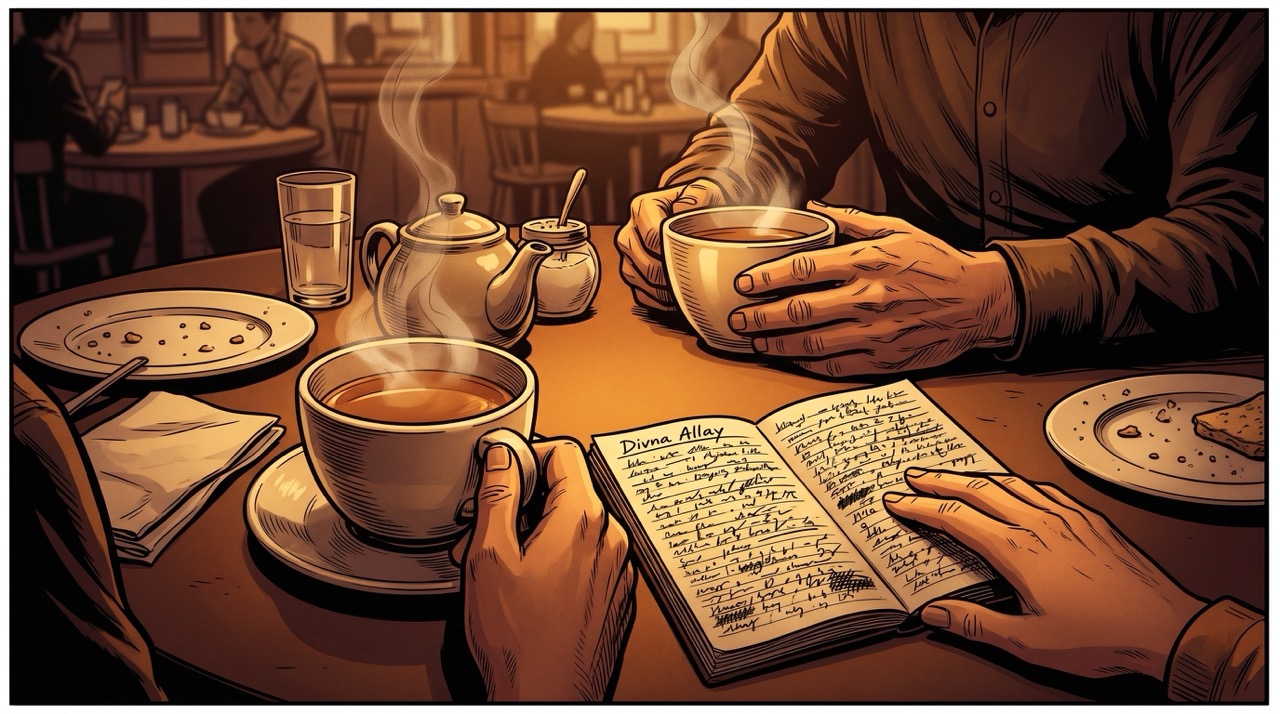
Colluphid looked at his tea.
He thought, without meaning to, of Essa on Allosimanius Syneca—her hands in the soil, Hurkel's closed notebook. Of the loose-notes document on the shuttle home, the line he'd written and not used: It is a relationship to the world. Of the Arvanthi testimony in the Oglaroonian gallery—I think I am sorry for thinking so—and the note he'd retrieved from the trash and still not acted on.
"You're not saying I'm wrong," he said.
"I'm saying your argument doesn't address the question it appears to be answering. Whether God is good requires a shared framework for what good means. You've assumed the framework, built a lecture on it, and called it evidence." She turned a page in her notebook. "That's not nothing—it's an important argument. But it's a different argument than the one you said you were making."
His communicator buzzed against the table. He ignored it. It buzzed again.
"Sorry," he said, and turned it over. The screen displayed a priority message from something called Cressfield Tonight, regarding his attendance at the Flandrathi Conditions Ceremony six months prior, the ongoing interest this had generated across fourteen galactic broadcast territories, and the show's sincere desire to discuss this with him in a constructive and wide-ranging format as soon as practically possible.
He looked at it for a moment. Then he set it face-down on the table.
"Talk show," he said. "About the ceremony."
Divna looked at the communicator, then at him. "Will you go?"
"Probably. I haven't—" He stopped. "I don't know what I'd say, if they asked what I was doing there."
"What were you doing there?"
"Observing. Research purposes."
"In your own time? At a personal colleague's invitation?"
He looked at her. She looked back with the patient precision that he was beginning to recognize as the particular quality of a question that has already been answered and is being asked again as a courtesy—to give the person being questioned the chance to hear themselves.
"I don't know what I was doing there," he said.
It was honest. He could feel that it was honest, which produced the immediate impulse to qualify it into something less so. The mechanism for that appeared to have temporarily gone offline.
The walk back to the university quarter was twenty minutes and conducted mostly in silence. Divna's accommodation was in the opposite direction—she was staying in the university's guest rooms for the week, having traveled from Brontitall for the lecture, a fact Colluphid had registered and not examined.
At the corner of the Faculty Bridge, she stopped.
"Your third section proposes that God is curious," she said. "That God wanted to see what we'd do with suffering." She looked at him steadily. "If that's true—by your own analysis—then what you're doing: examining the evidence, constructing the hardest argument you can find, refusing to accept an answer that doesn't satisfy you—that's exactly what God built us to do. You've argued yourself into being a very good advertisement for the designer's intentions."
She said goodnight before he had assembled a response, which was probably the point.
He went home.
The apartment was quiet and lit by the clock tower's light through the window—forty-seven minutes wrong, steady and familiar, the error so well established it no longer registered as one. He made tea he did not drink. He sat at his desk with the city arranged outside in its usual configuration: three quads, the empty paths between them, the buildings with their lights on in the pattern of things considered worth protecting.
He opened his manuscript.
WHERE GOD WENT WRONG.
The title sat at the top of the document the way it always had. He had typed it, deleted it, typed it again on the first night in October, and it had lived there since, unchanged. Declarative. The period in its place. The question answered, the finding recorded, the matter settled.
He looked at it.
The period at the end of the sentence was, he realized—and the realization arrived with the particular quality of something that had always been there, waiting for him to turn around and face it—doing work he had not examined. It said: the case is made. It said: wrong. It did not say: wrong?
Divna's question was there again, unasked and fully present: Wrong relative to what? What's your blueprint for a universe?
He had given the best lecture of his career three hours ago. He had not answered the question.
He closed the document without changing anything. He sat for a long time with the clock tower in the window, keeping its own time, perfectly wrong. Then he opened a new document—the loose-notes file, the one he was not yet calling anything—and typed, at the bottom of what was already there, a single line: What is the universe for?
He did not answer it. He was not sure he could. But he saved the document before he went to bed, which was, he supposed, a different kind of answer.
He did not sleep well. This was not unusual. What was unusual was the specific character of the not-sleeping, which had previously been the not-sleeping of a man with structural problems in a manuscript—paragraph-level concerns, argumentative gaps, the ordinary frustrations of a project still finding its shape. This was the not-sleeping of a man who has been told, with great precision and no cruelty, that the project has a different kind of problem. Harder to locate. Harder to fix. The kind that only becomes visible once you've built everything else and stepped back to admire it.
-
Colluphid would later describe the Problem of Pain lecture, in a brief personal history he recorded for Maximegalon's oral archive program and subsequently withdrew from publication, as "the last time I knew exactly what I thought." This description was considered, at the time, falsely modest. It was not falsely modest. ↩
-
The talk show appearance would occur three weeks later, under circumstances that Colluphid would subsequently describe as "entirely my own fault, in the sense that most things that happen to you are your own fault if you've been paying close enough attention." He had not, on this occasion, been paying close enough attention. This was also his own fault. ↩