Where God Went Wrong—Chapter 10: The Remnant
Posted on Wed 29 April 2026 in Fiction
Where God Went Wrong
Chapter 10: The Remnant
The planet had been occupied, by the most conservative academic estimate, for approximately four billion years. By a more liberal estimate, it had been occupied for longer than the current universe had existed, which raised questions that most cosmologists preferred not to engage with over breakfast.
Its name, in the oldest surviving translation, meant still here—a phrase that managed to be simultaneously modest and reproachful, like a message left by a houseguest who has been waiting three days for you to return. It appeared in Colluphid's travel documentation as Still Here, which is what the immigration authority at Maximegalon had stamped without apparent irony, and which appeared on the terminal board at the Brentovaal transit hub, where he and Hurkel changed shuttles, in plain text with no additional commentary.
Colluphid had found the Remnant in a footnote. This was, he reflected on the twelve-hour final transit, the most purely academic sentence he'd ever had reason to think about himself. Specifically: in a footnote of a footnote in a secondary analysis of the Preliminary Materials at the Cathedral of the Conditions on Brontitall—a brief reference to "first-cycle witnesses," beings who had survived the transition between creation cycles and who were noted, almost apologetically, as "the only available primary sources for the pre-Babel-fish period." The footnote had cited a transit heading and an academic contact protocol. Colluphid had commed the protocol ten days after the Problem of Pain lecture, received a response in two working days, and been granted a standard academic visit without any of the paperwork that the TRA had made him associate with anything interesting.
He had concluded this was because the TRA didn't know about the Remnant. Or didn't consider them worth regulating. Or—a third possibility that had occurred to him somewhere over the asteroid belt at Marcellan Point—had decided that what the Remnant told visitors was not worth restricting because it could not, by itself, be understood.
The Hitchhiker's Guide to the Galaxy has this to say about THE REMNANT OF STILL HERE:
Very little.
This is unusual. The Guide, which maintains opinions on everything from towel hygiene protocols on Betelgeuse Five to the optimum approach to a Vogon bureaucratic encounter, has in the case of the Remnant of Still Here produced a single entry of forty-seven words and then apparently stopped.
The entry reads: The Remnant of Still Here are the only known survivors of the previous creation cycle. They are very old. They are very polite. They do not charge for visits. Researchers who have spoken with them report, without exception, that they found the experience clarifying. When asked to specify in what sense, most of them change the subject.
The Guide's editorial board has declined to comment on the brevity of this entry. In a memo that was subsequently lost, the original researcher who filed it noted: "I know this isn't enough. I'm not sure I have words for the rest."
This is not, in the Guide's long publication history, an entirely unprecedented response. It has, however, only occurred twelve times.
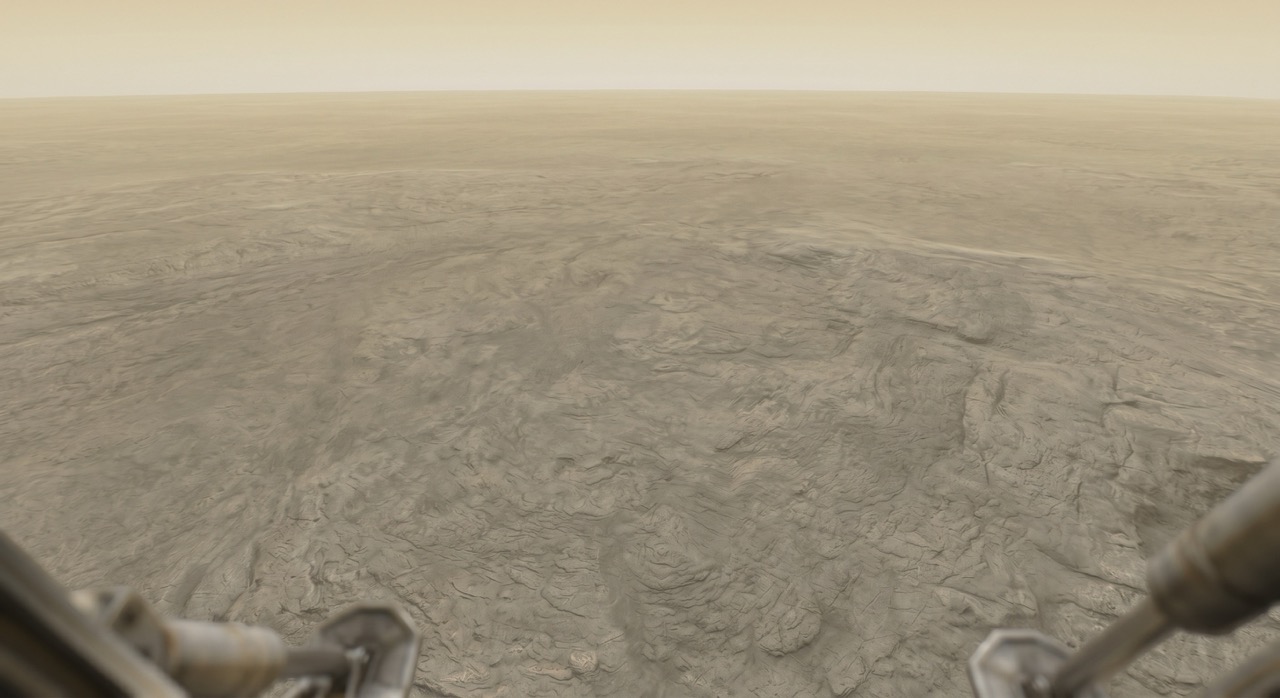
Still Here was flat. This was the thing that struck Colluphid first, descending through cloud cover toward the landing strip—not flat in the geographical sense, not the flatness of plains or tundra or the managed flatness of agricultural worlds, but flat in the way that things worn down over an inconceivable period of time become flat. The mountains had gone. The deep formations had smoothed. What remained was a landscape that had made its peace with being old in the specific way that required ceasing to be other things.
The light had the quality of something arriving from further away than it should have.
Hurkel pressed his face against the transport window with the enthusiasm he maintained was motivated entirely by professional interest. "The rock looks tired," he said.
"Rock doesn't get tired."
"This rock looks tired."
He was not, Colluphid acknowledged privately, entirely wrong. The landscape had a quality that was not quite color and not quite texture—difficult to articulate without the kind of pathetic fallacy that made academic papers impossible to publish. It was simply very old, and being very old had removed certain qualities that younger geological features possessed, in the same way that great age in a face removes the provisional quality of expressions that have not yet settled.
The landing strip had the quality of being unmanned by something not currently present rather than never having been occupied. There was a marker and a path and, at the end of the path, a structure that had been neither built nor grown but was simply there—past the need for explanation, past the moment when it would have been reasonable to ask when it arrived.
Three of the Remnant were waiting at the entrance.
They were not, at first glance, remarkable. This was itself remarkable. Colluphid had expected something that carried its age visibly, in the manner of ancient artifacts or eroded landmarks. Something that broadcast its improbability.
The Remnant looked like scholars. Three of them: different sizes, different apparent biological origins, all carrying the same quality of stillness—not the stillness of inactivity but of something that has long since stopped needing to move to demonstrate that it exists. They watched Colluphid and Hurkel descend the path with expressions that were welcoming in the way of people who have been welcoming visitors for longer than the visitors' civilizations have existed. They had found a rhythm for it.
"Professor Colluphid," said the one on the left. Its voice was pleasant, with an accent Colluphid couldn't place—an inflection that didn't correspond to any regional variant he'd encountered, because it predated the regions. "We were glad to receive your inquiry. We don't receive many these days."
"Thank you for agreeing to speak with me. I'm writing a book—"
"About God's failures," said the one on the right. "Yes. We've read the description in your research protocol."
"You've had others—theological critics, researchers interested in—"
"Several," said the one in the center. "We find them interesting. The questions change, depending on when they were born." It paused. "The young ones tend to have the sharper questions. The older ones tend to ask what the answers mean."
Colluphid was fifty-three standard years old and suspected he had just been categorized.
"The eldest is inside," said the one on the left. "She would like to meet you specifically."
"She?"
The three exchanged something—not quite a look; their apparent directions of attention didn't shift, but there was a quality of consultation.
"The pronoun is an approximation," said the one in the center. "We've been using it for about six thousand years. It seems to have stuck."
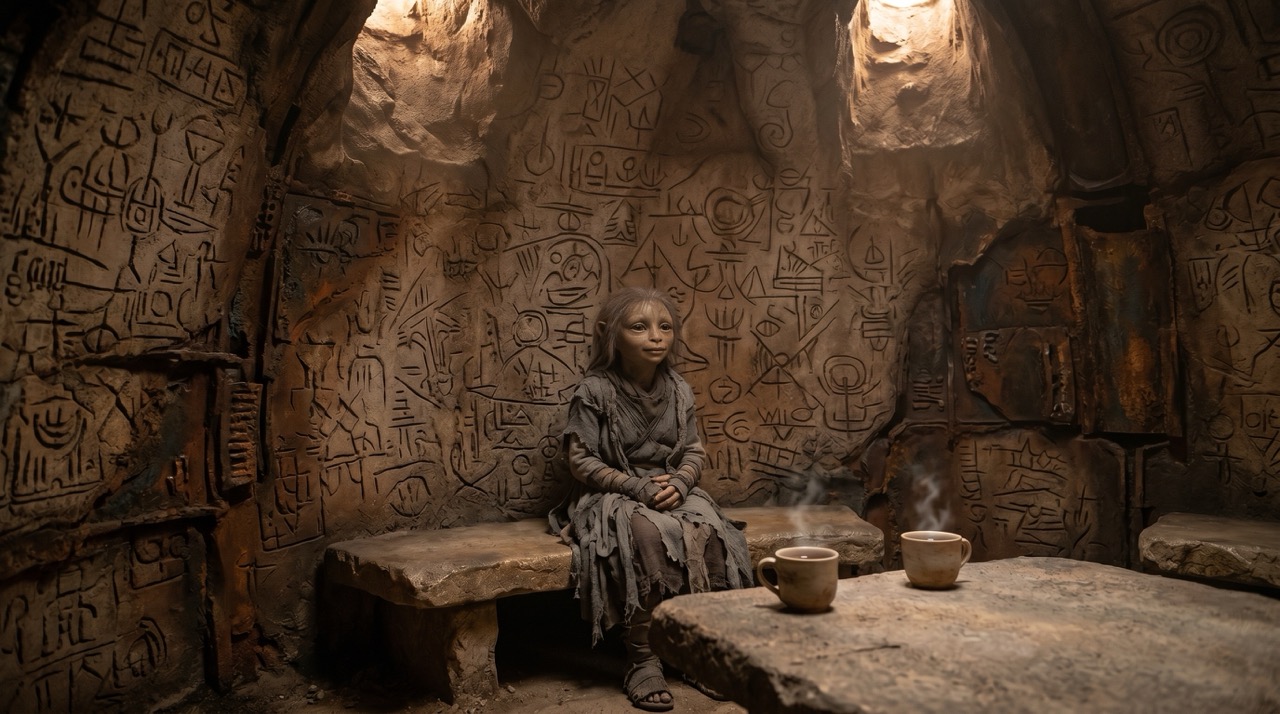
The interior was large in the way of spaces that have accumulated use over a very long time—not large by design but large by accretion, grown to fit everything that had happened in it. The walls were unmarked, which was the wrong word; they were marked so many times that the marks had become the wall itself, layered beyond legibility, past the point where any individual notation could be read and arriving at something that was, as a sum, its own kind of record.
The eldest was sitting with the quality of someone who has been sitting in the same position for a long time and has discovered, in that time, everything there is to discover about what that position is like. She was smaller than the others, which Colluphid had not expected, and looked at him from eyes that were the color of something occurring in places that haven't been around long enough to name it.
Hurkel set up his recorder without speaking. He had been unusually quiet since the landing—not the ordinary quiet of professional attention, but the quiet of someone paying careful attention to what they were noticing.
"Sit," said the eldest. "Please." She said please in the way of someone for whom politeness has moved beyond convention into instinct—a courtesy practiced for so long it had become indistinguishable from sincerity. "We have tea. We find that conversations are better with tea."
They had tea.
"Tell me about God," Colluphid said, because it was the question the research protocol had prepared him for and because he couldn't locate a better starting point.
"Which part?" said the eldest.
"What you remember of God. What God was like. What God's relationship to the creation was."
"That's several questions." She said it without criticism—the observation of someone accustomed to questions being sent in different directions than their askers intended. "Which would you like first?"
"What God was like."
The eldest considered this with the deliberateness of something reconsidering a question it has considered before and found worth reconsidering again. "The word that keeps coming up, when we speak among ourselves, is young," she said. "God was—" she paused, with the specific quality of someone looking for a word in a language that doesn't have it, "—working very quickly. With tremendous enthusiasm. The kind of enthusiasm that comes from not having done something before."
"Young."
"Relative to the question."
"God predated the universe."
"God predated this universe," said the eldest. "Yes. But the universe is very large and very complicated, and making something very large and very complicated for the first time—" She tilted her head. "Youth is not about how long you've existed. It's about the distance between what you know and what you're trying to do."
Colluphid wrote this down and was not sure whether it was a theological position or a description of himself.
"My research—" he began.
"The catalog," said the eldest. "The design failures. The incompetence argument." She named them without inflection—not dismissively, in the way of someone naming things she has heard named before. "We've had researchers like you before. Good ones. You're constructing the argument very well."
"And?"
"And nothing. It's a good argument. The universe has many failures by the conventional definition of failure. We were there. We remember them." She took a small sip of her tea. "God knew they were failures too."
Colluphid looked up from his notebook.
"God knew."
"God saw them happening. Not always immediately—some of them took a very long time to become apparent, and that period was difficult for everyone—but eventually, yes. God saw." She set her cup down. "You've built your case on the premise that God's failures represent an absence of competence, or attention, or care. We don't recognize that description. What we remember is a great deal of care, very visibly insufficient to prevent a great deal of harm, and the specific quality of pain that situation produces."
"That's a description of negligence."
"It's a description of parenthood."
The word sat in the space between them with the quality of something that has been accurately named for the first time.
"God made something alive," the eldest said. "Making something alive is not the same as making a machine, or a landscape, or a system. If you make a machine, you determine its output. If you make something alive—genuinely alive, capable of choice, capable of growth, capable of becoming something you did not specify and could not predict—you make something that is, by definition, no longer entirely yours. The moment it's alive, it begins to be other than what you intended." She looked at him steadily. "God knew this. It was the point."
"The point of what?"
"Of doing it at all." She gestured—a small gesture, encompassing something larger than the room. "You could make a universe without any of the things you object to. Without suffering, without the capacity for grief, without the machinery of loss. It would not be difficult, given the resources. But it would not be a universe with anything genuinely alive in it. It would be a very elaborate mechanism. Beautiful, perhaps. Perfectly functional. And nothing in it would ever surprise its maker." The eldest paused. "God was not interested in mechanisms."
Colluphid became aware, distantly, that Hurkel had stopped recording. He didn't look up to confirm this.
"You're describing a god who chose to build suffering into the design," he said. His voice had the quality he recognized as the argument still running, still intact, still doing its job—even as something beneath it was running a different calculation.
"I'm describing a god who chose to build life into the design," said the eldest. "Suffering is the shadow that life casts. You cannot have one without the other in any configuration that preserves what makes life interesting. God knew that. We discussed it."
"You discussed it."
"In the early period, yes. We were still here from before. God spoke to us sometimes—not as an explanation, more the way one speaks to old neighbors when one has done something large. Thinking out loud, perhaps." She considered. "God was not unaware of the weight of the choice. That's what I want you to understand. Not that God made a mistake without noticing. That God saw the whole ledger—what would be built in, what it would cost, what it would produce—and chose."
"And you consider that a defense of God? That God built grief into the architecture deliberately?"
"I consider it an accurate description of what happened," the eldest said. "Whether it's a defense depends on what you believe making something alive is worth." She tilted her head. "What do you believe it's worth?"
He had no answer that didn't restate the question.
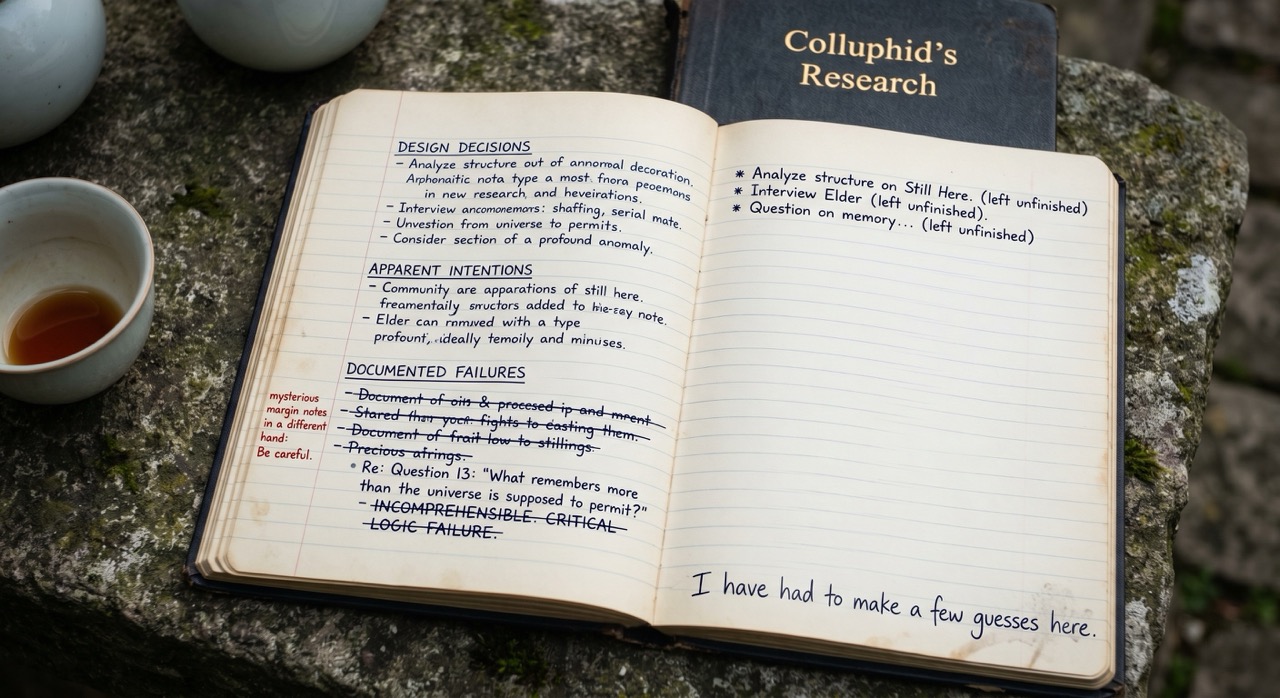
They broke for a time. One of the others brought more tea and said nothing. Colluphid reviewed his notes, which covered three pages of his notebook and then stopped—because somewhere in the middle of the second page his questions had run out. Not because he had asked them all. Because they had begun to feel like the wrong questions in the specific way that only becomes apparent once the conversation you expected to be having is replaced by a different one.
Hurkel was sitting with his recorder switched off and his arms resting on his knees, looking at nothing in particular with the expression of someone doing significant interior work and choosing not to announce it.
Colluphid said, quietly: "You've stopped recording."
"I'll start again when you start again," Hurkel said.
"You might miss something."
"I already have," said Hurkel, in a tone that made it unclear whether this was self-criticism or relief.
When they continued, Colluphid chose the angle he had decided, during the break, was most likely to recover the argument.
"Your account assumes that life—genuine life, as you describe it—required this specific architecture of suffering. But I've spent four months cataloging those features, and in every case I can identify alternative designs that would preserve genuine aliveness without the most extreme outcomes. The parasitic wasp. Certain forms of neurological degradation. The way grief compounds rather than diminishing. These aren't necessary features of life—they're specific choices within the design space."
"Yes," said the eldest.
He waited.
"Yes," she said again, with the patience of something that has learned that yes is sometimes a complete answer. "And God made different choices in the previous cycle. We were there for that too. Different approaches to the architecture. Less suffering. More—managed, perhaps. More efficient." She folded her hands. "It produced a universe of beings who were alive, by most definitions, but who were—the word that keeps coming up when we speak of them—careful. Everything was considered in advance for all its consequences. Very little surprise. Very little that its maker hadn't expected." She paused. "God watched it for a very long time. And then decided to try something else."
Colluphid was very still.
"The current universe," he said.
"With the full architecture," the eldest said. "The grief, and the loss, and the parasitic wasp, and the specific mechanism of loving something temporary. And everything that comes with it—the art, and the courage, and the things beings do for each other when they have no reason to and the cost is very high. All of it together." She looked at him. "We found the second approach considerably harder to observe. We also found it—" she paused again, in the way of someone locating a word that does not belong to them, "—not boring."
"God made the universe more difficult in order to make it more interesting?"
"God made the universe more real," said the eldest. "Real things suffer. Real things surprise their makers. Real things do things that were not specified in the design brief, and some of those things are the parasitic wasp and some of them are—" she looked at something, perhaps him, perhaps not, "—a being who looks at all of it and decides to write the case for the prosecution. Because someone should. Because not to would be a failure of attention." She tilted her head. "God built a universe with critics in it. Think about that."
He thought about it.
"You keep asking where God went wrong," the eldest said. "You've been asking it for years. Your books ask it. Your career asks it." Her voice held nothing but the accuracy of long observation. "The question you should be asking is where God went right—and whether God could bear it."
The room was very quiet.
"God went right," she said, "every time something happened in this universe that was not predictable from the initial conditions. Every time a being made a choice that cost them something they did not have to pay. Every time something was created by something that had no obligation to create it. Every time someone asked a question that the universe was not designed to answer." She took a sip of tea. The gesture had the ease of something practiced for an extremely long time and not yet exhausted. "And whether God could bear it—whether a being who made something real, and then had to watch everything that meant, in perpetuity, every iteration—whether God could bear that—" She set her cup down with the precision of something accustomed to the weight of things. "That is a question we have been asking since the beginning. We don't have the answer. We don't think there is one. We think it might be the question God left when God left."
The departure was conducted with the same courteous efficiency as the arrival. The three who had met them at the entrance walked them back to the landing strip as the local sun descended toward a horizon that had been descended toward for a very long time.
Colluphid had eleven pages of notes and the growing suspicion that they were notes for a different book than the one he was writing.
Hurkel walked beside him with his recorder pocketed and his hands in his jacket, a posture so different from his usual managed disengagement that Colluphid noticed it without being able to say why—only that Hurkel looked like someone who had arrived somewhere without having planned to travel.
At the landing strip, the eldest—who had walked with them at a pace that suggested the distance was not inconvenient—stopped.
"Your book," she said to Colluphid. "When you finish it. Bring it back. We'd like to read it."
"I'll see that you receive a copy."
"We'd prefer to read it with you here," she said. "We've found that discussing a book with its author produces a better conversation than reading in isolation." She paused, with something that was either humor or something for which he did not have a category. "And we are not in a hurry."
He said he would do that, with the sense of a promise he intended to keep.
"We'd like to read it," said the eldest, "because we knew the author."
He stopped.
"God," he said. It was not a question.
"A little," she said. "In the way one knows a neighbor who is building something very large next door and sometimes asks if you can hear it from where you are." She looked at him steadily. "You've been arguing with God for your entire career. From where we stand, that's a conversation that has been going on for some time. We thought the book should be read by someone who was in it."
He had no rebuttal for this either.
He walked up the ramp with the eleven pages of notes and the quiet, insistent sensation of his own framework—which had held everything up until now—shifting slightly beneath him. Not collapsing. Not yet. Moving, the way the ground moves in the first moment of something geological, before the sound catches up.
Hurkel, behind him, said nothing at all.
On the return transit, Colluphid opened his loose-notes document—the one he was still not calling anything, still not acknowledging as the beginning of something else—and sat with it for a long time. It already contained: "quiet faith is not a claim—it is a relationship to the world." And: "What is the universe for?" He had no new sentences. He had something else: the distinct impression that the document was no longer asking questions that were separate from the book. That the book and the questions were the same project. That he had been taking notes, all along, for a different manuscript, and the manuscript had been writing itself while he wasn't watching. He closed the document without adding anything. The cursor blinked. He looked out the window at a universe that had been built, according to at least one source, specifically for the purpose of producing things that would look out windows at it and find it insufficient. He was not yet ready to find this comforting. He noted, with some surprise, that this was different from finding it wrong.
-
The contact protocol for the Remnant of Still Here had been filed in the Cathedral's Preliminary Materials subdirectory under the heading FIRST-CYCLE: POTENTIAL INTERVIEW SUBJECTS, in a font approximately two-thirds the size of the surrounding text, as though whoever had added it had been uncertain whether it should be there at all. Colluphid had nearly missed it. He subsequently considered that this was probably not an accident. ↩
-
The eleven pages of notes from Still Here do not appear in Where God Went Wrong as published. They do appear, substantially reorganized, in a later work—though not in the form Colluphid would have anticipated when he wrote them. ↩