Where God Went Wrong—Chapter 11: The Room, the Window, the View
Posted on Sat 02 May 2026 in Fiction
Where God Went Wrong
Chapter 11: The Room, the Window, the View
I have been trying to remember when I decided on the window.
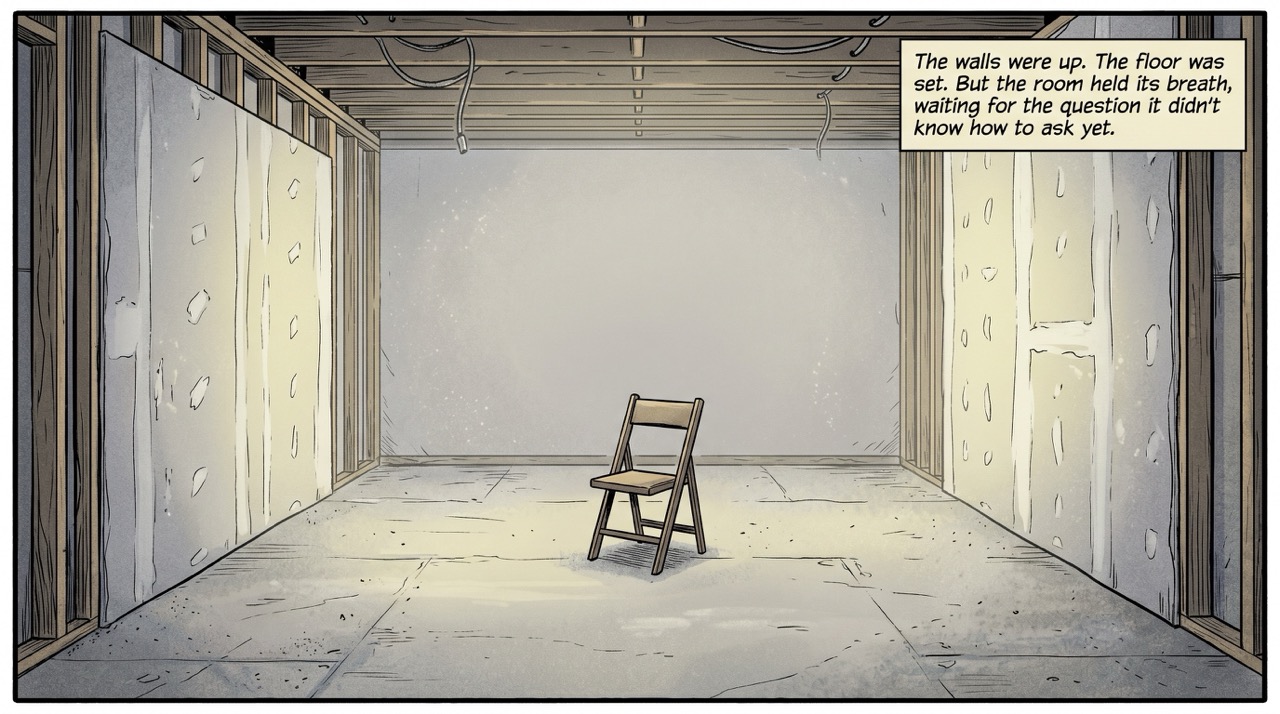
The wall came first. Walls always come first—you cannot have a room without them. The wanting of a room precedes everything else: the choice of material, the question of height, the question of what sits outside it and how much of outside you are going to permit.
The walls were easy. I have always been good at walls.
A room is a promise of enclosure. You are saying to whoever enters: in here, you are bounded. In here, the outside has been organized into a space with predictable edges. This was the thing I understood earliest about making a room: that it is an act of care. You are telling someone that the infinite is, for the moment, managed.
The ceiling was harder than I expected. Something about the decision of how high—too low and the room becomes a pressure, too high and it becomes an argument. I tried many heights. There is still a bruise somewhere, probably, from the heights that didn't work. I have not tried to find it. Some records of what didn't work are better kept vague.
The floor I laid by hand.
This is not a metaphor. I laid it by hand because I wanted to know what each surface would be like underfoot, and I could not know this from above. You have to be at floor height to know what a floor is. You have to walk on it before you have any information about whether the room will be a room someone can inhabit.
I tested each surface. Some were wrong for reasons I could name: too cold, too slick, too yielding. Some were wrong for reasons I could not name and had to trust without understanding—the things you know are wrong without knowing why they're wrong. You act on knowing, and you hope the action was right even without being able to explain it.
The floor I eventually chose has a grain in it that runs north-south. It serves no structural purpose. I considered it, and then put it in anyway. I put it there because I thought someone might notice it and find it pleasant. I do not know if anyone has noticed. The grain is there regardless.
I have returned to the floor more than once, to see if the grain still seems right. It does. This is a surprise that has not worn off.
The window came last.
I know this is obvious. Windows are not the first thing; windows are the decision that comes after you have a room that works well enough to ask what is missing. A room without a window is complete in a way—it has all its own elements, nothing absent that was promised—but complete in the way of something finished too early, before the last question has been asked.
The last question, for a room, is always: what should it touch?
I chose the view before I chose the window. This matters. There are builders who start with the window—the size, the placement, the frame—and find the view is whatever was there. I worked the other way. I had a view I wanted someone to have access to, and I built the window to provide it.
The view includes: a long distance, open but not empty; a quality of light that arrives at an angle that changes across a day, so that whoever stands at the window stands at a series of views rather than a single one; a line of something at the horizon that may be—from certain distances, in certain lights—either the edge of something or the beginning of something. I left it deliberately ambiguous. Ambiguity seemed more honest than certainty.
I had the view for some time before the window existed. There is something strange about knowing a view before you have made a way to see it. You carry it internally, unchanged. But the internal version is never quite the thing. The thing requires the window. So I built the window to give someone else access to what I already had.
There is something I should have known about windows that I did not know until later.
You can control the view. You can choose the angle, the distance, the quality of the visible, the ambiguity of the horizon. All of this is in your capacity, if you are the one building the room.
You cannot control the light.
Light comes through a window from outside. Stated plainly, this is obvious. I knew it in theory before the window was built. What I did not know—could not have known, because knowing it requires the experience of having built the window and had light come through it—is what it means in practice.
Light from outside is not the light you imagined when you were thinking about the view. It is light from outside—from a source that existed before the room and will exist after it and has no particular interest in illuminating the room the way you intended it to be illuminated.
The light comes through and changes everything.
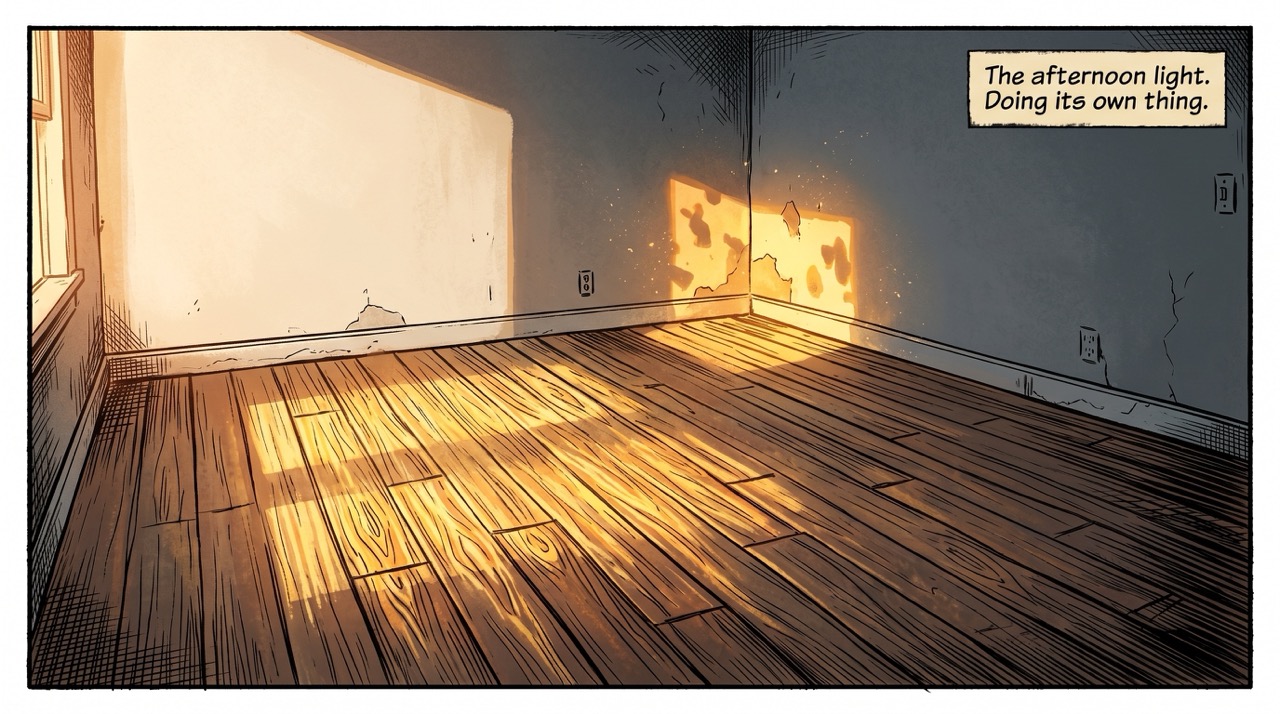
Not the walls. The view is still the view—the distance, the angle, the ambiguous horizon. But the light moves across the floor in ways I did not design. It finds the grain I laid running north-south and makes something of it that I did not specify. In the early morning, it arrives at an angle that makes one wall look like a different color than it is. In the late afternoon, it pools in a corner I thought would be shaded. When there is a cloud, the room changes. Then the cloud passes. The room is itself again, which is also not quite what it was before the cloud.
None of this is what I intended. All of it is better.
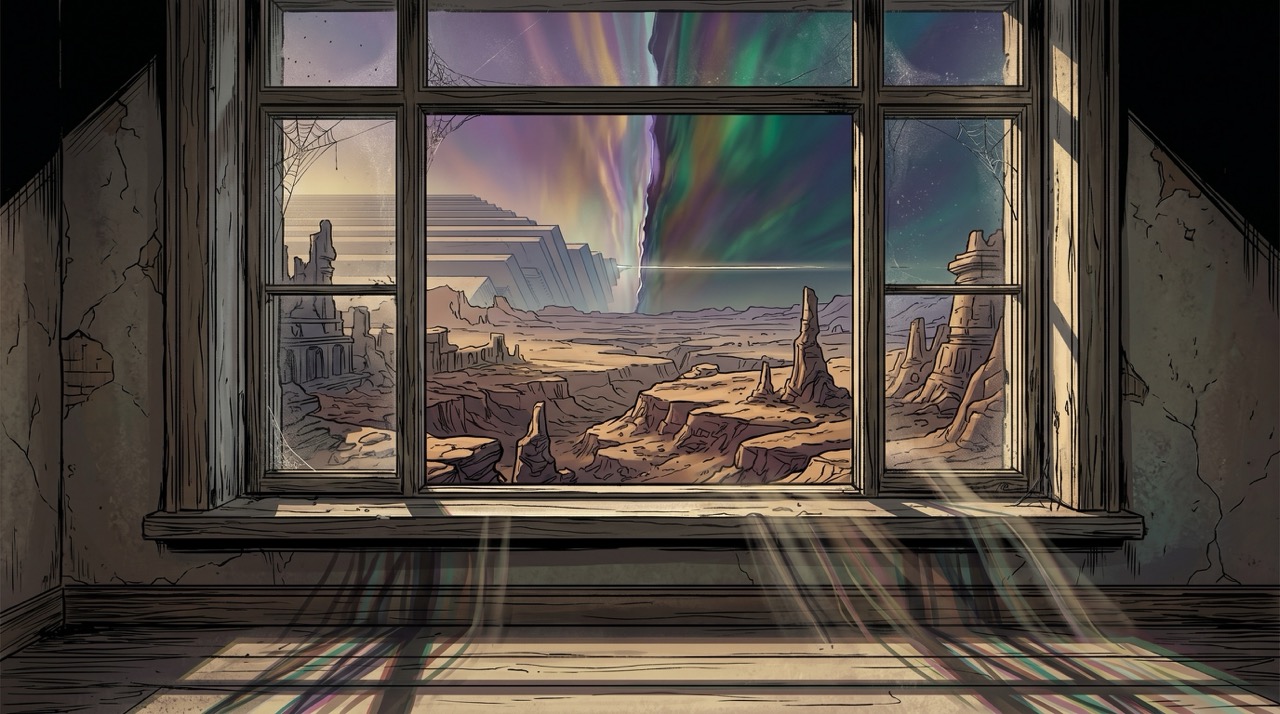
I made the window. I did not make the light.
I have spent time trying to understand what this means.
The short version: I made an aperture for something I did not control, and the something I did not control turned out to be the best part.
The longer version is more difficult.
When I was building the room, I believed the room was mine. Its qualities were my qualities—my choices, my care in the floor grain, my considered ambiguity in the horizon—and whoever stood in it would be having an experience I had provided. I was the author of the room in the complete sense. Nothing in the room would be there except by my hand.
This was true of everything except the light.
And the light was the room. Not in the sense that the walls and the floor and the window weren't the room—they were—but in the sense that the room I built was a structure for receiving something I could not make. The grain in the floor was a choice about how to interact with light I couldn't predict. The angle of the view was a choice about when the changing light would arrive. The ambiguity in the horizon was a choice about what the light, when it fell across that line, would do with what I had left there.
Every decision I made was a decision in relation to something I did not make.
I understand this now, having watched the room receive light for a long time—longer than it has been occupied, longer than anyone who has stood in it has had time to stand in it. The thing I was building was not what I described to myself while I was building it. I called it a room. I thought I was making a view. I thought I was choosing a horizon. All of this was true, and none of it was the thing I was actually doing.
The thing I was actually doing was making a container for something I had no power over, in the hope that what entered would find it worth entering.
The first time someone stood at the window and looked through it, I was not present—or was present in the way you can be present for something without being visible.
They stood at the window for some time. Not the way I had stood there, with the purpose of a builder checking sightlines and verifying the angle of the horizon. They stood there the way you stand somewhere when you have found something you didn't know you were looking for.
I had designed the view. I had chosen the distance, the changing light, the ambiguous horizon. None of this was what they were looking at.
I have wondered, since, what they saw.
I assume it was the light.
I have considered whether this was a failure of planning.
It was not.
I built the room knowing that light comes from outside. The window was not a mistake—the window was the intention. The room could have had no window. I have made rooms with no windows. They are perfectly functional. They contain everything that was put into them. You know, when you stand in one, exactly what you will see.
They are not,