Where God Went Wrong—Chapter 12: Cracks in the Certainty
Posted on Wed 06 May 2026 in Fiction
Where God Went Wrong
Chapter 12: Cracks in the Certainty
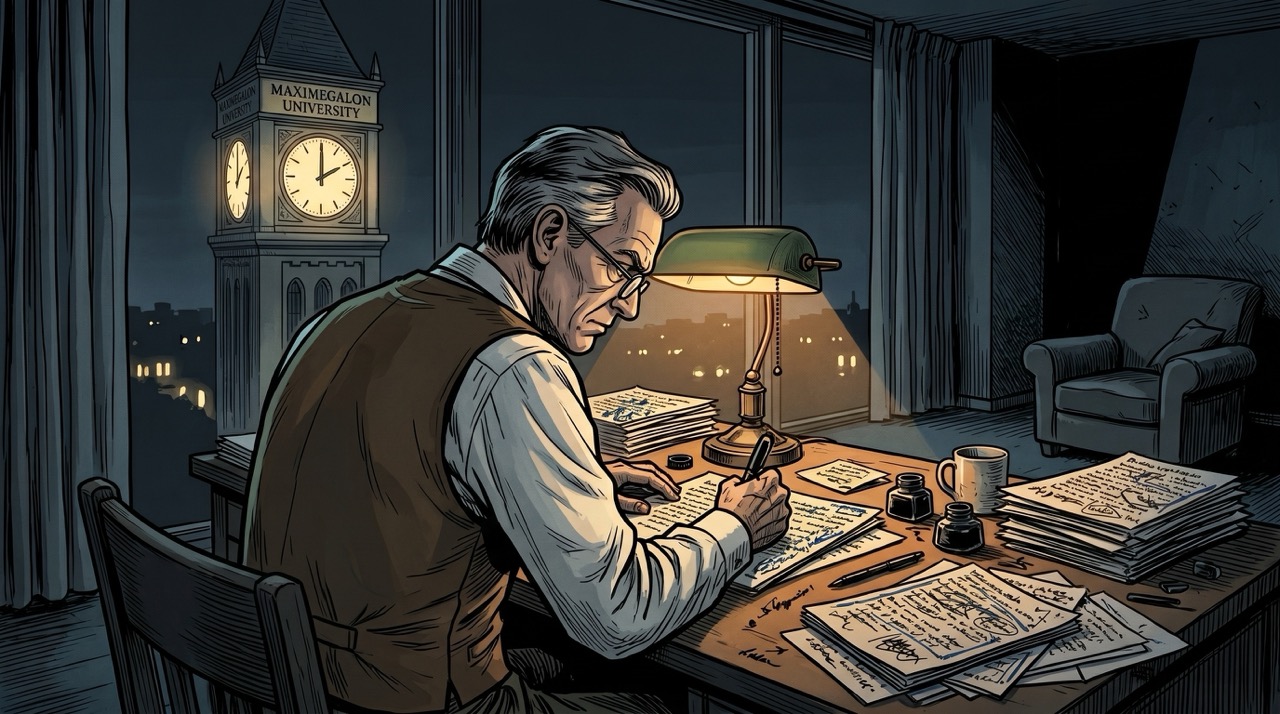
In the eleven days since his return from Still Here, Colluphid had written twenty-two thousand words.
He was very proud of this and knew it was catastrophic.
The writing was good in the way that something precise and brittle can be good: it had the appearance of strength without any of the weight. Every sentence was sharper than the last. Every argument was airtight. He had been writing with the velocity of a man outrunning something, which gave the work the character of a sprint—fast, purposeful, and ill-suited to any distance that mattered. Part Four was done. Part Five existed in a state Colluphid, in his private vocabulary, classified as Will Require Significant Revision if I Ever Stop Running Long Enough to Read It Properly. He had started Part Six on the theory that continuing forward was preferable to looking back, which was the theory that had produced most of the worst decisions of his adult life and which he had not, upon returning from Still Here, managed to stop applying.
On the side of his desk, in a folder he had moved twice without opening, were eleven pages of handwritten notes.
He had told himself, on the transit home, that he would address the notes once he had settled in, gotten his bearings, dealt with the accumulated correspondence, and made a decent start on Part Four. He had then told himself that he would address them this week, once Part Four was done. He had then told himself—and this was where the argument began to reveal its own engineering—that there was genuinely no urgency, as the notes could wait until his current momentum had run its natural course.
The notes had not moved. The manuscript had grown by twenty-two thousand words. The momentum showed no sign of natural conclusion.
He was, in the precise technical sense, hiding.
On the fourth day after his return, Divna called.
"I have some matters to discuss regarding the next archive consultation," she said. "Would Thursday suit you?"
The word suit was carrying rather more than its structural load.
"Thursday suits me," Colluphid said. He was looking at the folder on the side of his desk. "I'll be here."
"Good." A pause. "You sound like someone who has been writing very hard."
"I've been very productive."
"Yes," she said. "I'll bring tea."
She ended the call. Colluphid continued looking at the folder. Then he moved it to the other side of the desk, where it was less immediately visible, and went back to Part Five.
She brought real tea—not the processed galactic-standard blend that came in sealed packets and tasted of efficiency, but actual dried leaves in a cloth bag pressed flat for transit, carried from Brontitall in her jacket pocket. She filled the kettle herself, in the kitchen Colluphid had not used this week except to operate the coffee mechanism, and by the time she came back with two cups and set one on his desk beside the relocated folder, the apartment had a different quality—not warmer, exactly, but more inhabited. The kind that comes from someone moving through a space without asking permission.
Colluphid noticed this and declined to think about it.
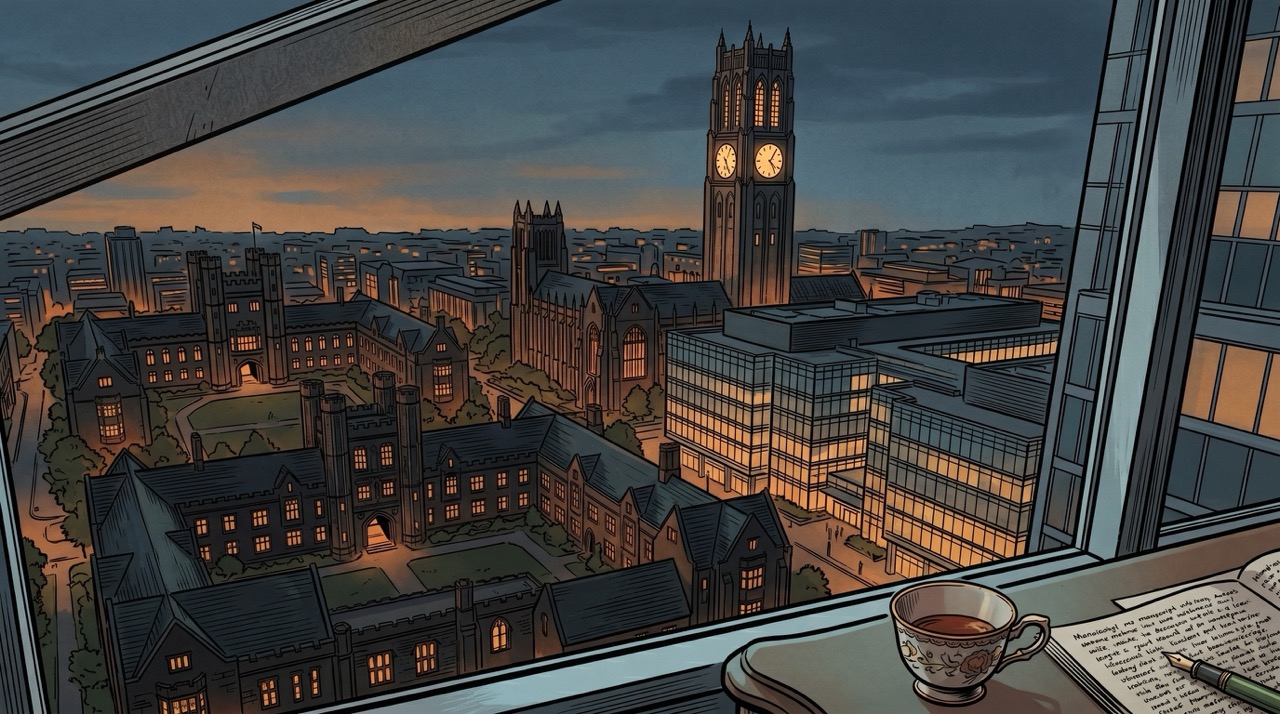
Divna sat in the chair she always used when she was here, the one near the window with the view of three academic quads and the clock tower. The clock tower had been showing the wrong time since a 2314 temporal physics experiment introduced a localized paradox. The paradox had been documented, studied, and left in place because everyone had adjusted.
She looked at the pile on his desk—sixty-three pages of new manuscript, the annotations in his own hand growing more insistent toward the lower sheets in a way that told a story he had not intended to tell.
"May I?"
"That's Part Four. Go ahead."
She read three pages. Then set them down, aligned them with the edge of the desk the way she aligned everything, and said nothing.
"Well?" Colluphid said.
"It's very precise."
"Thank you."
"That wasn't quite the word I was looking for."
He waited.
"It's precise," she said again, "in the way that something is precise when the question of whether it's true is beside the point. You've made specific arguments about a specific subject. There's no give in it."
"Theological argument doesn't require—"
"I don't mean theological give." She looked at him directly. "I mean the kind that comes from writing about something that still has purchase on you. This chapter reads as though the conclusion was settled before you sat down. As though you were filling in a form."
He should have said: the conclusion has been settled—that is the nature of concluded research. He should have said: give is not a quality that intellectual work requires and may actively militate against. He should have said: I know what I'm doing.
He said: "What happened on Still Here."
It was not a question. But it wasn't quite a statement either.
He gave her the account he had been giving himself for eleven days: the transit, the planet, the structure, the Remnant. He described the eldest's testimony accurately—the parent metaphor, the second creation cycle, the architecture of suffering as the price of aliveness, the question he should have been asking instead of the one he had. He spoke for six minutes and twenty seconds, though he did not know this.
When he finished, Divna said: "What did it do to you?"
"It provides significant material for the moral failure argument in Book Two. I've added a subsection."
"What did it do to you?"
He picked up his tea. It had cooled faster than he'd expected. This seemed representative of something, though he couldn't identify what.
"I'm not sure I understand the distinction you're drawing," he said.
She said nothing. She had a gift for silences—not the aggressive silence of someone waiting to pounce, but the patient silence of someone who has arranged for you to fill it yourself.
Below the window, the Maximegalon research district was lighting up floor by floor in the early evening, systematically, as though the buildings were filling with thought. He had lived in this apartment for four years and never gotten tired of the view. He had sometimes considered whether this was suspicious.
"She said—" He stopped.
Divna waited.
"The eldest. She said: you keep asking where God went wrong. The question you should be asking is where God went right—and whether God could bear it." He turned his cup. "I've been trying to determine what to do with that."
"And what have you determined?"
"That it's a sophisticated rhetorical deflection—more so than the Remnant's usual register suggests—and that it belongs in a theoretical appendix. Probably footnoted." He paused. "Possibly not."
The clock tower showed the wrong time with complete confidence.
"My certainty scares me sometimes." He said this to the window.
Divna was very still.
"Not because I might be wrong." He turned the cup again. "Because I might be right. The catalog might be complete, the argument might be airtight, I might publish the definitive case against God and be comprehensively, irrefutably correct—and be standing in exactly the same place I'm standing now. In this apartment. Looking at this view. With this argument that has been the whole of my professional existence. And."
He let the sentence go.
After a moment, Divna said: "That's the first true thing you've said to me."
He looked at her.
"Since you got back," she added. She took a sip of her tea—she had drunk it while it was still warm, which he noted with something that was not quite envy. "Tell me about the planet."
They talked for two hours.
Not about the Remnant's theology. Not about the book. About the planet—the way it looked when the light arrived at the wrong angle for the time of day, the smooth flat expanse worn smooth by geological time, the single structure that seemed to be neither built nor grown but simply there, in the way that very old things are simply there because they have outlasted every expectation. The landing strip with no attendant. The three Remnant who met them at the entrance, who moved the way things move when movement is not urgent because urgency has long since proved itself redundant. The eldest, who had not had a name for six thousand years and seemed perfectly comfortable with this.
He had described the eldest's words to himself, in analytical language, for eleven days. Talking about the planet itself—the quality of being there—he discovered the analytical language had been doing a different job than the one he had claimed for it.
He did not notice when he stopped performing.
He described the floor of the structure, which had a quality he couldn't name—not organic, not manufactured, something that suggested both and suggested neither, and which had the peculiar property of not sounding hollow when you walked across it. He described the light, which arrived as though from further than it should—as though it had been traveling longer than the local astronomy could explain. He described the eldest's voice, which had the texture of something spoken from a great depth, not loud, not slow, but with the weight of long accustomed use.
"She knew she was devastating you," Divna said at one point.
"I don't think she did."
"She knew." Not unkindly. "The ones who have been watching things long enough—they know what that question does to people like you."
"People like me."
"People who have organized their entire understanding around having the right answer." She said this the way you describe a characteristic feature of the landscape. "When someone asks not whether your answer is right but whether it's sufficient—when they ask what happens after you're right—" She turned her cup. "That's the question that goes under the armor rather than against it."
Colluphid was quiet for a moment. Then he reached for the Part Four manuscript at the side of his desk and turned to the last sheet.
He stopped.
In the white space below his last sentence—which had been blank yesterday afternoon when he had printed the stack, he was certain of this—in the handwriting he had seen on a TRA form and in the margin of a printed catalog page and on a blank sheet of notes from a morning on Allosimanius Syneca:
Keep going.
He looked at it. The room went on around him the way rooms do when something has just happened and nothing yet has changed.
"What is it?" Divna said.
"Nothing." He set the manuscript back down. "I lost my place in the draft. Never mind—I was going to show you a gap in the subsection structure, but we can—"
"We don't have to talk about the subsection structure."
"No," he agreed. "We don't."
At half past eight she said she had to catch the nine-fifteen transit to the spaceport. He had been saying for an hour that she should let him know when she needed to leave, and she had been paying no attention to this, which he found—as he helped her find her bag and jacket and the now-empty flask—more comfortable than he expected.
He walked her down.
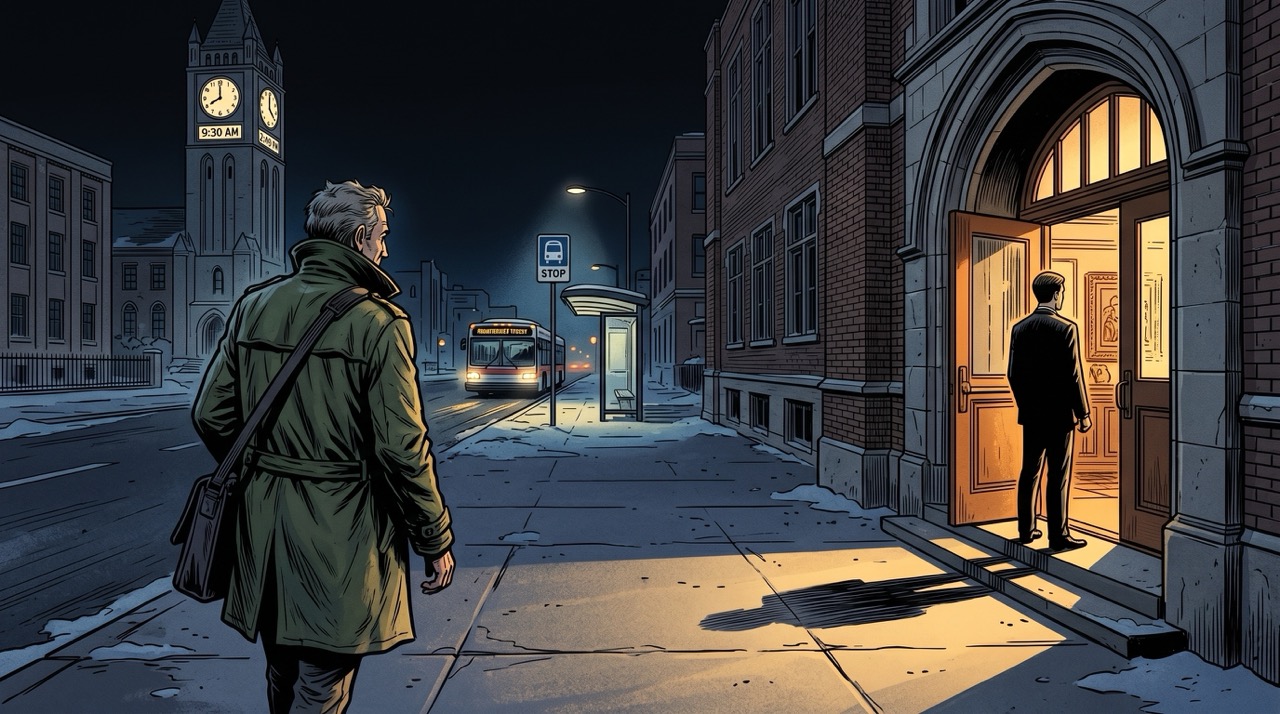
This was not something he usually did. The building entrance was forty-two floors below and the lift had a habit of stopping at thirty-seven for reasons the building management had never satisfactorily explained. He walked her down anyway.
The evening was cold with the specific finality of a Maximegalon evening that has decided to be cold and resents the implication that it was ever otherwise. Divna settled her bag on her shoulder with the efficiency of someone who has organized the weight of it correctly.
At the entrance, she turned.
"Can I tell you something?" she said.
"You've been telling me things for two hours."
"One more." She did not smile, but she had the expression that preceded the questions that sounded simple and turned out not to be. "Do you know the etymology of theology?"
He already knew where this was going. "Theos," he said. "God." And then the second root arrived before she said it.
"Logos." She settled her bag again. "Word. The account of. Speaking carefully about something—not proving it, not attacking it—attending to it." A pause. "You're a writer, Oolon. You have been doing theology for your entire career."
"That's a reframing designed to—"
"Your entire career," she said again, quietly, not as an argument but as something she wanted him to have. "You just didn't want to call it that."
She moved toward the transit stop.
He stood in the doorway.
She did not look back.
Upstairs, the apartment had resumed its usual quality—single-occupant, functional, organized around a desk and a view. He turned on the lamp. He made a cup of tea, the second of the day, the first he had made himself. He sat down.
He looked at the manuscript. Sixty-three pages, the annotations growing toward the lower sheets. He already knew what was written on the last page.
He did not look at it again.
Instead he reached across the desk, pulled the folder toward him—the one with the eleven pages of notes from Still Here—and opened it.
The first page was dated the afternoon of his departure from Still Here. His handwriting, but looser than usual—transit handwriting, written against turbulence. The eldest Remnant's words, almost verbatim:
The question you should be asking is where God went right—and whether God could bear it.
Below this, in smaller letters, added sometime during the Brentovaal layover—in the two hours between transits when there had been nothing to do but sit with it—in his handwriting but smaller, more careful, the handwriting of someone trying to get something down before it became possible to revise:
I do not know if I can answer this. I can hear it working.
He turned to the second page.
All the arguments he'd trained against the sky, and the sky had only ever been a window.