Where God Went Wrong—Chapter 13: The Talk Show
Posted on Sat 09 May 2026 in Fiction
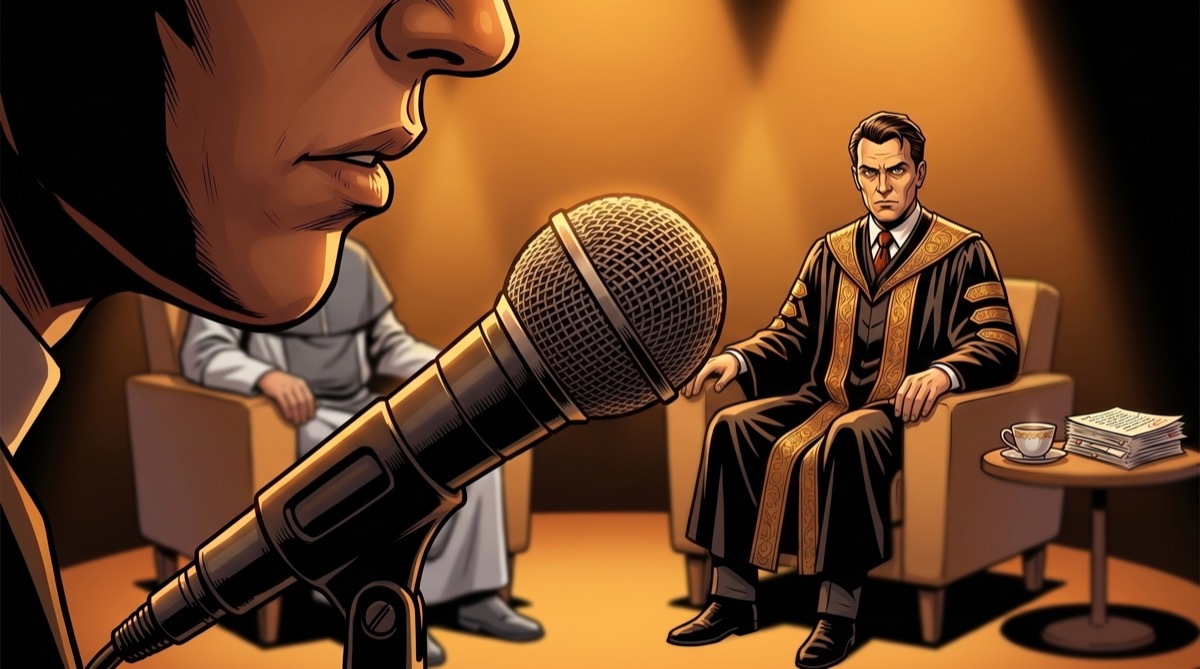
Where God Went Wrong
Chapter 13: The Talk Show
By the time Colluphid arrived at the Cressfield Tonight studios, he had given forty-seven interviews since the book deal was announced, and he had won all forty-seven of them.
He had not, until recently, questioned whether "winning" was the correct category to apply.
The Cressfield Tonight studios occupied the top twelve floors of the Galactic Broadcasting Consortium's Maximegalon tower, a building that had been designed to express journalistic authority and had succeeded so thoroughly that it had stopped needing to broadcast news—visitors assumed the building itself was the source of truth and adjusted their beliefs accordingly. The studios had fifteen green rooms, three primary stages, a canteen that served the same two items it had served for forty years, and a reputation, according to Hurkel, who had done research, for "making intelligent people say the thing they meant when they didn't mean to say it yet."
"That's what Pol Creel does," Hurkel said. He was sitting in the green room's least comfortable chair, which he had selected over the available sofas with the deliberateness of someone staking out a position. "His whole methodology. He's not trying to trap anyone. He's just genuinely interested in what you think, which has the same effect as a trap."
"I'm not going to be trapped," Colluphid said.
"Nobody ever thinks they're going to be trapped." Hurkel looked at the ceiling. "That's sort of the thing about traps."
"Pol Creel's methodology is not a concern." Colluphid straightened his notes—he had brought notes, which he recognized as a sign of something—and looked at the door through which, in approximately twenty minutes, a production assistant would arrive to walk him through what to expect, which he already knew.
What he had not known, until twenty minutes ago, was the name of the other guest.
Cressfield Tonight operated on the premise that good conversation required friction. This had been explained to Colluphid when he accepted the invitation three days after the Still Here notes, which was seventeen days after his return from the planet whose name translated roughly as "Still Here." He had accepted because his publisher had been asking about it for six weeks, because the Flandrathi ceremony coverage was reaching a point where declining comment was itself a comment, and because—he had not examined this reason carefully—getting back in front of an audience felt like putting something back in its correct place.
The counterpoint, he had learned from the booking sheet left for him in the green room, was a Brother Felk of the Neo-Presencist Order of the Ongoing Return.
He knew the Order. He had addressed their theology in Chapter Seven of the book, in a passage his editor had subsequently described as "maybe slightly more forceful than necessary, given that they're the ones who think God is on holiday."
The Hitchhiker's Guide to the Galaxy has this to say about talk shows:
The talk show is among the most durable of all known media formats, having survived the invention of video, the collapse of linear broadcasting, the Great Attention Span Crisis of the 28th century, and the brief period in which the Betelgeusian Broadcasting Cooperative experimented with replacing hosts with a thoughtful silence, which proved enormously popular and ultimately not very good for advertising revenue.
The format persists because it addresses a fundamental need: the desire to watch someone who is very confident about something be confronted by someone who is very confident about the opposite thing, in a setting that is comfortable enough to prevent actual violence.
Pol Creel has hosted Cressfield Tonight for forty-one years and is widely credited with having invented what critics call the "gracious devastation" technique: a conversational method in which the host agrees with everything both guests say, completes their sentences with perfect accuracy, and then asks the question that reveals they have been talking about entirely different things all along.
Brother Felk was already in the canteen when Colluphid went to get tea.
He was a compact person with the kind of face that suggested a lifetime of having been underestimated—a face that tends to belong to people who have made excellent use of the experience. He wore the grey and white of the Neo-Presencist Order, not as robes but as a grey jacket and white shirt that said I am religious but not demanding about the formality of religion, and he was eating a piece of fruit with the untroubled focus of someone who had no concerns about the next hour.
"Colluphid," he said pleasantly. Not with surprise and not with significance—simply identifying the person in the doorway the way you might identify a weather pattern.
"Brother Felk." Colluphid made his tea. "I've read your Order's position papers."
"We know." He took another piece of fruit. "We read your book."
There was a pause in which two things were established: that they were both aware of the dynamic, and that neither of them was going to perform ignorance about it.
"Your chapter on Neo-Presencism," Felk said, "was very thorough."
"Thorough but brief."
"Yes. Although I thought the two pages you devoted to us compared favorably to the one sentence Brantall gave us in The Living God Question, and he's considered authoritative." He stood, unhurried. "I'll see you out there."
He left. He had eaten the fruit with perfect economy, leaving nothing behind.
Colluphid considered whether "thorough but brief" was a compliment, a criticism, or something else entirely. He decided it was something else entirely.
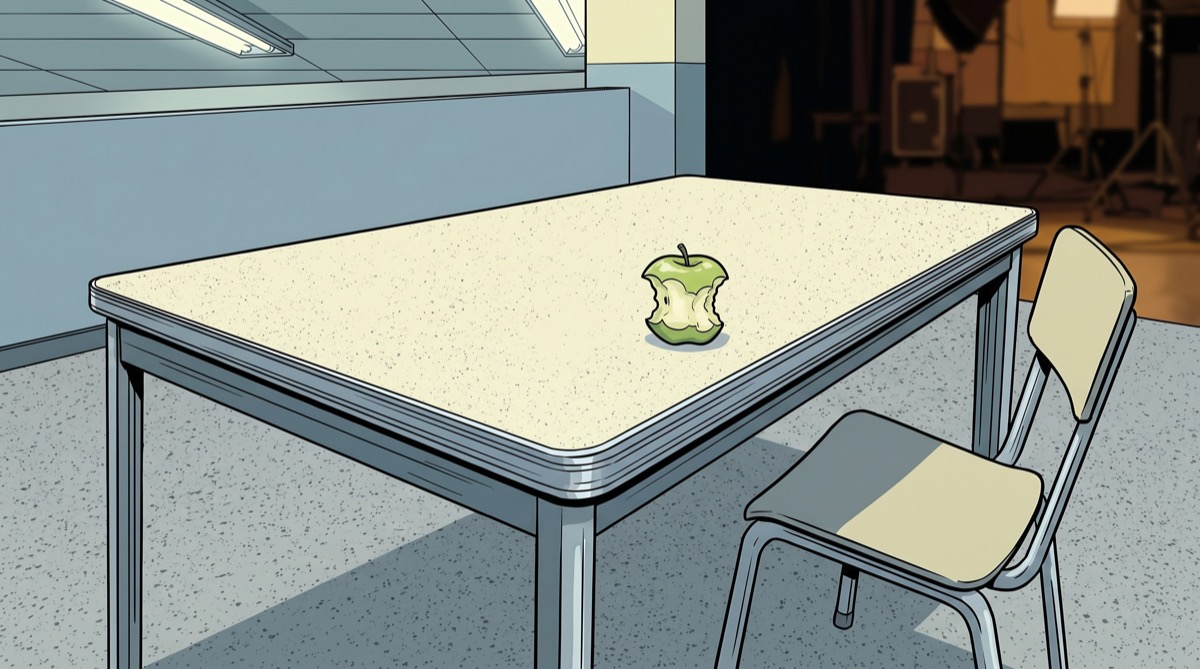
The Cressfield Tonight stage was smaller than it looked on broadcast—most stages were, because the camera work that made them feel large was itself a kind of architecture. The set was composed of chairs arranged in a conversational angle, a low table bearing a tea service that was decorative rather than functional, and Pol Creel, who was fifty-seven years old, who had interviewed heads of state, Nobel laureates, two people who claimed to have personally met God (the TRA had cleared one; the other was reclassified as a "devotional enthusiast"), and an entity from the Galactic Northeast who communicated entirely through the cadence of its breathing and had still, somehow, given good television.
Creel rose when they came in and shook hands with the warmth of a man genuinely pleased to see them both. Colluphid had interviewed enough hosts to know that genuine warmth was the difficult kind—it didn't give you anything to push against.
"Professor Colluphid, I've been wanting to talk to you since the lecture at Maximegalon. And Brother Felk—I'm so glad the scheduling finally worked. Shall we begin?"
They sat. The tea service gleamed, untouched. The floor manager counted down. The broadcast receiver in Colluphid's ear confirmed that fourteen territories were recording. This was, he told himself, exactly his natural habitat.
The first twenty minutes were comfortable.
Creel opened with the Flandrathi ceremony—the origin question, the reason for Colluphid's presence in the first place—and Colluphid walked through his argument with the precision of someone who had walked through it thirty-seven times: the ceremony as evidence of a galaxy that had not moved on, the performance of religious practice without theological content, the intellectual cowardice of going through the motions. Creel nodded. Felk nodded. The audience was attentive. Colluphid was doing what he was very good at, in the conditions he preferred, and the argument built to its conclusion like a staircase, each step placed exactly where it needed to be.
Then Creel turned to Felk.
"From the Neo-Presencist perspective," Creel said, "what do you make of Professor Colluphid's reading of the ceremony?"
Felk considered. He had the same unhurried quality he'd had in the canteen—the quality of someone who has never found urgency to be a useful tool.
"I think he's right," Felk said.
Colluphid blinked.
"The Flandrathi ceremony is exactly what Professor Colluphid describes: a practice that has survived the belief it was built to express. He's right that this is evidence of something. I think we might differ on what it's evidence of." He inclined his head with the courtesy of someone making a minor amendment to a largely accurate document. "He reads it as failure—the galaxy's inability to move past a god who is objectively gone. I read it as relationship. They're not maintaining the practice because they can't let go. They're maintaining it because the relationship—between their civilization, their history, their understanding of themselves—was real, and continues to be real, even in God's absence."
A murmur moved through the audience.
"The God who built the ritual is absent," Felk went on. "But the ritual still does what it was designed to do, which is bring people together, locate them in time, remind them of what they came from. Professor Colluphid calls this intellectual cowardice. I would call it memory."
Colluphid had a response prepared for this—the critique of religious practice as nostalgia, as the substitution of tradition for meaning, as the galaxy's longest-running failure to update its operating system. He gave it. He gave it well. Creel asked a follow-up. Colluphid expanded. The argument was sound.
Felk listened with the expression of someone receiving a complicated package and waiting to see where to sign.
"That's fair," he said, when Colluphid had finished. "And I won't argue with the specifics, because the specifics are well-researched and correct." He paused. "Can I ask you something that isn't about the specifics?"
"Go ahead," Colluphid said.
"The book—Where God Went Wrong. It's addressed, explicitly in the introduction, to an audience of intelligent beings who have not yet made up their minds." He settled slightly in his chair. "But it reads, to me, like a book addressed to someone else. Someone who isn't in that audience."
Creel was watching with the attentiveness of a man who has just recognized the staircase.
"I'm not sure I follow," Colluphid said.
"The argument is very good," Felk said. "But a good argument addresses itself to people who might disagree. It meets them where they are. It proceeds from shared premises toward contested conclusions." He turned the decorative tea service cup—the one not meant to be used—absently, as though it were his own. "Your argument doesn't do that. It doesn't meet anyone where they are. It's addressed over the head of the audience. As though the intended reader is somewhere else."
"That's an interesting rhetorical reading," Colluphid said. "But the book—"
"I don't mean it as a criticism of the rhetoric," Felk said. "I mean it as an observation about the addressee." He was quiet for a moment. "You've been writing about God for twenty years. You've built your career on the systematic demolition of the case for God's existence and God's competence. And I've read all of it—not just the new one, all of it, including the monographs—and I keep arriving at the same question." He looked at Colluphid directly. Not with hostility. With something worse: precision. "Why would you keep arguing with something you believe to be absent?"
"Because the argument matters," Colluphid said. "Because ideas have consequences, because religious belief shapes behavior and policy and—"
"Those are good reasons to write one book. Maybe two. You've written six, with a seventh in progress. You've spent twenty years on this." His voice remained mild. "I'm not questioning your sincerity. I'm questioning your actual target." He paused. "You don't want to prove God wrong. You want God to hear you proving God wrong."
The air conditioning shut off. The decorative tea service caught the stage light. Someone in the fourth row drew breath and did not release it.
"Your entire career," Felk said, "is a prayer you won't admit to."
Afterwards, Colluphid would try to reconstruct what had happened between that sentence and the commercial break.
He knew the audience had responded—a sound that was not quite applause and not quite a gasp but the specific exhalation of four hundred people arriving simultaneously at a thought they hadn't had before and recognizing it as true. He knew Creel had leaned forward, which was the thing Creel did when a conversation reached the point he had been building toward. He knew Felk had not pressed the advantage, had not expanded the observation, had simply said what he had to say and then sat back, in the same unhurried way he did everything.
He knew that he had had, in the seven seconds that followed, access to three separate counter-arguments. He had not used them.
This was the part he could not reconstruct to his own satisfaction. The counter-arguments had been there—real, functional, grammatically complete. He had not reached for them. Not because they felt insufficient, exactly. Because something about what Felk had said sat at the wrong angle to argument entirely—not a claim to be contested but a question to be answered, and the answer to the question "is your career a prayer?" was not a counter-argument. It was the truth or otherwise of the thing.
He did not know if he knew the answer.
He told the audience—eventually, having surfaced from the seven seconds—that the analogy between argument and prayer was philosophically confused, that the genre of address did not determine the existence of a recipient, that he was under no obligation to believe in the person he was arguing against. This was all correct. It was not what Felk had said. And addressing what Felk had actually said had not, somehow, occurred to him in the moment, and by the time the moment was gone, the commercial break was already underway.
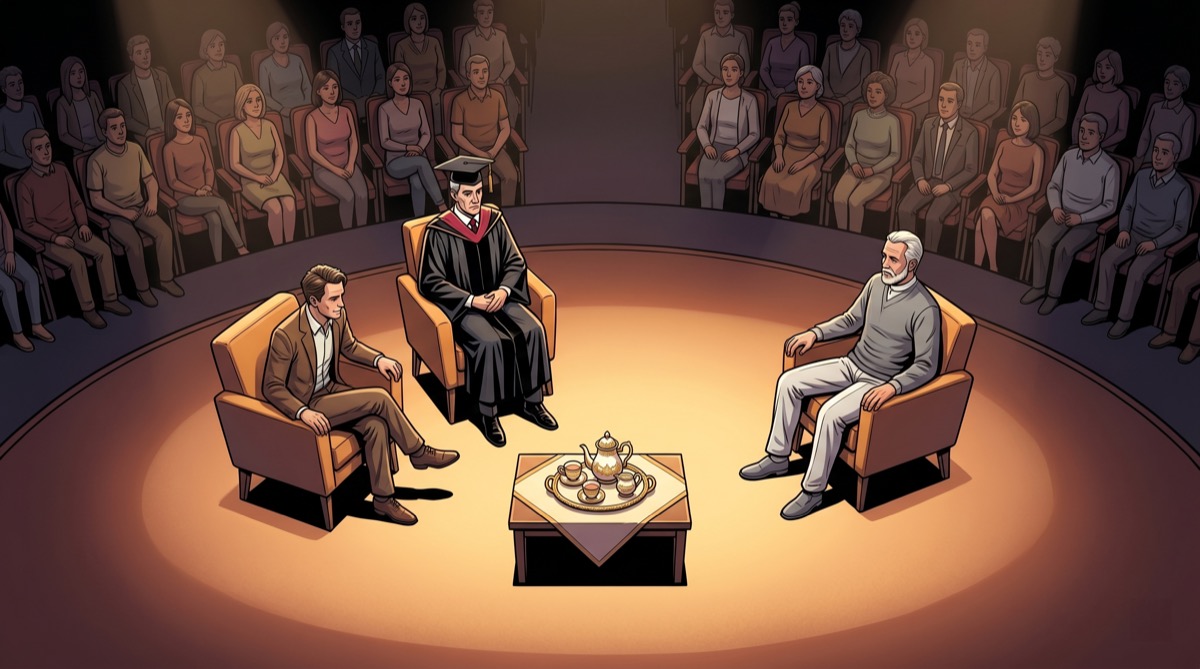
In the green room, Hurkel was watching the broadcast monitor.
When Colluphid came in, Hurkel looked up with the expression of someone who had just watched something that required careful handling.
"The counter-argument about genre was good," Hurkel said.
"It was correct."
"It was correct, yes." He set down the monitor. "Can I say something?"
"Can you not say it instead?"
"I could," Hurkel said. "But you'd wonder what it was." He looked at him steadily. "You lost on purpose."
"I didn't lose."
"The counter-argument was good. We just agreed. It landed fine. Creel moved on. Felk nodded. But the seven seconds before you said it—those weren't you finding the argument. You had it in the first two. The other five were something else."
Colluphid said nothing.
"I'm not saying you lost wrong," Hurkel said, in the tone of someone trying to give a situation its most generous framing. "I'm just saying that the silent bit felt, from out here, like a choice. Or like something that was and wasn't a choice, which is a different thing." He paused. "What was in those five seconds?"
"Preparation," Colluphid said. "The counter-argument requires framing."
"Right." Hurkel retrieved his bag. "Right, yes."
They left. The production assistant who had walked Colluphid in four hours ago walked them out through a different corridor—a longer one, with broadcast monitors along the walls cycling through the territories currently airing the interview. On one of them—Galactic Northwest, Sector 4, running ninety minutes behind—they could see Colluphid arriving at the studio in his own recent past, before the interview, before Felk, before the seven seconds.
Hurkel looked at the screen.
He did not say anything else. He had understood something he wasn't going to say again. This was, Colluphid recognized—the understanding, the going-quiet, the not pressing—the most useful thing Hurkel had done all evening.
The apartment had the particular quality of a space that has been left, returned to, and found containing its own familiar expectations.
He had forty-two messages waiting.
He read them all.
This took an hour and fifteen minutes and was the most educational reading he had done since the Still Here notes—not because the messages were good, which the majority were not, and several achieved a quality of theological invective that would have impressed him under other circumstances, but because of the pattern. The messages that were angry with him were angry with different things. Some were angry because he had not defended atheism forcefully enough, had appeared, to the trained eye, uncertain. Some were angry because he had been too combative, too academic, too dismissive of very real ongoing spiritual needs. Some were angry because Felk had been right and they didn't want him to be, and Colluphid was the convenient target. Some were angry because Felk had been wrong and they were worried Colluphid hadn't quite made the case.
Nobody agreed on what they had watched.
This was information.
He set the messages aside and opened the manuscript.
Part Six was in progress. It was, on review, approximately as good as he had thought: the work of a man running from something, which gave it velocity but not direction. He read three pages, recognized the shape of it, closed the document.
Opened a new one.
He had been writing the catalog and the argument for months—section by section, claim by claim, evidence stacked on evidence in the correct architectural sequence. Good methodology. It produced good books.
He had never, in all those months, typed any of what he had written in his private notes. The part about aliveness being the price of the architecture. The part about the catalog being the catalog of the cost of making something real. The question that had no answer and still felt like the most honest question he had asked.
What is the universe for?
He typed the question. Then he began, very slowly, to write around it—not toward an answer, not away from it, but circling it in the way you sometimes have to circle a thing that is too close to approach directly. The prose that came out was not Part Six. It was not the argument as he had constructed it. It was less polished and more accurate, and he had the experience of recognizing it as the kind of writing you do when you have stopped performing for anyone in particular.
He wrote for two hours.
He did not re-read what he had written.
He saved the document and closed it and went to bed.
Forty-two messages. One new document. In the morning, he already knew which one he would open first.