Where God Went Wrong—Chapter 14: The Inspector Arrives
Posted on Wed 13 May 2026 in Fiction
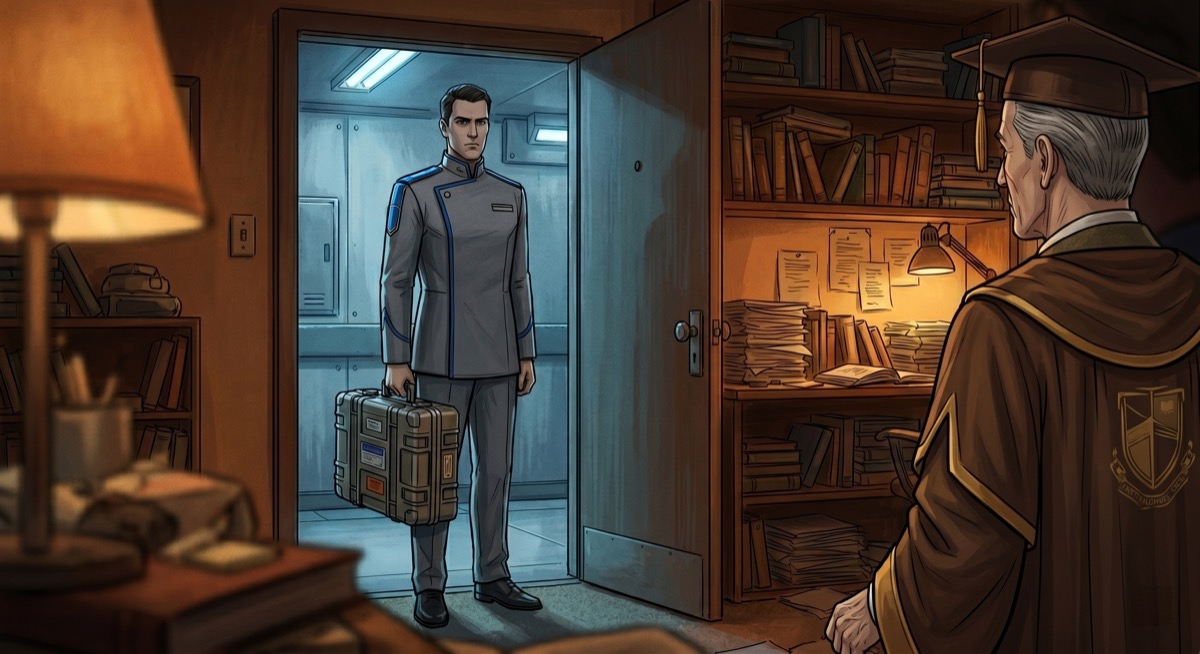
Where God Went Wrong
Chapter 14: The Inspector Arrives
He opened the new document first.
This had not been a decision, exactly. He had woken at seven, the apartment holding the particular quality of a morning after public humiliation—distinct from regular mornings in that the familiar objects were all slightly too present, the mug, the chair, the view of the quadrangles and the clock tower showing the wrong time, everything a shade too solid—and he had gone to his desk and opened the new document without reviewing the manifest and the archive and the drafts and the correspondence that also awaited him.
He read what he had written.
It was, as he had suspected in the act of writing it, not Part Six. It was not the catalog and not the argument and not the section headers and supporting evidence stacked in correct architectural sequence. It was something else: rougher, more circuitous, and considerably more honest than anything he had published in the last two years. He read it twice, which he almost never did with his own first drafts, and then sat for a moment with the specific quality of that honesty, which was uncomfortable in the way that honesty tended to be—like finding a door in your own house you had been walking past for years without noticing, and realizing the reason you hadn't noticed was not because it wasn't there.
He closed the document without editing it.
He made tea.
At nine forty-seven, a formal communication arrived from the office of Senior Inspector Azraphon Voostra, Research Oversight and Compliance Division, Theological Regulatory Authority, notifying Professor O. Colluphid that pursuant to the ongoing review of research activities under Provision 7(c) of the Research Oversight Framework (Third Revision, Annotated), an in-person inspection had been scheduled for the afternoon of the same day, that the inspection would proceed according to Form 223 (Structured Inspection Protocol—Academic Research), that Colluphid was required to have available for inspection all primary research materials, secondary analyses, correspondence with sources, and working documents in any form, including digital documents not yet in final draft, and that in accordance with Provision 12(a), the Inspector's arrival should be treated as an extension of the original regulatory engagement and not construed as a new proceeding requiring separate response.
The communication was forty-seven pages.
Pages twelve through nineteen were a bibliography of the regulatory framework being cited.
Colluphid read it, refilled his tea, and called Divna.
The Hitchhiker's Guide to the Galaxy has this to say about Theological Regulatory Authority inspectors:
The role of TRA Inspector was created in the aftermath of the post-God Theological Stabilization Period as a mechanism for managing what the Authority's founding charter describes as "the inherent destabilization risk of unrestricted theological inquiry." In practice, this means that any researcher whose work is deemed sufficiently interesting by the Authority is assigned a Senior Inspector, who will then conduct formal reviews of their work at intervals determined by the Inspector's own assessment of necessity.
The word "interesting," in TRA usage, does not mean what it normally means. In normal usage, "interesting" implies qualities such as novelty, depth, or the capacity to change the way a person thinks about something. In TRA usage, "interesting" is a formal risk classification meaning "likely to upset the carefully managed theological equilibrium that the Authority has been maintaining since God left and left the Authority holding the filing cabinet."
Senior TRA Inspectors are selected based on three criteria: thorough knowledge of the regulatory framework, an absence of theological views of their own, and what the Authority's internal performance assessments call "Form Discipline"—defined as the ability to conduct a multi-day inspection without once saying anything that couldn't also be found in the applicable forms.
Senior Inspector Azraphon Voostra has scored highest on the Form Discipline metric in his district for eleven consecutive years. He received this information with appropriate neutrality.
Divna arrived at midday.
She had come from a conference at the Maximegalon Institute of Applied Theology—this emerged in the call; it explained both the availability and the slightly compressed quality of her arrival, a sense of someone reorganizing their afternoon at short notice without complaining about it. She brought tea from Brontitall, which was either routine or was her method of establishing the conditions under which difficult conversations were possible. Colluphid had begun to suspect it was both.
"He's coming at three," Colluphid said.
"I know. I read the summary you sent." She had already located the clearest chair in the apartment—she did this every time—and settled into it with the focused stillness of someone managing something carefully. "Forty-seven pages is not a summary."
"Pages twelve through nineteen are a bibliography."
"Still." She looked at the stacked research materials Colluphid had organized for the inspection—primary sources by theological classification, secondary analyses by analytical framework, correspondence by regulatory relevance. Three hours' work. The work of a man who had nothing to hide and was doing the most thorough possible imitation of nothing-to-hide available to a man who had, in fact, nothing to hide, but who was aware that looking like you had nothing to hide and having nothing to hide were not, in certain regulatory contexts, distinguishable. "Have you done this before?" she asked. "A formal 7(c) inspection."
"I've filed the forms."
"That's different." She looked at the stacks. "Let him do most of the talking. If he asks for something, give him exactly what he asks for and nothing adjacent to it. Don't offer context unless he asks directly." A pause. "And don't argue with the framework itself. That's what he wants."
"I know how to handle a bureaucratic interview."
"I know you do." She was quiet. "I'm going to stay, if that's acceptable. As an institutional observer."
"The Cathedral has standing to observe?"
"I have standing to observe. The Cathedral can be added if it's useful." She looked at the window. "The TRA and the Cathedral have had a complicated relationship for approximately two hundred years. I have a right of institutional observation in any active 7(c) review involving a researcher who has accessed Cathedral materials."
"And you're using that right today."
"Yes."
"Because."
She turned back from the window. "Because I want to see him."
There was something in the way she said it that was not quite the same as the rest of what she'd said—a different texture, as though the sentence had taken a turn she hadn't accounted for. Colluphid heard it without comment, without pursuit, in the way he had been learning to hear things Divna said that had a different texture than the rest.
"Fine," he said. "You can make the tea."
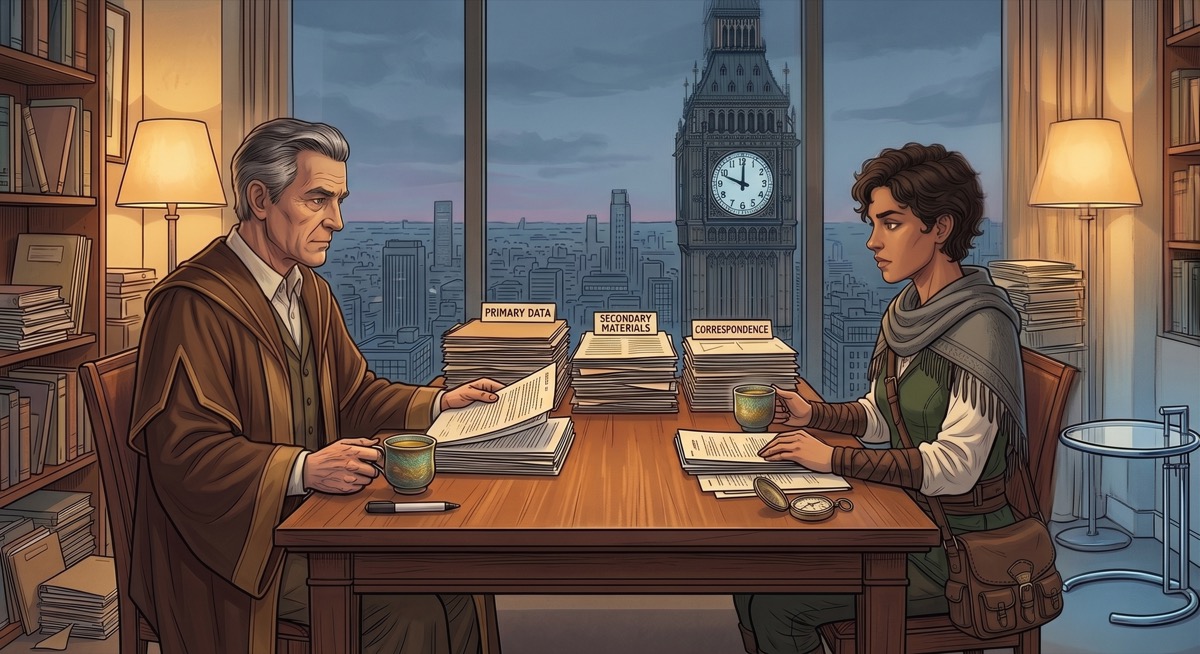
Voostra arrived at three o'clock exactly.
This was not a minor point. There were people who arrived at the time requested, and people who arrived slightly before or after, and the gap between the categories told you something about how they understood their own importance. Someone who arrived early was saying: my time is valuable and your preparation is less important than my demonstration of punctuality. Someone who arrived slightly late was saying: I have many demands on my attention and you are one of them. Voostra arrived at three o'clock exactly—the building's clock read 15:00:00 when the notification chimed and 15:00:03 when Colluphid opened the door—which said something different. It said: I have calibrated my arrival to the second. This was not difficult. I do it with everything.
He was a tall man who did not seem tall until he was in the room, at which point he seemed to have redistributed himself to fill the available bureaucratic space. He wore the TRA's standard grey with the Research Oversight division's blue stripe, and he carried a case of the kind that had multiple compartments organized by regulatory category—a physical object Colluphid had until now encountered only as a line item in the forms. His face was—the word that arrived to Colluphid, which he later tried to replace and couldn't—filed. The face of a man whose expressions had been properly catalogued, labelled, and returned to their correct locations.
"Professor Colluphid." He extended a hand. The handshake was regulation-appropriate: firm, brief, conveying nothing about the man performing it except that he had been assessed on handshakes and had scored adequately. "Senior Inspector Azraphon Voostra, Research Oversight and Compliance. Pursuant to Provision 7(c) of the Research Oversight Framework, Third Revision, Annotated, I am here to—" He saw Divna.
Something shifted. Not a reaction exactly—more a micro-adjustment, the way a form shifts when you realize a relevant field has been left blank. Divna, for her part, went very still in the way she had gone still on a phone call eight weeks ago when Colluphid had first mentioned the TRA. Only now there was an additional quality to it: the stillness of someone who has finally seen the face that belonged to the dossier.
"Professor Allay," Voostra said.
"Inspector." Her voice carried nothing.
"I was not aware that institutional observation had been invoked. Form 119 requires forty-eight hours' notice for—"
"Form 119 applies to external institutional observers." She spoke with the pleasant precision of someone who has read the relevant documents and knows the relevant documents have been read. "I'm invoking Article 7, Subsection 2(c) of the Cathedral Concordat, which provides for standing institutional observation in any active regulatory review involving Cathedral archive materials. Article 7 requires no prior notice. It requires only that I be physically present." She met his eyes. "Which I am."
Voostra considered this—or performed the administrative equivalent of consideration, which involved no visible cognitive activity but clearly involved something cross-referencing provisions. He set his case on the side table (the only entirely clear surface, because Colluphid had cleared it in anticipation of exactly this move) and said: "Noted." He removed a form from the first compartment. "Professor Colluphid, I'll need you to confirm your understanding of the scope of this inspection, your agreement to full cooperation under Provision 7(c), and your acknowledgment that materials produced during this inspection may be cited in subsequent proceedings."
"What subsequent proceedings?" Colluphid asked.
"The form acknowledges the possibility of subsequent proceedings. It does not assert that subsequent proceedings are anticipated." He held out the form. "It's Form 114B."
"It's a standard acknowledgment," Divna said quietly. "Sign it."
Colluphid signed it.
The inspection lasted four hours and seventeen minutes.
In the first hour, Voostra reviewed Colluphid's primary research materials with the methodical attention of a man who was not looking for anything in particular and was therefore capable of finding anything at all. He examined the catalog drafts by section. He examined the field notes from Oglaroon, which ran to sixty pages. He examined the field notes from Allosimanius Syneca, which ran to fourteen pages, the third page bearing the faint trace of a margin that Colluphid felt, in his peripheral awareness, without looking at directly. He examined these without comment. He examined the field notes from Still Here. He examined the lecture materials for the Problem of Pain presentation. He examined the correspondence with Galactic Horizons Press in its entirety.
He did not examine the new document. This was because the new document was not included in the inspection manifest, on the grounds that it was a personal note rather than a research document—a distinction Colluphid had made with the specific awareness that it was a distinction that might not survive scrutiny, but which he had made anyway.
In the second hour, Voostra reviewed the archive materials from the Cathedral of the Conditions.
"Your access to the Preliminary Materials," he said, without looking up, "was granted by Professor Allay in her capacity as supervising archivist."
"Yes," Colluphid said.
"The Cathedral has provided copies of the relevant access forms." He produced them from the second compartment. "These are in order." He set them aside.
He said nothing more about the Preliminary Materials for eleven minutes.
In the third hour, he asked questions. Each question had a form reference number attached to it—Section IV, Subparagraph 3(a); Section IV, Subparagraph 3(b)—and Colluphid answered them correctly, one by one. One sample exchange, representative of the hour:
"With respect to the evidentiary standard applied to the testimony of the entities identified in your notes as 'the Remnant of Still Here,'" Voostra said, consulting Section IV, Subparagraph 6(c) of Form 223, "how would you characterize the verification framework applied to their claims regarding direct observation of pre-Babel-fish events, specifically as it pertains to the corroboration requirements under Provision 3(d)(ii)?"
"I characterized them as primary source testimony from observers claiming contemporaneous presence," Colluphid said. "Consistent with the standard applied to any oral history from a civilization predating the documentary record."
"And corroboration?"
"The nature of their claims precludes standard documentary corroboration. I noted this in the research materials."
"You did." Voostra made a mark. "Form 223 requires notation when standard corroboration is unavailable. Your notation is on file." He turned to Subparagraph 6(d). "The methodology is therefore Acceptable-Conditional."
"How wonderful," Colluphid said.
Divna looked at the window.
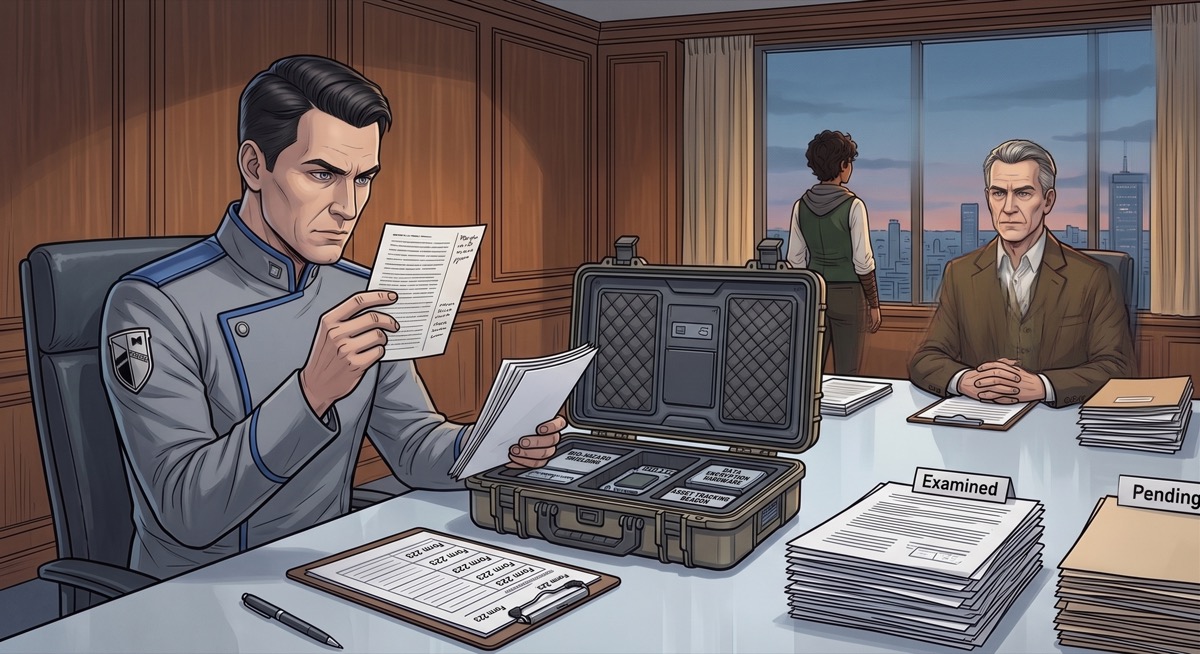
At five forty-three, as Voostra was replacing the third compartment's contents with the precision of a man who had never failed to locate something he'd put away, he said:
"There is one further area I should address, as a matter of administrative courtesy."
"Go ahead," Colluphid said.
"The Archive of First Causes. At Maximegalon University." He aligned the compartment's latch with a small, definitive click. "I notice it does not appear in your research materials."
"I haven't accessed it yet."
"No." He lifted his case from the table and set it on the floor—returning the table, implicitly, to Colluphid's administration. "The Archive of First Causes is classified under Provision 9(a) as Theologically Sensitive Primary Material. Access requires a Form 881—Justification of Theological Primary Material Access—countersigned by a Senior Inspector of the Research Oversight division." He adjusted his case handle to the locked position. "In the event that you were intending to request access, I would want you to be aware that, given the ongoing review under Provision 7(c), I would not feel it appropriate to countersign a Form 881 for your research until the review had reached a satisfactory conclusion." He looked at Colluphid with the same expression he had been using all afternoon. "I hope this is not an inconvenience."
The room held the specific quality of a silence after something has been established.
"I see," Colluphid said.
"The 7(c) review has no mandated conclusion date," Voostra added. "It concludes when the Inspector determines that the review is complete." He picked up his case. "Thank you for your cooperation. I'll have the Form 223 completion report to you within five working days."
He nodded to Divna—the same gesture he had used to acknowledge the Cathedral Concordat provision. He collected his coat. He left.
The door's click, when it closed, was quiet and final and very exactly what it was.
Colluphid stood at the side table for a moment, one hand flat on its surface. Then he sat.
Divna said nothing. She was looking at the door with the expression she had had when Voostra walked in, which had not changed in the intervening four hours and seventeen minutes: very controlled, very present, and saying something she was not going to say aloud.
"Well," Colluphid said. "He was exactly as advertised."
"Was he." It was not quite a question.
"The paperwork made flesh." Colluphid looked at the stacked research materials, all of them properly examined, everything in order, everything except the document he had not put on the manifest. "Four hours of inspection and thirty-seven seconds of actual content."
"That's what he wanted you to think." Divna stood and began reorganizing the tea things in the way she did when she was deciding how much to say. "He didn't come to inspect the research. He came to tell you that the Archive was blocked, and to do it in a setting where refusing him anything would be documented as non-cooperation." She carried the cups to the kitchen. "It was very elegantly done."
"You're not angry," Colluphid said.
She came back. "I'm extremely angry. This is what extremely angry looks like when you've had practice." She stood by the window. "The TRA has been managing the Archive of First Causes for forty years. Not regulating it—managing it. Regulating means setting conditions for access. Managing means deciding who asks the question in the first place."
Colluphid was quiet for a moment. "Why does he scare you?"
She looked at him. "He doesn't scare me. Voostra is the paperwork made flesh, as you said. You're right about that. He's very good at his job, and his job is to be exactly this, and I have no particular interest in him." She turned back to the window. The quadrangles below were quiet in the early evening, the clock tower showing the wrong time with its characteristic commitment. "What scares me is what the TRA is protecting."
"Which is?"
She turned back. At the door, she stopped, in the way she had on other nights at other thresholds—the Etymology night, the Faculty Bridge, each time finding something at the door she had to say before leaving.
"The possibility," she said, "that God had a very good reason for everything."
She left. The door closed with the same quiet finality it had closed with four hours earlier, and Colluphid was alone in the apartment with the stacked materials, the side table where Voostra's case had been, and the view of the quadrangles beginning to darken.
He sat for a long time.
Then he opened a new browser and began researching the security arrangements for the Archive of First Causes.
The TRA's Form 881 review process had an average completion time of fourteen working months. Colluphid gave himself two weeks.