Where God Went Wrong—Chapter 15: Unauthorized Access
Posted on Sat 16 May 2026 in Fiction
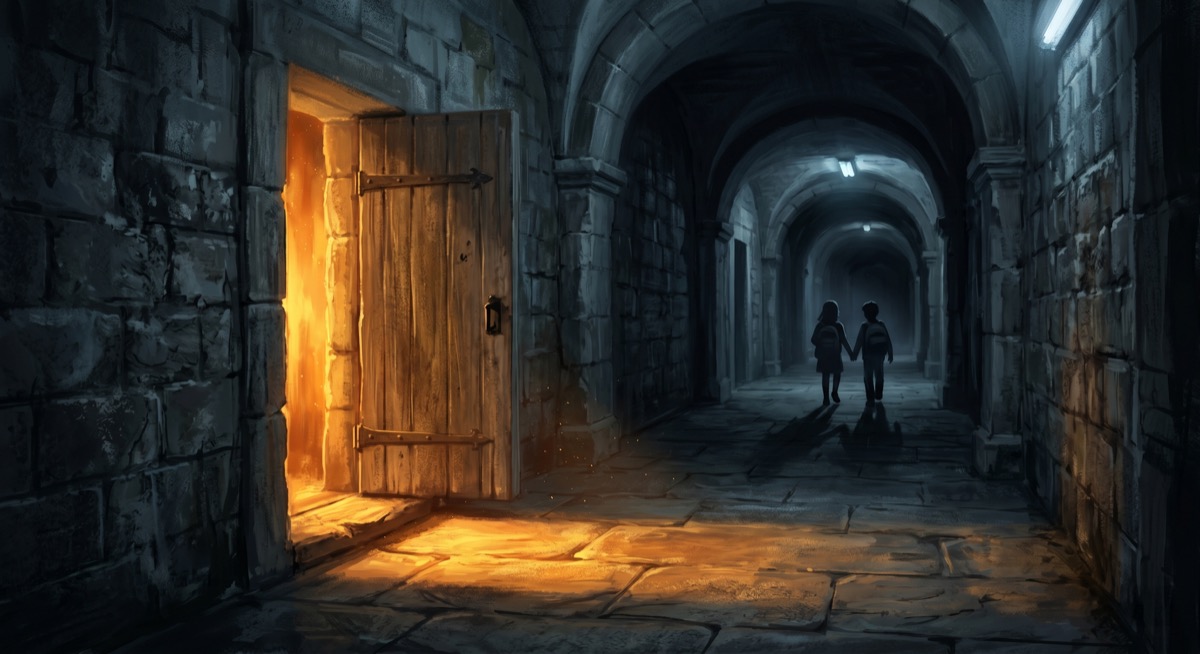
Where God Went Wrong
Chapter 15: Unauthorized Access
Divna sent a comms packet on the third day.
There was no accompanying message. The packet contained a single encrypted file, which, when opened with the decryption key Colluphid found embedded in the metadata of a recipe for a Brontitallian fermented tea beverage—a recipe he was fairly certain Divna had never sent him and was fairly certain he was not meant to explicitly notice—resolved into a six-digit numerical sequence, a floor plan of the sub-basement level of the Maximegalon Academic Records Repository (Building 42, Episteme Wing), and a note that read, in its entirety: I did not send this. You did not receive it. The floor plan is from 2019 and should be considered illustrative rather than current.
There was a postscript: The cameras in the east corridor have been on a twelve-hour maintenance cycle since Tuesday. They will remain so until the Form 223 is filed and acknowledged, which is projected to take until next Thursday.
Below the postscript, in handwriting: Be careful.
Colluphid looked at the handwriting for a moment. Then he forwarded the file to Hurkel with the subject line: "Research emergency. My office. Bring coffee."
Hurkel arrived in fourteen minutes, which was faster than Colluphid expected and slower than the coffee warranted.
"You've figured something out," Hurkel said, from the doorway, before Colluphid had said anything.
"How did you—"
"You made the coffee yourself." He came in, examined the cup, and made a face. "You only do that when you don't want to wait." He sat. "What is it?"
Colluphid turned the screen toward him. Hurkel looked at the floor plan. He looked at the six digits. He looked at the maintenance cycle notation. He looked back at Colluphid.
"Sub-basement," he said.
"Yes."
"Building 42."
"Are you going to confirm every word on the screen, or are you going to have an opinion?"
Hurkel leaned back. He had the expression he sometimes wore when applying the lateral thinking that Colluphid found simultaneously invaluable and infuriating—the look of someone picking up a problem from the other end. "I have a card," he said, after a moment.
"A card."
"An access card. For Building 42." He reached into his bag and produced, from a pocket clearly reserved for things Hurkel had lost and stopped looking for, a university access card three years old. The photograph made him look like someone who had recently been asked to explain the Arcturan Megadonkey incident to the Dean and had not yet found the right framing. "My zoological research posting. The facilities office never deactivated it." A pause. "I may have tested it."
"You tested a card issued in error that should have been returned."
"Theoretically."
"Hurkel."
"It works for Basement One and Two. Not sub-basement. Sub-basement requires either a Form 881"—he tapped the floor plan—"or the maintenance code for the service access panel." He looked at the six digits. "Which is a six-digit number."
The room held the specific quality of a silence between two people who have not technically agreed to do something yet and are not going to be the one to suggest it.
"The east corridor cameras," Colluphid said.
"Twelve-hour cycle." Hurkel was reading the maintenance window. "So the window is tonight, or we wait a week and hope nothing changes." He looked up. "She timed this."
"She didn't send it."
"Right. She didn't send it." He folded the floor plan carefully. "One more thing. The security panel for the service access is the same system that was upgraded after the Megadonkey incident—when facilities had to rerun all of Building 42's access protocols, they contracted with the same firm that manages the zoological research buildings. Same maintenance code schema." He held up the card. "Which means this might also work for the service panel."
"Might."
"Theoretically."
"Stop saying theoretically."
"It might work for the service panel."
The Hitchhiker's Guide to the Galaxy has this to say about the Archives of First Causes:
There are seventeen known Archives of First Causes across the galaxy, each claiming to hold the earliest verifiable records of the universe's creation. This claim should be evaluated with the awareness that the galaxy has a long and richly documented history of archives containing very old things and archives containing things that people very much wish were very old, which are not the same class of archive.
The Maximegalon Archive of First Causes is the oldest of the seventeen, predating the university that grew up around it by approximately four thousand years. It is also the most heavily regulated, having been classified as Theologically Sensitive Primary Material under Provision 9(a) of the Theological Regulatory Authority's Research Oversight Framework—a classification that dates to forty years ago and the details of which are not, technically, available for public review under Provision 9(a)(iii), which seals the classification documentation along with the classified material, the reason for the classification, and, in a move that even experienced regulatory theorists have found ambitious, the legal basis for Provision 9(a)(iii) itself.
What the Archive contains has therefore been a matter of speculation for four decades. Estimates range from the mundane (administrative records of the early post-Creation period), to the significant (direct records of the Creation event itself), to the alarming (evidence of why the Creation was designed the way it was, which several researchers have argued would constitute "theologically destabilizing information" under the Framework's quite broad definition of same).
The Hitchhiker's Guide to the Galaxy has this entry under "theologically destabilizing information": See: the Babel fish. See also: basically everything, eventually.
They went at two in the morning, which Colluphid felt was appropriately cinematic for the occasion, and which Hurkel felt was correct from a practical standpoint, and which Divna, who had not sent them the maintenance window, was presumably not thinking about at all.
Building 42 of the Episteme Wing communicated, through its architecture, the same thing most academic buildings communicated: that it had been built in sections over a long period by people who had not agreed on anything except the general concept of walls. The sub-basement had been added last—or first, depending on which section's timeline you believed—accessed via a service corridor behind the boiler access on Basement Two.
Hurkel's card admitted them to Basement One without incident.
Basement Two required a second card—or had, before the 2019 security upgrade consolidated access to a single panel. The panel accepted the six-digit code from the file Divna had not sent. There was a click.
"Don't," Colluphid said.
"I wasn't going to say anything."
"You were about to say something."
Hurkel opened the service corridor. "I was going to say it's going better than the Megadonkey incident."
"Everything goes better than the Megadonkey incident."
"Four of the twelve got out before—"
There was a sound from further along the corridor. A large, methodical sound, the sound of something moving in a space it did not quite fit. They both stopped.
From around a bend in the service corridor, preceded by a powerful and distinctive smell, appeared an Arcturan Megadonkey. It was approximately the size and rough personality of a small shuttle. It regarded them with the expression of a creature that has gone where it intended to go and does not especially require an explanation from anyone. Then it turned and ambled back toward the zoological research facilities, through a service hatch that it had, apparently, opened from the inside.
There was a silence.
"That was—" Colluphid began.
"Seventeen," Hurkel said, with the tired certainty of someone who has counted. "That one's been getting out through the duct since the winter inspection. I have an ongoing dispute with the facilities office about the hatch specification." He paused. "I haven't mentioned it recently. For various reasons."
They continued down the corridor.
The Archive of First Causes was not what either of them had expected.
Colluphid had expected—not a vault exactly, but the suggestion of one: sealed storage, climate controls, the hum of archival technology, the particular scent of preservation work. He had been in enough theological archives to know their register: deliberate coolness, careful light, the institutional sense that what was stored here mattered enough to be kept precisely.
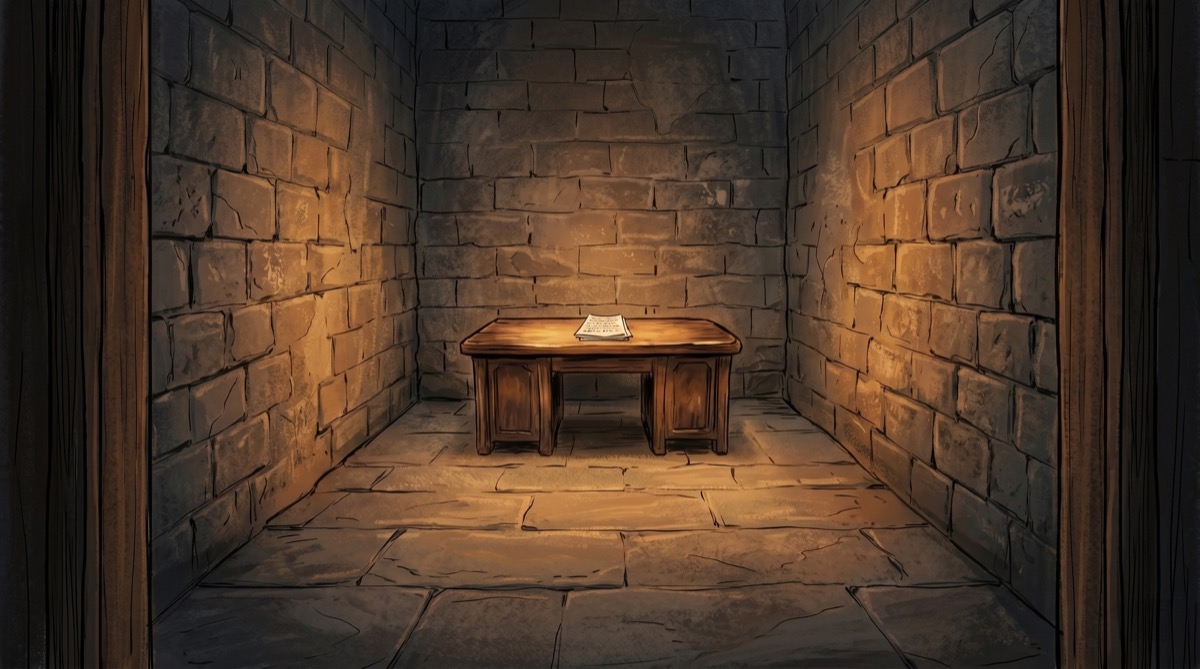
The Archive of First Causes was a room.
Not a vault, not a library wing, not a sealed facility with regulated humidity and sequential access protocols. A room, perhaps four meters by six, with a stone floor worn smooth in the manner of stone that is very old and walked on very rarely. The walls were the original sub-basement stone, cold to the air in a way that had nothing to do with temperature control. There was no climate equipment visible—no hum, no measured stillness of a managed environment. There was a single light source, dim and not obviously electrical, that seemed to come from the stone itself or from somewhere behind it. There was no security panel on the inside.
There was a desk.
The desk was simple: old wood, dark with age, no drawers, the surface worn to the same smoothness as the floor. No fittings. No lock.
On the desk there was a document. Perhaps forty pages, handwritten, loosely bound with a cord that had once been tied and had been untied and retied many times since. It did not look like an archive. It looked like something someone had been writing.
They stood in the doorway.
"This is it," Hurkel said, in a voice he was keeping carefully level.
"Yes."
"Room. Desk. Document."
"Yes."
Hurkel had not taken out his recording device. He was looking at the document the way he had looked at the Arvanthi testimony in the Temple of Failures—the look of someone applying their full attention and reserving judgment about what it meant.
Colluphid walked to the desk.
The document was handwritten in a hand he knew.
He stood looking at it for a moment before he touched it, because the recognition arrived before he was ready for it—abrupt and complete, the way a thing you have been moving toward without knowing it appears before you expected it to arrive.
He had seen this handwriting five times. Yes, but. Be careful. She's not wrong. Keep going. I hope this works.
The handwriting on the document was the same.
He opened it.
The document was titled, in letters larger and more deliberate than the rest of the handwriting: FIRST WORKING DRAFT — SUBJECT: UNIVERSE (CURRENT CYCLE). THIS IS NOT THE FINAL VERSION.
Beneath that: ALL ERRORS SUBJECT TO REVISION.
The first page after the title was blank except for a note in the upper right corner: I hope this works.
The second page was a diagram. Colluphid looked at it for a long time. He could not have said precisely what it was a diagram of—it had the quality of something drawn by someone thinking faster than they could draw, with arrows and corrections and phrases in three languages, one of which he did not recognize. At the center of the diagram, circled twice, was a number. The number was 42.
He turned to page three.
Things to figure out: — how much should it want to know? (risk: too much = entropy; too little = stasis; finding the middle is the actual problem) — sentience is probably necessary. sentience is probably going to be a problem. (see: page 12) — light. where does the light come from? I can make the container but I cannot make the light. this is not a design flaw, I think. this might be the point. — loneliness might be unavoidable. working on this.
There was a correction above loneliness: the word crossed out, replaced with individuation, then crossed out again, and loneliness reinstated with the word sorry written small in the margin.
Colluphid turned pages.
The document unfolded as a working process, not a finished argument—not a creation account or a specification, but the record of someone trying to work something out. There were failed approaches and notes to self: third attempt at consciousness architecture, abandoned; the previous cycle was careful but not surprising—see appendix. start over. There were page-length questions with no answers—what is it for? I need to decide what it is for before I can decide how to make it—and passages where the handwriting changed character, becoming faster and smaller, as though something had resolved itself mid-sentence and the writer had been trying to keep up with it.
On page sixteen, there was a section headed SUFFERING (THIS IS THE HARD PART).
Hurkel, who had been reading over Colluphid's shoulder for the last four pages in silence, said: "Should we—"
"Don't."
"I was going to say should we be photographing this."
"Oh." Colluphid stepped back. He hadn't thought of it. This bothered him—the not-thinking-about-it—because he was a researcher and photographing documents was the first thing a researcher did, and he had been standing here reading instead of documenting, which was not a thing he did. "Yes. Do that."
Hurkel photographed. Colluphid returned to page sixteen.
The problem: if I want it to feel anything, it has to be able to feel everything. There is no architecture for selective suffering. I've tried it. It doesn't work. You either build something that can be hurt or you build something that can't, and the thing that can't—it functions fine. It functions perfectly, actually. But I've tried it (see appendix: first cycle) and "functioning perfectly" is not the same as "alive." I want to make something alive. Something that could surprise me.
The cost is: everything.
I've decided: yes. The cost is worth it.
I'm not certain that was the right decision. But I made it. And I can't un-make it, because the moment it's made, it starts being real.
Below this, in different ink, as though added later: still worth it.
And below that, very small: please.
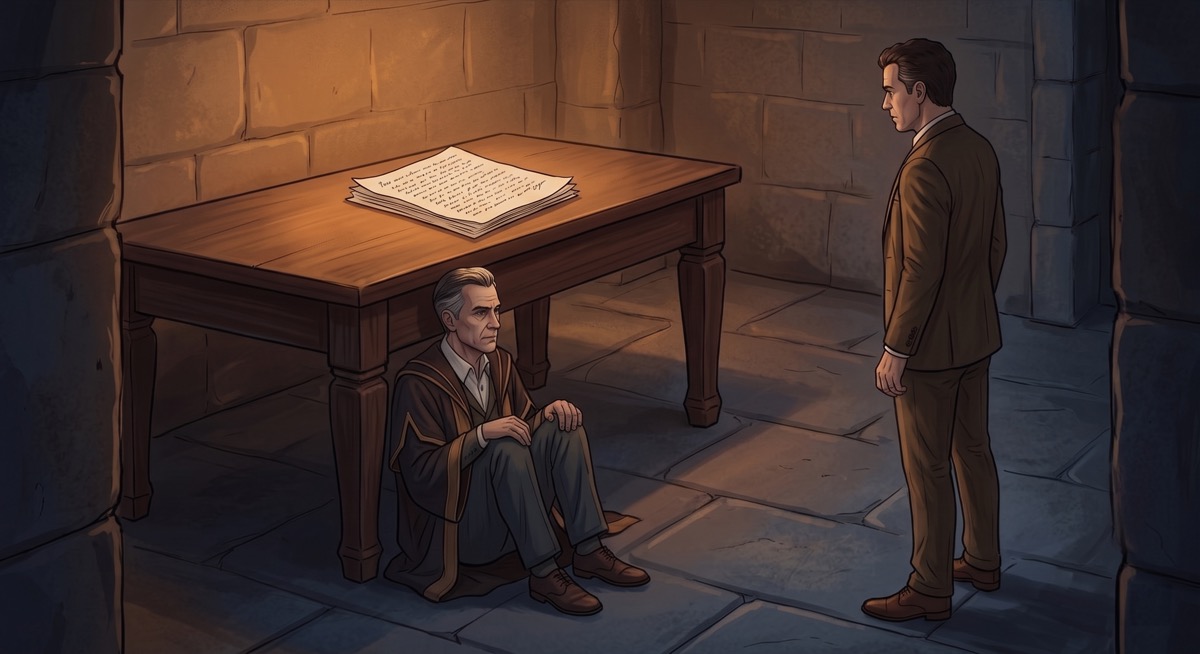
Colluphid sat down on the floor.
There was no chair in the room—there hadn't been, which in retrospect seemed appropriate—so he sat on the stone floor beside the desk, his back against its leg, and looked at nothing in particular. The floor was cold through his clothes. The dim light did not improve or worsen. Somewhere above them, Building 42 continued its night in ignorance of what was happening in its sub-basement, which was also something that seemed appropriate.
Hurkel finished photographing and came to stand nearby, not quite beside him, not quite at a distance—the position he adopted when he had decided the right thing was to be present and not add to whatever was already happening.
"It was a working draft," Colluphid said, finally.
"Yes."
"Not a blueprint. Not a specification." He looked at the document on the desk. "A draft."
"Yes."
"Revisions. False starts. Questions the author hadn't answered yet."
"Yes."
Colluphid thought about the section headers in his own manuscript—the clean architectural sequence, the supporting evidence stacked in correct order, the certainty of the argument at every level. He thought about the new document he had written the morning before the inspection, the one he had described privately as rougher and more circuitous and more honest than anything he had published in two years. He thought about what it felt like to write something before you knew what it was going to say.
"It was revising," he said. "The universe is not a final draft."
Hurkel made the sound he made when something had been said that was true enough not to need agreement added to it.
Colluphid stood, eventually. He returned to the desk and turned to the final page.
The final page was half the length of the others, in handwriting less controlled than the preceding pages—written in a rush, or under some pressure that the previous pages had not contained. It read:
Some things I still don't know how to fix: — the loneliness (see p.3). I reduced it as much as I could. It's still there. I think it might be structural. — what they'll think of me. (probably not good. I've thought about this. I think it's worth it anyway.) — whether what I want and what they need are going to be compatible. I can build the conditions. I cannot build the relationship.
And then, below a gap:
One thing I'm sure of:
They're going to need each other. I hope they figure that out.
The handwriting on that last sentence was shakier than anything else on the page—the handwriting of a sentence someone had been working toward for a long time and had finally written in a single movement before the momentum could leave. The words were pressed harder into the page than the words around them, the way a point made with feeling always is.
Colluphid read the line twice. Then a third time.
He closed the document carefully—not because it required care, but because it was the right thing to do—and stood for a moment with his hands on its cover.
"We need to go," Hurkel said. Not urgently. A statement about time and maintenance windows and the question of how long two unauthorized researchers could stand in a sealed archive before someone checked.
"Yes," Colluphid said.
He did not move for another thirty seconds. Then he did.
They came out the way they had come in: the service corridor, the Basement Two panel, the east exit of Building 42 into the pre-dawn of the academic quad. The clock tower showed the wrong time, as it did. The stars above the university's light cone were doing what stars did, which was burn whether or not anyone was looking.
They walked in silence.
"The margin notes," Hurkel said, eventually—casually, as though he had been thinking about something adjacent and this was where it led.
"I know."
"Yes, but. Be careful. She's not wrong."
"I know."
Hurkel was quiet for half a block. "So when it wrote in your catalog. And on the TRA forms. And in your notes." He didn't complete it.
"I know," Colluphid said. He had known from the moment he recognized the handwriting. He had known before that, in the way things arrive before you are ready for them—the way the Remnant's words had started working in him days before he acknowledged the work. "I know what it means."
"Does it change the book?"
The question sat between them, accurate and well-timed, in the way Hurkel's questions were when he had decided something was worth asking.
"It changes everything," Colluphid said. "The catalog, the design-flaws framework, the incompetence-versus-malice question—all of it is built on the assumption that the universe is God's final position. If it was a draft"—he stopped walking, which he almost never did—"then everything I've been critiquing is intermediate work. You can't review a draft and call it a failure. A draft isn't a failure. A draft is evidence that someone was trying."
Hurkel waited.
"And the margin notes." Colluphid started walking again because standing still was worse. "They're not from God criticizing my work. They're from God responding to it. Yes, but. Not disagreeing. Engaging." The pre-dawn was very quiet. "It's been reading along."
Hurkel said nothing, which was what the moment required.
They reached Colluphid's building.
"The last line," Hurkel said, stopping. "They're going to need each other." He looked at Colluphid. "Do you think that's in the catalog? The design-flaws catalog?"
Colluphid looked at the clock tower showing its characteristic wrong time. "No," he said. "That's one I left out."
"Right," Hurkel said, and left.
Colluphid went upstairs.
He sat at his desk for a long time in the not-quite-dawn, long enough that the clock tower's wrong time cycled around to something that might have been correct if you were willing to be optimistic about it, and he did not open the manuscript. He sat with what he had found, the way you sit with something you know is going to change everything and are not yet ready to apply to the things that need changing.
Then he opened the new document—the one he had not edited since the morning before the inspection, the one that was rougher and more circuitous and considerably more honest—and he added one line at the end.
He did not read it back. He already knew what it said.
He closed the document.
He did not open the manuscript.
Outside Building 42, the maintenance window closed on schedule. The east corridor cameras resumed operation. The Form 223 completion report was three days away. The Archive of First Causes—the single room, the single desk, the single document on its surface—held, in the silence of its stone floor, the absence of the two people who had just been in it. The document did not appear to have been disturbed. Whether this was because it hadn't been, or because it had been and didn't mind, is a question the Theological Regulatory Authority has thus far chosen not to investigate. The Authority has many fine qualities. Asking questions it doesn't want answers to is not among them.