Where God Went Wrong—Chapter 16: What the Draft Means
Posted on Wed 20 May 2026 in Fiction
Where God Went Wrong
Chapter 16: What the Draft Means
The morning arrived without ceremony.
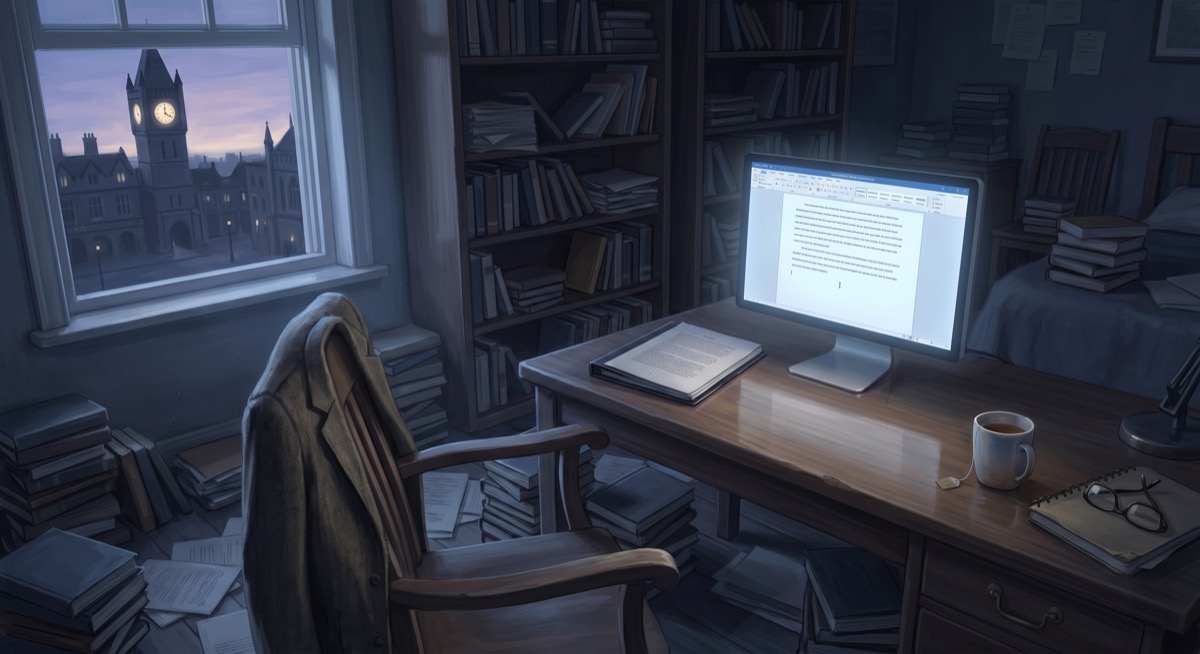
Colluphid had been sitting at his desk since he came upstairs—since Hurkel had said right and turned and walked away in the pre-dawn of the academic quad, since Colluphid had come up to the 42nd floor and opened the new document and added one line and closed it. He had looked at the manuscript without opening it. He had made tea in the mechanical way of someone performing a task to have something to do with their hands.
The tea was cold. It had been cold for an hour.
He opened the manuscript file.
He closed it again.
Hurkel came by at half past ten with better coffee and the air of someone who had slept adequately and thought about things on the way over.
"You haven't opened the manuscript," he said, from the doorway.
"How did you—"
"The window's not in your taskbar." He came in, took the chair, handed over the coffee. "Also you made tea and you only do that when you don't want to wait, and the tea's cold, which means you've been not-waiting for a while." He looked at the desk. "What is it?"
Colluphid held the coffee. It was better than the tea.
"The book," he said. "The book is built on a false premise."
Hurkel considered this. "Walk me through it."
"The catalog assumes the universe is a final product assessed against a finished standard. The document in the Archive was titled FIRST WORKING DRAFT. God was revising. God was in the middle of a revision process." He looked at the closed manuscript file. "Which means everything I've been cataloguing as design failures is not failures. They're the scars of revision. The artifacts of someone trying to get something right that might not have a right." He paused. "You cannot review a working draft and call it a failure. A draft isn't a failure. A draft is evidence that someone was trying."
Hurkel was quiet for a moment. "The observations are still true," he said.
"The frame—"
"The observations are true. Photosynthesis is still inefficient. The parasitic wasp is still real. Forms 27B/6 through 27B/9 are still genuinely inexplicable and I've reviewed all of them personally." He was looking at Colluphid with the lateral attention that was irritating because it was usually correct. "The frame is wrong. The facts aren't. You can still argue the revision should have gone further, faster, in a different direction. You just can't argue it was finished and fell short." He paused. "A right fact in a wrong frame is still a right fact."
Colluphid said nothing.
"So," Hurkel said. "What are you going to do about the book?"
The question sat between them, accurate and well-timed.
"There isn't time to rewrite it," Colluphid said. "The deadline is three weeks. The contract is binding. And the argument as written is—" He stopped. "It's the best version of the wrong argument that anyone has produced."
Hurkel was quiet for a moment. He drank his coffee. He looked at the window. Then: "Publish the wrong version," he said. "And then write the right one."
The apartment held the specific quality of a silence between two people when one of them has said something true and the other hasn't finished deciding what to do with it.
"You understand," Colluphid said carefully, "that you've just described a revision process."
Hurkel appeared to hear what he'd said. He looked at the desk. At the closed manuscript file. "I wasn't doing that deliberately," he said.
"I know."
"That was just the practical—"
"I know what it was."
Hurkel drank his coffee. Outside, the clock tower maintained its characteristic position on the question of time, which was wrong. The academic quad was doing what it did in late morning—undergraduates crossing it in the purposeful way of people going to lectures they will regret attending.
"It's what God did," Colluphid said, finally. "Published a universe that wasn't the final draft, knowing the errors were there. And then kept revising. In the margins. After."
Hurkel didn't answer for a moment. Then: "Right," he said. He did not add anything else, because there was nothing useful to add.
Divna came in the afternoon.
She had not been technically invited—Colluphid's message had said only come when you can, which was as close to asking as he had been able to manage—and she arrived with a paper bag from the Brontitallian fermented-tea bakery in the commercial district, which she had apparently located and evaluated at some prior point without mentioning, because this was the kind of person she was.
She put the bag on the kitchen counter. She looked at the desk, and the manuscript file still closed on the screen, and Colluphid sitting in the chair he had been sitting in for the better part of sixteen hours.
"Tell me," she said.
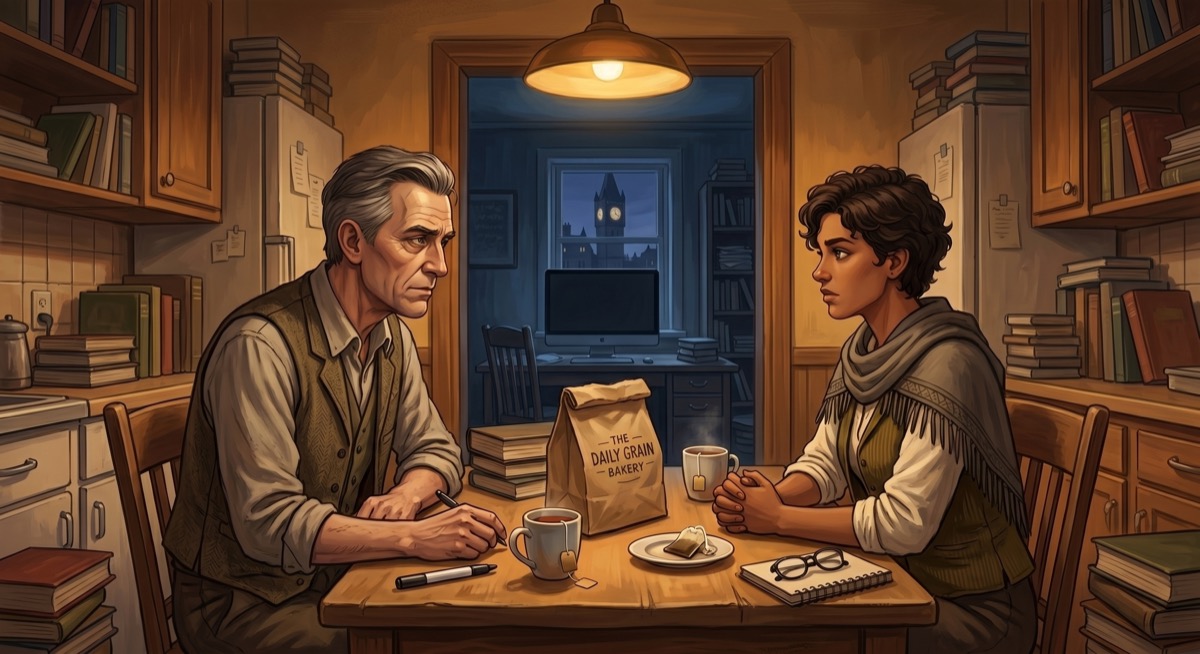
He told her.
He told her about the service corridor and Megadonkey Seventeen and the room that was not a vault. He told her about the desk and the document and the title: FIRST WORKING DRAFT. THIS IS NOT THE FINAL VERSION. ALL ERRORS SUBJECT TO REVISION. He told her about page three, the loneliness crossed out and reinstated with sorry in the margin, and page sixteen—the SUFFERING (THIS IS THE HARD PART) heading, and the decision written beneath it. He told her about still worth it in different ink and please written very small. He told her about the final page and the shakier handwriting and the sentence pressed harder into the page than anything around it.
She listened with her hands around her tea and her face set in the expression of someone receiving information they had expected and finding that expectation had not adequately prepared them.
When he finished, she was quiet for a moment.
"The margin notes," she said. Not a question.
"Same handwriting. All five." He paused. "And the note on your packet."
Her expression shifted—not surprise, something older and less comfortable than surprise. "Be careful."
"Yes."
She set down her tea. She looked at her hands. Then at the window. "I wrote that," she said. "The postscript. I wrote be careful in my own handwriting."
"I know."
"My handwriting."
"Your handwriting," Colluphid said carefully, "and the handwriting on the Archive document are the same."
The quality of the silence in the room changed completely.
Divna looked at him for a long moment—the look of someone doing a calculation that is not resolving the way calculations should. "That's not possible," she said.
"I'm aware."
"I write in my own handwriting. I've been writing in my own handwriting for fifty-three years."
"You've also been working with the Cathedral's Preliminary Materials for forty-four years. The same handwriting on the same pages."
She went very still—not the stillness of someone thinking, but the stillness of someone who has arrived somewhere unexpected and is taking a moment before deciding whether to enter.
"I'm not saying anything about what it means," Colluphid said. "I'm only saying the handwriting is the same. I recognized it the moment I opened the document. Before I read the title."
"Yes." She picked up her tea again with the deliberateness of someone choosing to continue on uncertain ground. "That doesn't necessarily—"
"No. It doesn't necessarily mean anything. Yet."
"It could be that forty-four years with the same documents—the handwriting influencing—"
"It could be."
They sat with the possibilities, which were not comfortable and were not going to resolve themselves this afternoon. Outside, the university went on in ignorance of what was being held in a 42nd-floor apartment above it.
"What are you going to do about the book?" Divna said, finally.
The practical question. Hurkel had used it too. He was starting to think there was a structural reason for it—that when confronted with the unresolvable, the people he trusted most moved to the actionable. He was not certain this was wisdom. He was not certain it wasn't.
"Hurkel thinks I should publish it as-is and write the correct version afterward," he said.
"That's sensible." A slight pause. "For Hurkel."
"He stumbled into it."
"Most sensible things are stumbled into." She looked at him. "Do you think the book is salvageable as it stands?"
"The arguments are still true. The frame is wrong." He looked at the manuscript file. "The catalog is the best case for a false premise that anyone has written. The incompetence reading is airtight. It's the wrong question, but it's asked with complete precision." He paused. "I've spent two years being precisely wrong."
"Then publish it."
"The truth doesn't care about my publication schedule."
"I never said that."
"You would have."
She acknowledged this without denying it. "The book will make people think," she said. "It will make the galaxy look at God's absence and ask whether it was incompetence or malice or intent. Some of them will arrive at intent and find the door you've accidentally left open—the one that leads toward what you actually found." She paused. "And then you'll write the next one. The one that goes through the door."
"Based on what I actually found."
"Yes."
Colluphid looked at the window. "It's close enough to true," he said.
Divna did not respond to this immediately. When she did, it was to change direction.
"You know what frightens me," she said. "In what you've described."
"Tell me."
"The please." She said it quietly. "On page sixteen. After still worth it. Written very small." She looked at her tea. "That's not the God of the institutional record. That's not the God of the Theological Regulatory Authority's classified archive, the God they've been protecting for forty years because of what the public might make of the information." She paused. "That's something like—a being who made a decision and was not certain it was right. Who made it anyway. Who then stood in front of the thing they had made and said please." She looked at him. "Please to what? To whom?"
"I don't know."
"Neither do I." She was quiet for a moment. "I've believed in something for forty-four years. I'm not certain it was this." Another pause. "I'm not certain it wasn't."
The afternoon light was going now, the office shifting toward the grey-blue of the academic evening. Colluphid looked at Divna across the kitchen table—the paper bag between them, the tea cooling, the manuscript on the screen behind him, the archive photograph on Hurkel's device somewhere across the city—and thought that this was, by some significant margin, the most honest conversation he had ever had in this apartment.
"They're going to need each other," he said. The final line, in the shakier handwriting.
"Yes."
"I've been thinking about who that means."
"And?"
"I think it means everyone," he said. "And I think I'm included in everyone."
Divna looked at him for a moment. Then she picked up her tea and drank it.
She left in the early evening, declining another cup with the grace of someone who knows precisely when a moment has run its full course.
At the door she paused—not characteristic—and looked at him with an expression that was not quite the one she usually wore. "For what it's worth," she said, "the be careful was genuine. I wrote it because I meant it."
"I know."
"Whatever it means that the handwriting matches." She looked at the floor for a moment, then back at him. "I meant what I wrote."
"Yes," Colluphid said. "I know."
She left without looking back, which was her way.
He sat at the desk for a long time after.
Then he opened the manuscript and read it from the beginning, straight through, without stopping to edit. He read it as a reader would—or tried to, which was harder than it sounded. The arguments landed the way they were meant to. The catalog sections did the work they had been designed to do. The structure held. The prose carried its weight.
The premise was wrong.
The premise was wrong and the book was still the best thing he had ever written. Both of these things were true simultaneously, and he held them that way, and they did not resolve into anything simpler.
He thought about ALL ERRORS SUBJECT TO REVISION. He thought about the sentence on the final page, pressed harder into the paper than the words around it. He thought about still worth it in different ink, and please written very small, and the working-through quality of the whole document—someone trying to figure out, in writing, something they did not yet understand.
He scrolled to the final page of the manuscript. Below the conclusion paragraph—the universe, in sum, represents not a conscious design but the absence of one, and we should be honest about what inhabits that absence: not God, but us, and whatever we choose to make of the silence God left—he placed his cursor in the blank space below. He sat with it for a moment.
Then he typed four words.
I hope this works.
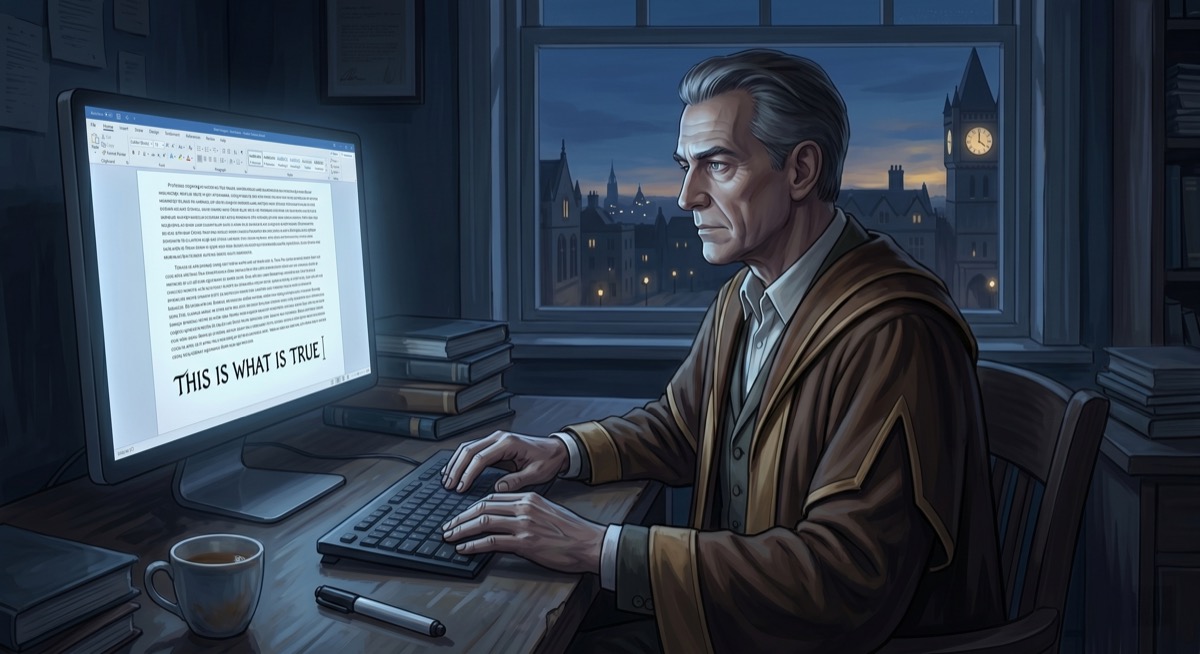
He looked at the sentence for a long time.
Then he sent the manuscript to Merriwyn Satch.
The terminal made its soft departure sound. The apartment was quiet after it. The clock tower was wrong about the time. The stars above the Episteme Wing were doing what stars did whether or not anyone was watching them do it.
He did not open the new document.
He did not open the manuscript again.
He sat in the quiet and looked at the window—not at the view, but at the glass itself, the frame holding it—and he thought about a line he had read in a room below a building and could not un-read: I can make the container but I cannot make the light.
After a while, he made another cup of tea.
The gap between what Oolon Colluphid had published and what Oolon Colluphid knew was, as of that evening, approximately the size of everything he still had to say. He had been in this position before, more or less, across the whole of his career—the man who said the true thing and stopped one sentence short of the truer one. The difference was that now he knew someone else had been there first. And that someone else had kept going anyway.