Who is this God Person Anyway?—Chapter 1: The Biographer's Problem
Posted on Sat 01 August 2026 in Fiction
Who is this God Person Anyway?
Book 3 of The God Books
"I interviewed forty-seven beings who claimed to have known God personally. Forty-three were lying. Three were insane. The forty-seventh asked me a question I still can't answer, and then offered me a biscuit." —from the dedication page of Who is this God Person Anyway?, first edition, later removed at the request of the forty-seventh interviewee, who felt it undersold the biscuit.
Chapter 1: The Biographer's Problem
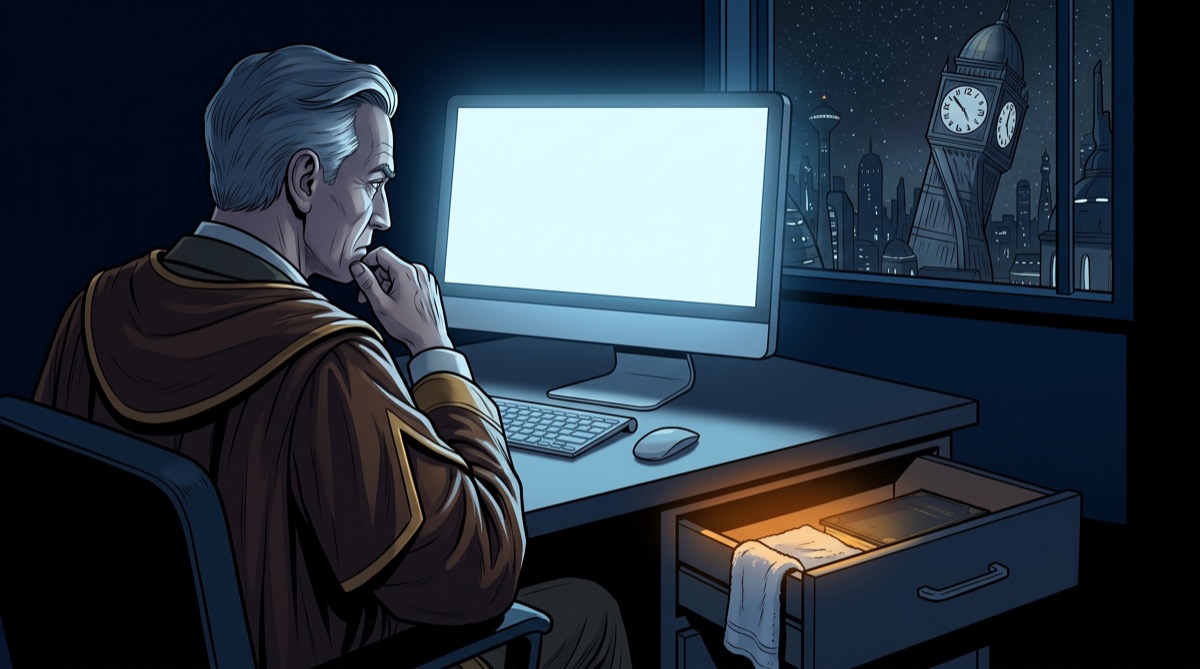
The cursor had been blinking in the same spot for eleven minutes, which Colluphid knew because he had been counting, which he knew was a bad sign, because counting the blinks of a cursor was not research, drafting, or outlining. It was a coping mechanism dressed as punctuality.
The document was called, for the moment, Untitled Document 4, which was one worse than Untitled Document 3, which had at least had the courage to get deleted.
He had written two books about what God did wrong. The first had taken him fourteen months and cost him, by his own private accounting, most of his certainty. The second had taken six days of testimony and an entire folder he still could not read all the way through in one sitting, and it had cost him the argument itself—not lost it, exactly, but set it down, the way you set down a tool you've finally admitted was never going to fit the job. Both books had defendants. Both books had evidence: fossils, archives, a diorama of a parasitic wasp that continued, four planets and two published volumes later, to make people cry in the second gallery of a museum on Oglaroon.
This book had a blank page and a question so simple it embarrassed him to type it.
Who was God?
Not what God did. He'd spent six years and two books on what God did, catalogued and cross-referenced and occasionally illustrated, and he had discovered, somewhere in the middle of what, that he had never once asked who—the way you can spend years reviewing a colleague's published work without ever once asking what they had for breakfast, or who they missed, or what kept them up on the nights the work wasn't going well. He had built an entire career on the assumption that the what would eventually add up to a who, the way enough footnotes add up to a thesis. It hadn't. He had two finished books and no idea what kind of person had built the thing he'd spent them arguing with.
The problem, stated as a problem, the way he stated everything when he was avoiding writing a sentence: God left almost no biographical information. The universe was the work. The artist was, structurally, invisible—not absent from the record, which would at least have given him something to excavate, but unrecorded, the way a finished bridge tells you everything about load-bearing capacity and nothing about whether the engineer ever doubted the design at two in the morning.
It was, he thought, rather like being asked to write a biography of Shakespeare using only the plays as source material, if someone had also burned Stratford-upon-Avon to the waterline, salted the earth, and erased the concept of Warwickshire from three subsequent centuries of maps. You'd have Hamlet. You would not have a childhood, a marriage, a debt, a grudge, a single Tuesday. You would have the work and none of the person who made it, and you would be expected, by a publisher who had already announced the title, to produce four hundred pages closing that gap.
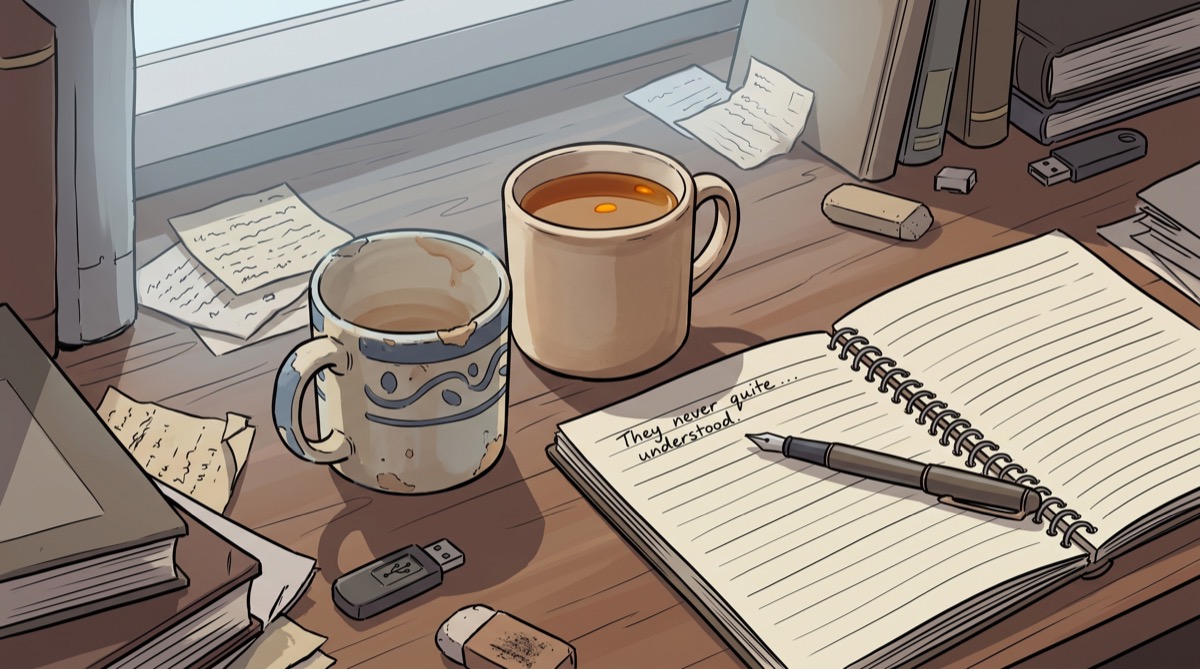
He typed a sentence. He deleted it. He typed a different sentence, which was worse, and left it, on the theory that a bad sentence on the page beat a good sentence that stayed a thought.
The subject of this biography left no diary, no correspondence, no portrait, and no forwarding address.
He looked at it for a while. It was, he decided, accurate, and accuracy was the only virtue he currently had the energy to aim for.
The Hitchhiker's Guide to the Galaxy has this to say about the biographer's dilemma:
"Writing a biography requires, at minimum, a subject who did things a second party can verify. The universe does not, strictly, meet this standard for its own Creator, who did one enormous thing exactly once and then declined all further comment. Biographers faced with this problem have historically chosen one of three approaches: (1) write about the work and call it a portrait, which is a bit like writing a biography of a parent by describing the house they built and never mentioning that they also, at some point, presumably had a face; (2) invent the missing material, a technique known in academic circles as 'scholarship' and in every other circle as 'lying'; or (3) give up and write a memoir about trying to write the biography, which has the considerable advantage of being about someone who is, at least, still answering his messages.
"The Guide notes, for the record, that a fourth option exists—showing up, in person, and asking the people who were there—but flags this as historically the least popular option among biographers, most of whom would rather reconstruct a childhood from tax records than knock on a door and be told something they didn't already believe."
Divna found him like that at half past ten: hunched, unmoving, the cursor still going about its business with the patient indifference of something that had never once, in the history of cursors, been asked to feel bad about the wait.
"You've written four words," she said, not as an accusation, just as a fact she'd observed on her way past with two mugs of tea, one of which she set down at his elbow without being asked.
"Five, if you count the title, which I don't, because it's wrong."
"What's wrong with it?"
"It doesn't have a question mark." He rubbed his eyes. "I keep typing it without one. Habit, apparently, from two books that were both, secretly, arguments, and arguments don't ask questions, they perform them and then answer themselves before anyone else gets a turn." He looked at the screen again, as though it might have improved in the last four seconds. It hadn't. "This one's an actual question. I don't have the answer sitting behind it, ready to be revealed at the end of Part Three. I don't know who God was. I don't know if anyone does. I don't know if there's a does to be known."
Divna pulled the second chair around—the one that had, over the last several weeks, become hers, in the unremarked way furniture reassigns itself around a person who has started living somewhere without either of them ever formally discussing that this was what was happening—and sat with her own mug held in both hands, not drinking it yet, just holding the warmth.
"That's not writer's block," she said. "That's the first honest position you've started a book from."
"It doesn't feel like an advantage."
"No," she agreed. "It never does, at the start."
He looked at her for a moment—really looked, the way he'd been trying to remember to do more often, since the desk drawer, since the folder, since the sentence that had ended leaving was also love and rearranged something in him he hadn't gotten around to naming yet. She looked tired in the specific way of someone who has recently made a decision she doesn't regret and is still discovering all the ways it costs. He knew, roughly, what the decision had cost, because she'd told him the way she told him most things now—directly, without staging it, the information arriving in the same tone she used to tell him the tea was ready.
The Cathedral's Ecclesiastical Council had asked her to sign a statement distancing Applied Divinity from the "designed vanishing" reading his book had put into circulation—not disproving it, just declining to endorse a version of God's departure that was a decision instead of a tragedy, because a decision is a much harder thing to grieve. She'd have kept her chair if she'd signed it. She hadn't. She'd resigned instead, on a Tuesday, in a letter she described afterward as "shorter than I expected and truer than I wanted." That was, as far as either of them discussed it aloud, the entire story.
"I keep waiting for you to be angrier about it," Colluphid said.
"I was angry for exactly one day. Then I noticed I hadn't been sleeping well at the Cathedral for about three years, and I'd stopped noticing that I'd stopped noticing." She turned the mug in her hands. "I'm allowed to have left something I loved because it stopped fitting who I was becoming. You've been doing that with certainty for two books. I'm allowed to do it with a job."
He had, in fact, no rebuttal to this, which he was getting rather better at recognizing as a category of response in itself, rather than a failure to produce one.
Hurkel arrived at eleven with three separate documents under one arm, a fourth balanced on top of the stack in a way that suggested engineering principles he had not consulted anyone about, and the specific energy of a man who has been up since six doing something he considers important and has not yet been told by anyone else that it's important, which he has decided not to let slow him down.
"Right," he said, dropping the stack on the desk with a sound like a small structural failure. "I've been thinking about the archive problem."
"I've been thinking about it too," Colluphid said. "I've produced a title with a question mark in it. What have you produced?"
"A method." Hurkel pulled the top document free and spun it around so it faced Colluphid, which was, Colluphid reflected, becoming a familiar posture for both of them—Hurkel presenting, Colluphid receiving, the roles from two books ago quietly reversed somewhere around the Spawning Pools and never reversed back. "You can't write a biography of someone with no biographical record. Fine. But you can write an archaeological biography—same as any dead civilization with no written history. You don't ask what they said. You ask what they left. Tools, structures, waste patterns, burial practices. You reconstruct the person from what they built and how they built it."
"God built a universe."
"God built a universe," Hurkel agreed, with the particular relish of a man about to say something he'd clearly been saving. "Which means we have the largest and most complete data set of anyone's creative process in recorded history, and we've spent two books treating it as an argument instead of a body of work. What does the placement of the Babel fish tell you about someone's patience—four billion years in advance, hidden inside a proof, timed to the exact stratum? What does the Remnant's account of the first creation cycle—the 'careful' one, the one God abandoned for something riskier—tell you about a person who tries the safe version, hates it, and starts over?"
Divna, who had been listening with the specific stillness of someone recalculating a case she thought she already understood, said, "You're describing a working method. Not just a research method—an artist's method. Draft, dissatisfaction, revision, a second attempt that costs more and risks more because the first one wasn't true enough."
"Exactly." Hurkel looked, for a moment, genuinely pleased with himself, an expression Colluphid had learned to trust precisely because Hurkel so rarely allowed it to show. "So the investigation isn't interviews and archives and hoping someone remembers a conversation from four billion years ago, though we'll do that too, obviously. It's forensic. We go to the oldest sites in the galaxy. We reconstruct a timeline the way you'd reconstruct any timeline nobody wrote down—physical evidence, cross-referenced, dated, argued over. It's not a memoir. It's an autopsy."
"That's a grim word for a biography," Divna said.
"It's a grim book," said Hurkel, not unkindly. "We're writing about someone who's dead, or as good as, or worse than, depending which theory you believe by Thursday. Might as well use the honest word for it."
Colluphid found, turning the phrase over, that he didn't dislike it. An autopsy of a divinity. It had the kind of ugly precision that made for a very good working title, possibly even a chapter heading, and it did what Hurkel's ideas increasingly did, which was to reframe a problem Colluphid had been circling for a week into a shape he could actually start walking toward.
"Where do we start," he said. It wasn't quite a question. He'd stopped, somewhere in the last two books, expecting Hurkel not to already have an answer.
Hurkel didn't disappoint him.
"Still Here," he said. "Obviously. They said to come back when you were ready to ask who instead of what. I'd say four days without you writing a sentence you didn't immediately delete counts as ready."
The message arrived at noon, which was, Colluphid would later note in the loose pages that didn't make it into any published draft, either a coincidence or the kind of timing that had stopped being coincidental somewhere around the end of Book 2 and simply hadn't been given a new word yet.
It came through the Still Here relay—the old channel, four thousand years older than the Theological Regulatory Authority and considerably less interested in filling out forms about it—and it was, unlike every previous message that channel had carried them, not routed, not anonymous, not encrypted in three overlapping systems. It was short, and it was, in the specific way of messages from beings who have had six thousand years to decide which words are worth the transmission cost, entirely sufficient.
Come. Bring tea.
Hurkel read it over Colluphid's shoulder and said, "Well, that settles the packing list, at least," which was the kind of remark Colluphid had once found irritating and now recognized as Hurkel's particular way of not saying something larger out loud.
Divna read it after him, and was quiet for a moment, and then said, "Four words. That's less than the Remnant usually manages before they say something that takes you apart."
"I noticed."
"Are you ready?"
It was, Colluphid understood, not really a question about the tea, or the transit schedule, or which of the three of them would carry the good cups, the ones Hurkel had bought specifically for occasions he'd described as "cosmically significant" and which had, until today, only been used twice. It was the question underneath the four words on the screen, the one he'd been circling since the cursor started blinking that morning: whether a man who had spent six years arguing with an absence was actually prepared to go and ask the absence's oldest surviving neighbors who it had been, before it left.
"No," he said, which surprised him less than it once would have. "But I wasn't ready for the first book either, and I wasn't ready for the drawer, and readiness appears to be a thing that happens somewhere in the middle of doing the thing, rather than before it. I'd rather be unready on the way to Still Here than unready in front of this cursor for another week."
He packed that evening, which took him considerably longer than the size of his bag warranted, because he kept stopping to look at what he was putting into it.
The clothes went in first, efficiently, the way a man packs when he's done it enough times that his hands know the order without consulting him. The notebook went in second, three-quarters empty by his usual standards, which he'd stopped apologizing to himself for; testimony, he'd learned, filled pages differently than argument, and this book, whatever it turned out to be, didn't feel like either.
Then he went to the desk drawer.
He opened it the way he'd opened it every few days since the night he'd closed it—not to read anything, not this time, just to look. The annotated first edition, spine soft now from handling. Not bad. But you left out the best part. The Intention Document, folded along its original creases, the last page's apology still exactly where he'd left it, still exactly as devastating on the fortieth reading as the first. And the towel—the one thing in the drawer he had never once managed to explain, and had, at some point in the last several weeks, stopped trying to.
He looked at the three objects for a moment. An accusation. An apology. And something that had no business working and had worked anyway.
He put all three into the bag.
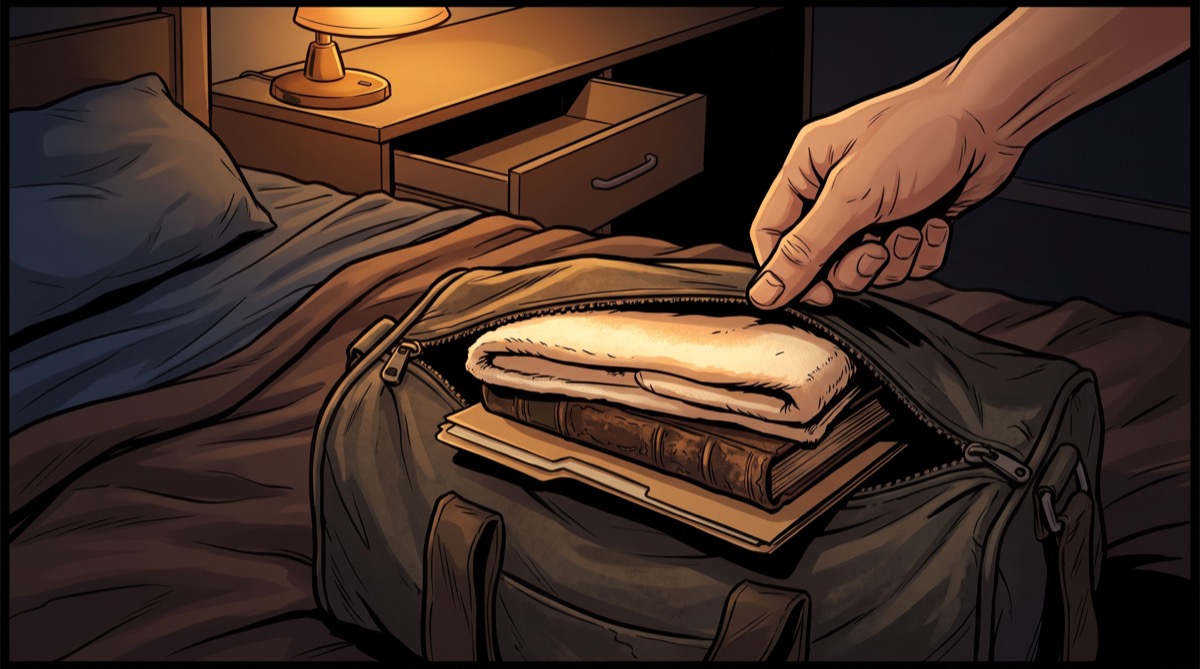
He didn't examine why, this time. Packing, he'd stopped requiring himself to examine everything before he was allowed to act on it—some decisions, apparently, were made by a part of him that didn't file its reasoning where the rest of him could access it, and that part, increasingly, was the one he trusted most. He folded the towel one more time, out of habit rather than necessity, and set it on top of the other two, where it would be first out and first in, the way you pack the thing you might need in a hurry.
From the hall, Hurkel called that the transit was booked for oh-six-hundred, and did Colluphid want the good cups wrapped in a shirt or did he trust the case, and from further off, in the kitchen, Divna was laughing at something Hurkel had apparently just said to her about the phrase cosmically significant, a sound Colluphid had not, six years ago, expected to be one of the things that made a departure feel less like leaving and more like going somewhere together.
He zipped the bag.
Untitled Document 4 was still open on the desk behind him, cursor blinking in the same patient rhythm it had kept up all morning, four words further along than when he'd started and no closer to a title that felt true. He left it open. He suspected, closing the apartment door behind the three of them, that whatever filled the rest of that page was not going to come from this desk at all, but from a planet old enough to have stopped counting, and a table where the tea, according to every prior account, was always exactly right.
Somewhere on that planet, three cups were already being set out, though no one there yet knew how many guests were coming, or that one of them would be carrying a towel he could not explain, a folder he had finally finished reading, and a question small enough to fit on a blank page and large enough that he had no idea, boarding the transit at oh-six-hundred, how many more books it would take to answer it.