Some More of God's Greatest Mistakes—Chapter 18: The Suicide Note
Posted on Wed 29 July 2026 in Fiction
Some More of God's Greatest Mistakes
Chapter 18: The Suicide Note
The apartment had been loud for nine days, and then, on the tenth, it simply stopped. Not gradually. All at once, the way a held note stops when the instrument is set down—the comms silent, Hurkel out for the evening at a dissertation committee meeting he'd finally agreed to reschedule, the messages still arriving somewhere out in the galaxy but no longer arriving here, at this desk, in this room. Colluphid sat in the quiet for a while before he understood what it was for.
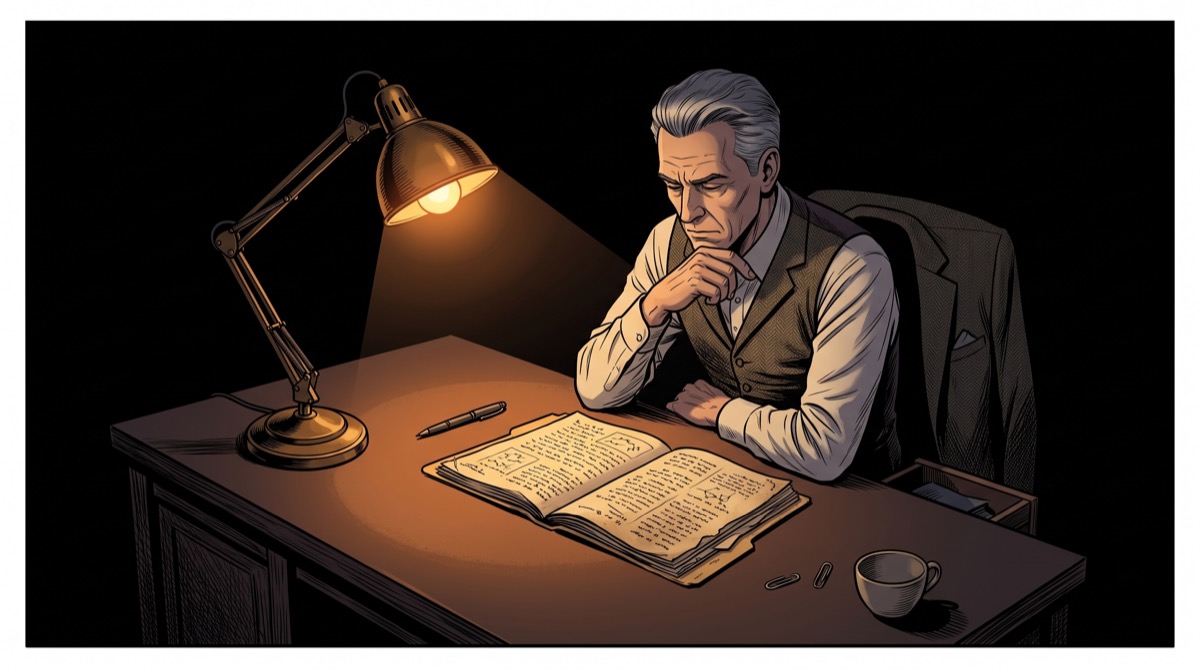
The folder was still in the drawer where he'd put it weeks ago, the night he came home from Kless Depot, unopened past the one page he'd let Voostra read aloud in a cafeteria that no longer felt like it belonged to the same story. He had told himself, each time he'd passed the drawer, that there would be a better night for the rest of it—a night with less noise in it, less publication, less galaxy. He understood, opening the drawer now, that he had simply been waiting for tonight, the way you wait for weather to clear before you go and stand in a field you've been putting off standing in.
He took the folder to the desk. He did not turn on the overhead light. The lamp was enough.
The first pages were not what he expected, which was, he reflected, becoming the defining feature of everything in this Archive—a document that anticipated the shape of his expectation and then declined, politely, to fit it. He had braced for grandeur. What he found instead was closer to a working notebook: sketches of the fish's resonance organ, redrawn four times with the fourth version circled twice; a column of dates that resolved, on the third read, into a countdown running backward from something unspecified; a note in the margin of a diagram, in handwriting he now recognized on sight the way you recognize a signature—this has to feel like an accident, or it doesn't work. that's the whole trick and I hate it. Page after page of a mind working out, with the same fussy, recursive care Colluphid recognized from his own drafts, how to build something that would look, to the people finding it later, like a discovery rather than a gift. There was crossing-out. There was a section restarted three times with the header rewritten each time, the previous headers not deleted, just struck through and left visible, as though the author wanted whoever read this to see the false starts and not only the version that worked.
Around page thirty, the tone changed. The sketches stopped. The handwriting, already familiar, got smaller and more careful, the way handwriting does when someone has decided that what comes next has to survive being read by someone they will never meet.
From The Hitchhiker's Guide to the Galaxy, entry: Reading, The Last Page Of Something, General Notes On:
The Guide does not, as a rule, comment on final pages. It has learned, across several editions and one memorable libel suit, that the last page of anything belongs more to the reader than to any commentary that could be printed alongside it. But it will note, once, and then stop: there is a particular kind of document that is not trying to convince you of anything. It has given up on argument entirely. It is only trying to be understood, by exactly one person, before it runs out of room. These documents are rare. They are the only kind the Guide has never managed to be funny about, and it has tried.
The last page was one page. Everything before it had been the work of getting there.
I am sorry for the pain, it said. I am not sorry for the capacity to feel it. They are the same thing, and I could not give you one without the other.
Colluphid read the sentence twice before he let himself keep going, the way you check a step is solid before you put your full weight on it.
I made you capable of breaking because I made you capable of love. I hope you will forgive me for that. I hope you will forgive me for leaving. I hope, when you find this, you will understand that leaving was also love.
There was no argument after it. No appendix, no defense, no anticipated objection answered in advance the way every other page in the folder had anticipated something. It simply stopped, the way a person stops talking when they've said the true thing and have nothing left that wouldn't be decoration.
He did not reach for a rebuttal. He noticed himself not reaching for one, the way you notice a habit by its absence—the old reflex, the one that had built an entire first book and half a second one, sitting quiet in his hands for once, unsummoned. There was nothing in the sentence to argue with. It had not made a claim. It had made a confession, and a confession is not the kind of sentence you can prove wrong; you can only decide whether you believe the person saying it, and Colluphid found, sitting with the page in the lamp's small circle of light, that he did.
In the margin, beneath the last line, in the same handwriting, smaller than everything else on the page, as though it had been added after the rest was already finished and there had been just enough room left for one more thing:
Thank you for reading this far.
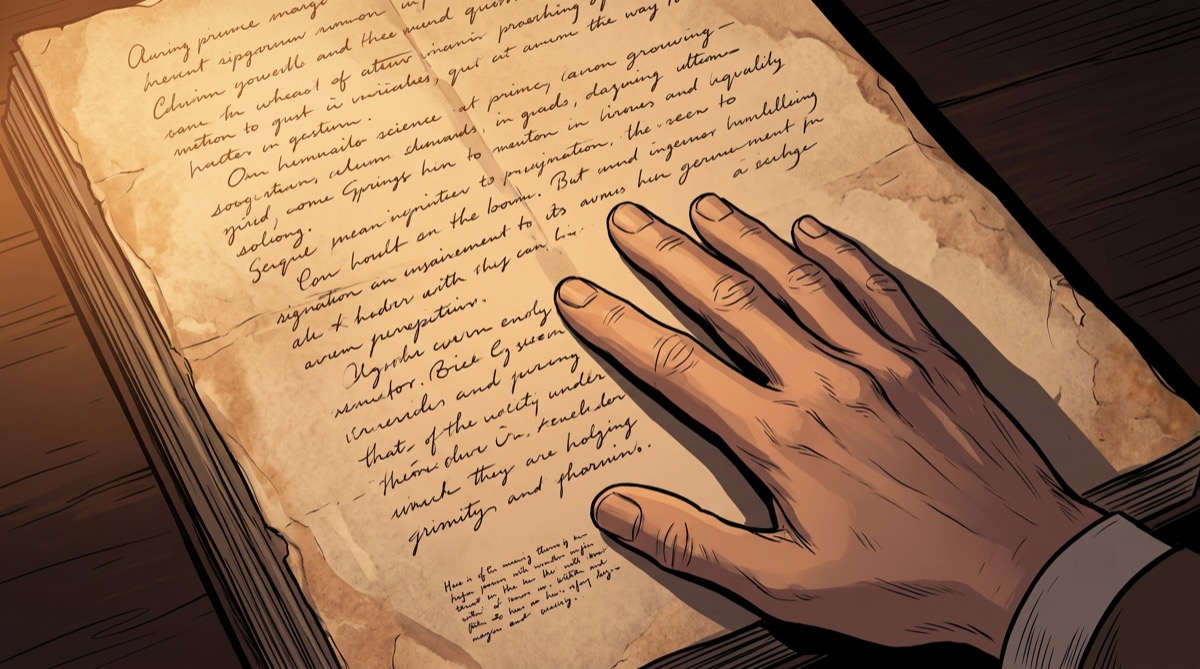
He sat with it for a long time. Not writing. Not thinking, exactly, in the sense he usually meant by thinking—the organized kind, the kind with a thesis at the end of it. Just sitting, the way Divna had once told him theology actually was, if you stripped away the arguing: logos, attending to something. He had spent six years attending to God the way a prosecutor attends to a defendant, cataloging, building a case, waiting for the moment the evidence would let him rest. He understood now, with the specific quiet of a man setting down something he has carried so long he'd forgotten it had weight, that the evidence had never actually pointed toward guilt. It had pointed toward this. It had been pointing toward this the entire time, and he had needed two books and a folder and a tired man's coffee going cold in a station cafeteria to be ready to read it as what it was.
He thought about the question he had built his entire career answering. Where did God go wrong. He turned it over, the way you turn over a stone you've walked past for years without noticing it was carved. It was the wrong shape for the thing he actually wanted to know, and it had always been the wrong shape. He had a new question now, and it was smaller, and stranger, and he had no idea how to research it, which was, he suspected, exactly why it was the right one.
Not what God did.
Who God was.
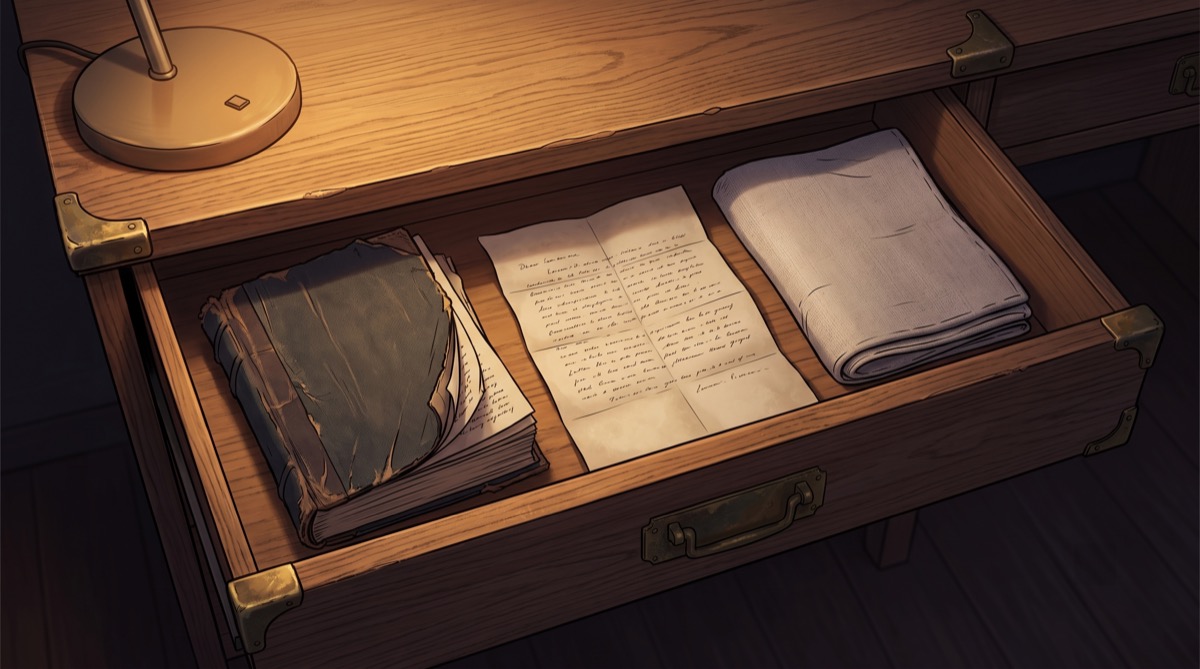
The drawer already held one thing: a first edition of Where God Went Wrong, spine creased, dog-eared, a stranger's margin note on its title page that he had read so many times he could recite it without opening the cover. Not bad. But you left out the best part. An accusation, more or less—gentle, but an accusation, the way the whole first book had been an accusation, dressed up as scholarship and footnoted within an inch of its life. He had built a career out of the same posture that note took toward him: you left something out, and I noticed.
He folded the Intention Document along its original creases, careful of the thin, worn paper, and set it beside the first edition. The apology, next to the accusation. He looked at them together for a moment—two documents, two handwritings that turned out to be the same handwriting, having what amounted to the longest conversation either of them had ever conducted, entirely without him, across the closed drawer of a desk in an apartment on the forty-second floor of a building whose clock tower had told the wrong time since 2314 and which everyone, including Colluphid, had long since stopped minding.
He went to the hall closet for the last thing.
The towel was where it had been since Praxis Interchange, folded into the same rough square Hurkel had made of it in a decompressing corridor with considerably less ceremony than Colluphid was about to bring to it now. He had never examined why he kept it. He examined it now, briefly, standing in the hall with it in both hands, and found he still didn't have an answer that satisfied the part of him that wanted everything to have a mechanism. It had worked when nothing about it should have worked. It had sealed a hole in a hull the way a note in the margin of a manuscript had once told him to keep going, and he had never been able to prove the two things were related, and he had also never been able to convince himself they weren't.
He folded it again, properly this time, and carried it back to the desk, and set it in the drawer beside the other two.
Three objects. An accusation. An apology. And something that had no business working, and had worked anyway, for reasons that remained, appropriately, exactly as mysterious as everything else in this investigation had turned out to be once you looked at it closely enough.
He closed the drawer.
Hurkel came home a little before midnight, dissertation folder under one arm, looking like a man who had successfully rescheduled a rescheduling and was already regretting agreeing to a third date for it. He found Colluphid at the desk, not writing, the lamp the only light in the apartment, and stopped in the doorway the way he'd learned to stop, over two books, whenever the room had the wrong kind of quiet in it to walk into carelessly.
"Good quiet or bad quiet," he said.
"I don't know yet." Colluphid considered it, and found, turning the question over the way he'd been turning everything over tonight, that this was the truest answer available to him. "Ask me again in a few books."
Hurkel looked at him for a moment longer, decided against whatever question he'd been about to ask instead, and said only, "There's tea, if you want it. I'm not making it, but it exists, in the cupboard, theoretically." He went to bed without asking what had been in the drawer. Colluphid noticed him not asking, and understood it, this time, for exactly what it was—not indifference, but the same gift Hurkel had been offering him in small doses since a comms booth on the Reasonable Doubt, the specific mercy of not requiring an answer before you were ready to give one.
He did not open a new document that night. The one waiting for him—two words and a question mark, sitting patiently where he'd left it four days ago—could wait until morning. Some things, he was beginning to suspect, deserved to be approached rested rather than urgently, and this felt, for the first time in either book, like one of them.
He turned off the lamp. In the dark, the drawer was just a drawer, indistinguishable from any other drawer in any other desk in any other apartment on Maximegalon, holding nothing that would register on a TRA inventory form or a Provision 14 impact assessment or any instrument built to measure the things instruments were built to measure.
Somewhere on a planet old enough to have stopped counting, a small structure that was neither built nor grown sat waiting, the way it had been waiting for six thousand years and would, if it came to it, wait six thousand more, for a man who had finally started asking the only question that had ever actually mattered, and did not yet know that the answer would take three more books to find, and would not, even then, be the kind of answer you could footnote.