Some More of God's Greatest Mistakes—Chapter 17: Publication Day (Again)
Posted on Sat 25 July 2026 in Fiction
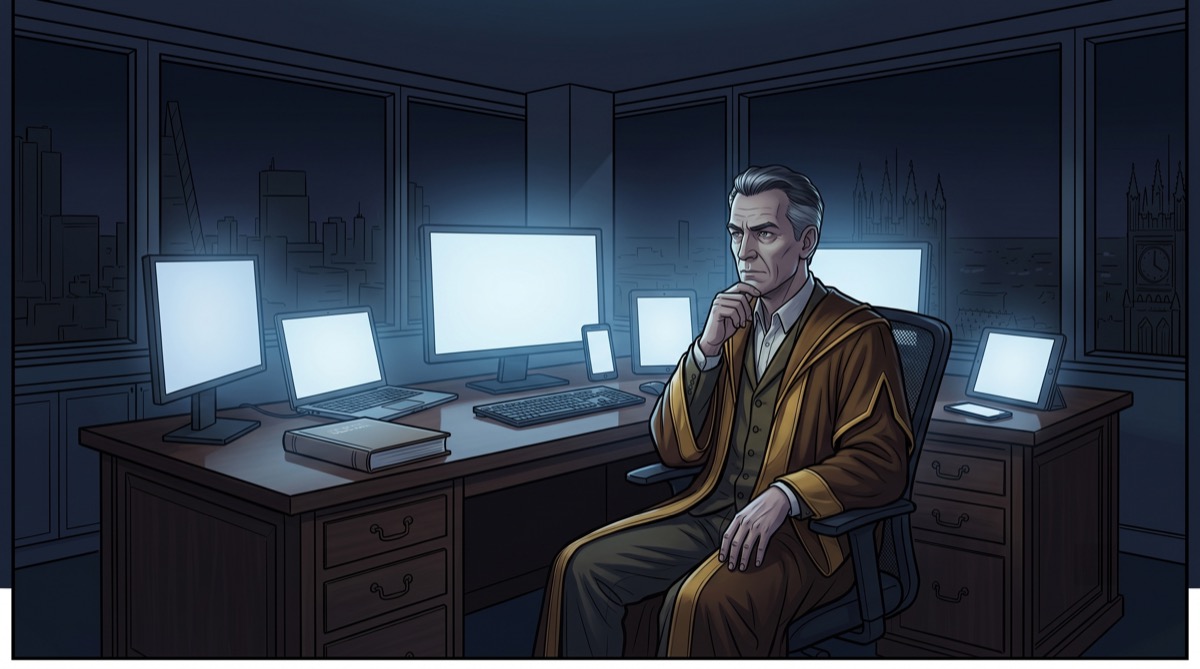
Some More of God's Greatest Mistakes
Chapter 17: Publication Day (Again)
The last time Colluphid had published a book, it had gone out on a Tuesday, at Merriwyn Satch's strategic insistence, because Tuesdays polled best for controversy with a full week to metabolize before the weekend news cycle. There had been a printing of three million copies and a countdown clock on the Galactic Horizons Press homepage. There had been reviews waiting before dawn, filed in order of hostility, and a Theological Regulatory Authority designation arriving in time for the second news cycle, as though someone in Provisioning had choreographed the whole thing for maximum narrative efficiency. It had felt, Colluphid remembered, less like publishing a book than detonating one.
This time he asked for none of it.
Zarniwoop, who had spent thirty years building a career on precisely the opposite instinct, agreed with a speed that unsettled Colluphid more than an argument would have. "No countdown. No embargo. No advance copies to anyone who reviews things for a living." He'd said it the way a man agrees to skip his own retirement party—not reluctantly, exactly, but with the specific carefulness of someone who has decided this particular ceremony doesn't belong to him this time. Some More of God's Greatest Mistakes. went out at six in the morning, Maximegalon time, on a Thursday nobody had picked for any reason except that the typesetting happened to finish then. No livestream. No signing tour booked in advance. Merriwyn Satch sent one line: I don't know what you two have done, but I've cleared my calendar for the fallout, whatever shape it takes. She did not say what shape she expected. Colluphid suspected, reading it twice, that she genuinely didn't know, and that this was the first time in her professional life she had let a book go out without a prediction attached.
From The Hitchhiker's Guide to the Galaxy, entry: Publication, Reader Response To, Statistical Patterns Of:
Controversial books generate reaction within hours; this is well documented and entirely predictable, since outrage requires no comprehension and can therefore travel at the speed of the headline summarizing it. True books are slower. They require the reader to finish them, which takes time, and then to sit with what they've finished, which takes considerably longer, and the Guide notes that this delay is frequently mistaken by the author for failure. It is not failure. It is digestion. The galaxy, taken as a single organism, is not actually very fast, whatever its transit times suggest, and the things that change it tend to arrive in the mail well before they arrive in the mind.
For four days, nothing happened.
Colluphid had braced for outrage. He had, if he was honest with the version of himself that only came out late at night, braced for outrage the way you brace for a familiar weather pattern—unpleasant, but at least legible, at least something you knew how to stand in. What he got instead was silence, and the silence was worse, because it offered no shape to react to. Sales figures arrived from Galactic Horizons in flat, uncommented columns. Hurkel checked the review aggregators three times a day and reported, each time, the same number of published reviews: zero. Not negative. Not delayed. Zero, as though the book had gone out into a vacuum that had not yet noticed there was air to disturb.
"Maybe it's bad," Colluphid said, on the third night, staring at a ceiling he had grown intimately familiar with over the preceding seventy-two hours.
"It's not bad." Hurkel didn't look up from whatever he was doing to the room's third houseplant, a rescue effort that had been ongoing since roughly the same week the manuscript went to typesetting. "You wrote a true thing and sent it into a species-spanning readership that has spent six years building elaborate structures on top of a story they thought was finished. Structures take time to notice a crack. That's not the same as there being no crack."
"That's a very confident metaphor for a man repotting a fern."
"I've had four days to work on it."
On the fourth night, Colluphid sat at his desk—the same desk, the water ring, the cracked leg—and did not write anything, and did not read anything, and simply sat, for the first time in either book, with the specific vertigo of having said the true thing and discovering that the true thing, once said, was no longer his to manage. He thought, not for the first time, about the difference between being right and being heard, and found he no longer entirely trusted himself to tell them apart.
He did not know, going to sleep that night, that on eleven thousand worlds, people had just finished reading the same paragraph at roughly the same hour, in eleven thousand translations that all, thanks to a fish nobody had thanked yet, arrived carrying exactly the same weight.
The break, when it came, did not look like a break. It looked, for the first ninety minutes, like a system failure. Hurkel woke Colluphid at 4:12 a.m. Maximegalon time with the flat, urgent voice of a man reporting a fire rather than a fact.
"Something's happening to the networks."
It was not a fire. It was several billion beings, across a substantial fraction of a spiral arm, attempting to say something to each other and to no one at the same time, and the infrastructure built to carry ordinary conversation had simply not been engineered for a species-wide intake of breath. Comm relays queued. Broadcast bandwidth that normally carried entertainment and shipping manifests filled instead with something closer to a single held note played on several trillion instruments simultaneously. The Guide's own real-time commentary feed—usually a dependable font of dry unbotheredness—posted, at 4:47 a.m., a single unadorned line: Something is happening. We are not equipped to be funny about it yet. Please stand by.
It broke into pieces almost immediately, the way anything that large has to, because no single reaction can hold several billion different griefs and relief and furies at once without shattering along its own fault lines. Some of it was argument—entire forums devoted, within hours, to whether designed and abandoned could coherently be the same word, whether autonomy handed over unasked-for was a gift or simply a more elegant abandonment, whether Voostra's forty years of suppression had been cowardice or mercy or the only ethical position available to a man who couldn't get anyone to agree on the answer. Some of it was fury—several governments issued statements; one small but vocal sect on Blagulon Kappa declared the entire book an elaborate TRA disinformation operation and were, within a day, arguing furiously with a second sect who believed exactly the opposite for exactly the same reasons.
And underneath the argument and the fury, spreading slower and going deeper, was the third thing, the one nobody—not Colluphid, not Zarniwoop, not the Guide's stunned commentary desk—had predicted. Gratitude. Not for Colluphid. Colluphid understood this early and held onto the understanding carefully, the way you hold onto a fact that keeps trying to slip sideways into something more flattering than it is. The gratitude moved through him without stopping for him, addressed to something that wasn't reading its mail, the way a letter can be sincerely meant even when everyone involved knows it will never technically arrive.

He read them for six hours straight, past the point where Hurkel suggested, twice, that he stop. Messages from strangers, in translation, in the flattened cadence of a species he'd never studied, saying some version of the same nine or ten things over and over, until the repetition itself became its own kind of proof: I thought I was angry at nothing. It turns out I was angry at someone who left a note. That's different. I don't know if it's better. It's different. A Jatravartid elder, four hundred years old by their reckoning, wrote to say that the Great Green Arkleseizure's sneeze had never made sense to her as an accident, not really, not the way the elders taught it, and that she had spent four centuries quietly believing something closer to what the book said without ever having a word for it, and that having the word, even now, even this late, felt like being handed a key to a door she'd stopped trying. A parent on a colony world Colluphid had never heard of wrote three lines about a child who had died young, and about the specific, unbearable comfort of learning that the universe's capacity to let that happen had been chosen on purpose by someone who also, apparently, could not bear it either.
He got to a message from a being identifying only as someone who read your first book and hated you for it that read, in its entirety: I still hate you a little. But I don't feel alone in the hating anymore, and I didn't expect that to be the thing that helped.
That was the one that did it. His face did something he recognized, distantly, as familiar—the same pressure behind the eyes from a trade station once before, a linguist's density map, a fish that turned out to be a library. That time he had pressed his fingers against it and held on, because Hurkel had been in the room and there had been a professional posture to maintain. There was no professional posture left to maintain now. He let it happen. Not grief, exactly. Not relief, exactly. Closer to the unglamorous exhaustion of a man who has been carrying an argument for six years and has just set it down somewhere it can finally be read by someone other than the person who built it.
Across the apartment, on the balcony he thought no one had noticed him using, there was a second toothbrush in the bathroom that hadn't been there a month ago, and a jacket on the hook by the door that wasn't Hurkel's, and neither of them said anything about it, because some things were true enough not to need announcing yet.
The message from Still Here arrived on the sixth day, routed through the same four-thousand-year-old relay that had once told him, on a run-down trade station, that he was getting closer and that was why they were afraid. This time it wasn't text. It was a voice—the eldest's, the six-thousand-year approximation of she, warmer than he remembered it, or perhaps he simply hadn't been listening for warmth the first time.
"You found the library," the voice said, without preamble, the way the Remnant said everything, as though preambles were a luxury available only to species with more time than they had. "You found the gift. You found the man who carried it and put it down. You are very close now." A pause, filled with something that might have been the sound of wind moving across a landing strip that had not seen a scheduled flight in longer than most civilizations had existed. "But you keep asking what God did. Come back when you're ready to ask who God was. We knew him a little. We would like to tell you, if you're finally ready to hear it as a person instead of a defendant."
The message ended there. Hurkel, listening beside him, said nothing for a long moment, and then said the only thing there was to say, which was, "Well. That's Book Three, then," in a tone that suggested he had known this was coming for longer than he'd let on.
The TRA said nothing at all. No Designation. No seizure order. No enforcement team at the door, no seventeen-field registry, no formal notice under any provision Colluphid had learned to recognize by number. Zarniwoop, checking with a lawyer out of habit rather than concern, reported back that the Authority's silence appeared to be genuine rather than strategic—that whatever machinery had once moved against Where God Went Wrong within a day of publication had simply not moved this time, as though the entire apparatus were waiting to see what its own Senior Field Inspector did next before deciding what it believed. Colluphid thought of the licensing office somewhere in the Conditions of the Conditions of the Conditions, the form filed under Books Requiring Advance Notification, the unnamed reader who hadn't smiled. He did not know what that reader had done with the working title after reading it twice. He suspected he wouldn't find out for some time. He found, examining the suspicion, that it no longer frightened him the way it once would have.
The dedication survived. He checked, the way you check a wound to see if it's still there—not hoping it had healed, exactly, just needing to know. For God, who went wrong in all the right ways. Printed, bound, sitting on a shelf in several billion homes now, unremoved, unedited, the first thing he had ever put his name under that he hadn't taken back before it could be seen.
He sat at the desk long after Hurkel had gone to bed, in the particular quiet of an apartment that had spent a week being loud and had finally, mercifully, stopped. The manuscript—finished, bound, out in the world doing whatever a true thing does once it stops belonging to the person who wrote it—sat closed on the shelf where he'd put it. He did not open the private journal. Four lines was still four lines; it would keep, the way it had always kept.
He opened a new document instead.
He looked at the blank first line for a while, the way he'd once looked at the fish were planned and, before that, at a note in someone else's handwriting that read I hope this works, and found that the question forming in him now was not the one he'd started either book with. Not what did God get wrong. Something else. Something that had been sitting underneath the first two questions the entire time, patient, waiting for him to run out of arguments before it would agree to be asked.
He typed: Who is this God Person Anyway
He looked at it. Then, for the first time in two books—the first time, if he was being honest, in his entire career—he added the mark he had always, on some private editorial instinct he'd never examined closely enough to name, left off.
Who is this God Person Anyway?
The question mark sat there at the end of the sentence, small and correct and long overdue, the first thing he had written in either book that admitted, on the page, in front of everyone who would eventually read it, that he did not already know the answer.
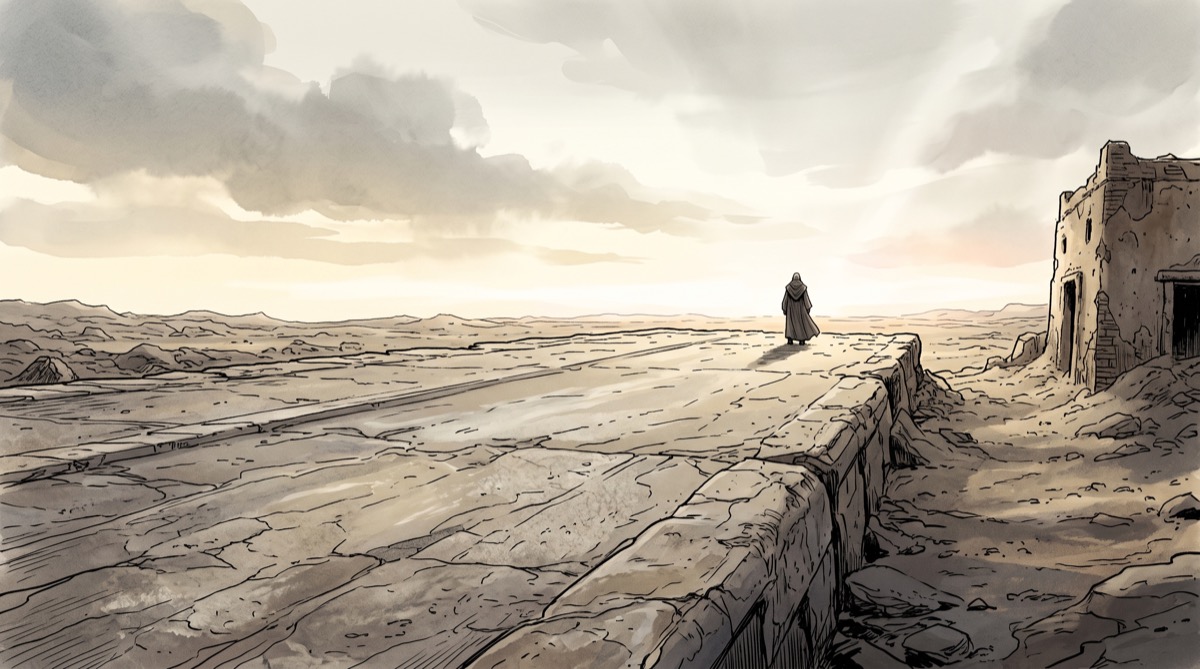
Somewhere on a planet old enough to have stopped counting, a landing strip that had not needed lights in four billion years flickered once, experimentally, as though testing whether it still remembered how.