Some More of God's Greatest Mistakes—Chapter 16: Writing the Truth
Posted on Wed 22 July 2026 in Fiction
Some More of God's Greatest Mistakes
Chapter 16: Writing the Truth
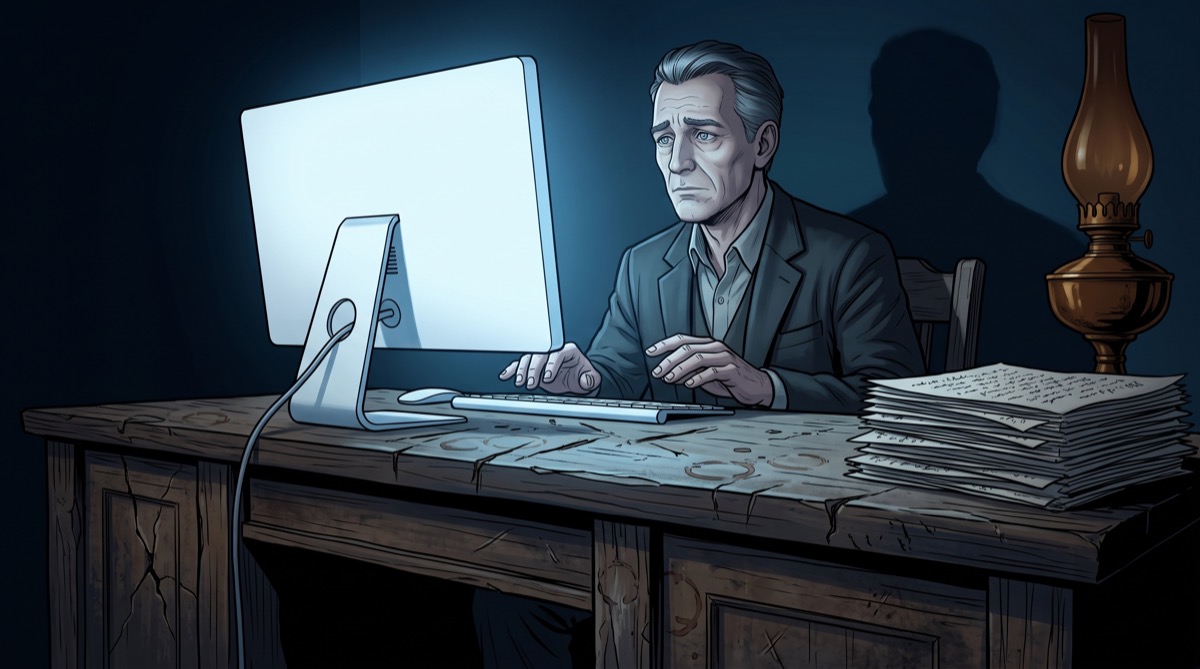
The desk was the same desk. That was the first thing Colluphid noticed on the morning he sat down to write the real book, the way you notice a familiar face has aged only when you've been away from it—the same scarred oak, the same water ring from a mug of tea he'd let go cold four years and one book ago, the same crack in the left rear leg that he'd been meaning to fix since before he owned a career worth having a desk for. He had written Where God Went Wrong at this desk. He had written the first eleven chapters of its sequel at this desk, all of them clever, all of them performing, all of them—he understood this now, with the specific nausea of a man recognizing his own handwriting in a ransom note—entirely beside the point.
He deleted none of it. He opened a new document instead, because there is a particular kind of cowardice in editing your old certainties and a particular kind of honesty in simply setting them down beside the new ones and letting a reader see the distance, and Colluphid, for the first time in two books, wanted to be honest more than he wanted to be right.
He wrote: The fish were planned.
He looked at the sentence for a long time. It was four words. It contained no subordinate clause, no rhetorical flourish, no parenthetical demonstrating that he had, in fact, read the relevant literature. It was the least impressive sentence he had written in a decade, and it was the first one in a decade he was entirely sure of.
He kept going.
From The Hitchhiker's Guide to the Galaxy, entry: Writing, The Difficulty Of, When The Thing Being Written Is True:
Most writing is a negotiation between what happened and what makes a better story, and most writers settle this negotiation without noticing they've had it. True writing is different, and considerably rarer, because it requires the author to keep losing an argument with themselves, repeatedly, on purpose, in front of witnesses. The Guide does not recommend this. The Guide recommends a strong opening line, a controversial subtitle, and a publicity tour timed to a slow news cycle. The Guide notes, however, that on the rare occasions someone ignores this advice and writes the true thing anyway, the resulting book tends to outlive every other book published that decade, largely because it is the only one that wasn't lying to anyone, including itself.
It took him eleven days to write what the first draft of the sequel had taken him four months to almost-write, and he understood, somewhere around day six, why: he had spent four months building an argument, and arguments require scaffolding, citations, anticipated objections, the whole architecture of a man defending a position he has already decided to hold no matter what the evidence does. This was not that. This was closer to testimony, and testimony did not require him to win anything. It only required him to say, in order, what he had seen.
He wrote about the fish, and the fossil record with no precursors, and the point-source founding population that should not have existed and did. He wrote about the Archive, and the handwriting he'd recognized before he'd let himself admit he'd recognized it. He wrote about Voostra's folder, and the sentence Voostra had read aloud twice because summarizing it removed something the original did not survive losing, and Colluphid found, transcribing it, that he still couldn't get through the sentence without his hands going still on the keys for a moment before he could continue: I built you the capacity to not need me. Now prove I was right to trust you.
He did not write it as a gotcha. He had planned, four months and one draft ago, to write it as a gotcha—the triumphant unmasking of a Theological Regulatory Authority that had spent forty years lying to the galaxy by omission. He found, when he actually sat down with the sentence in front of him, that he no longer had the stomach for the triumph. Voostra had not lied. Voostra had carried something too heavy for one person and had, eventually, correctly, put it down. There was no villain in the true version of this story, and Colluphid discovered that writing a story with no villain in it was considerably harder than writing one with several, because a villain gives a reader somewhere to put their anger, and without one the anger simply sat on the page, undirected, looking for something to be about.
He let it be about the right thing. He wrote: We were left alone on purpose, and being left alone on purpose is not the same as being abandoned, and I have spent two books failing to understand the difference, and here, finally, is my attempt at understanding it.
He did not reread that paragraph before saving. He had learned, over two books, that some sentences survived being reread and some did not, and he had gotten better—not perfect, but better—at recognizing which was which before he found out the hard way.
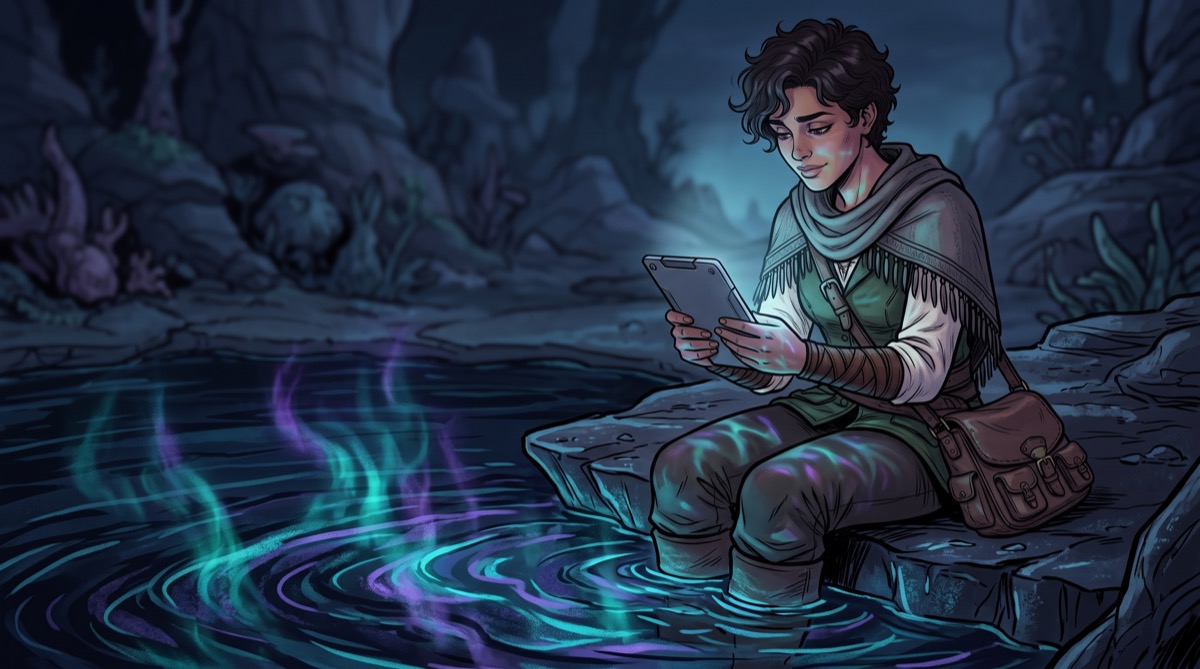
Divna read the draft at Viltvodle VI, in the transmission window Gargravarr's archive could spare between resonance cycles, three days after Colluphid sent it—not because she was slow, Hurkel guessed, but because she'd made herself wait, the way you wait to open something you suspect will require you to be a different person on the other side of it. She called at an hour that meant she'd finished it and not slept since. On the small screen, pool eight's after-dark glow lit her from below, so that for the length of the call Colluphid could not entirely tell whether the light in her face was the water or her.
She did not open with a review. She had never once, in two books, opened with a review.
"It's true," she said.
"I know."
"It's going to hurt people." She said it the way Voostra had said it, in the cafeteria, and Colluphid understood, hearing it a second time from a second person, that this was not a warning either of them expected to change his mind. It was a thing that needed saying aloud by someone who loved him, so that when it happened he could not tell himself no one had told him.
"I know that too."
"Write it anyway." She was quiet for a moment, the pools murmuring somewhere behind her, doing whatever it was they did to thoughts that came too close to them at night. "You've spent two books being right, Oolon. This is the first time you've been honest. I didn't think you had it in you to notice the difference." A pause that traveled the way a held breath travels across a comms delay too short to blame on distance. "I'm glad I was wrong about that. I'll tell you the rest of what I'm glad about when I'm standing in front of you. I haven't stopped meaning that."
Hurkel proofread the manuscript the way Hurkel did everything—apparently carelessly, at three in the morning, with the specific unearned competence of a man who had never once studied for an exam he subsequently aced. He found four misplaced commas, one continuity error involving the color of Voostra's coat, and, on page two hundred and eleven, something he brought to Colluphid's desk at an hour that suggested it could not wait for breakfast.
"You've used the word 'love' fourteen times," he said.
Colluphid looked up from a sentence he'd been failing to finish for twenty minutes. "That seems like an editorial note, not an emergency."
"It's not an editorial note. It's a fact I'm reporting." Hurkel dropped into the chair across the desk—not Divna's chair, his own, worn into a different shape entirely, the shape of a man who sat sideways in every seat he'd ever occupied. "Fourteen times, Colluphid. In a book about theological fraud and a bureaucrat's suicide note and a fish that shouldn't exist. I went back and checked the first book. You used it twice, and one of those was sarcastic."
"I'm sure it's a coincidence of subject matter."
"You wrote 'the love embedded in the design' on page forty. You wrote 'I built you the capacity to not need me' and then, two paragraphs later, wrote a whole sentence explaining that this was, structurally, the only kind of sentence love actually knows how to construct. You wrote about Divna's hand on your shoulder in the cafeteria doorway, which, incidentally, I did not know happened, and did not need described in that much sensory detail, and used the word love to describe it twice in one paragraph like you were worried the first one wouldn't survive."
Colluphid said nothing for a moment.
"I didn't notice," he said finally, and it was, he realized as he said it, entirely true, which frightened him slightly more than the count did.
"I know you didn't." Hurkel said it without cruelty, which was, for Hurkel, its own kind of tenderness. "That's why I'm telling you. A man who used the word on purpose fourteen times would be making an argument. A man who used it fourteen times without noticing has just told you what the book is actually about, whether or not he meant to publish that part."
"Should I cut them?"
"God, no." Hurkel stood, stretched, and headed for the door, pausing with his hand on the frame in the particular way he did when he had one more thing and wanted it to land after the exit had already begun. "Leave every one. It's the only part of the manuscript I'm certain you didn't write for an audience."
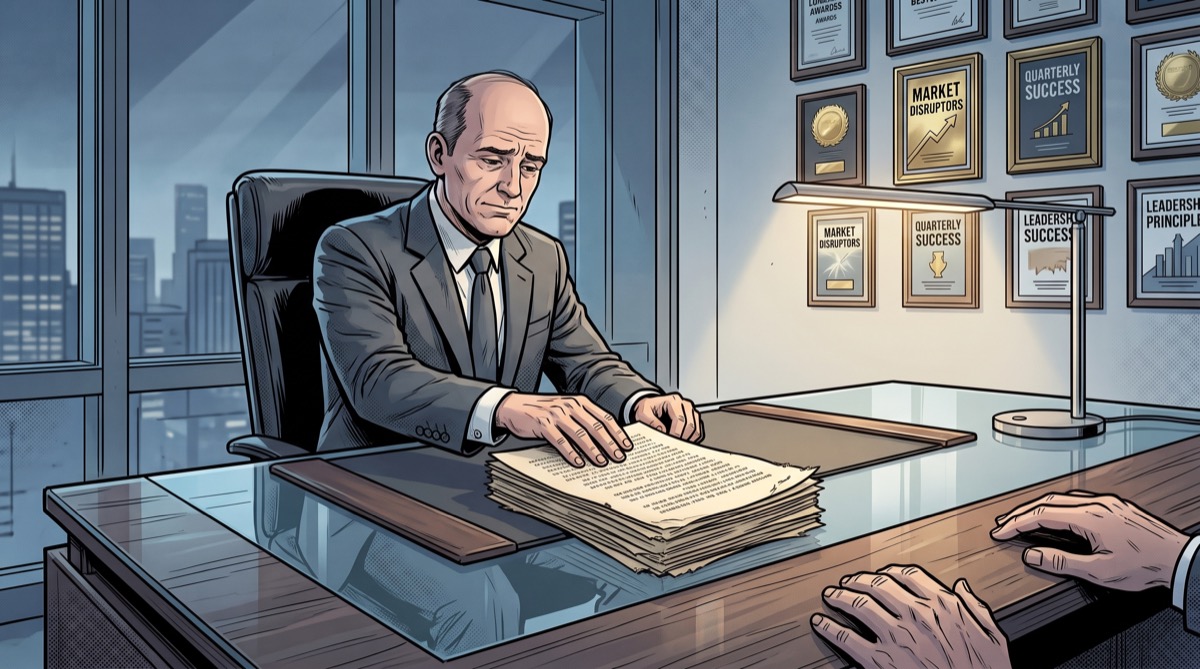
Zarniwoop Venvoo III read the finished draft in his office on Maximegalon, in a single sitting, which Colluphid understood from prior experience to be either a very good sign or a professional courtesy extended to authors whose contracts included escalating royalty clauses. He said nothing for the first four hundred pages. Colluphid, present in the room for reasons that had more to do with contractual obligation than any expectation of useful feedback, watched him read the way you watch weather approaching—no way to hurry it, no way to stop it, only the option of waiting to see which way it broke.
Zarniwoop finished. He set the pages down, squared nothing, because squaring things was not a habit Zarniwoop had ever needed to develop. He looked at Colluphid for a long moment across a desk considerably larger and considerably less scarred than the one at home.
"This isn't what I asked for," he said.
Colluphid had rehearsed several responses to this sentence over the preceding eleven days, ranging from apologetic to defiant, and found, now that the moment had arrived, that none of them fit his mouth. He said nothing, which turned out to be the correct choice, because Zarniwoop was not finished.
"I asked for Where God Went Wrong Again, But Louder." He picked the manuscript back up, weighed it in one hand like a man pricing cargo, and set it down with a gentleness that did not match his tone at all. "I asked for an indictment. A punchline with footnotes. Something with a cover I could put an explosion on." He was quiet for a beat that Colluphid, four months into knowing this man, recognized as entirely uncharacteristic. "This has no punchline. I read four hundred pages and the funniest thing in it is a line about a towel, and even that one made me feel something, which I resent, because feeling things is not in my job description and I have spent thirty years successfully avoiding it during business hours."
"Zarniwoop—"
"It's better." He said it flatly, the way he priced everything, as though the word had already been through cost analysis and come out the other side unable to be said any other way. "I don't know how to sell it. I don't know what the cover looks like. I am going to lose money on the marketing meeting alone, because nobody in that room is going to know what genre this is, and genre is the only thing marketing knows how to talk about." He pushed the manuscript back across the desk, toward Colluphid, in a gesture that was—Colluphid noted, filing it beside every other small unbudgeted honesty of the last eleven days—almost exactly the gesture Voostra had used, in a cafeteria, with a folder, four weeks and one confrontation ago. "But it's the best thing you've written, and I have made an extremely comfortable living knowing the difference between those two facts even when I'd prefer not to, and I am telling you, against every instinct that has ever made me money: publish this one exactly as it is."
He wrote the dedication alone, at night, at the same desk, with the same water ring and the same cracked leg, three days before the manuscript went to typesetting and became, irreversibly, a thing other people would read. He had drafted eleven versions across the previous two books and used none of them—had told himself, each time, that the book wasn't finished enough to earn a dedication, when the truer answer was that he hadn't been finished enough to write one honestly.
He did not draft this one eleven times. He wrote it once, looked at it the way he'd looked at the fish were planned a month earlier, and did not change a word.
For God, who went wrong in all the right ways.
He sat with it for a while in the particular quiet of a room where a decision has just finished being made. Somewhere behind him, on a shelf he did not turn to look at, the private journal—the one that wasn't for anyone, the one with four lines in it now, none of them shown to Divna or Hurkel or anyone else living—sat closed, exactly where he'd left it, saying nothing, the way it had said nothing since the night he'd added the fourth line and shut it without checking what he'd written.
He left it closed. This book, the public one, the one about to belong to several billion strangers, had taken everything honest he had to give it tonight. The other book—the true one, the one only he would ever read—could wait. It always had.
He turned off the desk lamp. In the dark, the manuscript sat where he'd set it down after carrying it home, four hundred and eleven pages, its title unchanged from the one he'd typed the night he decided to write it at all, a publication date already circled on a calendar in an office on Maximegalon in ink Zarniwoop had not asked him to approve.
Somewhere in a licensing office in the Conditions of the Conditions of the Conditions, a form was quietly filed under a heading that translated, roughly, as Books Requiring Advance Notification, and stamped, and forwarded, and read by exactly one person, who did not smile, because smiling was not something the form accounted for, but who read the working title twice before passing it along.