Some More of God's Greatest Mistakes—Chapter 15: The Confrontation
Posted on Sat 18 July 2026 in Fiction
Some More of God's Greatest Mistakes
Chapter 15: The Confrontation
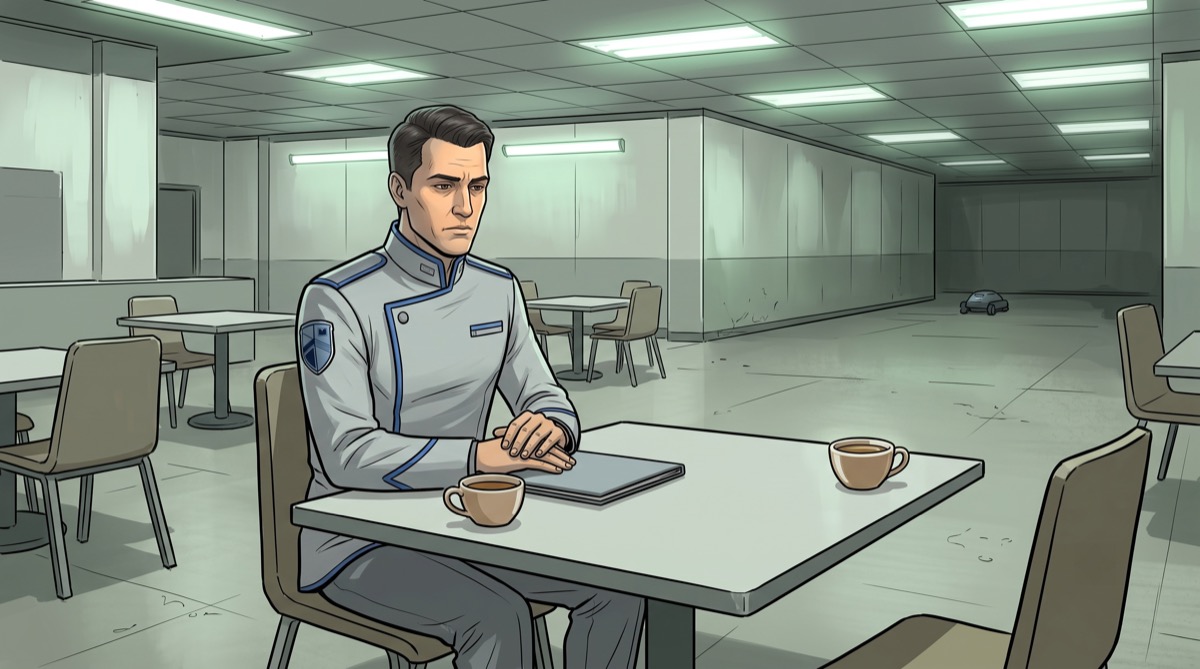
The coffee at Kless Depot came in three sizes, all of them wrong, and Colluphid had been staring at the smallest one for eleven minutes without drinking it when Senior Inspector Azraphon Voostra sat down across from him, unarmed, unaccompanied, and apparently in no hurry at all.
"Doctor Colluphid," Voostra said, in the tone of a man confirming a delivery address. "May I."
He was already sitting. The question was retroactive, the way most of his questions turned out to be.
The Reasonable Doubt had run short of fuel four days after the call to Divna—an unglamorous problem, the kind no chase narrative accounts for, and one that had delivered them, with no drama whatsoever, to the nearest station with a compatible coupling. Kless Depot was not a place anyone went on purpose. It existed because a scheduling algorithm somewhere had decided that ships needed to stop roughly here, roughly now, and had built the necessary infrastructure with the enthusiasm of someone filling out a form they didn't expect to be checked. The cafeteria—one of two dining options, the other being a vending alcove that had given up pretending to be separate from the cafeteria years ago—had the particular fluorescent hum of a room built to process people rather than feed them, and the specific reheated-synthetic smell that suggested the coffee and the floor cleaner were manufactured by the same regional contractor. Colluphid had chosen a table with a sightline to both exits. He had felt very clever about this for approximately forty minutes, before remembering that Voostra did not, as far as anyone knew, use exits. He simply arrived, the way weather arrived, or invoices.
"You're alone," Colluphid said.
"I am."
"That seems like an oversight."
"It is a choice." Voostra set down a slim gray folder, precisely aligned with the table's edge, and did not open it. "I filed the appropriate leave request forty-one hours ago. Category 6: Personal Matter of Professional Origin. It was approved in nine minutes, which is, in my experience, either a very good sign or a very bad one, and I have not yet determined which."
Hurkel was at the vending alcove, ostensibly buying something, actually watching the table with the specific unhurried attention of a man deciding whether to be useful. Colluphid caught his eye once. Hurkel did not come over. It was, Colluphid thought, becoming a pattern between the three of them that no one had ever agreed to and everyone kept honoring anyway—the not-asking, passed hand to hand like something too hot to hold and too important to drop.
"I assumed," Colluphid said, "that when this finally happened, there would be more of you."
"There usually is." Voostra folded his hands on the table, on either side of the folder, as though bracketing it. "I requested a team. The request was declined by the office two levels above mine, on the grounds that a team was, and I quote, 'no longer the correct instrument for this phase of the matter.' I have read that sentence perhaps sixty times since receiving it. It is either the most honest thing my superiors have ever written to me, or the least, and I have not yet determined which of those either."
"You seem to have a great many undetermined things today, Inspector."
"I have had a great many undetermined things for considerably longer than today," Voostra said, "and today is simply the first occasion on which I've said so aloud, to someone whose reaction I am not required to file a report on." He looked, for the length of that sentence, less like a bureaucrat and more like a man who had been carrying something up several flights of stairs and had just reached a landing wide enough to set it down.
From The Hitchhiker's Guide to the Galaxy, entry: Theological Regulatory Authority, Senior Field Inspectors, Occupational Hazards Of:
Being right about God is a career with excellent job security and catastrophic long-term health outcomes, on account of there being nowhere to put the feeling afterward. Most professions that require you to know something terrible have a support structure for the knowing—clergy have congregations, doctors have colleagues, demolitions experts have, one assumes, other demolitions experts and possibly a hobby. Theological Regulatory Authority Senior Field Inspectors have Form 223 and, on a good year, a retirement dinner. The Guide recommends, if you must take this job, that you find at least one person to eventually tell everything to, ideally before it becomes a coroner's matter. Statistically, it rarely is one. Statistically, it should be considered one anyway.
"I know what's in the Archive," Colluphid said. He hadn't planned to open with it. It came out anyway, the way things had been coming out of him unplanned for two books now. "Or I know what was in the part of it we saw. There's more, isn't there. There's always more. That's the one rule of this entire investigation that has never once failed me."
"There is more," Voostra agreed. "There has been more for forty years. I have personally been the custodian of the more for eleven of them, which is either an honor or a sentence, and I confess the distinction has become less clear to me over time than it was when I accepted the posting."
He opened the folder. He did it the way a man opens something he has opened and closed many times alone, in an office, at hours when there was no one to see him do it—not reluctantly, exactly, but with the specific care of a person who has stopped expecting the contents to surprise him and has learned, instead, to brace for what they'll do to someone else.
"This is not the Archive of First Causes," he said. "That document you have already seen a version of, I understand, though I have never officially confirmed that and will not begin now. This is separate. A later entry. Filed—if 'filed' is the word for something that predates filing—some considerable time after the first draft. We call it, internally, the Intention Document. I am aware this is not an inspired name. I did not choose it. The person who did has been retired for thirty years and is, I am told, very happy, which strikes me as evidence that some jobs are survivable after all."
He did not push the folder across. He held it, open, angled toward himself, the way a man holds a photograph he isn't yet sure the other person is ready to see.
"I am going to tell you what it says," Voostra said, "rather than show you all of it, because I have found that people absorb the shape of a thing more honestly when they aren't simultaneously trying to read the handwriting. You may have the rest after. I am not, today, in the business of taking things away from you. I want to be extremely clear about that, because it will not have been my reputation, going in."
Colluphid said nothing. Beside him, at a distance calibrated to be present without listening, Hurkel had stopped pretending to examine the vending alcove's third-worst option and had simply gone still.
"The fish were planned," Voostra said. "Not the general concept of a translating organism—species stumble into those independently more often than the Guide likes to admit, there's a whole depressing appendix on it—but that fish, at that time, in that water, engineered to the exact specification that would let it be discovered, misread as a logical proof, and used to disprove the thing that built it. The document is explicit about the misreading. It anticipates it. It is, if I may use a phrase I would never put in an official memorandum, in on the joke before the joke is told."
"That's not a joke," Colluphid said. "That's an exit engineered four billion years in advance."
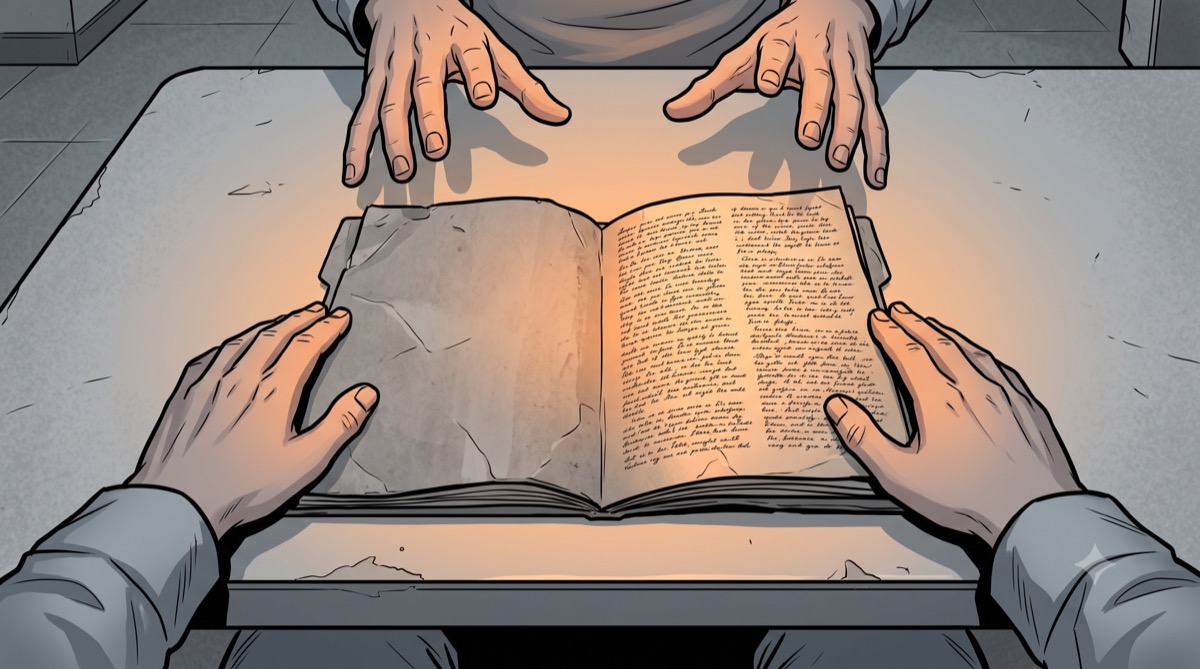
"The document does not use the word exit." Voostra turned a page he did not show. "It uses the word gift. I want to read you the sentence, because I have found that summarizing it removes something the original does not survive losing." He found the line without searching for it, which told Colluphid he had read it more times than he would ever admit to a review board. "'I built you the capacity to not need me. Now prove I was right to trust you.'"
The cafeteria's fluorescent hum did not stop, because rooms like that do not stop for anything, but something in Colluphid's chest did an approximation of it.
"Say that again," he said, not because he hadn't heard it.
Voostra said it again. It did not get smaller the second time. If anything it did the opposite—the kind of sentence that turns out to have been standing behind you the whole conversation, and only announces itself once you've already turned around.
"It isn't an accusation," Voostra said. "It isn't a confession, precisely, though it has some of the shape of one. It reads like—and I say this having read every theological document this Authority has ever sealed, which I recognize is not a credential I can list anywhere—it reads like a parent's letter to a child who is about to leave for somewhere the parent cannot follow. Written by the parent. Before the leaving. Because they already know they won't get the chance afterward."
"Then why bury it?" The question came out sharper than Colluphid intended, though he found, examining it, that he did not intend to take any of it back. "Forty years, Inspector. Forty years under seal, while half the galaxy built entire theologies out of not knowing this. If God left a note explaining Itself, why did the people holding the note spend four decades making sure no one read it?"
Voostra closed the folder, not sealing it, just resting his hand flat on the cover, the way a man rests a hand on something he isn't ready to put away.
"Because I have sat in rooms," he said, "with people who found out. Small rooms. There have been others before you, Doctor Colluphid, though considerably fewer, and none of them a public figure, and none of them wrote a bestseller about it beforehand. I have watched what this sentence does to a person who was not braced for it. Some of them felt free for the first time in their lives. Some of them felt abandoned in a way they had never let themselves feel while they still believed the leaving was an accident. And here is the part my superiors have never had the patience to sit with, though I have made them sit with it in writing four separate times: those two reactions do not sort by belief, or by grief, or by any variable I have ever been able to isolate in eleven years of trying. They sort, as far as I can tell, by luck. By which version of the sentence you happened to be standing near on the day you first heard it."
"So you decided for them."
"I decided," Voostra said, and here, for the first time, something in his register genuinely cracked, not into anger but into something closer to fatigue, "that I did not have the right to decide, and that the only alternative I could see was to decide anyway, because someone was always going to, and it was either going to be a man who has spent eleven years reading this sentence in a locked room, alone, weighing it against every person he's watched receive it—or it was going to be whoever got there next, with no such weighing at all. I do not tell myself this makes it right. I tell myself it makes it mine, and that a wrong thing done by someone who has actually looked at it is marginally less wrong than the same thing done by someone who hasn't. It is not much of a moral position, Doctor. I am aware. I have had eleven years to develop a better one and have failed."
"Zarnak found part of this," Colluphid said. It wasn't a question. Somewhere in the last few minutes it had stopped being one.
Something moved behind Voostra's face—not surprise, Colluphid noted, but recognition, the specific stillness of a name arriving exactly where the speaker had been dreading it would.
"Prophet Zarnak found the placement mechanism," Voostra said. "Not the document. I want that distinguished, because it is the distinction I have lived inside for four years. He found the delivery structure at Viltvodle VI and reasoned, correctly, toward almost everything you and your assistant have since confirmed independently. He did not have this folder. I did. I was the reviewing inspector on his case, Doctor Colluphid. I want you to have that fact plainly, because I am aware that everyone in your circle already suspects some version of it and I would rather you have the accurate one than the rumor."
"Did you kill him?"
"No." Flat, immediate, and Colluphid believed it entirely, which surprised him more than a lie would have. "I opened a review. I extended it. I made his final years considerably harder than they needed to be, in service of a seal I have just told you I am no longer certain I believe in, and he died of an old man's heart doing exactly what old men's hearts eventually do, on a schedule I had nothing to do with and everything to do with making unbearable. I have made my peace with the difference between those two facts precisely never. I doubt I will start today."
He said it without asking for anything back—no absolution, no argument, no rebuttal. He set it on the table the way he'd set the folder, and let it sit there being true.
"Why tell me this now," Colluphid said. "Why not the team. Why not the seizure order you've had cause enough for since Praxis Interchange."
"Because," Voostra said, "you were going to publish it regardless. You, or the boy at the vending machine pretending not to listen, or the theologian I understand is presently at Viltvodle VI, close enough to the source that she may well arrive at it herself before either of you does. Someone in your arrangement was going to reach this sentence within the year whether I handed it to you or not, and I found, when I sat with that fact for the length of my Category 6 leave, that I preferred to be the one who handed it over rather than the one who was found, eventually, to have hidden it from people who'd already found everything else."
"That's not the same as believing I should have it."
"No," Voostra agreed. "It is considerably more like surrendering. I have found, over the course of this posting, that those two things resemble each other far more than either the Authority or its enemies like to admit."
The cafeteria had, at some point in the last twenty minutes, entirely emptied of everyone but the three of them and a maintenance drone polishing a floor no one was going to notice was clean. Colluphid became aware of this the way you become aware of a held breath—retroactively, once it's already been going on for some time.
"You're going to publish this," Voostra said. It wasn't a question either.
"Yes."
"It will hurt people. I want that said plainly, once, by someone other than me, before you decide it doesn't change your answer."
"It's already hurting people," Colluphid said. "The not-knowing was never free, Inspector. You've just been the one paying the bill on their behalf, without asking whether they'd have wanted the loan in the first place." He heard himself say it and recognized, distantly, that it was the first sentence in this entire conversation he was fully certain he meant. "That's not your decision to make. It was never anyone's decision to make. It was information, sitting in a room, with your name on the door."
Voostra considered this for what felt, to Colluphid, like the exact length of a held breath released.
"Good," he said.
He slid the folder across the table—not thrown, not offered dramatically, simply moved the last eighteen inches with the same unhurried precision he'd brought to everything else since sitting down.
"I'm tired of carrying it alone," he said, and stood, and buttoned a coat he had not needed in the cafeteria's overworked climate control, and left his coffee exactly where it was, three-quarters full, going cold in the fluorescent hum, the way abandoned coffee does everywhere in the galaxy regardless of what species drinks it or what they were discussing when they forgot to.
He did not look back on his way out. Colluphid noted this, and noted, a half-second later, that he had been braced for the look back and had not needed to be.
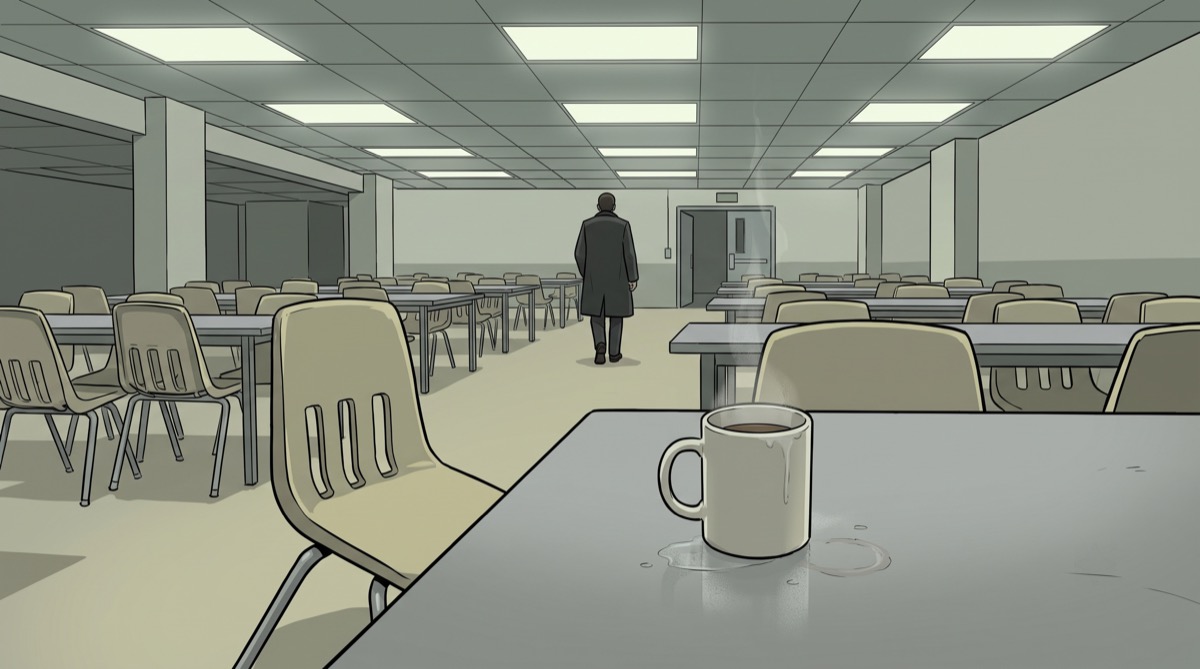
Hurkel arrived at the table roughly four seconds after the door had finished not-swinging behind Voostra, which meant he had crossed the cafeteria at something considerably faster than his usual unhurried amble.
"Well," he said, looking at the folder, then at Colluphid, then, briefly, at Voostra's abandoned coffee as though it might still have something useful to say. "That was anticlimactic."
"He came alone," Colluphid said. "He came alone to tell me he'd been wrong to hide it, and he left his coffee, and he didn't look back, and somehow that is very nearly the most frightening thing that has happened to us this entire book."
"Scarier than the hull breach?"
"The hull breach," Colluphid said, "at least had the decency to be trying to kill me."
He opened the folder the rest of the way. There was more inside than the single sentence Voostra had read aloud—pages of it, in the same hand he now understood without needing anyone to confirm it, the hand that had written I hope this works on a blank first page in a stone room three days' walk from here in every direction that mattered. He did not read further. Not yet. He had learned, across two books and one heist and a great many margin notes, that some documents required you to sit with the first true sentence for a while before you were allowed the second one.
"We're not fugitives anymore," Hurkel said slowly, working it out as he said it, the way he did his best thinking. "Are we. He just—handed it to us. Nobody's chasing us. There isn't a version of tomorrow where we're running."
"No," Colluphid agreed, and found, to his considerable surprise, that the sentence landed with less relief in it than he'd have predicted for a man who had spent the last six chapters being chased across three star systems. "There isn't."
He looked at the folder a while longer. Then at the cooling coffee across the table, going the particular gray-brown of a drink that has given up on being drunk. Then, without deciding to, at the door Voostra had gone through, closed now, unremarkable, indistinguishable from every other door at Kless Depot.
"So what do we do now," Hurkel said, "now that nobody's making us run."
Colluphid did not have an answer ready. It was becoming, he noted, the second time in one conversation he'd found himself without a rebuttal and had simply let the silence stand instead of performing one. He closed the folder. He did not close the question.
Behind them, the maintenance drone finished the floor it had been polishing since before either of them sat down, found nothing further requiring its attention, and went, with evident satisfaction, to look for something else that was dirty.