Some More of God's Greatest Mistakes—Chapter 14: The Mirror
Posted on Wed 15 July 2026 in Fiction
Some More of God's Greatest Mistakes
Chapter 14: The Mirror
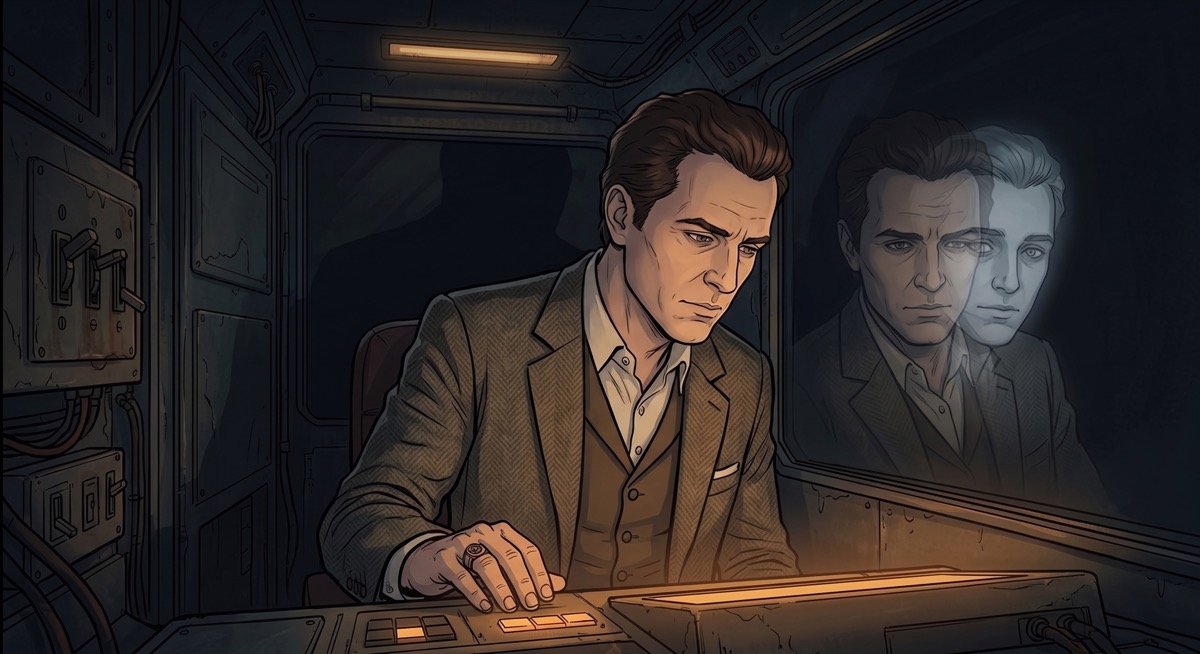
"Where are you," Colluphid said, before hello, before he had entirely decided to place the call.
It was 03:40 ship time, the specific dead hour that survey vessels seemed to manufacture on purpose out of nothing but engine hum and bad lighting, and he was sitting in the same comms booth Hurkel had occupied six hours earlier, close enough that the air still held a trace of him—engine coolant, and under that, the particular mineral dust that had worked its way into every surface of the Reasonable Doubt despite decades having passed since anyone had shipped an actual mineral through it. He had told himself he was checking a citation. He had, in fact, been staring at the same three words in his manuscript for forty minutes—and yet, still—without managing a fourth, when his hand had done something his brain had not signed off on and opened the connection.
He had spent the hour before that failing to write a sentence, and the two hours before that watching Hurkel walk a ship corridor in slow, deliberate circles until he'd arrived, apparently, at the entire rest of his life. Colluphid had picked up the pages Hurkel left sliding off the table, weighted them under a cold mug, and gone back to his own three words feeling something he did not have a clean name for—not envy exactly, though it was standing close enough to envy to borrow its coat. Hurkel had walked a corridor and come out the other side certain of something. Colluphid had circled the same handful of questions for two books, four systems, and one hull breach, and come out the other side only with a towel he couldn't explain and a manuscript that stalled at and yet, still.
There was a pause on the line long enough that he assumed the routing had failed, the way it periodically did on channels this far from anywhere. Then Divna's voice arrived, unhurried, faintly amused, entirely awake.
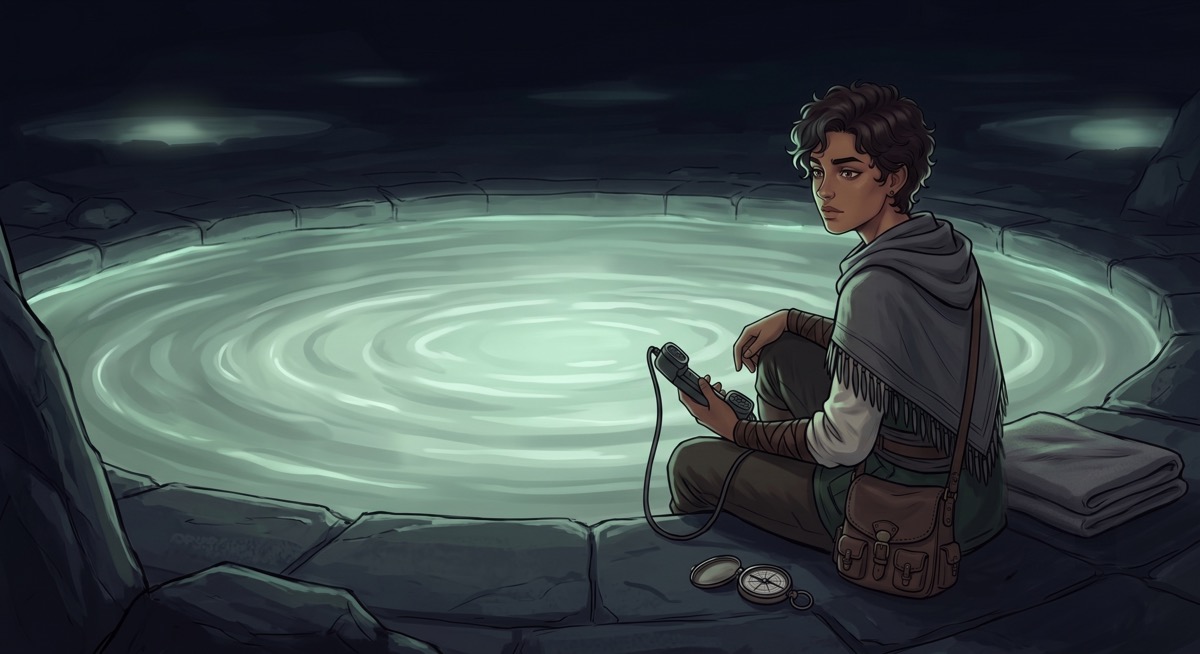
"Viltvodle VI," she said. "Pool eight, specifically. Or close enough to it that Gargravarr keeps asking whether I want a blanket."
He sat back. Something in his chest did an undignified thing it had not asked permission for. "You went."
"I went four days ago. I was going to tell you when there was something worth telling."
"And is there?"
"There's a very old man who makes excellent tea and worse jokes, and a body of water that hums in a key I don't have a name for, and no—before you ask—I haven't found anything your book doesn't already have. I came to look. Not to add a chapter." A beat, the pause of someone deciding whether to say the rest. "I came because I couldn't stand not knowing what you'd been standing next to."
He didn't have anything ready for that, which was becoming, he noted with the part of his mind that never entirely stopped noting things, an alarming pattern in her company.
She told him what the pool sounded like at night—not the low daytime resonance the equipment had measured and Hurkel had photographed from every angle, but something that only surfaced after dark, once the wind dropped and the water's private frequency stopped competing with anything else for attention. A hum so far under hearing that she'd stopped noticing she was hearing it and started noticing, instead, that her thoughts had gone oddly legible: sentences arriving already finished, instead of half-built the way they usually were by the time she got to them.
Gargravarr had warned her about this on the first night. He'd called it the pools showing their work, and told her, with the specific gravity of a man delivering the one piece of advice he actually meant, not to say anything into a comm line she wasn't prepared to have meant.
She was telling Colluphid this, she said, because she had already decided not to heed it, and wanted him to know in advance that whatever she said next could be filed under the water's fault, if either of them needed somewhere to file it.
The stylus he'd been turning between two fingers had gone still without his permission, same as everything else tonight. "All right."
"I stood at the edge today and thought about Zarnak. He stood at that same edge twenty-two years ago and found the thing at the bottom of it, and told exactly one person, and the one person he told wasn't me." Her voice didn't shift register so much as thin, the way a very controlled thing thins under sustained pressure instead of snapping outright. "Thirty years he taught me. Thirty years, and the last thing he ever discovered turned out to be the one thing I didn't get to have."
"He was protecting you."
"I know he was protecting me. I've known that for four days, sitting with it at the edge of the exact pool he stood at, and it hasn't once made it feel like anything other than being left out of the will." A short, unlovely laugh—the kind that isn't about anything funny. "Which is a strange thing to feel about your own teacher's death. I didn't expect it. I don't love it."
Colluphid, four systems and one hull breach removed from anything resembling professional composure, said: "My father did the same thing." He hadn't meant to bring it up twice in one investigation. It was becoming, apparently, the sentence he reached for when he ran out of better ones. "Left. No explanation. I used to think the not-explaining was the whole crime. I'm starting to wonder if it was the kinder part—if the explanation would have been so much worse than the silence that he did the arithmetic and picked the smaller cruelty."
"Or he didn't think about it that hard and simply left," Divna said, "and we're the ones doing all this generous arithmetic on his behalf, because the alternative is believing he genuinely didn't think we were owed one."
The silence that followed had a different shape than the silences they were used to producing together.
He heard her shift—cloth against stone, the small sound of someone sitting down properly instead of standing at the edge of something. "Gargravarr says the second gallery of his private archive has a whole shelf on grief and none on gratitude, and when I asked him why, he said gratitude doesn't generate paperwork the way grief does. I've been turning that over for four days. I think he meant it as a joke. I don't think it was one."
"Everything that man says turns out to be load-bearing eventually."
"He'd like you. He already likes Hurkel enormously, on the strength of one dive report." A faint smile made it through the connection somehow, the way certain things did over distance and static that had no business surviving the trip. "He asked if you were the funny one or the sad one. I told him you were usually both in the same sentence, and he said that explained the books."
"I watched Hurkel decide something today," Colluphid said, mostly to redirect the pressure building behind his sternum. "The TRA offered him his whole life back, cleanly, in writing, and he turned it down without telling me first, and when I finally asked him why, he gave me an answer I still don't have a rebuttal for. It took him one afternoon. One walk down a corridor. I've been circling the same question for two books and I don't have a fraction of his clarity."
"What's the question."
He should have expected her to ask it directly; she always did, and he was never braced for it, four books' worth of practice notwithstanding. "What I actually think I'm doing. Whether I'm still writing an argument, or whether I stopped being able to tell the difference between an argument and a—" He stopped.
"A letter," Divna said quietly. Not a correction. More like someone finishing a sentence they'd already been holding for her own reasons.
"I was going to say appeal."
"Same shape. Different furniture."
He almost laughed—the real kind, the kind that arrives before you've had time to arrange your face around it. "You do that. You take the thing I've spent an entire paragraph avoiding and hand it back to me in four words."
"It's a skill I developed defending a position I'm not always certain I still hold," she said. "You argue with God because you can't admit you want God to answer. I defend God because I can't admit I want God to explain. I've been doing that arithmetic for four days at the edge of a pool that apparently reads minds, and that's what it came out to. We're not opposites, Oolon. We're the same sentence with the subject changed."
He turned the stylus over once more and set it down. "That's what I was going to say. About the sentence."
"I know. That's rather the point of a mirror. It says your line back to you half a second before you've finished thinking it."
Neither of them said anything for a while. On his end, the Reasonable Doubt's hum filled it—engines, recyclers, the small mechanical breathing of an old survey ship keeping itself alive three days from anywhere. On hers, he could hear water, faint and low, the pool doing whatever it did to the air around it, and under that, footsteps, unhurried, that might have been Gargravarr arriving with the blanket she hadn't asked for and would almost certainly accept anyway.
Through the booth's small viewport, Colluphid saw Hurkel pass in the corridor outside, on some errand of his own at an hour that suggested neither of them had found much use for their bunks tonight. Hurkel glanced in, took in whatever was visible of Colluphid's face through the glass, and—for once, mercifully—did not slow down to ask about it. It was, Colluphid thought, a fair exchange for the question he hadn't asked in the same corridor six hours earlier.
"There's a version of this conversation," Divna said eventually, "where I say the rest of it."
"I know which version."
"I'm not going to say it over a comm link, four systems away, with an audience of one extremely nosy Jatravartid pretending not to be listening."
"That's not a no."
"It's not a comm-link yes, either." A pause with weight in it rather than emptiness. "Ask me again when you're standing in front of me and not running from a Theological Impact Assessment."
"That could be a while."
"I've read your first two books, Oolon. I have time."
It was, he thought, the single most devastating sentence anyone had said to him in either volume, and she had delivered it the way she delivered everything—warmly, precisely, as though it cost her nothing at all, which he was reasonably certain, by now, was the tell rather than the truth.
They sat in it a while longer, the two of them, four systems apart, saying nothing, in a silence considerably more articulate than the six hours they'd once spent working through God's motives from a freight carrier's forward observation deck. Colluphid did not want to be the one to end it. Divna, eventually, was.
"Get some sleep, Oolon."
"You too."
"I'm standing next to a pool that thinks for me. I'll manage." A last pause, softer than the rest. "Goodnight."
The connection closed with its small, ordinary click—the least dramatic sound in the galaxy for the amount of silence it left behind it.
He did not go back to the manuscript. He opened, instead, the other document: the one with three lines in it, the one no one else had ever read, the one that had started on a night eleven months ago he still hadn't fully accounted for even to himself. He read the three lines once, the way he always did before adding a fourth, and then he typed:
She thinks we are the same sentence with the subject changed. I think she's right, and I no longer know which of us is the original and which of us is the reflection.
He looked at it for a while. He did not read it back a second time. He closed the document the way you close a door you fully intend to open again, and sat in the booth a while longer, listening to a ship three days from anywhere hum quietly to itself in the dark, and did not, for once, reach for a rebuttal.
Somewhere on Viltvodle VI, an old man brought a blanket to a woman who hadn't asked for one, and didn't ask what she'd been saying into the dark—some questions, he had learned across several centuries, answer themselves eventually, if you only wait.