Some More of God's Greatest Mistakes—Chapter 13: Hurkel's Choice
Posted on Sat 11 July 2026 in Fiction
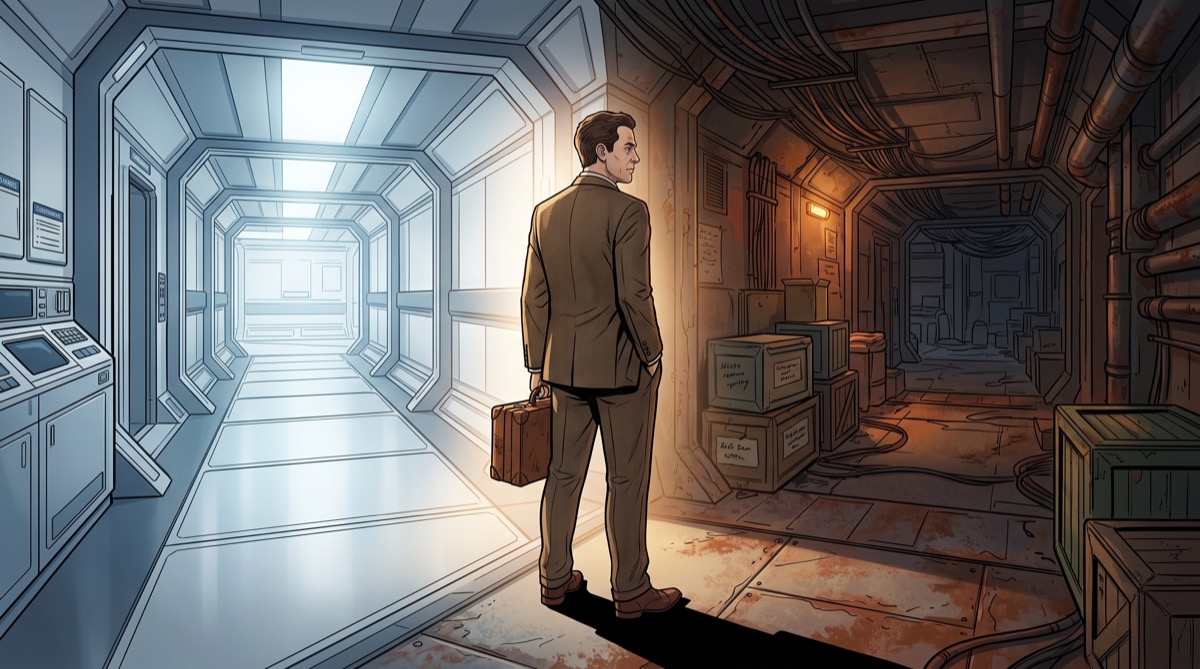
Some More of God's Greatest Mistakes
Chapter 13: Hurkel's Choice
The message arrived at 04:12 ship time, addressed to RANSEN, H., Doctoral Candidate (Suspended), Department of Conditions of the Conditions, Maximegalon University, and it did not arrive through any of the channels Hurkel had spent the last several weeks learning to distrust.
It came through the university.
That was the detail that kept him sitting upright in his bunk for a full minute after he'd read it, the Reasonable Doubt's low engine hum vibrating up through the mattress in the particular frequency that meant they were still three days from anywhere. Every other message that had found them — the anonymous tip at Ressen Approach, the seizure orders, the seven-second silence before a klaxon went off on Praxis Interchange — had come at them sideways, routed and rerouted and bounced through relays four thousand years old. This one had simply walked in the front door, because the front door had never been locked. He was still, technically, a student. Suspended, not expelled. The Theological Regulatory Authority did not need to hunt him down. They could just ask his dissertation committee to forward something.
He read it twice before he let himself think about what it said.
It was seven pages, which for a TRA document was practically a postcard, and it was written in a register Hurkel hadn't seen from them before — not the bristling multi-clause hostility of Voostra's seizure orders, but something almost gentle. Reasonable. It offered, in exchange for the return of all physical and recorded material pertaining to the Viltvodle VI excavation and a signed statement characterizing his involvement as "academically motivated fieldwork conducted without full awareness of its theological sensitivity," the following: reinstatement of his doctoral candidacy in good standing, expedited review of his dissertation with the suspension period struck from the record, and — this was the part that made him put the page down and stare at the bulkhead for a while — a formal notation that no further action would be taken regarding "administrative reassignment."
He knew that phrase. He'd looked it up himself, weeks ago, in a different life: four of eleven yellow-classification researchers over the last twenty years, administratively reassigned, no further record, no forwarding address. He'd told Colluphid about it once, in passing, as a statistic. He hadn't told him what it had done to his stomach to find it.
The offer wasn't a threat. That was what made it good. A threat he could have refused on principle, the way you refuse a dare — quickly, loudly, for an audience. This wasn't that. This was someone offering him his life back exactly as it had been before he'd walked into Colluphid's apartment eight months ago and found four whiteboards and a kettle that never got used for tea. Clean record. Finished degree. A future that made sense on paper, filed correctly, in triplicate, signed and dated and done.
All he had to do was hand over a data unit the size of a deck of cards and stop being the person who'd carried it.
He didn't answer it. He put the tablet face-down on the shelf bolted to the bunk wall — a habit from six systems' worth of fieldwork postings, where you learned fast that a screen left face-up was a screen someone else could read over your shoulder, even when there was no one else in the room — and got up, and got dressed, and went for a walk, because the Reasonable Doubt was two hundred and eleven meters of decommissioned survey vessel and Hurkel had learned, in the last three weeks, that some thoughts needed more corridor than a bunk could give them.
The ship had belonged, in a previous administrative life, to a geological survey consortium that had lost its funding somewhere around the third moon of its second-to-last contract, and Hurkel's fieldwork contacts — the same network that had rerouted the samples off Stremm Hub, the network he'd built during a first-year rotation Colluphid still thought of as an unexplained gap in his CV — had gotten it for them at a rate that involved not asking what year its transponder credentials had last been legitimately renewed. It had a cargo hold built for core samples, a galley that smelled permanently of whatever the last crew had been surveying, and corridors long enough that a man could walk the length of the ship, turn around, and walk it again, and again, without ever quite arriving at a decision, which was, Hurkel reflected, either a design flaw or the exact feature he needed right now.
He passed Colluphid twice.
The first time, Colluphid was in the galley, hunched over a mug of something that had started as tea and given up somewhere along the way, three pages of manuscript spread in front of him and a expression on his face that Hurkel recognized as the specific, focused misery of a man trying to write something true. Colluphid glanced up, said "There's more water if you want it," and went back to the page without waiting for an answer, which was either politeness or obliviousness, and with Colluphid it was frequently both at once. Hurkel kept walking.
The second time, forty minutes later, Colluphid was asleep sitting up, chin on his chest, the manuscript pages having slid halfway to the floor. Hurkel picked them up without reading them — an act of restraint that cost him something, because Colluphid's handwritten marginal notes were usually the best part — and set them back on the table, weighted under the mug, and kept walking.
He thought about Essa.
He hadn't meant to. He'd meant to think about the offer, weigh it properly, the way you were supposed to weigh things — costs here, benefits there, a ledger, the kind of clean accounting his dissertation advisor had spent three years trying to get him to apply to his own research instead of just his citations. But somewhere around his fourth or fifth pass down the aft corridor, past the cargo hold hatch with its faded stenciling for a mineral survey team that no longer existed, his mind had gone sideways to a garden on Allosimanius Syneca — a rough circle of turned earth, thirty meters across, stone-bordered, and a woman who had been tending it for forty years and did not require the thing that made it grow to have a name.
I might come back, he'd told her, at the door, two hours after he'd stopped taking notes. He'd meant it in the vague way people mean things they intend to get around to eventually, the way you mean to write back to old friends. He hadn't gotten around to it. He'd been busy discovering that the universe had a library card system running underneath the argument he and Colluphid had spent two books dismantling.
What he thought, walking the Reasonable Doubt's corridor for the sixth time, was not really about the TRA's offer at all. It was: Essa never once asked me for proof of anything, and I have spent my entire adult life demanding it, and she has more of whatever this is than I do, and I don't even know what to call it, and I would like to know what to call it before I decide whether it's worth going back to a life where nobody asks.
His dissertation — three years in, half-finished, working title Recursive Bureaucratic Structures as Theological Metaphor: A Provisional Taxonomy — sat somewhere on a server at Maximegalon, waiting for a bibliography revision he'd never submitted. He tried, honestly tried, to feel something about it. What he felt instead was the specific, quiet vertigo of realizing a thing you'd spent three years building had stopped being the thing you actually cared about sometime in the last eight months, without telling you.
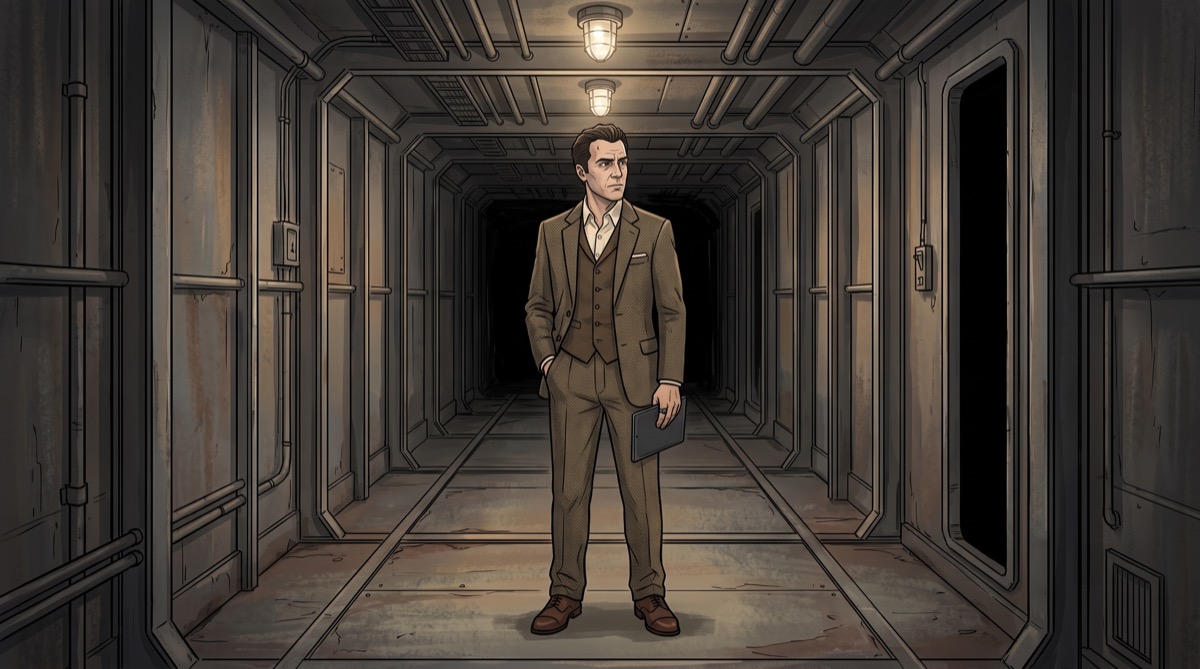
He stopped walking. He was standing, he realized, exactly halfway down the aft corridor — equidistant, near enough, between the cargo hold behind him and the forward berths ahead, where the tablet with the TRA's very reasonable offer was still lying face-down on a shelf, patiently not being answered.
He thought about the word reasonable. It kept appearing in the document, threaded through every clause like a seam: a reasonable resolution, a reasonable accommodation, a reasonable path forward for a promising young scholar who had, through understandable academic enthusiasm, become entangled in matters above his proper scope. Reasonable. He turned the word over. It was, he decided, the loneliest word in the whole document, because it assumed the thing being weighed against his degree and his record and his forwarding address was unreasonable — an indulgence, a phase, a fieldwork rotation he'd get tired of eventually, the way you got tired of any hobby.
He did not feel unreasonable. He felt, for the first time in three years of academic life, entirely sane.
He walked back to his bunk without having decided anything he could have put into words, which was, he was beginning to suspect, how most of the decisions that actually mattered got made — not as conclusions arrived at, but as things you discovered you'd already done, the way you discover you've already forgiven someone by noticing you're not angry anymore.
He picked up the tablet. He read the offer a third time, all the way through, more slowly, giving every clause its due — because it deserved that much, because whoever had drafted it had clearly meant it kindly, and because refusing something without understanding it properly was a discipline problem he'd promised his advisor he'd work on. Then he opened the reply field, typed nothing into it, and deleted the message instead. No statement. No counteroffer. No performance of moral clarity for an audience that wasn't watching. He deleted it the way you delete a meeting invitation for a meeting you already know you're not attending, and then he put the tablet down, and went to find something to eat, because it turned out that refusing your entire future back was, among other things, hungry work.
He was two bites into a ration bar that tasted primarily of the packaging when Colluphid found him in the galley.
"You've been walking for two hours," Colluphid said. He'd woken up at some point, found his manuscript pages weighted under a cold mug, and drawn, apparently, no particular conclusions from either fact. "I assumed you were either thinking or dying. I decided not to interrupt either process."
"Thinking."
"About?"
Hurkel considered several answers, in ascending order of honesty. He gave the fourth one.
"The TRA offered me a way out." He said it plainly, the way you report weather. "Clean record. Finished degree. All I had to do was hand over the unit and say I didn't know what I was doing."
Colluphid went very still in the specific way he went still when something had landed somewhere he hadn't braced for. "When?"
"This morning. Ship channel. Through the university, not through us — they didn't need to find me, I was already findable."
"And you said—"
"I deleted it."
Colluphid set down his mug. He had the look of a man doing careful arithmetic he did not want to get wrong. "Hurkel. That's your degree. Three years. You could have walked away with everything intact and no one would have—"
"I know what I could've walked away with." Hurkel said it without heat, which was somehow worse than heat would have been, because it meant he'd already had this argument with himself and won it before Colluphid got the chance to have it with him. "I've had a very reasonable morning, Oolon. I'd like to not have another one."
"Why," Colluphid said — not the sharp, cornering why of an interrogation, but the smaller, genuinely bewildered version, the one he used least often and meant most. "You could finish the degree. You could have both, eventually, if you—"
"Because." Hurkel looked at the ration bar, put it down, and looked, instead, at nothing in particular — the specific unfocused middle distance of a man saying a true thing for the first time and discovering, as he said it, that it was in fact true. "If God cared enough to build a library, someone should care enough to read it."
Colluphid didn't say anything for a while. It was, Hurkel thought, one of maybe three times in eight months he'd managed to leave the man without a rebuttal, and he found he didn't especially want to enjoy it, though some small, petty part of him did anyway.
"That's not an answer," Colluphid said finally, quietly. "That's a — that's practically a psalm."
"Yeah, well." Hurkel picked the ration bar back up. "You've been rubbing off on me. It's very inconvenient."
He called Essa that evening, from the small comms booth off the galley that smelled faintly of engine coolant and, underneath that, of somebody's abandoned rock samples. The connection took a while to route — Allosimanius Syneca wasn't well served by the kind of infrastructure that made calls easy, which he suspected she preferred — and when it finally caught, there was a pause before her voice came through, low and unhurried, the voice of someone who had never once in forty years needed to rush toward an answer.
Nobody else on the ship heard what was said. Colluphid, walking past the booth an hour later on his way to the cargo hold, glanced through the small viewport in the door and saw Hurkel sitting with his elbows on his knees, head bent toward the speaker grille, wearing an expression Colluphid had genuinely never seen on him before — not the deadpan, not the irreverence, not even the focused competence he brought to sealing hull breaches with rented towels. Something quieter than all of those. Colluphid, to his credit, did not ask about it later, though he thought about it for the rest of the night.
When Hurkel came out of the booth, he was smiling in a way that had nothing performative in it at all, and he went, without any particular ceremony, straight to the cargo hold.
The unit sat where it had sat since Stremm Hub: wedged into a gap between two mineral-sample crates that had come with the ship and had never once, as far as Hurkel could tell, held minerals, in a corner of the hold that the Reasonable Doubt's scanning arrays didn't reach because of a decade-old wiring fault nobody had bothered to fix. It was smaller than most people would have guessed, given everything it contained — a matte gray case, palm-sized, holding forty-seven photographs of a structure four billion years older than the planet it was buried in, three surface-sample analyses, and eleven pages of Hurkel's own field notes that he'd never let anyone else read in full.
He sat down on the deck next to it, back against a crate, in a hold that was cold in the specific, industrial way of a room built to preserve rock samples rather than comfort the people handling them.
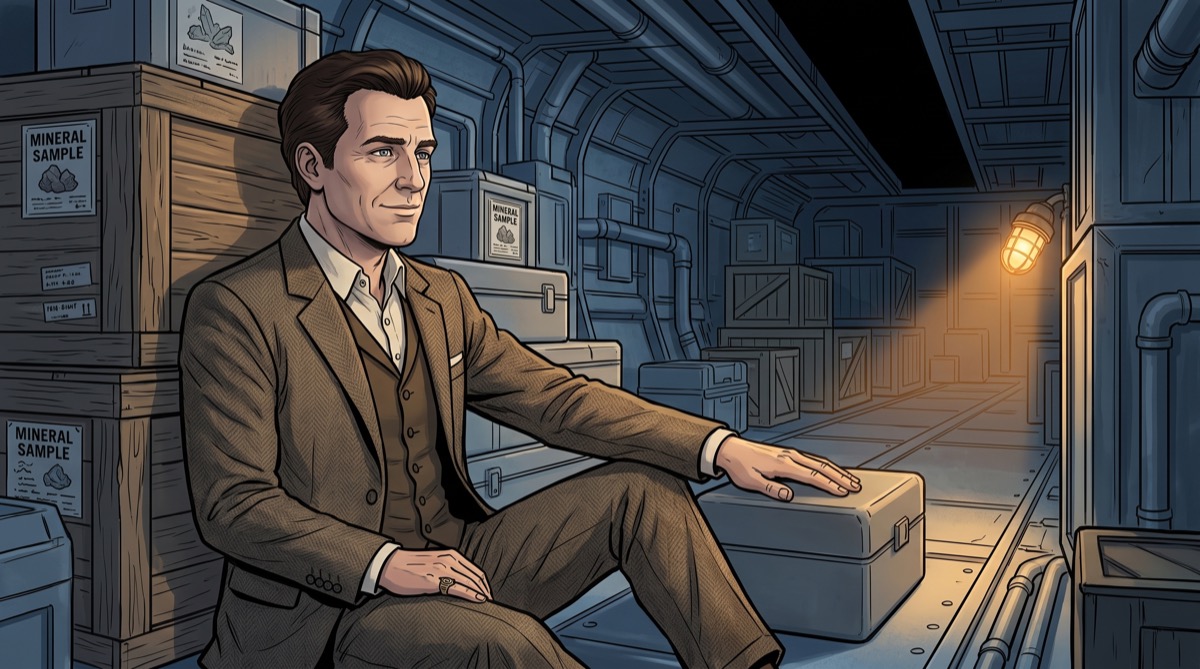
He thought about Essa's garden, and about the number of things in it that had grown there without anyone requiring proof they would. He thought about the seven-page offer, deleted now, unretrievable, and about how light he felt without it, in a way that had surprised him. He thought about his dissertation, still sitting unfinished on a server at Maximegalon, and decided, with the particular calm of a man who has just discovered which of two things he actually wants, that it could wait. It had waited three years. It could wait a little longer, for a better reason than the one it had been waiting for before.
He put his hand flat on the case. Not opening it — he'd looked at everything inside it more times than was probably healthy — just resting his palm there, the way you'd rest a hand on the shoulder of someone who'd been carrying something heavy for a while and deserved, at minimum, to be noticed.
"Okay," he said, to no one, to the hold, to the case, to whatever four-billion-year-old patience had put a structure at the bottom of a pool and waited this long for someone to come looking. "What else have you got?"
The Reasonable Doubt held its course. Somewhere behind them, a message with no reply sat in a queue on Maximegalon, waiting to be marked declined by someone whose job it was to notice such things — and would, eventually, though not for several days yet.