Some More of God's Greatest Mistakes—Chapter 12: The Towel
Posted on Wed 08 July 2026 in Fiction
Some More of God's Greatest Mistakes
Chapter 12: The Towel
The trouble with a klaxon, Colluphid had decided somewhere in the last four minutes, is that it does not care whether you are already running.
It went off anyway. It went off with the serene indifference of a machine that had been built to make one specific noise under one specific condition and had, at long last, been given the opportunity to do its job, and intended to savor it. Colluphid, sprinting down a service corridor on Praxis Interchange with a bag of field notes over one shoulder and a research assistant several strides ahead of him, found he resented the klaxon personally. It felt like being heckled by furniture.
"Left," said Hurkel, without looking back, and went right.
"You said left."
"I meant right. Left was a diagnostic error."
Praxis Interchange was, by any reasonable standard, the wrong place to be interdicted. It handled nine hundred thousand transits a week across six trunk lines, which meant it had been built for throughput rather than intimacy, which meant the corridors were wide, well-lit, thoroughly monitored, and — Colluphid was beginning to appreciate this as a design failure in its own right — entirely unsuited to two men attempting not to be found in them. A quiet, run-down trade station like Stremm Hub had corners. Praxis Interchange had sightlines. Somewhere behind them, a Theological Regulatory Authority enforcement team was working its way through the passenger manifest of an alias transport with a thoroughness that suggested someone, somewhere, had told them exactly which transport to look at.
Colluphid had wondered, distantly, between the third and fourth turn, how they'd known. He filed the question next to several dozen others he did not currently have the lung capacity to pursue.
"There," said Hurkel, and shoved open a maintenance hatch that had clearly not been designed to be shoved open by anyone in a hurry. It gave with a shriek of protest and deposited them both into a service corridor lit by the low amber glow of systems that existed to be functional rather than photogenic: exposed conduit, a maintenance cart abandoned at an angle that suggested its owner had left in some haste of their own, and, at the far end, a hatch marked with a symbol Colluphid didn't recognize and a phrase he did, in the particular red lettering stations reserved for things they very much did not want you to open.
"That's an airlock," he said.
"That's an airlock," Hurkel agreed, already moving toward it.
"We are not qualified to open an airlock."
"We are extremely qualified to open an airlock. We are underqualified to survive what's on the other side of it, which is a different problem, and one I'm hoping we don't have."
Behind them, the hatch they'd come through banged open. A voice — official, amplified, entirely unbothered by the fact that it was chasing two theologians and a bag of field notes through a maintenance corridor — announced that they were to stop, in language that ran to eleven words and somehow still felt like it had subclauses.
"That's Voostra's phrasing," Colluphid said. "I'd know it anywhere."
"That's not Voostra."
"It's Voostra's house style. He's trained someone."
"Wonderful. Write the biography later. Move."
The corridor bent, and bending, revealed the actual reason the maintenance section had been left dim and unstaffed on a station otherwise lit like a confession: a rupture, high on the outer wall, no larger than a fist, from which the air of the corridor was leaving in a thin, steady, appallingly matter-of-fact stream, with the specific hiss of something that had been doing this for a while and fully intended to keep at it.
"That's new," said Hurkel, in the tone of a man revising a plan mid-sentence.
The pressure alarm, when it started, was a different animal from the klaxon behind them — lower, more patient, the tone a building uses when it has stopped asking you to hurry and started informing you, as a courtesy, of the exact number of minutes you have left to do something about it. Colluphid had never heard one in person before. He found he understood it immediately, on some level below language, in the same part of the brain that understands a held breath.
"How long," he said.
"Four minutes to the corridor going below survivable pressure. Less for us, personally, because we're both breathing like we've been running, which we have."
"Can we get to the airlock before that?"
"Not through that." Hurkel nodded at the rupture, which sat directly between them and the hatch, in the specific, personally targeted way that obstacles have when the universe wants you to notice them. "It's small. It's also getting bigger. Metal doesn't tear neatly."
Colluphid looked at the hole. He looked at the amount of corridor between them and the airlock, which was not very much corridor, and at the amount of atmosphere leaving through a gap the size of his fist, which was, apparently, quite a lot of atmosphere. He had spent a bestselling book and the better part of a sequel — the sequel currently at the specific stage of progress that involves being chased through a space station — building an increasingly elaborate case that the universe was a poorly run operation, staffed by an absent management that had never once, in six years of documented failures, shown up to fix anything.
He was aware, distantly, that this was possibly not the moment to feel vindicated. He noticed he felt it anyway, underneath the fear, small and petty and entirely unhelpful.
"We need something to cover it," Hurkel said. "Anything. Sealant, a panel, a—"
Colluphid's bag was already open. He didn't remember opening it. His hand had gone in on its own, the way a hand does when a body has decided, faster than a mind can follow, that it already knows the answer and is merely waiting for the rest of the person to catch up.
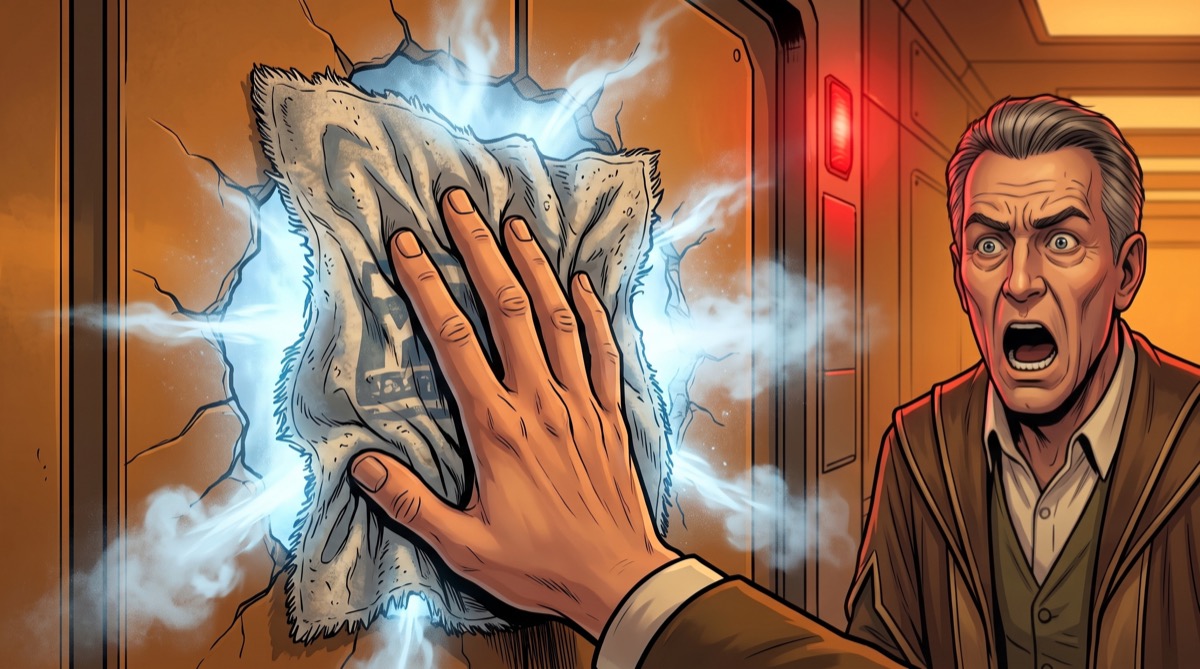
He pulled out a towel.
It was not a remarkable towel. It was the standard-issue kind that came folded in the corner of a rented shuttle berth, slightly rougher than it should be, printed with a faded logo for a hospitality chain that had gone out of business four systems and one bankruptcy ago. Colluphid had no memory of packing it. He had a very clear memory of not packing it, in fact, of a version of himself three weeks and two systems ago who had specifically thought I don't need a towel, I'm not going anywhere with beaches — and yet here it was, in his hand, at the one moment in recent memory when its absence would have mattered.
"Is that a towel," said Hurkel.
"I don't know how it got here."
"Give it to me."
"I don't know how it got here, Hurkel—"
"You can have the existential crisis after we don't die. Give me the towel."
He gave him the towel.
Hurkel folded it twice, fast, with the specific competence of someone who had once, during a first-year fieldwork rotation that neither of them had fully discussed, packed emergency seals for a living, and pressed it flat against the rupture with both hands and the better part of his body weight. For one full second, nothing happened, and Colluphid had the sinking, entirely rational thought that a piece of fabric was not, physically, going to hold back the vacuum of space, that this was not how atmosphere worked, that he had a doctorate and could, if pressed, explain in some detail why this would not work.
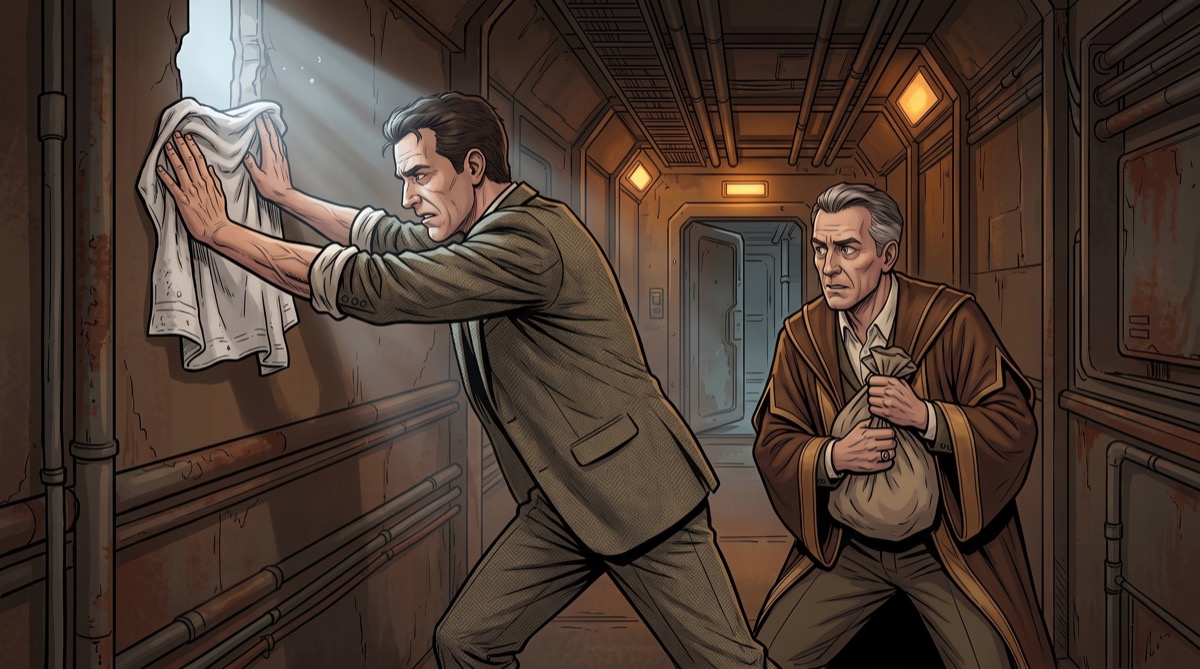
It worked.
Not perfectly — the hiss didn't stop so much as change register, becoming a thinner, more grudging sound, the sound of something being merely inconvenienced rather than defeated — but the pressure alarm's countdown, which had been ticking down with the specific relentlessness alarms have, hesitated. Recalculated. Slowed.
"That should not be working," Colluphid said.
"I'm aware."
"Towels are not — the weave isn't — there's no seal to a towel, Hurkel, it's not designed for this, nothing about its manufacture accounts for—"
"Oolon." Hurkel didn't look away from the wall, both hands still braced, forearms shaking slightly with the effort of holding a piece of terrycloth against an act of physics that had every right to ignore it. "I will let you finish this sentence once we're through that airlock. Move."
The Hitchhiker's Guide to the Galaxy, in the section on practical galactic survival that most readers skip in favor of the section on alcoholic beverages, has for several editions now maintained that a towel is, all things considered, about the most massively useful item a traveler can carry — not for any single one of its many uses, which range from the obvious (drying oneself) to the improvised (signaling, insulating, bluffing one's way past customs officials who assume that anyone still in possession of a towel has their affairs sufficiently in order not to be worth the paperwork), but for what carrying one reliably communicates about a person's general competence. A hitchhiker who has a towel, the Guide notes, can be assumed to have a plan, a spare set of underwear, a working knowledge of local hospitality customs, and — this is the part most readers underline — a fighting chance.
The Guide does not mention emergency hull breaches specifically. In its defense, it does not mention most things specifically. It has always preferred to gesture confidently in the general direction of usefulness and let the universe fill in the details, which is, if you think about it for slightly too long, not a bad description of a great many belief systems, several of them significantly more expensive to print.
"Get to the door," Hurkel said, still braced against the wall, forearms shaking. "When I say, you pull it off and you run, you don't stop to admire it, you don't stop for anything."
"What about you—"
"I'm right behind the towel. Go."
Colluphid went. Three steps to the airlock's outer control, a lever built for hands less occupied with terror than his currently were, and then Hurkel's voice, tight: "Now."
He peeled the towel from the wall in one motion. The hiss became, immediately and alarmingly, a shriek, the corridor's remaining atmosphere making its intentions known all at once — and then they were both through the airlock's outer door, Colluphid still gripping the towel, damp and cold and, absurdly, still perfectly intact, and the door sealed behind them with a heaviness that felt, for the first time all night, like something built to actually work.
"It's still in one piece," Colluphid said, disbelieving, looking down at the thing balled in his fist.
"It's a good towel," said Hurkel, which was not an explanation, and which they both understood was not an explanation, and which neither of them was, for the moment, prepared to improve on.
Through the small reinforced window, they watched the maintenance corridor finish what it had started — the rupture giving way all at once now that nothing remained to slow it, the corridor's air emptying itself into the dark beyond the station's hull with the flat, business-like violence of a system correcting an anomaly. Colluphid did not know what would have happened to a hand left a half-second longer on that wall. He decided, consulting the tightness in his chest, that he did not want to.
The airlock's inner door released them into a docking bay, small and unmonitored in the specific way that only the least prestigious berths on a major interchange manage to be, where a boxy, unlovely transport shuttle sat with its ramp already down and its pilot — a woman Colluphid didn't recognize, whom Hurkel greeted with the particular economy of two people who had exchanged exactly the information required and nothing more — waving them aboard with the brisk irritation of someone being paid enough to overlook how many questions she wasn't asking.
They were three minutes into transit, station traffic control fading behind them into the specific silence that follows a klaxon once you're too far away to hear it, before Colluphid managed to say anything at all.
"Ford Prefect," he said, "was right about everything."
Hurkel, slumped in the shuttle's second seat with his eyes closed and his hands still faintly trembling from having held a towel against a hole in the universe for slightly longer than any reasonable person should have to, opened one eye.
"Who?"
"Nobody. A reference. It doesn't matter." Colluphid found he was laughing, in the thin, involuntary way people laugh after they've stopped being afraid and haven't yet worked out what to feel instead. "There's an entire section of the Guide about towels. I read it in university and thought it was the single stupidest thing I had ever encountered in a text that otherwise seemed to be trying. I have quoted it, in print, as an example of the Guide's tendency toward whimsy over rigor."
"And now?"
"Now I would like to formally revise my position, and I have no idea how to write the correction."
They didn't speak again for a while. The shuttle held its course toward whatever destination Hurkel had arranged with the pilot, and Colluphid sat with his bag on his lap and his hands, he noticed, still shaking slightly — not from the running, which had stopped, but from something underneath the running that hadn't.
He looked down at the towel, still balled in his hand, damp and unremarkable and printed with the fading logo of a hospitality chain that no longer existed. He smoothed it out over one knee, folded it in half, then in half again, with more care than a rented towel from a defunct shuttle-berth chain had any right to receive, and set it on top of the bag rather than back inside it.
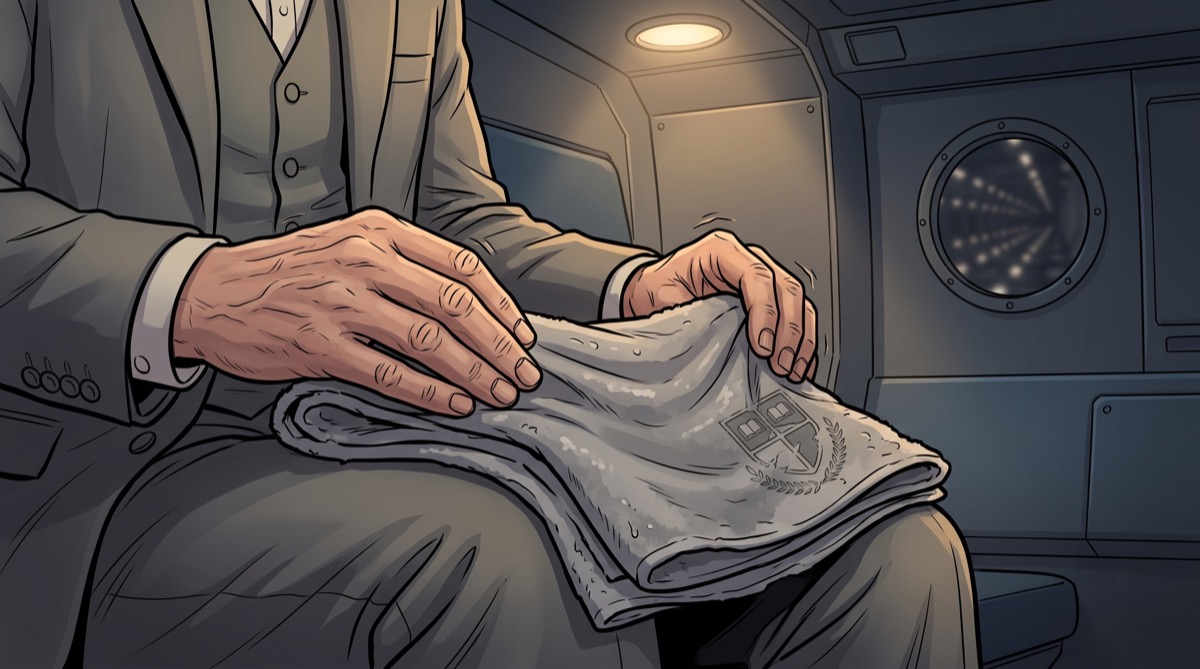
He did not examine why. He thought about the exact, specific, undeniable fact of it being there at all, in his bag, at the one moment in the last three weeks when its absence would have killed him, and about how easy it would be to write that off as coincidence, and about how he had built an entire career on the practice of not writing things off as coincidence when they arrived exactly, suspiciously, inconveniently on time.
He thought about a margin note in a handwriting he had long since stopped being able to call a coincidence: Keep going.
He did not open his notebook. He did not, this time, write anything down. He sat with it instead, which was new, and which he suspected — though he was not, yet, prepared to say so out loud — was the more honest response.
"Oolon."
He looked up. Hurkel had opened both eyes now and was watching him with the particular expression he wore when he had decided a question was worth the risk of asking it directly.
"Do you think that was a coincidence?"
"Yes," Colluphid said, immediately, the way you say a thing you have decided to believe rather than a thing you have concluded.
"Are you sure?"
Colluphid opened his mouth. He had, over six years and one very successful book and a hundred interviews, become extremely good at answering questions like this one — quickly, precisely, with exactly enough confidence to close the subject before it opened into something he wasn't ready to stand in. He found, this time, that the answer wasn't there. Not the confident one, anyway. Something else was, sitting where the answer should have been, and he did not yet have a word for it, and he was fairly sure that whatever word he eventually found would not fit in a footnote.
He said nothing.
Hurkel, to his considerable credit, did not push. He closed his eyes again, settled deeper into the seat, and within a few minutes was asleep in the specific, total way of someone who has just held a hole in a starship shut with sheer stubbornness and intends to be unconscious about it for as long as the universe will permit.
Colluphid sat alone with the hum of the shuttle and the slowly receding lights of Praxis Interchange, and thought, not for the first time, that he had spent six years writing about a management that never showed up, and had just been saved by exactly the kind of thing you'd expect to find left behind by someone who'd had to leave in a hurry and cared, very much, that you didn't notice they had.
He did not know why he was keeping it. He suspected, somewhere below the part of him that wrote books, that he already did.