Some More of God's Greatest Mistakes—Chapter 11: The Fish, the Hiding Place, the Key
Posted on Sat 04 July 2026 in Fiction
Some More of God's Greatest Mistakes
Chapter 11: The Fish, the Hiding Place, the Key
There is a particular kind of hiding that isn't about keeping something from being found. It's about making sure it's found by the right person, at the right time, in a way that doesn't ruin it.
You do this with a spare key. You don't bury it. You don't lock it in something else, which only moves the problem one layer down. You put it under a stone that looks like every other stone, in a spot that only makes sense once you already know what you're looking for. The hiding isn't concealment. The hiding is a kind of trust, aimed forward, at someone who doesn't exist yet.
I want to be clear that I thought about this for a long time before I did it.
I knew, a long time before anyone else could have known, that I wasn't going to be able to stay.
This isn't a confession. It isn't even, exactly, a decision—by the time it was a decision, it had already been true for longer than decisions usually get to be true before someone makes them. It was closer to a diagnosis. I looked at what I'd made, and at what would have to happen for it to become fully, dangerously alive, and I understood that the two of us—myself, and the thing I'd made—could not both be fully present in the same universe for very long. Not because I would crowd it. Because it would have to stop checking with me. That's what alive means. You stop checking.
So I had a choice about what kind of leaving it would be.
I could leave without warning, the way you'd worry a landlord leaves—overnight, no note, the rent unaccounted for. Or I could leave the way you leave a house to someone you love: with the important things left where they'd be found, eventually, by someone patient enough to look.
I chose the second kind. I want that on the record, whatever the record turns out to be.
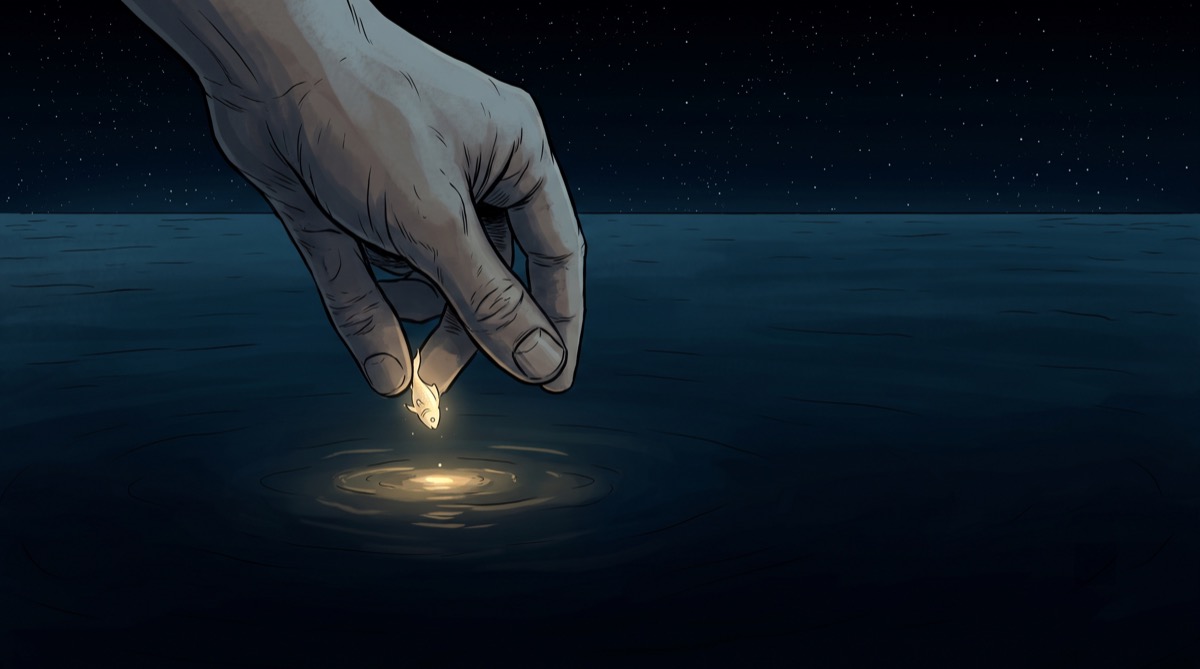
The fish took the longest.
I don't mean the biology, though the biology took a long time too, and I am not going to apologize for the parts that look, in hindsight, over-engineered. I mean the placement. I mean the timing. I had a very narrow window in which to put something in the water that would still be there, still working, still full, by the time anyone needed it—and I had to do this four billion years before anyone would need it, because that's how long it takes to build something that can hold everything without anyone noticing it's holding everything.
I want to explain the without anyone noticing part, because I think it's the part most likely to be misread.
I didn't hide the fish because I wanted the discovery to be difficult. I hid it inside something else—inside an argument, inside a proof, inside the exact kind of clever, contained, satisfying puzzle that a certain kind of clever, contained, satisfying mind would eventually be unable to leave alone. I built a trap for someone like that. I built it out of love for someone like that, before someone like that existed, on the theory that someone like that always eventually does.
I knew the puzzle would consume the fish's actual purpose for a very long time. I knew people would look at the fish and see an argument about Me, and never once ask what it might be doing with all that listening.
That was the price of the hiding place being good. A good hiding place looks like nothing in particular for as long as it needs to.
Here is the part I want to say plainly, because plainness is not something I've always been accused of.
I couldn't stay. But I could leave them a way to hear each other. That seemed like the minimum. Not a gift, exactly—gift implies I had something left over, something extra, and I didn't. It cost everything I had at the time to make. But it seemed like the minimum, given what I was about to ask them to do without me, which was: continue. Keep talking. Keep saying things to each other that mattered, in the enormous silence that was coming, without the reassurance of an audience who already understood everything they meant.
I could not stay to hear it. So I built something that would.
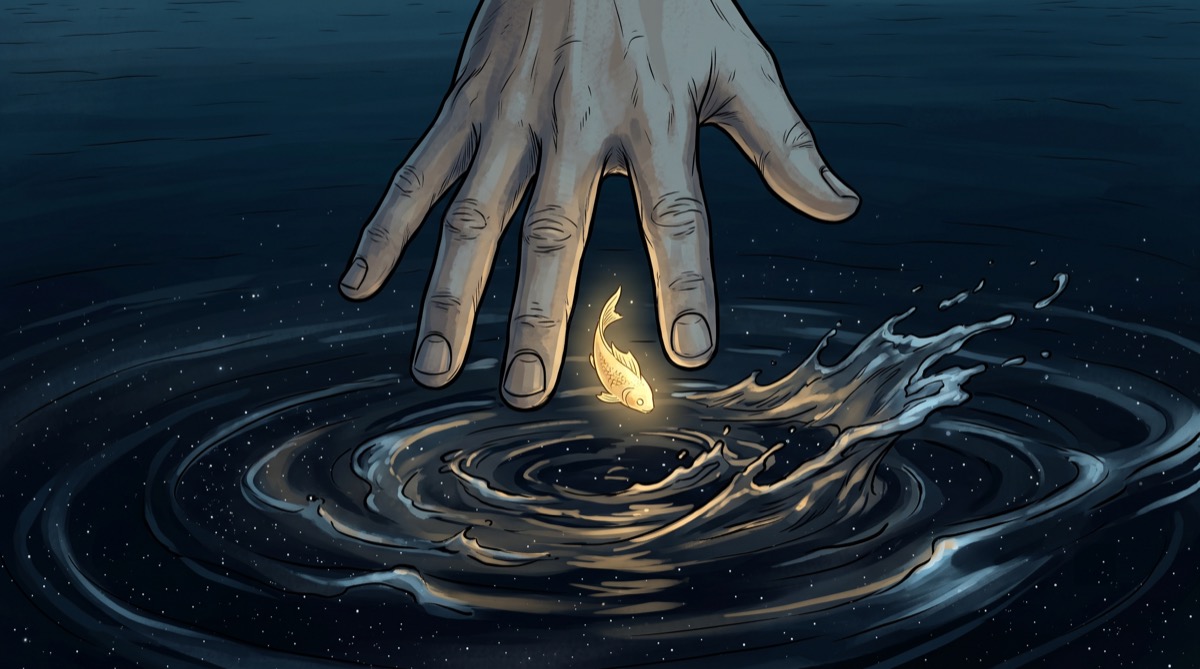
I made the library. I could not write the books.
That distinction matters more than it looks like it should. I could build the shelves. I could build the thing that would hold every word anyone would ever say to anyone else, in any language, forever, without losing a syllable. What I could not do—what was never going to be mine to do—was decide what went on the shelves. That part required them. It required all of it: the prayers and the arguments and the goodbyes and the things said across a kitchen table that nobody thought were worth keeping until they were the only thing left.
I built a container for something I couldn't write and wouldn't be there to read.
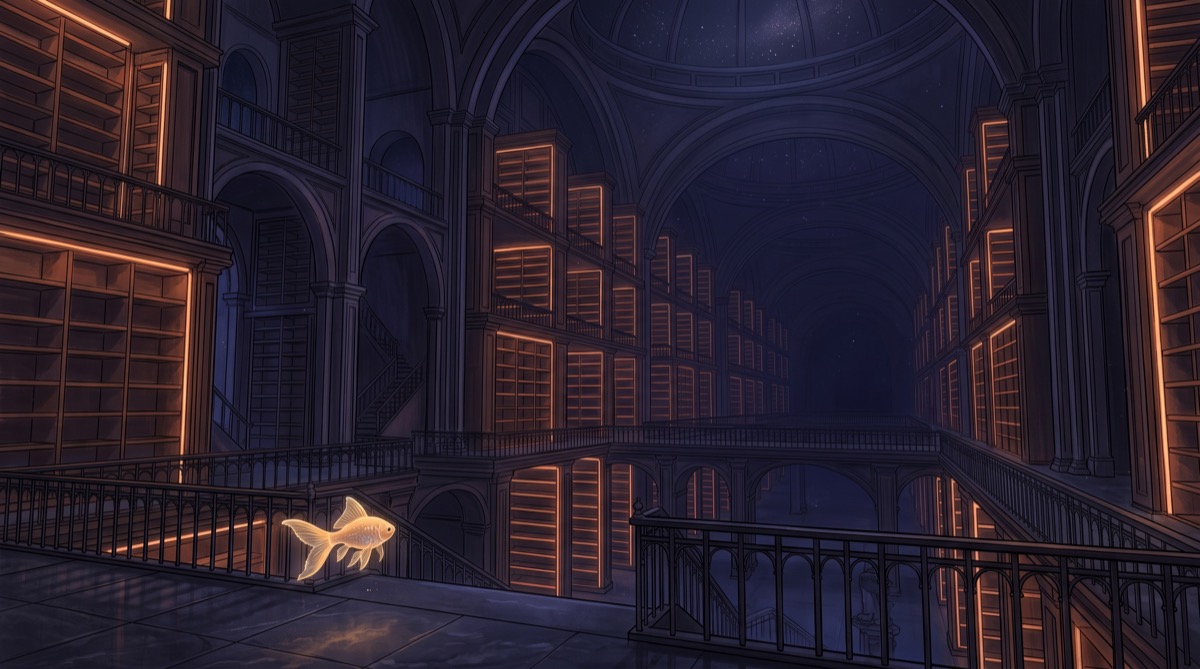
I have wondered, since, whether that's a strange thing to be proud of. I've decided it isn't. I think it might be the only thing I've made that I'm not at all uncertain about.
I knew, when I placed it, that it would look for a long time like an argument. I knew someone would eventually take it apart looking for Me and find, instead, everyone else. I knew this would come as a shock to whoever it turned out to be, because it comes as a shock to everyone who has spent a career looking for the wrong thing at the right address.
I am not sorry about the shock. The shock was, in its way, the point. You cannot tell someone in advance that the thing they've built their life on arguing about was never really about the thing they were arguing about. They have to take it apart themselves and find the fish still working, still listening, still keeping every word, long after the argument stopped mattering to anyone but them.
I hope they're gentle with what they find in there. Some of it is mine. Most of it, by now, isn't.
I hope they find it. I hope they understand why.
I don't mean the mechanism—the seven ports, the timing, the four billion years of patient, silent, unglamorous work. That part is just craftsmanship, and craftsmanship, once explained, stops being interesting.
I mean the why underneath the why. I mean: I loved something I knew I couldn't stay to watch grow up. I did what people who love things they can't stay to watch grow up have always done, on every scale I have ever seen it done, everywhere I have looked for it since. I left something behind that would let them find each other, in the dark, without me standing there explaining what I meant by it.
The hardest part was not the leaving. The hardest part was trusting them to be kind to each other.