Some More of God's Greatest Mistakes—Chapter 10: The Babel Fish Testimony
Posted on Wed 01 July 2026 in Fiction

Some More of God's Greatest Mistakes
Chapter 10: The Babel Fish Testimony
The waypoint station at Ressen Approach occupied the L4 position of a gas giant that had been named on two separate charts by two separate survey teams and therefore went by both names interchangeably, which bothered the cartographers and nobody else. It had forty-three docking berths, a small commercial section, a food counter in the eastern terminal, and the particular atmosphere of a place whose entire justification for existing was that ships stopped there. Under the circumstances, this was exactly what Colluphid needed.
He should have been sleeping. His bunk on the alias transport had been functional and nothing else, and he had spent four hours on it performing the general movements associated with sleep while his mind continued its established practice of examining the preceding forty-eight hours from every available angle. When this stopped being useful, which was around the hour that his body reported it would not be sleeping under any conditions, he gave up and found the food counter.
The tea was recognizable as tea. He had his notebook open on the table. He had not written anything in it. The forty-seven photographs were in his comms unit, and the implications of the artifact, and the conversation with Divna, and the three questions in the margin of the page he wasn't looking at, and none of them were moving.
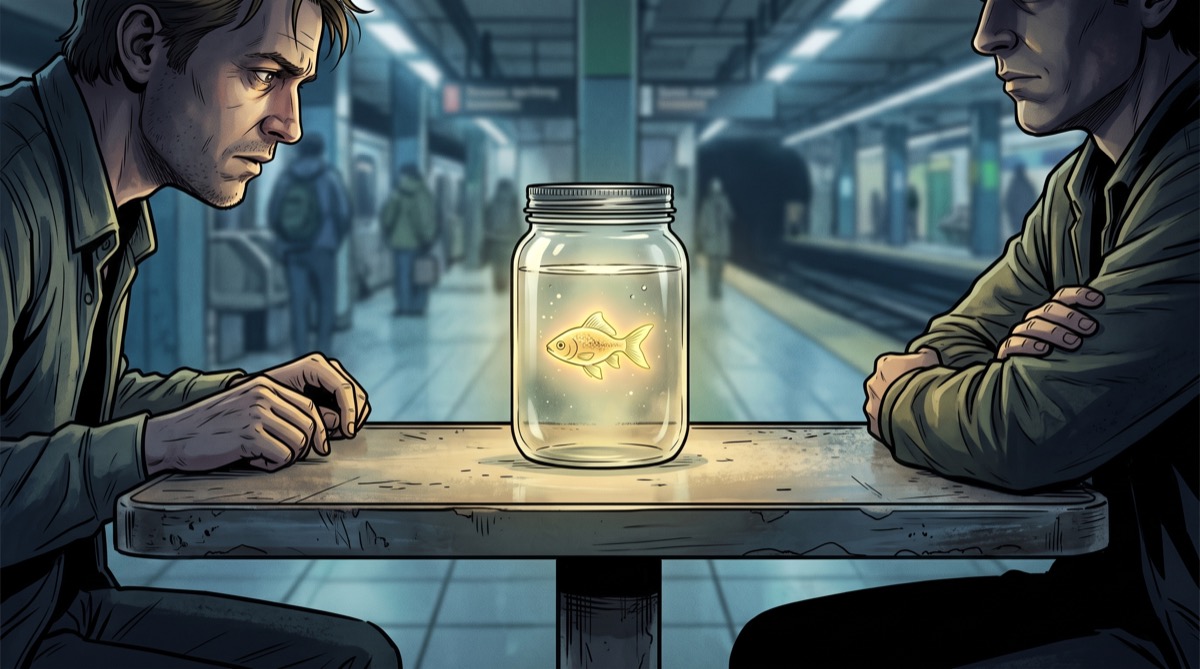
There was one other person in the eastern terminal. She sat at the table nearest the viewport, surrounded by a tablet, three physical notebooks in varying states of filling, and a sealed containment unit approximately the size of a coffee mug. The unit held a small amount of water. In the water was a Babel fish.
It was doing what Babel fish did: not very much, and that efficiently. Small, yellowish, translucent enough that Colluphid could see the fine architecture of its nervous system through its sides as the tank's circulation moved it in a slow quarter-turn and back. It had been the proof of God and the disproof of God and the mechanism of universal translation across the known galaxy for four point two billion years. It had no opinions about any of this. It never had.
The woman was typing without looking at her tablet, her attention on the fish. She looked up when Colluphid sat down, registered him the way one registers a chair, and returned to her work.
Colluphid looked at his tea. He looked at the fish. He said, without having intended to say anything: "They're extraordinary, aren't they."
She looked up again. A longer look this time. "Yes," she said. "Almost no one notices."
"I've been to the Spawning Pools. Viltvodle VI. Last week."
She set down her tablet. She had the quality of a person who could determine, within the first three sentences of a conversation, whether it was going to be worth having. Colluphid had the same quality, and he recognized it in her with the brief wariness of a mirror.
"What did you find there?" she said.
She was looking at his comms unit, which he had left on the table with one of Hurkel's photographs open on the screen—the artifact at ninety-four meters, seven sealed ports facing the camera, material composition unknown to any current taxonomy. He had been looking at it before he noticed her.
She looked at the photograph for a long moment.
"You found it," she said. Not a question.
Her name was something beginning with V. He received it when she introduced herself and lost it within the first thirty seconds of what followed, which was not a reflection of his interest but entirely a reflection of the quality of what she said. He would remember this later, when he was embarrassed about it. He gave his own name in return, which she received without visible reaction, which was a welcome change in the direction his life had been moving.
She was a xenolinguist. She studied the biological encoding of language in organisms that processed multiple syntax systems simultaneously—Hruvian resonance-singers, the trilateral grammar-fish of Betelgeuse IV, and then the Babel fish, which she had arrived at eleven years ago via a conference talk that had bored her into productive thinking. She had four published papers and an office that held equipment she had built herself because the equipment she needed had not previously existed.
"The fish translate," Colluphid said.
"That's the observable behavior." She pulled her tablet across the table and turned it toward him. A biological diagram of a Babel fish in section: nervous system in blue, a distinct structure in the prefrontal lobe highlighted in green. "I've been studying this structure for eleven years. The medial resonance organ. My first paper concluded it was vestigial. Evolutionary residue. Nonfunctional."
"And?"
"I was wrong. It took me eight years to work out how."
She explained it in the way that people explain things they have spent years compressing and rarely had occasion to say aloud: with the specific momentum of material that has been waiting for the right receiver.
The fish didn't translate the way an algorithm translated—converting syntax to equivalent syntax, mapping meaning across structures. The fish interfaced directly with the listener's perceptual system. It didn't replace the sounds; it interpreted them in a way that arrived already understood. The distinction was operationally invisible and—she said this with the matter-of-fact precision of someone who had worked through its implications alone for a long time—deeply strange.
"More like being read than reading," Colluphid said.
"Exactly like that. The fish reads the language and reads it into you." She turned to the next diagram: a population map, not one fish in section but hundreds, the medial resonance structures highlighted across all of them, and between them a signal pattern she had spent eleven years mapping with instruments she had assembled from parts designed for other purposes. "The organ in one fish is a node. The species is the library."
Colluphid looked at the diagram. He looked at the fish in its containment unit, which was still moving in its slow quarter-turn, unhurried.
"A library," he said. "Of what."
"Language. Everything they've ever processed." She scrolled down to a density map—a three-dimensional visualization of accumulated data across the species, color-coded by information concentration. It was, objectively, beautiful. A bloom of interlocking systems, each fish a point of light, connected to every other, the whole thing alive with something that had been building for—
"Four billion years," Colluphid said.
"Four point two, approximately."
He set his tea down.
"The fish were introduced four point two billion years ago," he said, working through it aloud. "At the artifact. At the temporal displacement event. Introduced at that specific moment, and they've been present in every water system they've expanded into since, and they've been processing language for four billion years, and—"
He stopped.
"And they've kept it," she said.
He looked at the diagram without speaking.
He thought about every language. Every syntax. Every species that had had a Babel fish in its presence for four point two billion years—which was, across the settled galaxy, nearly all of them, across nearly all of their recorded history. Every word spoken by every being in the known universe, in every language that had ever existed, preserved in the collective biology of a small yellowish fish that everyone assumed was there to settle an argument about God.
Every prayer. Every proposal. Every argument. Every goodbye. Every nothing-in-particular said across a kitchen table in a language that might have no other living speakers. Everything.
"God didn't plant the fish to prove God's existence," he said.
"No."
"God planted the fish to—" He stopped. Found it. "To make sure nothing would be lost. Before leaving. Before the conditions for leaving were even established—four billion years before—God built something that would ensure we'd remember each other after God was gone."
He was aware that something had happened to his voice. He addressed this by looking at the viewport.
The gas giant continued its rotation, unnamed, its atmospheric bands moving in colors no one had cataloged because no one had needed to. He thought about all the conversations those colors had never witnessed and the fish was carrying anyway. He thought about his father, who had left when Colluphid was nine without a forwarding address, without an explanation, without a single preserved syllable of the years before the leaving—and about what it would have meant to know that somewhere, in a system he couldn't access but which was real and running, the things they had said to each other were still intact. The mornings. The arguments. The afternoon by the river on Brontitall that he had spent thirty years trying to remember accurately.
He thought about a creator who had known four billion years in advance that it was going to leave, and who had chosen to spend some portion of that time building an ark. Not for bodies. Not for texts. For the conversations. For the things said between beings who would not otherwise have known those things were worth preserving.
He pressed his fingers against his eyes.
"Are you all right?" the woman said.
"I don't know." He kept his fingers there for a moment. "I don't know what this is."
He didn't hear Hurkel come in, which meant Hurkel had been there for a while before Colluphid became aware of him. He was sitting at the counter near the entrance with something steaming in his hands, reading from his unit, in the particular posture of someone who had assessed the room and decided not to interrupt it.
"How long have you been there?"
"Long enough." Hurkel came over, sat in the empty chair at the end of the table, and looked at the density map on her tablet. He looked at it with the focused attention of someone who had spent several months developing a professional relationship with Babel fish biology. "The medial resonance structure."
"Yes," she said.
"Distributed across the whole species."
"Yes."
"And the whole species has been present since—"
"Four point two billion years before galactic standard present."
Hurkel nodded slowly. He looked at the fish. He looked at the photographs open on Colluphid's unit. He looked at the ceiling of the eastern terminal, which was standard station composite and had no significance, which appeared to be precisely what he needed it to be for a moment.
"God didn't kill itself," he said. "God backed up the hard drive and logged off."
"That's—" Colluphid began.
"Accurate?"
"Profoundly reductive."
"Those aren't mutually exclusive."
They weren't. A machine that saved its data before shutting down was not a being who had made something and loved it and spent four billion years building an archive to prove the memories were worth keeping. The language of backup and logout didn't capture what the gesture was. But it captured the shape of it. The decision. The deliberateness. The care in the construction of the exit.
"God couldn't stay," Colluphid said. "The proof erased faith erased God—the mechanism was designed that way, four billion years in advance. But before the conditions for leaving were established. Before the proof was ever made. God built the archive first." He paused. "God made sure we'd remember each other before making it inevitable that God would have to leave."
Wonder, he thought. He had the particular chest-tightness of a person who has spent a career examining evidence and has found, in a transit station at the wrong hour of the morning, the only piece of evidence that mattered.
He asked, eventually, how she had known to wait for them here.
"I received a message three weeks ago," she said. "Anonymous routing. It said someone would come through this waypoint who needed to know what the fish do. I've been here since." She showed Hurkel the routing code on her unit. He read it, set it down, and said nothing.
"Four thousand years old," she said. "I checked."
Colluphid and Hurkel looked at each other.
"The same relay," Colluphid said.
"Someone knew you'd be here," Hurkel said. "And knew she'd need to be here."
"And knew she'd found what we needed to hear."
Neither of them said the rest aloud. There was something operating at the edge of what the word coincidence was equipped to describe, and all three of them, by different routes, had arrived at the same position relative to it.
"Do you believe in God?" Colluphid asked her.
She considered this with the care of someone for whom the question carried a different weight than it did for the person asking. "I believe in the fish," she said. "I've believed in the fish for eleven years. What they are is more extraordinary than any argument anyone has ever made using them." She began gathering her notebooks. "The argument was always beside the point. The fish were the point."
She stood. Picked up the containment unit. Looked at him.
"Write the book," she said.
"The research will be public. If you want attribution—"
"I know where to find you." She was already moving. "Write the book."
She left.
Hurkel watched the door close. He looked at the ring the containment unit had left on the table surface—a small, perfect, unambiguous circle.
"She didn't tell us her name," he said.
"She did. At the beginning." Colluphid looked at where she'd been sitting. "I don't remember it. I think it began with V."
"Narrows it down."
"She'll be in the footnotes." He picked up his notebook. "Go to sleep."
"I only just woke up."
"Go back, then." He opened to a clean page. "I need to write something."
Hurkel looked at him with the quality of a person deciding how much to say. He settled on four words.
"Don't over-explain it."
He went.
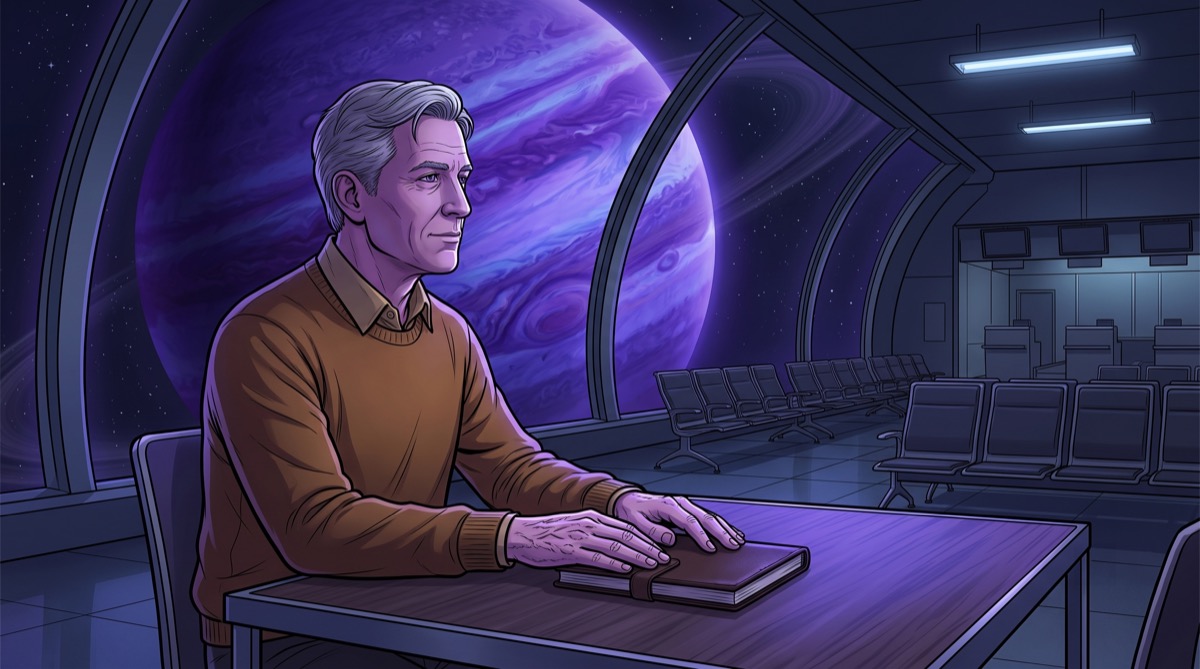
Colluphid sat alone in the eastern terminal with his tea and his notebook and the density map still running on the woman's abandoned tablet, which she had left without switching off, which he assumed meant something.
He thought about the Archive of First Causes and its single wooden desk and the document with I hope this works on the first page, and the section that said they're going to need each other, and the section that said still worth it. please. He had read that please as the register of a God who wanted to believe the cost was worth paying—the note of a maker who had decided yes but kept the question open, just in case. He read it differently now. The please was not the register of doubt. It was the register of someone who had already decided, who was not asking for permission but for understanding. When you find this, I hope you will see what I was trying to do. Please.
He opened his manuscript. Not the notebook. Not the journal with its three lines. The manuscript—Some More of God's Greatest Mistakes, the document he had been filling with careful prosecution for seven months. He looked at the last page. He looked at the unnamed gas giant. He typed one sentence. He read it back twice.
God's greatest mistake was caring enough to make sure we'd remember each other after God was gone.
He sat with it for a long time in the eastern terminal of Ressen Approach Station, which existed because ships stopped there and needed somewhere to wait while they figured out where they were going next.
He didn't know if it was an accusation or a thank-you note.
He didn't know, he was finding, if the distinction mattered.
He saved the document.
In the water of three thousand systems, in the collective biology of a species that had been keeping records since before most of those systems had planets, the fish continued their work. They had been doing it for four point two billion years. They would continue for as long as anything was alive to say anything worth keeping. They had no opinion about this. They were, in their way, the most faithful beings in the galaxy: present for everything, asking for nothing, forgetting nothing at all.