Some More of God's Greatest Mistakes—Chapter 9: On the Run
Posted on Sat 27 June 2026 in Fiction
Some More of God's Greatest Mistakes
Chapter 9: On the Run
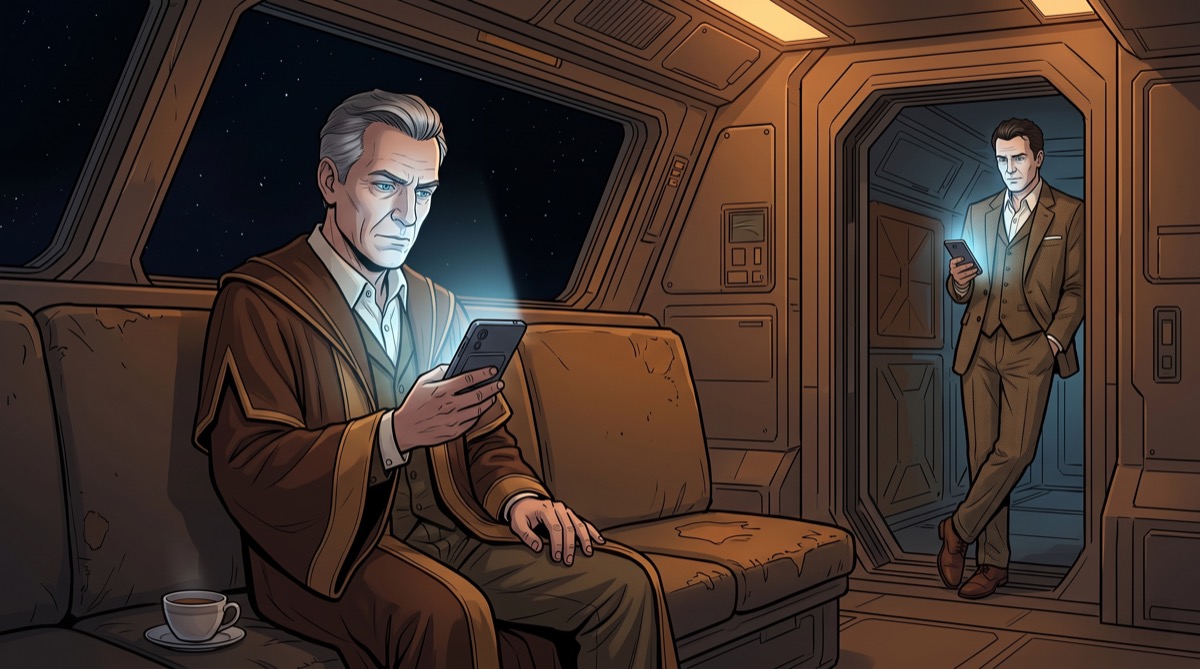
The call had ended at 5:47 Brontitall time, which meant approximately four in the morning by the Deliberate Conclusion's galley cycle, and Colluphid had not moved from the forward observation area since.
He had, at some point, produced tea. He was aware of it going cold in his hand. The viewport showed the same section of space it had been showing for six hours—empty, patient, unhurried by the work of the universe's smaller concerns—and he was looking at it in the way that people look at things when they are not, in fact, seeing them.
In his notebook, on the page he had not written on during the call, were two lines. He had written them in the twenty minutes after the connection closed:
What do you call a God who left a note?
And below it, a question he had not anticipated:
What do you call a man who keeps writing back?
He was not ready to answer either of them. He was also aware that the not-being-ready was itself a kind of answer. He set the notebook on the seat beside him and looked at the stars.
The comms unit's notification tone was a sound he associated with Galactic Horizons Press, his university, or bureaucratic trouble, which covered three of the four categories of things that could make his life substantially worse. He picked it up.
PRIORITY TRANSMISSION: THEOLOGICAL REGULATORY AUTHORITY SEIZURE ORDER: PROVISION 14(b)(iii) — UNAUTHORIZED THEOLOGICAL EXCAVATION ADDRESSEE: OOLON COLLUPHID, 42ND FLOOR, MAXIMEGALON UNIVERSITY RESIDENCE RESEARCH MATERIALS DESIGNATED FOR IMMEDIATE TRA CUSTODY. DETAINMENT WARRANT ISSUED PENDING INQUIRY. DESIGNATED COLLECTION POINT: MAXIMEGALON, DOCK FOURTEEN, ARRIVAL BAY SEVEN...
He read the rest. It was eighty-three pages. He read the first page again to verify that he had read it correctly the first time.
He had.
He went to wake Hurkel.
Hurkel read the first page and said "Hm," which was either deeply insufficient or perfectly calibrated, and Colluphid couldn't determine which.
"They've issued a detainment warrant," Colluphid said. "For me. A—" He stopped. "A formerly tenured—"
"Are we still heading to Maximegalon?"
"Yes. Why?"
"Because the warrant specifies Maximegalon as the collection point." Hurkel was reading on his own unit, scrolling with the particular speed of someone who had developed, in the course of a graduate career, an efficient relationship with documents he was not supposed to have. "If we dock at Maximegalon, TRA enforcement meets us at the bay."
"They can't—the Cathedral Concordat—"
"The Concordat protects the research conducted under Cathedral auspices. It doesn't address the physical persons of the researchers while in transit in a freight carrier." Hurkel scrolled to footnote 7. "I read Provision 14(b) three weeks ago."
"When were you planning to tell me?"
"Now," Hurkel said, in the tone of someone who finds this answer technically adequate. "I'm telling you now."
Colluphid looked at him. "So we can't go to Maximegalon."
"Not yet."
"And the samples are on a freighter to Maximegalon."
"Yes." A pause. "I'm handling it."
"What does 'handling it' mean?"
"It means I'm contacting someone." Hurkel had already opened a separate comms channel and was composing. He did not elaborate.
Colluphid looked at the viewport. The empty section of space continued to decline to have opinions about any of this. He had the particular feeling of a person who had, over the course of one night and one six-hour conversation and one eighty-three-page legal document, crossed a line from "academic with complicated research" to something else entirely, and who had not precisely prepared for the transition.
"Hurkel," he said.
"Still composing."
"Are we fugitives?"
A brief pause in the typing. "The warrant says 'persons of interest for inquiry purposes pending material collection'—"
"Are we fugitives."
"In the practical sense," Hurkel said, "yes."
The Hitchhiker's Guide to the Galaxy has this to say about theological fugitives:
The history of individuals fleeing theological regulation across the known galaxy is both longer and sadder than most people expect, and begins at least as far back as the First Great Theological Authority of the Outer Western Sectors, established approximately 8,000 BGE to prevent unauthorized prophethood following an incident in which a Hruvian farmer accidentally produced a burning bush that, on close inspection, was describing the weather.
Theological fugitives tend to share several characteristics: conviction (usually sincere), poor forward planning (almost universal), and a marked tendency to explain their positions at length to enforcement personnel, which is consistently counterproductive but appears to be irresistible.
The most successful theological fugitive in recorded galactic history is generally agreed to be Plessik of Brentovaal IV, who evaded the Second Theological Authority for twenty-two years and three months by maintaining a scrupulously accurate registry of his own location and submitting it to the Authority every six weeks, on the theory that they would never check. They never did. He published his work—a substantial text arguing that God had "gone somewhere interesting and would be along"—at age 91, and was apprehended in the bookshop where he was signing copies. He described the experience as "a relief."
The least successful theological fugitive in recorded galactic history is not listed here, as all records were promptly seized.
The freighter captain's response to learning her cargo included two persons subject to a TRA detainment warrant arrived as a seventeen-second silence. It communicated several things simultaneously: that this was not what she had agreed to transport; that the TRA's freight carrier monitoring protocols were more thorough than Colluphid had assumed; and that she had opinions about academics who created paperwork for freight professionals who were simply trying to move goods between systems without incident.
"I can explain," Colluphid said.
"I can also," Hurkel said, "ensure we disembark at Stremm Hub rather than Maximegalon, which would mean you're clean on your manifest at the relevant arrival point."
The captain looked from one to the other. She appeared to intuit, correctly, that the one she was actually negotiating with was not the taller one.
"Stremm Hub is four hours out of my way."
"I'm aware. We'd cover the diversion."
She looked at them once more. "Fine," she said.
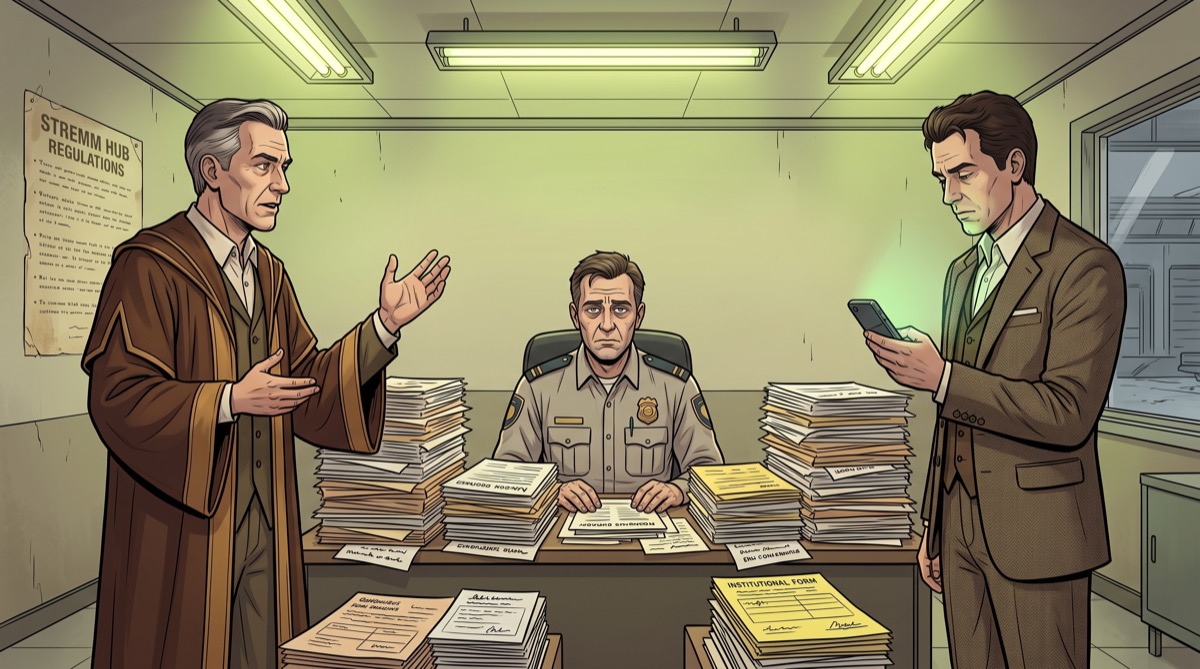
Stremm Hub was a transit station that existed because transit routes created them—a node that had accumulated docking facilities, a commercial section, and a customs office around the fact that ships stopped there. The customs officer, Trent, had been assigned to Stremm Hub three years ago and had developed a functional approach to his work: confirm identity, check for outstanding notices, ensure form compliance, proceed. He had never, in three years at Stremm Hub, managed a situation involving a Provision 14(b)(iii) detainment warrant, a University-Cathedral institutional affiliation document, a counter-filed proportionality complaint, and a research materials declaration containing photographs of a device that appeared to pre-date the planet it had been found in.
"So," he said, for the third time, to the two individuals sitting across from his desk. "You're not at this location."
"We are at this location," the taller one said. "We are physically present here. However, Provision 14(b)(iii) specifies Maximegalon as the designated collection point, which—"
"Which means the warrant doesn't apply here," the shorter one said. "We're not at the collection point."
Trent looked at his desk. He had a form for people who were here. He had a form for people who were somewhere else. He did not have a form for people arguing that their current location was a legal technicality.
"I'll need to contact the regional TRA office," he said.
"Which is at Maximegalon," the shorter one said.
"Yes."
"We're not at Maximegalon."
"You are not at Maximegalon."
"So."
Trent filed a query to the regional TRA office and noted, in the transit log, that inter-office query processing times were currently running fourteen business days. "You can proceed through pending the query response."
"Thank you," the shorter one said.
"Could I—" the taller one began.
"No," the shorter one said, and took his arm.
Stremm Hub's transit options included a connecting shuttle to four systems and a livestock transport to seven. The connecting shuttles, Hurkel explained with the patience of someone who had already thought this through, were the kind of scheduled service the TRA's secondary teams would be monitoring. The livestock transport was not in any commercial directory.
It smelled of Betelgeusian bovine analogs and moved through space with the unhurried confidence of a vessel that had never been monitored because no one had ever considered it worth monitoring. Colluphid sat on a surface that was not quite a seat and opened his notebook to a blank page. He held his pen. He looked at the page. He put the pen away. There were certain classes of observation that could not be transcribed from a moving agricultural vessel, and he was discovering, slowly, that the category was larger than he had previously supposed.
"The samples," he said.
"Redirected."
"By the person you were contacting."
"Yes."
"Who is—"
"A contact." Hurkel had settled against the wall with the ease of someone who had spent fieldwork years becoming comfortable in unsuitable conditions. "First-year fieldwork across six systems. You accumulate people who know how to move things without using the monitored routes."
Colluphid stared at him. "You have a smuggling network."
"I have fieldwork contacts." A pause. "The distinction is a matter of framing."
"Where are the samples?"
"Safe. When we need them, I'll know where." Hurkel produced his unit and showed Colluphid a file path pointing to nothing he recognized as a server name. "The photographs are backed up at three locations. If someone takes the unit, the copies remain."
Colluphid sat with this for a moment. He was looking at Hurkel in a way he had not, he realized, looked at Hurkel before—as someone who had been running a parallel operation, quietly and competently, in the margins of the official one, for weeks. He had been Hurkel's nominal supervisor for eighteen months. He was only now understanding what that had meant from Hurkel's direction.
"You planned this," he said.
"I flagged the shuttle booking timing in red three weeks ago. You were making tea on the memo."
"I owe you."
"You owe me a dissertation defense that doesn't get suspended." Hurkel closed his eyes. "Wake me when we reach the trade station."
The trade station at the edge of the Hreckin system existed for the same reason all trade stations existed: ships stopped there. It had forty-seven docking ports, accommodation that was willing to operate without documentation, and an atmosphere suggesting that everyone present had private reasons for preferring not to be somewhere else. Under the circumstances, this made it precisely suitable.
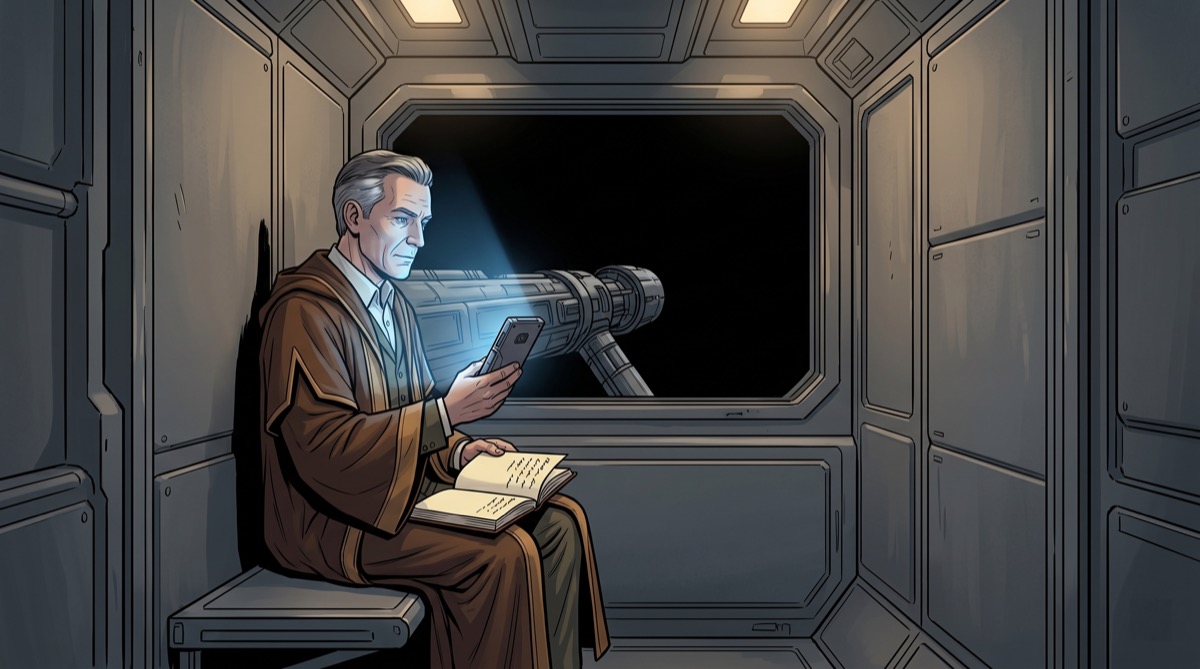
Colluphid's room was approximately the size of his university bathroom and offered, by way of features, a surface to sit on and a viewport facing a dock strut. He sat on the surface with his notebook on his knee and took account of his situation.
He was, by the day's accumulating evidence:
A theological fugitive. A man who had spent his career constructing arguments from the position of institutional authority and epistemological rigor, who was currently in a room smaller than his university office on a trade station in a system he had never visited, sharing his circumstances with a suitcase and forty-seven photographs of pre-planetary alien technology and the biological memory of a livestock transport.
He was also—and this was the part he kept returning to—strangely calm.
He opened his notebook. The two lines from the freighter were still there. He looked at them for a while. Then, without quite deciding to, he wrote a third:
What do you call the investigation, when you realize you're not only the investigator?
He had no answer. He was not distressed by this. He was, which was the strangest thing about the day, not finished.
The comms unit showed a message. Unknown sender. Untraceable routing. He sat with it for a moment before opening it.
You're getting closer. That's why they're afraid.
He read it twice. He looked at the ceiling—metal, unadorned, without significance. He looked at the message again.
He wrote it down in his notebook: the full text, the timestamp, the routing code. Then he sat back.
Closer to what, specifically, the message did not say. This was either a flaw or a gift, and he was aware that his certainty about which, as recently as two books ago, would have been unambiguous.
He was no longer certain.
In the morning, Hurkel analyzed the routing code over something the station served as breakfast, which addressed the need for caloric intake without making any promises about quality.
"The relay's at least four thousand years old," Hurkel said, reading from his unit. "Pre-TRA. Possibly pre-Concordat. The encryption is layered—the outer protocol is current, but the core is older than any documented standard. And the signal path bounced through a relay node on Still Here."
"The Remnant."
"Someone used their routing. Or they did." He set down the unit. "They've been following the investigation."
Colluphid thought about the eldest, who was 6,000 years old and used a pronoun as an approximation. About We knew the author. About a universe on its second attempt, and a research team that had found the delivery mechanism of the first attempt's most significant proof.
"Since before it started," he said.
"Probably."
"Then they know what we found."
"Or they always knew it was there to find." Hurkel looked at him steadily. "There's a difference."
There was. A being who had survived four billion years and a creation cycle would know what had been placed at the bottom of pool eight. Whether they knew it would be found was a different question—one that implied either confidence or involvement, and he was not ready to determine which.
"We need to get to—" he began.
"I know where we need to get to." Hurkel opened his unit. "Four options. Two faster, two less visible."
"Less visible," Colluphid said, without hesitation.
"Less visible," Hurkel agreed, and booked two seats under names that were not theirs on a transport to a waypoint that was not their destination, which was, Colluphid was learning, how getting closer worked when the people who were afraid of you controlled the monitored routes.
In the Hreckin system, the TRA regional coordinator filed a request for the Stremm Hub transit records and received, in return, a fourteen-day processing timeline. She noted it in her file and opened a separate channel to Voostra's office.
Voostra's office did not respond.
At the forty-second floor of the TRA regional administration building, Voostra read the Stremm Hub transit log. He read the note Trent had added: "Pending inter-office query. 14 business days."
He sat with this for a while.
He made tea.
The tea was not particularly good. It never was.