Some More of God's Greatest Mistakes—Chapter 8: The Weight of Capacities
Posted on Wed 24 June 2026 in Fiction
Some More of God's Greatest Mistakes
Chapter 8: The Weight of Capacities
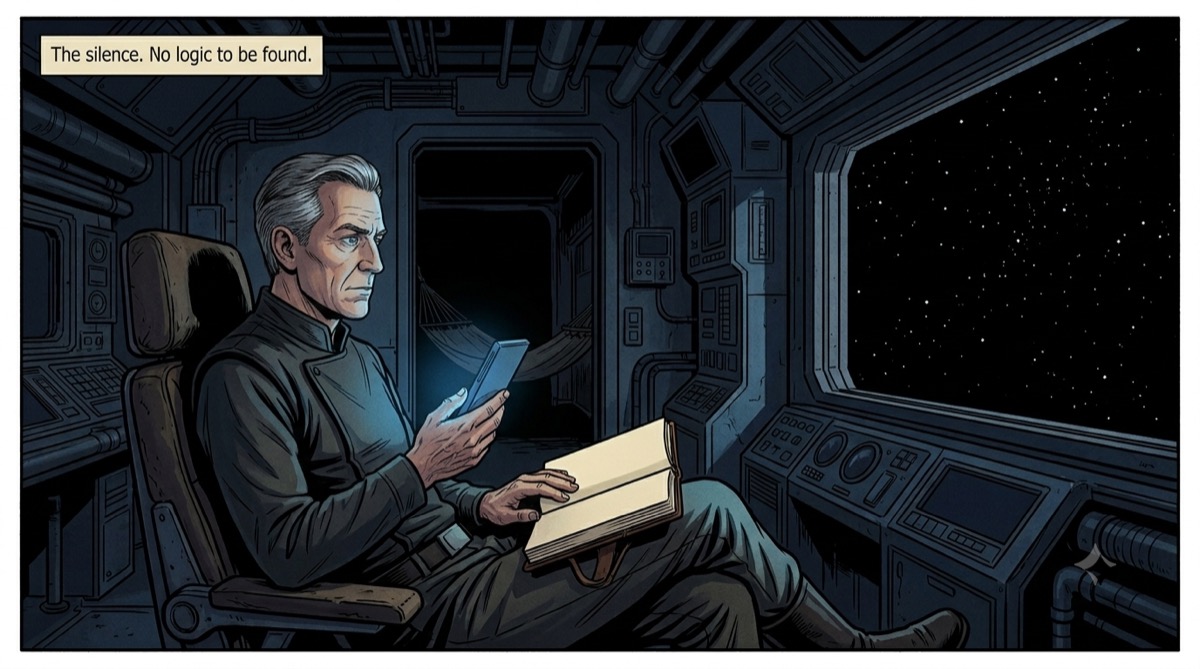
The freight carrier Deliberate Conclusion had been built to transport—without complaint and without fuss—the sort of thing that needed to get from one system to another without anyone being particularly pleased about the transit. It had two hammocks in the cargo berth, added by a previous owner as an afterthought, a small galley, and a viewport in the forward observation area that faced the wrong direction for anything visually interesting.
Hurkel was in the cargo berth. He had fallen asleep, apparently without effort, approximately twelve minutes after boarding, which Colluphid found either admirable or philosophically suspect and was leaning toward the latter.
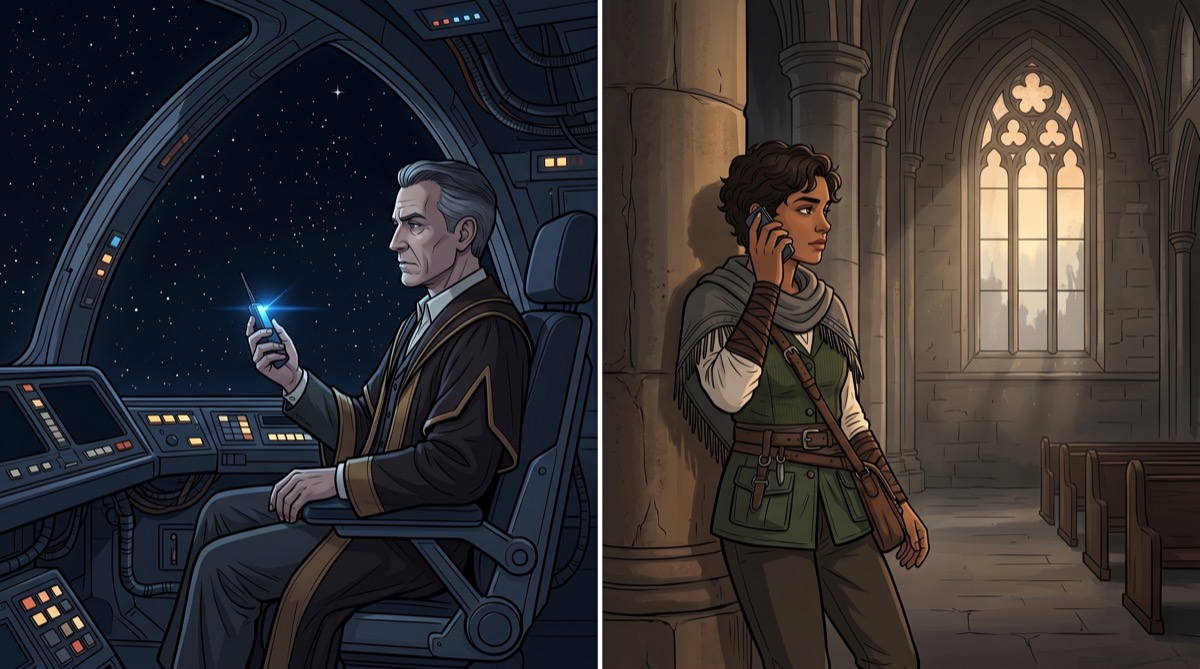
Colluphid was in the forward observation area, looking at the wrong direction, with his notebook on his knee and the comm unit open in his hand. The viewport showed a section of space that contained nothing of visual significance. This was calming in a way he hadn't expected. The universe was very large and mostly empty, and most of it had not been at the bottom of pool eight on Viltvodle VI, and it helped to look at that part for a while.
He opened the comm.
Divna answered on the second signal. It was early morning on Brontitall—she had been awake; he did not ask why—and her voice was clear and alert, with the particular quality of someone who has been sitting with a thought and is now prepared to speak.
"The samples made the freighter."
"Yes." He looked at the viewport. "We're on it."
A pause. "Tell me."
He told her. He went through it in order: the sonar return, the equipment check on the cliffside path, the dive, the artifact's dimensions and material composition, the sealed ports, the age that crossed the sediment deposition record in a direction that said this was here before the planet was here. Seven ports. Seven loci in the founding population's genetic markers. He described the decompression stops and what Hurkel had said at the surface.
I think God killed itself on purpose.
He told her what he had said in response: Not killed. Retired.
He did not tell her about the small handwriting in his notebook, or the question at the bottom of the column—What do you call a God who left a note?—because he had not yet decided what it meant that the question felt personal.
When he finished, she was quiet for long enough that he checked to make sure the connection was still open. It was. She was thinking in the way she thought: without urgency, without performance. The way someone thinks when they take the thing seriously.
"Suicide," she said, finally. "Sacrifice. Or trust."
"I've been working through the same three options for the last four hours."
"And?"
"And I can dismantle each of them individually with no difficulty whatsoever, which suggests I'm doing it wrong."
"Suicide requires a motive that involves ending something." Her voice had the precise quality it got when she was working through an argument she hadn't completed yet. "God building the exit mechanism four billion years in advance doesn't suggest suicide. Suicide is reactive. This is—" A pause. "Architectural."
"Which lands you where?"
"Not at suicide. At the question of what the architecture was for."
He wrote: Architecture of disappearance. Then looked at it. The phrase wasn't new—he had been circling it since the pool shelf—but writing it made it sit differently. More solid. More load-bearing.
"Sacrifice," he said, "requires something given up for something gained. God gave up presence so the universe could have—what? Autonomy? The capacity to grow without being watched?" He paused. "Ford Prefect always said having someone look over your shoulder puts you off."
"That's not a theological framework."
"It's a start. But sacrifice still positions God as the primary agent, the universe as the recipient. It's still—" He stopped.
"Patronizing," Divna said, with the small precision she reserved for identifying the exact wrong word.
"I was going to say asymmetric."
"You were going to say asymmetric and I was saying it first." A brief pause. "Which leaves trust."
He looked at the viewport. The universe continued to be empty in a way that did not require his analysis. "Trust assumes equivalence. I trust you to manage without me because I believe you are capable of it. Not because I'm getting something from your managing. Because I believe—" He stopped. "Because I believe it's true."
Neither of them said anything for a moment.
"And the artifact," Divna said.
"Yes."
"God placed a device at the bottom of an ocean before there was a planet to put an ocean on, and in four billion years it released a species whose existence would constitute a logical proof that simultaneously destroyed God, and this was not an accident." She paused. "That's not a being who made a mistake, Oolon. That's a being who knew, exactly, what they were doing."
"Which is either—"
"The most frightening thing anyone has ever told me, yes. Or the most hopeful." A pause. "I haven't decided which. I expect I'll know by morning."
The conversation had been going for two hours. The galley had produced tea at some point—he had not registered going to make it, which meant he had been on the comm without a break for long enough to operate the galley on muscle memory alone. This was not the first time this had happened in conversations with Divna, and it was not something he was ready to examine.
"There's something else," he said. "About Zarnak."
He heard her stillness. Not silence—she was breathing, the comm picked it up—but the quality of attention that had a specific weight.
"Gargravarr knew him."
A long pause. "Knew him."
"He found the structure in pool eight twenty-two years ago. The same way Hurkel found it—following the fossil record anomaly, pursuing the archive that was sealed before the proof existed. He told Gargravarr. Three months later the TRA opened a review of his work. He was ninety years old and died four years ago." He waited. "You knew he was investigating whether God's vanishing was deliberate."
"Yes."
"Did you know he'd been to Viltvodle VI?"
The silence was longer this time. "He told me once," she said, finally, "that there was something underneath the Spawning Pools that would settle the question. I thought—" She stopped. "I thought he meant philosophically. The way theologians say things are beneath other things. The nature of translation. The architecture of understanding."
"He meant a device at the bottom of pool eight, older than the planet."
"Yes." Very quiet. "He meant that."
He waited. The freighter moved through the dark in the way freight carriers moved through dark: purposefully, without drama, indifferent to the weight of what was being carried.
"He protected you," Colluphid said.
"He protected me from knowing that he was about to—" She stopped. Started again. "He died three months after the TRA review opened. I was told cardiac failure. He was ninety-three. It was plausible." A pause. "I believed it for four years."
"And now?"
"Now I have a timeline."
She said it steadily, but underneath the precise delivery—there was something that had been sitting with this longer than the last five minutes and had not found anywhere to put it. "He found the artifact. Told no one except Gargravarr. Didn't publish. Didn't file a formal report. And three months later the TRA opened a review, and four years later he was dead, and I have spent four years thinking about what he might have been close to and I—" She stopped. "I did not know it was this."
He didn't say anything immediately. There were analytical things to say—the observation that Zarnak's suppression was now evidence of a pattern rather than an incident, that the timeline was itself documentation. He didn't say them. He sat with the image of Divna wherever she was—her office in the Cathedral, her quarters, the tea shop near the east wing—facing the fact that her teacher had found the same pool and the same dark and the same sealed ports and had not survived the knowledge long enough to share it.
"He taught you for thirty years," Colluphid said. Not a question.
"Thirty-one." A pause. "He used to say that the most important theological question was the one you were too afraid to ask aloud. That asking it privately, to yourself, before you knew whether the answer was survivable—that was the practice. The rest was documentation."
He wrote: The most important question is the one you ask before you know if the answer is survivable.
Then, below it: He knew. He asked anyway.
Divna said: "I think he was very afraid. And I think he was afraid the way brave people are afraid—knowing the full cost and deciding it was worth it regardless."
They had been on the comm for four hours when Colluphid said the thing he had not planned to say.
It arrived the way unplanned things arrived: sideways, through a gap left by something else. They had been talking about the nature of designed departure—about what you owed to something you'd made, about whether leaving could be, in some circumstances, a form of care—and Colluphid had been making an argument that was technically correct and increasingly hollow, and Divna had been not-quite-disagreeing in the way she did when she was waiting for the real version of what he was saying.
He said: "My father left when I was nine. He didn't explain. He just—wasn't there. And I spent twenty years constructing the most detailed, rigorous, unanswerably airtight explanation of why he was wrong to leave, which is not what it sounds like but is also—" He stopped. The argument had gone somewhere he hadn't charted. "I suppose what I'm saying is that I understand the framework. The absent creator. The creation that has to make sense of itself without a key."
He did not say the next part. Then he said it anyway:
"Maybe that's why I'm so angry at God. Not because of the design failures. Because of the not-explaining."
He heard the silence in a new way—not Divna thinking, but Divna not moving.
"I didn't mean to say that," he said.
"I know." A pause. Then: "I'm glad you did."
He didn't say anything for a moment. Outside the viewport, space continued to be large and mostly empty and without opinion on any of this.
"The catalog," he said, carefully. "Every entry in it. The capacity for grief, for loss, for anticipation—I've been writing about them as the evidence against God. The case for the prosecution." A pause. "Hurkel told me, on our second day of research, that every item on the catalog is also a precondition for love. Sentience, grief, memory, anticipation, empathy, loss." He stopped. "I told him to shut up."
"Did you cross anything out?"
"No."
"Then you already knew he was right."
"Knowing someone is right and being prepared to say so in print are two different—"
"Oolon."
"Yes."
"Your father didn't explain. And you have spent your career constructing the explanation he should have given." A pause. "Is that what you're saying?"
He looked at his notebook. The page was blank. Then another blank page. The entire conversation—four hours of it—and he had not written anything except two lines, neither of which were for the book. He was, functionally, not the kind of writer who forgot to take notes. He had, in fact, organized his professional life around never being caught without a record of a conversation that mattered.
He said: "I think that is what I'm saying, yes."
There was a particular quality to a conversation that had gone past its intended length. Colluphid had been in enough of them to recognize it—the point past which the professional and the personal had traded places, the point where what you were supposed to be talking about had become a room you'd both walked out of. He had been in a handful of these conversations in his life. He would not have listed Divna Allay as someone he expected to have them with, which was something he was now recognizing as one of the more significant miscalculations of his recent career.
He checked the time. It was past five in the freighter's galley cycle. The Brontitall dawn would be, by his calculation, approximately forty minutes away.
"I should let you go," he said. "You have the Cathedral's legal office at seven."
"I have forty minutes."
"Divna."
"I know." A pause. "I know."
He looked at the two lines in his notebook. They were not for the book and were not, he was slowly understanding, for anyone except himself. And beneath them, in smaller handwriting:
He knew. He asked anyway.
Outside, the freighter continued its transit. Somewhere aft, in the cargo berth, Hurkel was asleep with forty-seven photographs and three sealed sample containers that were older than the planet they had been sitting under. The quiet of someone who had dived to ninety-four meters and come back carrying something that changed the weight of things.
"If God left on purpose," Divna said, and stopped.
He waited.
"If God designed the departure—built the fish, planted the device, arranged the proof and the disproof and the vanishing with the precision of something planned before the planet existed—then it wasn't abandonment." A pause. "It was a decision made by something that knew, exactly, what it was leaving behind, and decided: they can do this. They are capable of this."
He said nothing. The statement had weight that he didn't want to blunt by speaking into it before it was finished.
"God trusted us," she said. "Not in the sentimental version. In the engineering version—trusted the way you trust an equation: this will work. I have checked the conditions. I am confident." A pause. "And the question is not—it has never been—where did God go wrong. The question is where do we go right. What we do with the trust. Whether we deserve it."
A longer pause.
"I'm not sure we've been asking the right question. I'm not sure we've ever been asking the right question."
Silence.
He had no arguments. He had, which was unfamiliar, no preparation for this particular moment—which meant whatever he said next would be something he actually thought rather than something he had constructed. He found he did not have anything to say. He found he did not mind this. The feeling was new enough that he was paying attention to it rather than categorizing it.
"Goodnight, Oolon," Divna said.
A click. The connection closed.
He sat in the forward observation area for a long time. The viewport showed the same section of empty space it had been showing for six hours. The universe had not changed. He had the distinct and irrational impression that it had been listening.
He opened his journal—not the manuscript, not the notebook. The private document he had never shared with anyone, which had two lines from Book 1 and had been accumulating things he was not ready to say aloud at the rate of approximately one honest sentence per crisis.
He wrote:
I am arguing with something I love.
He looked at it. He did not specify whether he meant God or Divna, because he had, in the last six hours, made the discovery that he was not certain those were different questions.
He closed the journal. He looked at the blank pages in his notebook—the ones he had not written on, the record of every sentence in the conversation he had not been fast enough or distant enough to transcribe. He put the notebook away.
He looked at the viewport.
At some point, the stars came.
On Brontitall, the dawn arrived at 5:47. In a corridor outside the Cathedral's legal office, Divna Allay sat on a bench with a cup of tea she'd forgotten to drink and thought about a pool eight she had never seen, and a structure at its bottom, and a man ninety years old who had gone to the edge of it and found the answer and taken it with him into the dark.
She thought: he tried to tell me. He said it was underneath.
She thought: I will have to go and look for myself.