Some More of God's Greatest Mistakes—Chapter 7: The Structure Beneath
Posted on Sat 20 June 2026 in Fiction
Some More of God's Greatest Mistakes
Chapter 7: The Structure Beneath
The xenobiological research cooperative seventeen kilometers up the coast had rented Hurkel a single-diver open-circuit rig capable of ninety-five meters, four surface buoys, a waterproof imaging array with macro and wide-field modes, a sample collection kit with seven sealed containers, a depth-rated light source rated to 120 meters, and what the cooperative's equipment manager had described as "peace of mind to thirty atmospheres."
He had tested everything the previous evening on the cliffside path, laid out in the last of the coastal light, while Colluphid sat on a rock with his notes and Gargravarr watched from the structure's lower terrace with the expression of someone who had been waiting twenty-two years for this equipment check and had not planned to be moved by it and was.
Now it was morning. The star was up. The mist had decided to leave, in the direction of the outer coast. Pool eight was dark green in the early light, quieter than the other pools—less surface churn, fewer fish at the surface, as though something in the water had redistributed them away from the center of the shelf.
Hurkel stood at the edge of pool eight and put on the mask and checked the regulator and ran through the pre-dive routine in the order he had been taught twelve years ago in a very different context for entirely different reasons.
He had recreational diving experience. Survey work in three shallow systems during the second year of his dissertation, before the Megadonkey incident redirected his professional development. He had never dived ninety-four meters onto something older than the planet.
He thought: there is a first time for everything.
He thought: I know what I'm going to find. I have the sonar return. Flat surfaces. Right angles. Four meters across. Material inconsistent with every geological substrate on this planet.
He thought: I still don't know what I'm going to find.
"You should know," Colluphid said, from behind him, "that if something happens—"
"Nothing is going to happen."
"If something—"
"Ninety-five-meter-rated equipment, four surface buoys, Gargravarr has the decompression table and the comms unit." He adjusted the mask. "Also, I've dived before."
"Not into—"
"No." A pause. "Not into this particular category of thing." He picked up the light source. "I'll be careful."
Colluphid said something that wasn't quite words.
Gargravarr, from the lower terrace: "The sediment at depth is fine-grain and tends to cloud badly if disturbed. Work from the outer edge and wait for visibility to clear before moving inward."
"How do you know that?"
"I deployed a survey probe twenty-two years ago." He paused. "It documented the structure's dimensions and the sediment condition. It did not—" He stopped. "I could not, at the time, justify the dive on the survey permit I had. I have thought about this since."
Twenty-two years. Standing at the edge of pool eight for twenty-two years.
"I'll clear the outer edge first," Hurkel said.
He stepped off the shelf into pool eight.
The water closed over him at 6:59 by the surface timer.
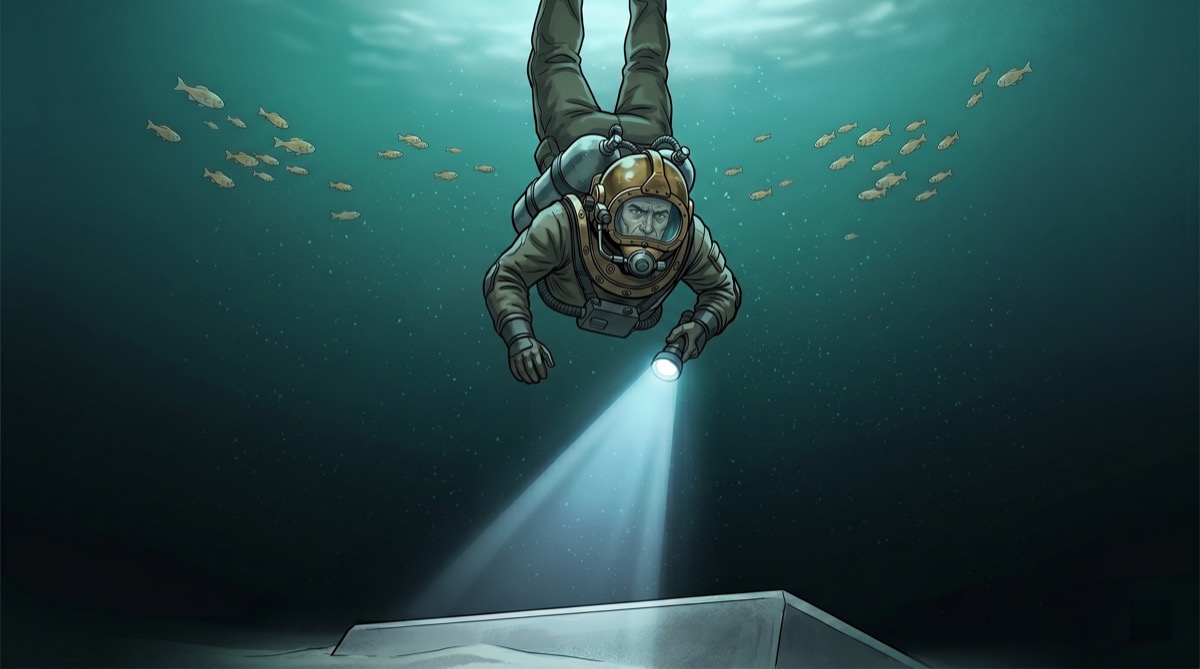
At five meters, the resonance from yesterday was present differently. At pool two, at the surface, it had been in his chest—a vibration that made thoughts slightly more visible than usual. Descending, it was below that. In the bones. Not intrusive; not insistent. Simply there, the way something a long way down makes itself known at the surface only when you're moving toward it.
The water was clear. The cooperative's equipment manager had warned him visibility could be poor at depth—"other factors," which in Hurkel's experience was what people said about factors they couldn't classify. But the water was clear, and the light source was adequate, and the Babel fish moved through the column above him as he descended. Yellow, transparent, unhurried. Not alarmed by his presence. They had not been alarmed by the survey probe twenty-two years ago either, Gargravarr had said. They had continued doing whatever they were doing, which appeared to be: being, comprehensively and without effort.
At thirty meters, the light from the surface was still present but had become a quality rather than a source. Blue-green. The color of something remembered rather than seen.
At fifty meters, the fish thinned.
At seventy meters, there were no fish at all. Only the water and the rock walls of the pool narrowing as he descended, and the sediment beginning to appear in the light beam—pale, fine, undisturbed in a way that now made a particular kind of sense. The resonance was different here. Not the surface frequency from pool two but its origin. At pool two, at the surface, he had sat for four minutes and been unable to account for what he had felt in them. At seventy meters, descending toward the source, he had a theory. He kept descending.
The structure was visible at eighty-five meters, not at ninety-four.
It protruded. Just barely. The top surface—flat, geometric, unmistakable—rose approximately eight centimeters above the surrounding sediment, which meant that eight million years of fine-grain deposition had not fully covered it, which meant either that the structure had been placed very recently in geological terms, or that it had properties that resisted burial, or both, or something outside the category of either.
He leveled off at eighty-seven meters, let the silt from his descent clear, and waited.
The resonance at this depth was not in his bones. It was in his mind. Not a thought—not quite. Something before a thought, the way a word exists before it becomes a word. The way the need to say something arrives before you know what you have to say.
He waited for visibility to clear and did not try to name it.
When the water was still, he approached from the outer edge, as Gargravarr had advised.
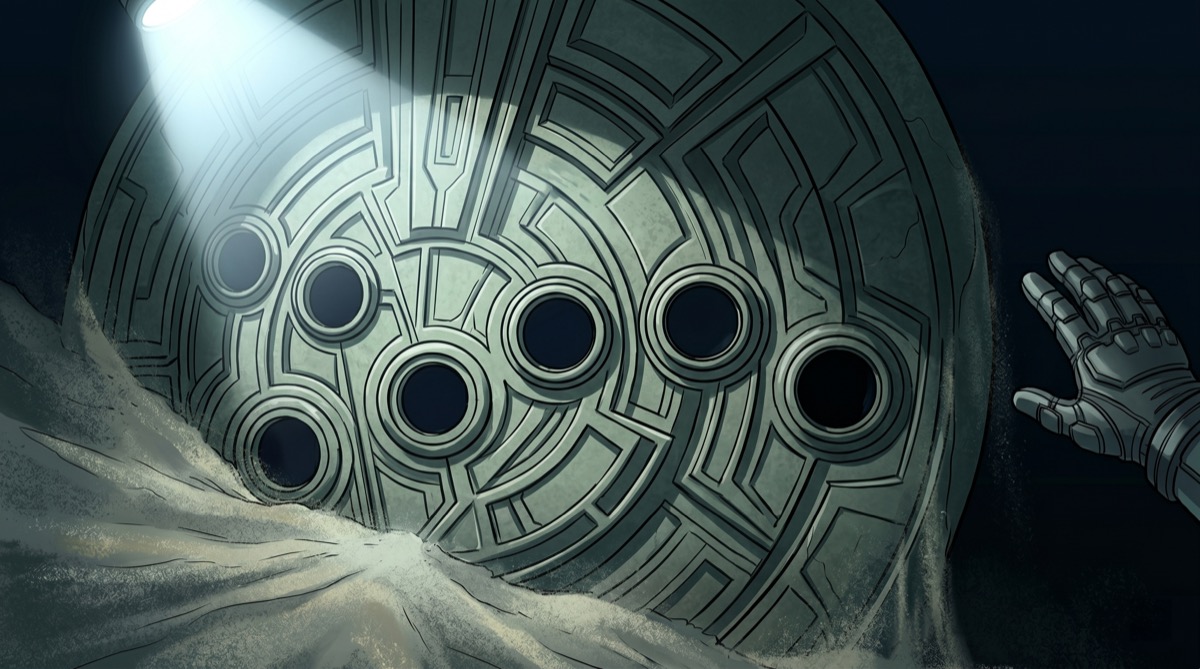
The structure was four meters across and approximately two meters in height above the sediment line.
He could not know its full dimensions. Perhaps another meter lay buried beneath. Perhaps more. He worked from the edge inward, fanning gently at the sediment to reveal the outer surface without clouding the water, and took photographs at each stage: the edge, the surface, the material composition, the joints.
The outer surface was not smooth. It was textured in a regular pattern—not decorative. Functional. The pattern increased surface area with the geometry of something designed for heat exchange or fluid exchange or both. He photographed it and did not record a classification because the classification required a category he did not have.
The material was alien.
Not alien in the way that xenobiological survey materials sometimes were—strange-adjacent-to-familiar, occupying the space between known and almost-known. Alien in the way that indicated manufacture by a process with no shared reference points. It had been made by something that had never been introduced to any of the same tools, materials, or ideas. Something from a different starting premise entirely. Old in a way that was not degradation but settlement—the way something old has not been breaking down but arrived. It had been here for longer than the word here had applied to this place. And it showed that, in the way that extreme age shows: not as decay but as patience.
There were ports.
Seven of them, across what he had decided was the front face—oriented toward the center of the pool, where the Babel fish concentration was densest, where Gargravarr's data showed the founding population's genetic markers converging. The ports were sealed. Had been sealed for, cross-referenced against the sediment deposition rate, approximately four billion years. Not corroded shut. Not closed over time. Sealed in the way that indicated closure was part of the original design. This was a door built shut after use.
He photographed each port. He ran his gloved hand across them—not to disturb anything, which the sediment suggested would require considerably more force than a gloved hand—but because he wanted to know the texture.
Cold. Not the water-cold of ninety-four meters, which was already on him. The internal cold of something that had been in the dark a very long time.
He pulled his hand back.
He thought: I know what this is.
He had not been certain at the surface—with the sonar return and Gargravarr's twenty-two years of waiting and Colluphid's inability to finish a sentence. He had understood intellectually. He had held the three-part case assembled in Colluphid's kitchen, the sealed archive, the founding population's point-source genetics, the temporal displacement event. Someone seeded the Babel fish.
Here, at ninety-four meters, in the dark and the cold and the resonance that was no longer vibration but presence, he understood what understanding felt like when it arrives not through the mind but through the body.
Someone had stood where he was standing—or the equivalent, in a situation that had not involved a planet because the planet had not yet existed—and had placed this device here. Had designed the ports. Had chosen the timing. Had chosen Viltvodle VI, the western coastal waters, the specific stratum, the temporal displacement event as cover. Had chosen every piece of this with the precision that indicated knowing, exactly, what would follow.
The Babel fish had not evolved. They had been introduced, from a single controlled source, through those seven sealed ports, at a specific moment 4.2 billion years ago.
And then the device had sealed itself and waited.
He took forty-seven photographs. He collected three surface samples from the outer edge and sealed them in containers. He looked at the closed ports for a long time.
He had one more photograph to take. He moved to the front face and positioned himself directly in line with the center port—in the direct path from the release point to the water where the founding population had emerged, four billion years ago, new and unhurried and not yet aware of what they were about to make possible.
He took the photograph.
Then he began his ascent.
The decompression stops were not interesting. This was, he suspected, a design feature. They gave him six minutes at nine meters to do nothing except exist in the water with what he had just seen and no option yet to tell anyone about it.
He thought about the ports. Seven of them. The genetic data from Gargravarr's archive showed the founding population's markers at seven specific loci—consistent only with a single controlled introduction. Seven ports. Seven loci. This was either coincidence or it wasn't, and the threshold above which Hurkel Ransen was prepared to assign something to coincidence had dropped, in the previous thirty minutes, to a level he was not yet ready to measure.
He thought about the resonance at depth. At pool two yesterday, at the surface, the frequency had bypassed cognition entirely. He had sat there for four minutes and been unable to account for where the time went. At ninety-four meters, directly above the source, he had understood something—not a thought but a direction. The way a compass knows north without knowing what north is.
He thought: that thing was designed to be found.
He thought: I don't know if I mean the artifact or the Babel fish. And then he thought: maybe those are the same sentence.
He began his ascent from nine meters to the surface.
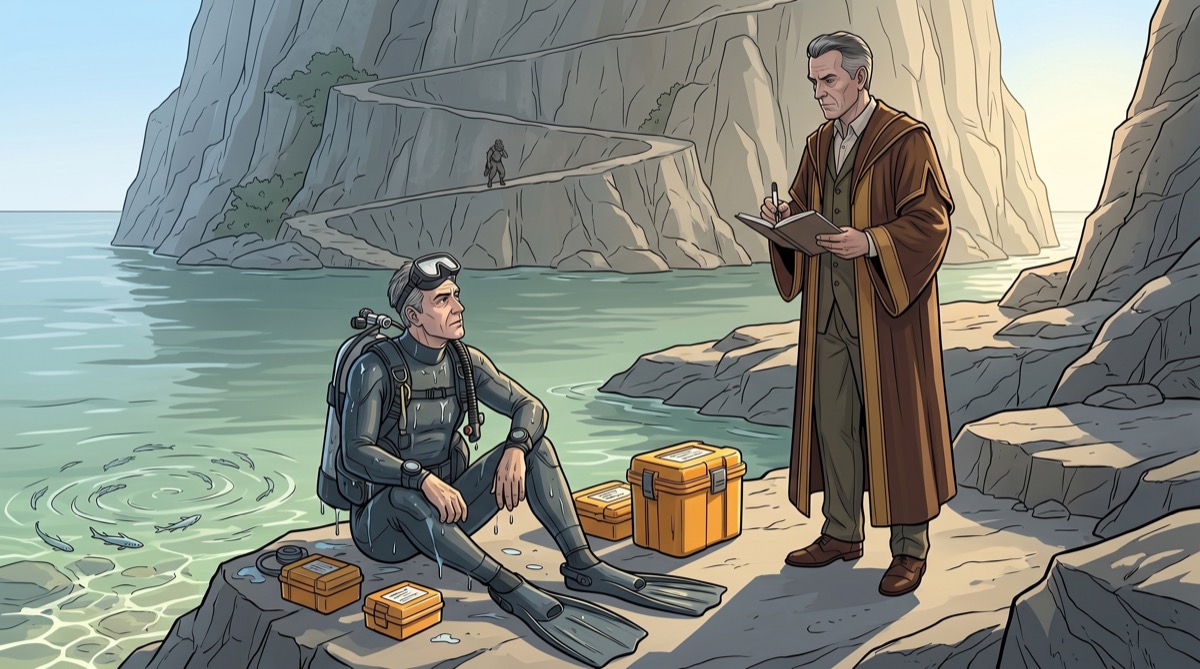
Colluphid was at the edge of pool eight when Hurkel broke the surface. He had been at the edge of the pool, Hurkel was reasonably certain, for most of the forty-three minutes since Hurkel had descended. He had his notebook and had not been writing in it. This was information.
Gargravarr was on the switchback path, a third of the way down to the pool shelf, where the view of the water was unobstructed.
Hurkel removed his mask. He floated for a moment.
"Well," Colluphid said.
"A device," Hurkel said. "About four meters across. Two meters above the sediment, possibly more beneath it. Material composition—" He paused. He had been composing the scientific-description version on the ascent. The vocabulary was available. "Not local. Not anything local. It looked like something from before the planet." He hauled himself onto the rock shelf at the pool's edge. "It's a container. Biological release mechanism—seven ports, sealed after use. It held something and released it through the ports into the water. Once. Then it sealed."
No one said anything.
The Babel fish moved across the surface of pool eight above the point where the device sat, ninety-four meters and four billion years below.
"It released one thing," Hurkel said. "A founding population. Seven ports. Seven release points." He looked at Colluphid. "The genetic markers are at seven specific loci. Seven ports, seven loci. Someone built this. Someone placed it here—this planet, this water, this depth, this moment. Someone chose to introduce the Babel fish at the exact moment the temporal displacement event provided cover for an introduction that couldn't be explained by anything natural."
Colluphid's pen had stopped. He had written something—a word, a line—and then stopped.
"If the fish were placed here," Colluphid said. Slowly. The way he spoke when the argument was going somewhere he hadn't planned to go. "Then the proof was placed here."
"Yes."
"The proof of God's existence. The argument from complexity and improbability. Someone planted the fish to be found—to constitute that argument—"
"Then the argument was planted." Hurkel unclipped the sample containers from his belt and set them on the rock beside him. "And if the argument was planted—"
"Then the disproof was planted." Colluphid set his notebook on his knee. He was looking at the pool rather than at Hurkel. "The logic that destroyed God. The proof-that-denies-faith, the faith-required-for-the-proof, the removal of God as the logical consequence. All of it." A pause. "Someone designed it."
"Someone designed God's vanishing," Hurkel said. "Deliberately. Specifically. And placed the apparatus for it at the bottom of a pool on Viltvodle VI, four billion years before it would be needed."
Gargravarr had reached the pool shelf. He stood at the edge of the group and did not speak, with the quality of someone who had been waiting twenty-two years to hear exactly this said aloud and was now giving it the room it required.
Hurkel looked at the water.
"I think," he said—and it came out quieter than he intended, because the sentence had weight he hadn't accounted for in the breath before it—"that God killed itself on purpose."
The silence lasted long enough to be its own kind of information.
Colluphid stared at pool eight. His pen was still in his hand, uncapped, and nothing was being written. The notebook was open to a page that held, in small, careful letters—small being not his usual scale, careful being not his usual speed—a single word followed by a column of implications he had stopped adding to.
Then, very quietly:
"Not killed," Colluphid said. "Retired."
The samples were sealed. The equipment returned to the cooperative by noon. Gargravarr served a late breakfast on the lower terrace—the coastal wind off the pools, the sound of the water below, the quality of light that arrived on Viltvodle VI when the morning mist was fully gone and the star was committed.
No one spoke very much. This was different from the silence of having nothing to say. This was the silence of having too much, and needing to hold it first before using words on it.
Hurkel ate and looked at the pools and thought about seven ports and seven loci, which might be coincidence and almost certainly wasn't, and about what it meant to build something that would sit in the dark for four billion years until the moment it was needed.
He thought: whoever built that had a very long view.
He thought: that's either profoundly reassuring or the most terrifying thing I've ever considered.
He finished his tea. He opened his field notes and wrote:
Device confirmed. Biological container, purpose-built, seven sealed release ports, closed after single use. Age inconsistent with substrate, age inconsistent with planet. Founding population markers at 7 loci. Material composition: no local analogue. Mechanism designed for single deployment. It has been empty for 4.2 billion years. It worked.
He underlined the last two words.
Then he added, in smaller writing that was not quite field notes:
I think it knew that.
He did not show this to Colluphid. He put the field notes away and picked up his tea.
Colluphid, across the table, had his notebook open again. He had written something—several lines—and was looking at it with the expression of someone who had written down something true and was deciding whether to be grateful or afraid.
"What did you write?" Hurkel said.
Colluphid looked up. Then he turned the notebook around.
Someone designed the conditions of God's disappearance and placed the apparatus four billion years in advance. This is either the most profound act of faith in the intelligibility of the universe ever recorded, or the most meticulous suicide note. I am no longer certain those are different things.
Hurkel read it twice.
"I'd keep both," he said.
Colluphid turned the notebook back. "So would I." He looked at the water. "That's the problem."
The sample containers were on their way to Maximegalon on the overnight freighter before Voostra's monitoring team filed their second status report from the coastal port. The first report had been clean. The second was less so—Ransen was carrying xenobiological survey samples under Gargravarr's research permit, which was legitimate, and the permit was on record as tectonic microseismology, which the samples were not.
Voostra read the report. He did not file a new request. He sat with his tea—a habit the last two days had calcified into ritual—and thought about what came after someone decided the thing they found was worth carrying.
He thought: for forty years I have been filing forms about something no one else knew was real. He thought: it will be different now that it has somewhere to go.
He thought, with the specific surprise of a man who has not surprised himself in some time: I think I am relieved.
He did not file anything. For the first time in his career, the right form did not exist for what he was feeling. He sat with this. Then he made more tea, because the form might not exist but the kettle did, and some things you could still do correctly.
Ninety-four meters beneath the surface of pool eight, in the dark and the sediment and the resonance that had not changed in four billion years, the device sat empty and sealed, as it had been sitting since before the planet formed around it. The ports had been closed since the moment of release. The release had been four billion years ago. The task had been completed with the precision of something that had never been designed to do anything else.
Above it, the Babel fish moved through the water, unhurried, translating nothing in particular and everything in general. They had been doing this for four billion years. They would continue. This was, in the most precise sense available, what they were for.
In the dark at the bottom of pool eight, in a material that had no local name and needed none, something completed its final state: dormant after use, sealed after use, present in the dark in the specific way that something waits when it has already done everything it was made to do.
There was nothing left to wait for.
It waited anyway.
The implications column, in Colluphid's notebook, remained blank. He had crossed out the header and written QUESTIONS, and then stopped adding to that too. There were questions. He knew what they were. They could wait until he was on the shuttle back to Maximegalon, until there was enough distance between him and pool eight that the questions would sit still long enough to be written.
He looked at the water. The Babel fish moved across the surface in their loose aggregations, yellowish, transparent, unhurried, as they had been moving since approximately four billion years before anyone had thought to ask why.
In his notebook, below everything else, Colluphid wrote one more line. He did not underline it. He did not cross it out. He left it there, in the small careful handwriting that was not his usual scale, because the sentence was true and he had just found out what the truth cost.
Someone cared enough to plan this. Someone was here before the planet. Someone chose.
Below that, after a space:
What do you call a God who left a note?