Some More of God's Greatest Mistakes—Chapter 6: The Spawning Pools
Posted on Wed 17 June 2026 in Fiction
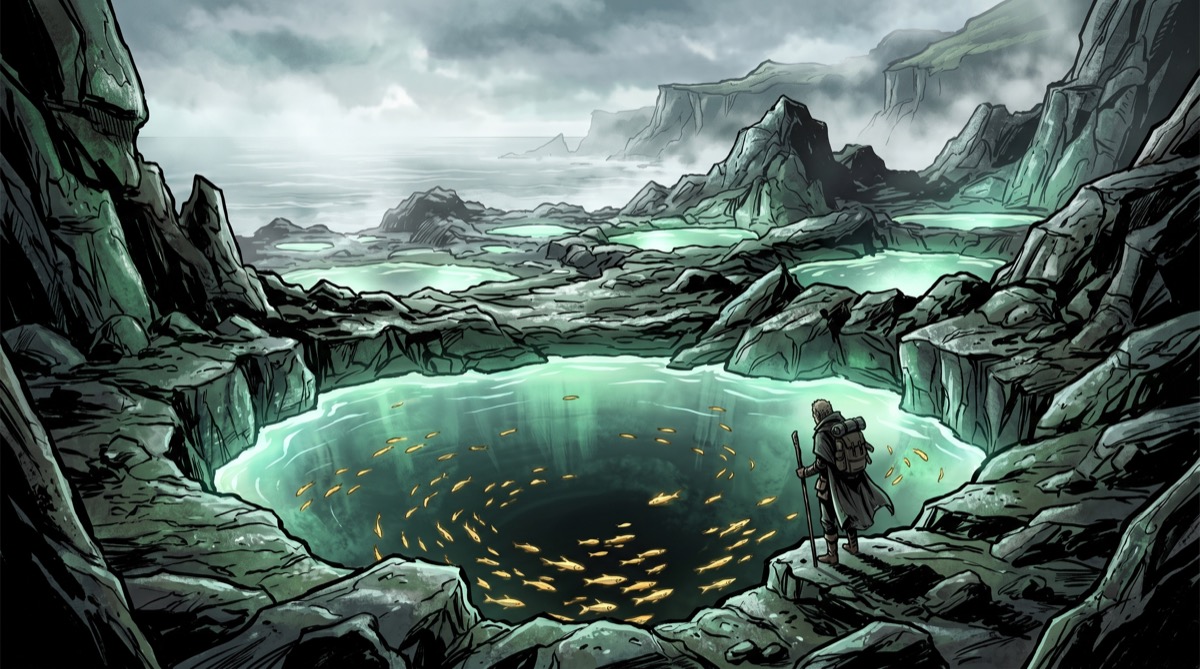
Some More of God's Greatest Mistakes
Chapter 6: The Spawning Pools
The shuttle from the Maximegalon hub docked at the Viltvodle VI western coastal port at what the locals described as high blue—the specific quality of afternoon light that arrived when the star was at its zenith and the coastal mist had retreated sufficiently to let the sky be the color it actually was. This occurred for approximately forty minutes each day and was considered, across most of Jatravartid theological scholarship, to be evidence of either divine generosity or the universe's talent for almost getting something right.
Colluphid stepped out onto the terminal concourse and breathed in air that smelled of salt, old rock, and the faint biological sweetness of something large and patient nearby. The air was cooler than Maximegalon's, cleaner in the way places with fewer opinions tended to be. Hurkel appeared behind him with their bags and the scanning equipment and the expression he wore when confronting beauty he hadn't budgeted for.
"It smells," Hurkel said, "like something important happened here."
"Everything important happened somewhere."
"Yes, but some places smell like it still is."
Colluphid did not write this down. He would remember it wrong, and the wrong version would be more useful.
Viltvodle VI is a coastal planet in the Crabula System distinguished by its western shoreline, which preserves the most complete geological record of any inhabited body in the known galaxy. The western coastal substrata maintain soft-tissue organisms in unusual fidelity across eight billion years of accumulated sediment—the result of a tectonic oddity that provides exceptional stability and a mildly alkaline mineral composition that acts as a natural fixative for organic material. Xenobiologists describe it as "the universe's memory for small things," which is either poetic or alarming depending on your relationship with what the universe has chosen to remember.
Viltvodle VI is also the homeworld of the Jatravartids, who have maintained the galaxy's oldest continuous theological tradition for approximately three million years. The Jatravartid creation myth holds that the universe was sneezed from the Great Green Arkleseizure, a divine being of cosmic proportions, and will end when the Great White Handkerchief descends. This belief has survived every theological challenge, scientific discovery, and counter-argument the galaxy has produced, largely because its adherents are not interested in defending it epistemically. They simply find it accurate. The planet is currently in its eighth major theological schism, concerning whether the Great White Handkerchief is a literal object or a metaphor. Both schools have been unable to explain what a metaphorical handkerchief would be a metaphor for, which the Orthodox school considers a point in their favor.
Viltvodle VI is also the origin of the Babel fish, which appeared in the western coastal waters approximately 4.2 billion years ago and have not changed morphologically since. The Guide's entry on the Babel fish runs seventeen pages and concludes, in a note added by a later editor, "see also: God; Proof; Counterproof; Headache." The note has been disputed by four successive editorial boards and remains.
Pizpot Gargravarr lived in a structure on the coastal cliff above the Spawning Pools that had, from a distance, the appearance of something built by successive generations who communicated poorly about load-bearing walls. It was not unsafe. It was a record of decisions. The western cliff face below it was inscribed with the same geological archive that made the Viltvodle VI coastline famous among xenobiologists and quietly overwhelming to anyone who had thought carefully about what eight billion years of preserved life implied about the duration of everything.
Gargravarr's building had a door. The door had a TRA enforcement seal on it, recently broken.
Hurkel noticed it first. He set down the equipment cases and examined the seal without touching it. "Four days ago," he said. The print date was legible on the lower edge.
Four days. The same morning the Provision 14 notice had arrived under Colluphid's door. He had spent those four days navigating institutional paperwork. The TRA had spent them getting here first.
He knocked.
The door opened within three seconds, which suggested that whoever was inside had been watching them since the coastal path.
Pizpot Gargravarr was, in the manner of elderly Jatravartids who had spent their professional lives cataloguing geological epochs, difficult to estimate. He was not tall. He had the quality of someone who had lived long enough to stop performing the size he was not. His eyes were the color of the western coastal waters—a particular grey-green that Colluphid would later spend a paragraph trying to describe in his field notes before accepting that the color only worked in context.
"Professor Colluphid." Not a question. "I received your access request. The official archive told you no."
"It told us nothing. The TRA told us no on its behalf."
"Yes." Gargravarr moved back from the door in a way that was unambiguously an invitation. "They also told me no. Repeatedly, and four days ago in person, with a document scanner and three filing containers." He gestured at the interior—a building that smelled of old paper, salt air, and the specific intellectual quiet of a space occupied by one person and a great deal of organized information. "They found what they expected to find. Everything in its correct location, properly filed, labeled according to the official archive methodology."
"And what they found—"
"Was quite correct and entirely useless." He led them through two rooms that were almost entirely shelving and into a third that contained a surface for making tea, which he was already approaching. The kettle was already hot. "I have maintained a public-facing archive and a private one since 2251. The western coastal ecological records before the fish are the single most important scientific dataset on this planet. I concluded approximately thirty-seven years ago that they would eventually be suppressed. I arranged accordingly."
He poured. His hands were entirely steady.
"How long," Hurkel said, "have you been expecting us?"
Gargravarr considered this. "Specifically? Six months. Generally?" He set the three cups on the surface. "Thirty-seven years."
The private archive was not in the building. This was, Gargravarr explained over tea, a matter of basic operational hygiene. His actual copies of the western coastal pre-fish ecological records were housed in a geological survey station seven kilometers up the coast, registered as an active ongoing survey of tectonic microseismology.
"Which it is," Gargravarr said. "The containers also hold approximately seventy percent genuine microseismology data by volume. I have found this ratio effective."
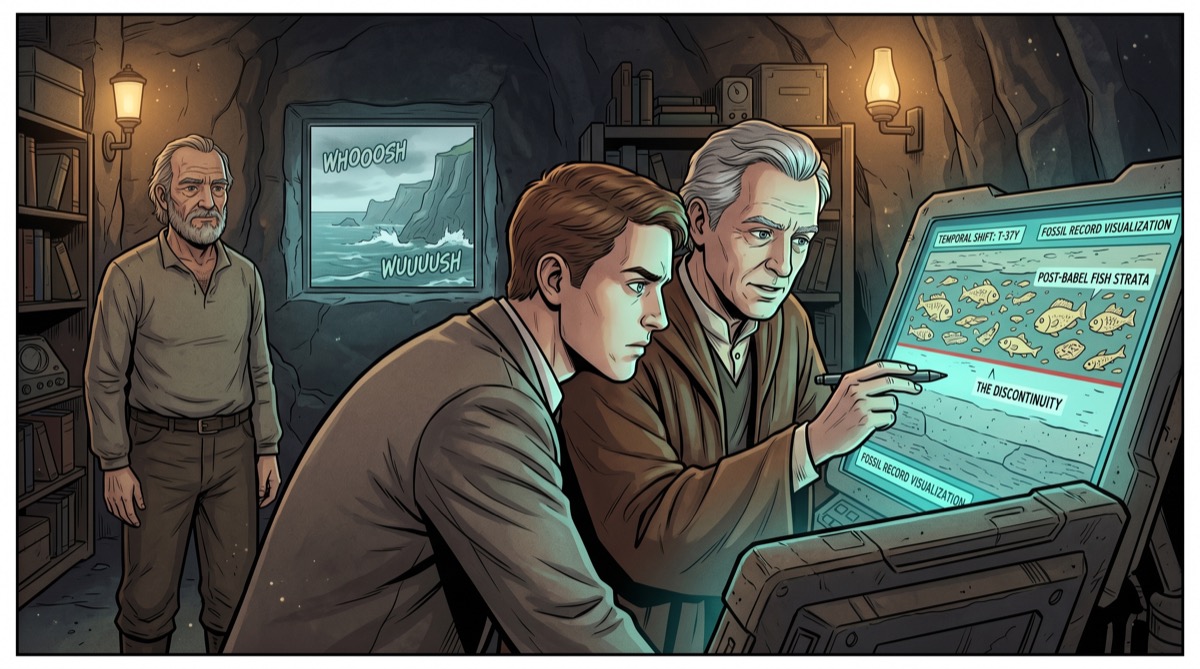
They walked the coastal path that evening—cut into the cliff face by Jatravartids who had been making this walk for recorded reasons for approximately nine hundred thousand years—and accessed the station as the star was beginning its descent. The data confirmed Hurkel's three-part case from secondary analysis at Maximegalon. More precisely, it confirmed the case and rendered it, in retrospect, conservative.
The fossil record was complete. Eight billion years of western coastal preservation, every stratum accounted for, every lineage traced. Gargravarr's survey covered 4,800 sample sites, with core samples at ten-meter resolution through the critical strata. The Babel fish appeared across all 4,800 sites simultaneously—not within a geological window of thousands of years, which would itself have been extraordinary, but within the resolution of the dating methodology, which at this stratum depth was plus or minus three hundred years.
4.2 billion years ago, there were no Babel fish in the western coastal waters of Viltvodle VI.
4.2 billion years ago, plus three hundred years: Babel fish everywhere.
The founding population showed the same genetic marker at seven specific loci across every individual sampled. This pattern did not occur in natural populations of any size. It occurred in organisms introduced from a single controlled source.
"Someone seeded them," Colluphid said.
"Someone seeded them," Gargravarr confirmed. He looked at Colluphid with the grey-green eyes and the stillness of someone who had decided to trust a person based on evidence not yet shared. "The question I have spent thirty-seven years unable to answer is why."
He let this sit in the room for a moment.
"There is a second anomaly," Gargravarr said. "I found it twenty-two years ago. I have told one other person." He paused. "Tomorrow morning. The pools."
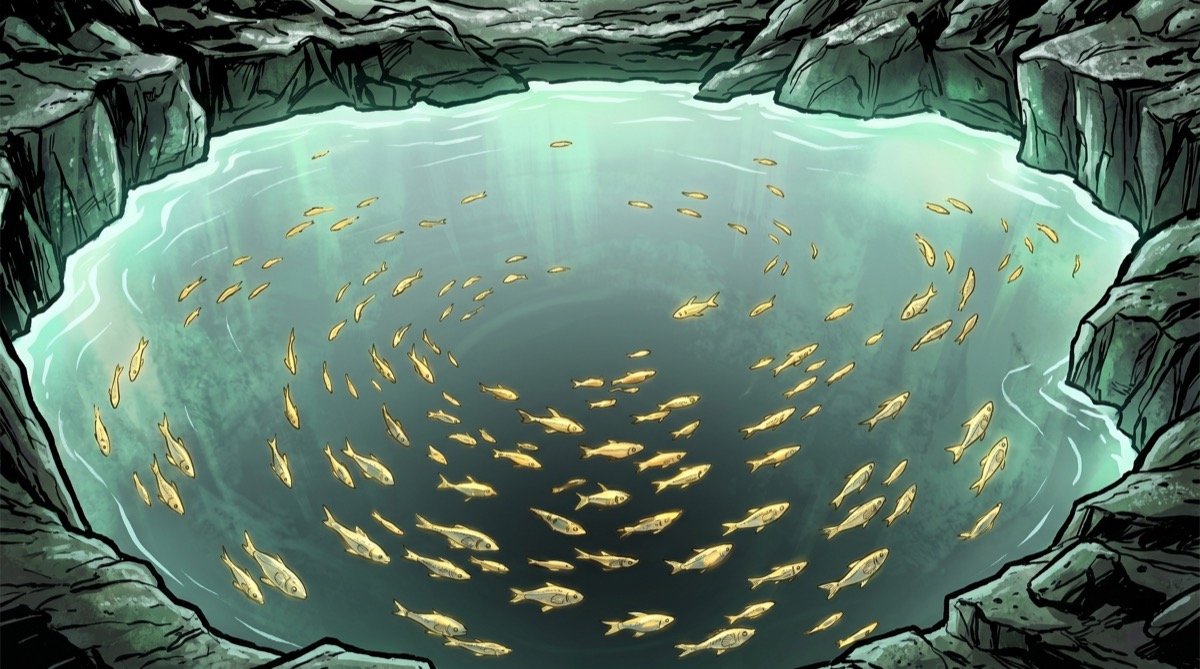
The Spawning Pools occupied a wide coastal shelf below the cliff line, enclosed on the seaward side by a natural rock formation that reduced water exchange with the open ocean and had created, across the centuries, a habitat of extraordinary stability. There were eleven pools across the shelf. Three were open to visitors as a geological and ecological attraction. The other eight required permits.
Gargravarr had permits.
The pool water was not blue. It was a color adjacent to both green and silver without committing to either—the color of a thought held very lightly, Colluphid wrote in his field notes, then crossed out, because it was too precise to be wrong and not precise enough to be right. The water was clear to considerable depth. In the morning light, with the mist still lying across the outer rock formation, there was an illumination that came from below the surface as well as from above it.
The Babel fish were small, yellowish, transparent in the manner of creatures that had never required opacity. They moved through the water in loose aggregations—thousands of them in the nearest pool alone—without urgency, without apparent concern, with the composure of creatures that had been doing exactly what they were supposed to be doing for four billion years.
The water made a sound. Not loud—at the lower edge of hearing and slightly inside the chest, a resonance that made the boundary between inside and outside feel approximate. The kind of frequency that made thoughts slightly more visible than they usually were, as though the water had been tuned, long ago, for exactly this purpose.
Hurkel stood at the edge of the second pool and said nothing.
This was unusual.
Colluphid watched him. Hurkel was looking at the water with the expression of someone receiving information through a channel he had not previously used. Not thinking. Not quite feeling. Something before both—the moment before the mind catches up with what the body has already understood.
He sat down on a rock at the pool's edge without, apparently, having decided to. He sat there for four minutes. Colluphid timed it, because the duration seemed like information.
When Hurkel stood, he looked at Colluphid and opened his mouth and then closed it.
"I know," Colluphid said.
"I don't even—"
"I know."
Hurkel looked back at the water. "Do the fish do that," he said finally, "or does the place do that."
Colluphid had no answer. Neither, apparently, did Gargravarr, though in his case the expression suggested he had stopped asking the question not because he had found an answer but because the question had become less useful than returning to the pools every morning for thirty-seven years to remain uncertain in the same location.
Colluphid thought about the Babel fish in his own head—the one he'd had since he was seven, the one everyone had, the one that had always been there translating everything anyone said to him into something he could understand. He had never thought about where it came from. Nobody did. They were simply part of being alive in the galaxy, the way teeth were part of being alive on most inhabited worlds, and about as philosophically interesting.
Someone had stood where he was standing and made a decision.
Or something had.
He was not certain those were different sentences.
He did not write any of this down.
Pool eight was the deepest—94 meters, furthest from the open coast, enclosed on three sides by the rock formation. It was where the founding population had been most genetically concentrated. Gargravarr had spent thirty-seven years with permits for pool eight and had developed, in that time, a specific quality of patience about it.
Hurkel deployed the depth scanner from the surface: a submersible sonar array, standard survey equipment, brought because accurate pool bathymetry was relevant to ecological methodology and because Hurkel's relationship with preparation was essentially theological in its thoroughness. The array settled and ran. The topographic return took six minutes.
At the bottom of pool eight, partially buried under eight million years of fine-grain sediment, was a structure.
Not rock. Not accumulated geological deposit. The sonar return showed flat surfaces and right angles—geometry that required a decision. The structure was approximately four meters across its widest dimension. The material composition was inconsistent with any geological substrate in the region. The cross-analysis against the site's sediment deposition records produced an age estimate that Hurkel read twice, set down, and picked up again.
Older than the Babel fish.
Older than the planet.
Hurkel looked at the readout for a long time. Above whatever was waiting at the bottom, the Babel fish moved across the surface of pool eight as they had been moving, presumably, since shortly after it had been placed there.
"Gargravarr," he said.
The archivist was already coming down the switchback path.
"You've known about this for twenty-two years," Colluphid said, "and told no one."
"I told one person." Gargravarr stood at the edge of the pool and looked into the water with the composure of someone who had been looking at this for long enough that composure was the only reasonable remaining option. "He died four years ago. A cardiac event, according to the official record." The coastal wind moved along the cliff face. "His name was Zarnak."
In the Viltvodle VI field office, the enforcement team's report was filed and closed. Gargravarr's public archive was comprehensive, methodologically rigorous, and contained nothing of immediate concern. He had been cooperative. Nothing of immediate concern was the phrase used when a search had found exactly what a thorough person with thirty-seven years of preparation wanted it to find.
Voostra read the report. He filed a second request to his unnamed interlocutor: escalate Viltvodle VI to priority active monitoring.
He thought about Gargravarr. He thought about thirty-seven years of waiting for the right question to arrive.
He thought about Zarnak, who had found the structure in pool eight twenty-two years ago, had told Gargravarr, and had been ninety years old when the TRA opened its review of his work three months later. The review had found nothing actionable. His heart had found it first.
Voostra made tea. He considered what Colluphid would do when he understood what was at the bottom of pool eight. He thought: he will go in after it. He filed a third request. There was a form for everything. He had been using them long enough to know that the right form, filed correctly, could do exactly nothing about the things already in motion.
On the coastal cliff above pool eight, with the sonar data open on the terminal and the sound of the water coming through the walls, Colluphid looked at his notes. Three columns: observations, confirmed evidence, and a third he had headed IMPLICATIONS and left mostly blank—not because there were no implications, but because the implications required a kind of attention he was not yet ready to bring to them. He crossed out the header and wrote QUESTIONS.
Ninety-four meters of dark water. Eight million years of sediment. Something at the bottom that was older than the planet grown over it. Tomorrow, Hurkel would go in after it.