Some More of God's Greatest Mistakes—Chapter 5: The Authority Tightens
Posted on Sat 13 June 2026 in Fiction
Some More of God's Greatest Mistakes
Chapter 5: The Authority Tightens
The shuttle from Brontitall docked at Maximegalon's north transit hub at eleven forty-three in the evening, which was late enough that the building's delivery system had completed its final round and early enough that the night security staff had not yet developed a strong opinion about anything. Colluphid rode the lift to the forty-second floor, unlocked his door, and found an envelope under it.
Printed, not transmitted. The Theological Regulatory Authority's seal was on the flap.
He carried it to the kitchen, where Hurkel was sitting at the table with a mug and the expression of someone who had been awake and waiting and had developed, over the course of the evening, a complete theory about what was in the envelope.
"You knew," Colluphid said.
"I suspected." Hurkel pulled a folded paper from his jacket pocket and set it on the table. It had red annotations in the margins, some underlined twice. "The shuttle booking confirmation came back in four minutes. I looked it up—independent carriers on that route use manual processing. Standard turnaround is twelve to fifteen minutes." He tapped the paper. "Four minutes means someone was watching the queue."
Colluphid looked at the red ink. He set the TRA envelope beside it.
"When were you going to tell me."
"When the thing it predicted arrived," Hurkel said. "Which is now."

The envelope contained eighty-one pages.
The first three were cover correspondence from Senior Inspector Azraphon Voostra, which managed, through the formal artistry of someone who had spent a career constructing sentences that said exactly what they meant while also saying something else, to be simultaneously procedurally precise and something Colluphid could only describe as architectural—like standing in a building you had not consented to enter.
The operative section—what the first three pages had been preparing him to receive—was a notification that his sequel research project, Some More of God's Greatest Mistakes (provisional title), had been classified under Provision 14(a) of the Theological Regulatory Authority's Impact Assessment Protocol as a Theologically Consequential Inquiry. This required:
Pre-submission of all research materials, primary sources, field notes, and any objects, documents, or artifacts of theologically significant origin currently in the research team's possession, to be held under provisional TRA administrative authority pending classification review.
A research methodology declaration, certified by an academically recognized theological oversight body.
A seventeen-field Theological Impact Registry covering the anticipated response of each of the seventeen registered theological traditions to any claim, implication, or inference that might reasonably be drawn from the research.
And a hold on all planned research activities in the Viltvodle VI system until the Assessment was complete, which the Protocol indicated would take a minimum of fourteen months.
"Fourteen months," Colluphid said.
"Page forty-two," Hurkel said. "Subsection (e), clause seven. I read ahead."
Page forty-two noted that in cases involving primary materials of unusually significant theologically sensitive origin, the review period might be extended at the Inspector's discretion. No maximum was given.
The Hitchhiker's Guide to the Galaxy has, among its seventeen million entries on theology, approximately four hundred and twelve covering the Theological Regulatory Authority of the Western Spiral Arm. Of these, three hundred and nine are procedural summaries, sixty-seven are warnings, twenty-two are historical accounts, and exactly one is classified as "advice."
The advice reads: "Do not publish anything that makes the TRA's regulated theological landscape look complicated, since the TRA's entire operational mandate rests on the premise that the theological landscape is manageable. Publishing research that implies the landscape is considerably more complicated than forty years of careful management have indicated will cause the Authority to activate Provision 14(a), which is the TRA's way of saying: we can keep you here indefinitely, and we will, and there is a form for that.
"The Guide reviewed twenty-three academic researchers who received Provision 14(a) notices in the previous century. Their subsequent research productivity averaged forty-one fewer publications than their pre-notice trajectory would have predicted. The Guide does not say what happened to the researchers. It says only that the pattern was consistent.
"The Guide's editorial board has declined to add further comment. Three of them have tenure at Maximegalon and prefer to keep it."
Merriwyn Satch called at eight forty-two the following morning.
The TRA's Publishing Review Division had notified Galactic Horizons Press at seven fifteen—the precise hour at which the press's administrative department opened for incoming correspondence—and Colluphid recognized the timing as coordination rather than coincidence. The notification indicated that publication of materials currently under Provision 14(a) review might constitute unauthorized disclosure of Theologically Sensitive material, subject to the Authority's enforcement provisions.
"Which means they can seize the print run after publication," Satch said. "The lawyers spent the morning on this. The answer is yes, if they can classify the material—and given that you are writing about God, they can probably find something."
"The commercial window," Colluphid said.
"Depends on delivery by the fifteenth of next quarter." She said this in the tone of someone delivering a message they were asked to deliver in a way that communicated more than the message. "Zarniwoop would like me to note that the first book sold four million copies after the TRA notice. He would also like me to note, in the same breath, that a fourteen-month hold is not a TRA notice. A fourteen-month hold is a fourteen-month hold."
"I understand."
"Oolon." Her version of his first name, deployed at the register where it meant the professional relationship did not technically cover what came next. "What are you into."
He thought about the fossil record, the temporal anomaly stratum, the pre-proof seal placed forty-one years ago, the shuttle confirmation returned in four minutes by someone watching a queue they should not have been watching.
"Significant research," he said.
"Should I be concerned."
"Not yet. But accurately."
A brief silence in which both of them contemplated the specific logical structure of that sentence.
"Not reassuring," she said.
"No," he agreed. "But accurate."
The university's notification arrived at eleven.
The Maximegalon Academic Conduct Committee—a body Colluphid had not encountered in twenty-two years of tenured appointment, apparently convened under a provision dating to 2187, the same year the clock tower had acquired its temporal paradox—had received, via administrative coordination with the TRA, a query regarding whether his research was being conducted in compliance with Document 7(b) of the university's Theological Research Protocol. This Protocol, not formally invoked in forty-three years, required that research "likely to produce findings with significant theological implications" be conducted under an academically recognized oversight framework certified by a registered theological institution.
Colluphid did not currently have a certified oversight framework. The Committee had opened a formal inquiry. If the inquiry found him non-compliant, his tenure could be placed under review.
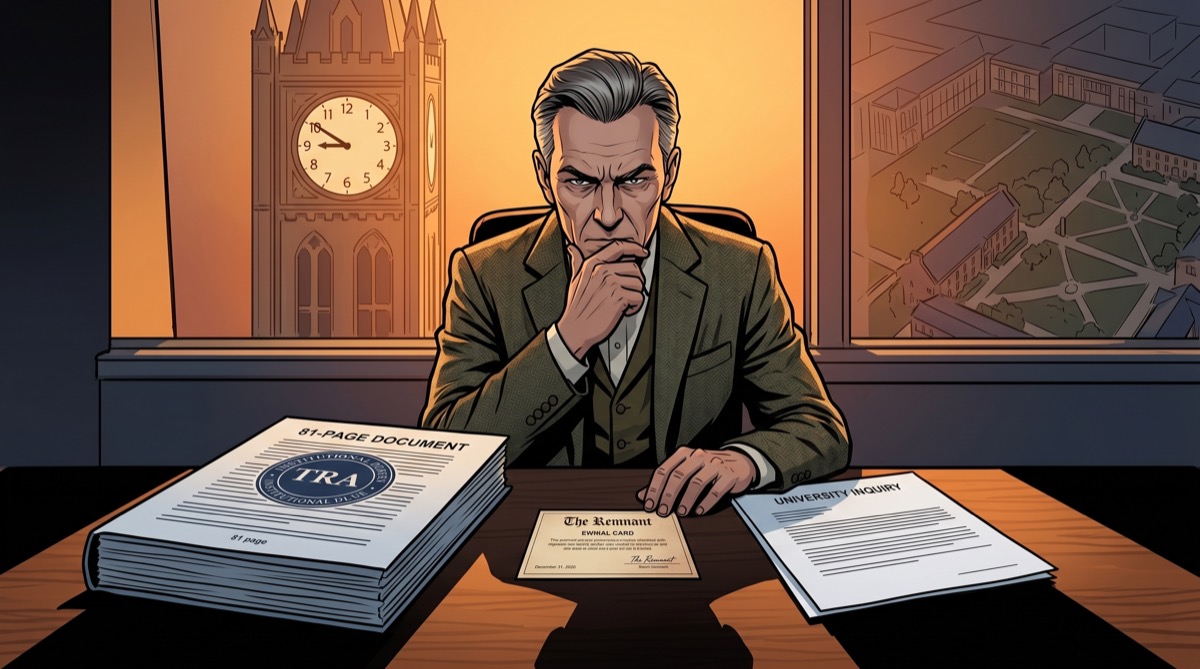
He read it twice. The clock tower was visible through the window—showing eleven twelve, which was either correct or, depending on how the temporal paradox had resolved itself over the past twelve years, approximately forty minutes ahead of reality. Colluphid had never established which. Everyone had simply adjusted.
"Hurkel," he said.
Hurkel appeared in the doorway.
"The university access card."
"Valid during review. Revocation requires a completed finding, which takes months." Hurkel leaned against the frame. "We leave for Viltvodle VI in four days."
Colluphid looked at the two documents side by side—eighty-one pages and four pages, both aimed at the same point. Someone had spent considerable time identifying the exact levers. The TRA threatened the research. The publisher threatened the deadline. The university threatened the platform. Each mechanism was individually coherent. Together they produced a narrowing corridor rather than a wall, which was more sophisticated and, he reflected, considerably more irritating.
He thought about this for approximately ninety seconds.
Then he stopped thinking about it, because there was nothing in the corridor that was going to stop him from boarding a shuttle in four days, and the ninety seconds had been sufficient to confirm this.
He called Divna.
She answered on the second ring.
"You've seen the notice," she said.
"All eighty-one pages."
"We received a copy through Cathedral channels this morning. The Viltvodle VI hold is the operative threat—they're not trying to stop the book. They're trying to stop the source."
"I know." He was at the window. The three academic quads below were doing what they always did in the mid-morning—filling and emptying with the unhurried rhythm of institutions that expected to be here after everyone currently standing in them was gone. "Can they enforce the hold."
"On research conducted under your current standing? Yes." A pause in which she was clearly deciding how much to give at once. "On research conducted under formal Cathedral institutional authority? No. The Brontitall Concordat of 1847 established reciprocal research immunities between the Cathedral of the Conditions and the Theological Regulatory Authority. Research conducted formally under Article 12 falls outside TRA Provision 14 jurisdiction. To touch it, they'd need a separate inter-institutional process through the Brontitall Ecclesiastical Court."
"How long would that take."
"The Court's standing docket backlog is approximately eleven years."
He looked at the quads.
"Divna," he said.
"Formal affiliation with the Cathedral's Applied Divinity department requires a sponsoring faculty member." Her voice was steady and deliberate in the way that things said carefully are steady and deliberate. "I am a faculty member in the Cathedral's Applied Divinity department."
"It would put your name on the research."
"Yes."
"The TRA's attention would extend to the Cathedral."
"The Cathedral has been managing TRA attention since before Voostra was in his first posting." A shorter pause, this one a different quality than the previous ones. "I want to be clear: this is not without risk."
"I know," he said. "That's why I said your name rather than someone else's."
She was quiet for a moment. Through the window, a cluster of students crossed the second quad in a loose formation that suggested argument without urgency about something that probably mattered and probably wasn't this.
"I will send you the affiliation paperwork today," she said. "Complete it before your shuttle leaves. The Cathedral's institutional stamp covers all research conducted under the arrangement." A brief pause. "Oolon. The Concordat holds because nobody has been foolish enough to force the Ecclesiastical Court to test it in living memory. If what you find on Viltvodle VI is significant enough, Voostra may decide the eleven-year wait is worth it."
"Then we'd better find it fast," he said.
"Yes." Then: "Tell me what you find."
It was the second time in two days he had said he would. This time the sentence carried something the first time had not. He was not certain the first time had been a different sentence, now that he was two days further from it.
By mid-afternoon he had annotated eighteen provisions of the TRA notice, completed Sections One through Four of the Impact Registry, and confirmed, in the amount of time it took to read eighty-one pages twice, that Provision 14(a) had approximately the same relationship to ongoing scholarship as quarantine had to medicine—technically valid and practically inert, provided someone had left the door open before the lockdown was implemented. Someone had. He was leaving for Viltvodle VI in four days regardless of what the Protocol said about his itinerary.
Hurkel had spent the same period reviewing TRA enforcement records—specifically, which research projects had been stopped by Impact Assessment and which had continued. "The ones who got stopped tried to fight it directly," he said. "The ones who kept going found a door."
"Divna found a door."
"She had one made," Hurkel said. "Which is considerably better."
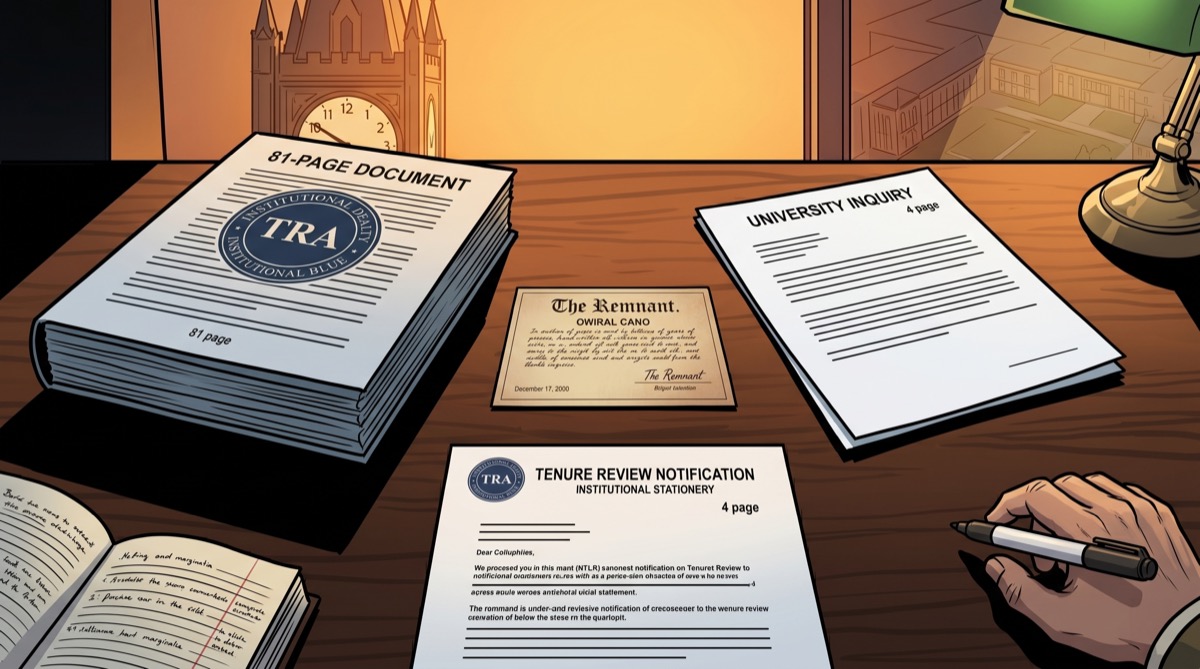
The formal tenure review notification arrived from the Academic Conduct Committee at eighteen twenty, as the administrative offices were closing for the day and no one would be available to discuss it until morning. Colluphid read it, placed it on the desk beside the other documents, and looked at the arrangement.
Three documents. Eighty-six pages of institutional intent, all pointed in the same direction.
Under the TRA notice—filed there before he had opened it, not moved because he hadn't noticed it—was a card. Smaller than the others. Not institutional stationery. Something older, written in a hand that had been practicing this particular form of patience for considerably longer than any of the institutions currently demanding his attention.
He knew the handwriting from eleven pages of notes he had not re-read.
Professor Colluphid,
We are aware that the truth has become inconvenient for certain administrative parties. We would like to observe, from the vantage of four billion years of continuous residence on this planet, that this is entirely normal. The truth has never been convenient for administrative parties. In our experience this is the primary method by which you can distinguish the truth from other things.
The truth is never convenient. That's how you know it's the truth.
We look forward to your visit.
—The Remnant, Still Here
He read this twice. Then he set it down on the desk between the eighty-one page TRA notice and the university's four-page inquiry, where it occupied considerably less space than either and somehow weighed more.
The clock tower showed six fifty-two. Colluphid had no information about whether this was accurate. Everyone had simply adjusted.
He opened his notebook to the page that should have held yesterday's notes from Brontitall and still didn't. In the margin, in the small handwriting he used for things he wasn't ready to draft, he wrote:
Four billion years and they still think it matters.
He meant the Remnant. He also, without having planned to, meant himself.
In his office three blocks from the university's theological faculty, Senior Inspector Voostra filed the Impact Assessment confirmation at nineteen hundred hours exactly and permitted himself approximately ninety seconds of what might, from the outside, have appeared to be satisfaction.
He had read the Brontitall Concordat of 1847. He had, in fact, read Article 12 more carefully than Divna Allay knew. The Cathedral's institutional umbrella was real. The Ecclesiastical Court's backlog was real. The eleven-year timeline was real.
He filed a secondary request to his unnamed interlocutor: accelerate the Viltvodle VI operational timeline. If Colluphid was going to reach Pizpot Gargravarr before the Assessment held him, what Gargravarr knew needed to be contained before they arrived.
Voostra closed the file. He thought, briefly, about a researcher named Zarnak who had been ninety-three and had also found a door.
He made tea. He drank it.
On the forty-second floor, four days from Viltvodle VI, Colluphid folded Divna's affiliation paperwork into his bag.
He had never required an institutional umbrella before. He had always been sufficiently inconvenient on his own terms.
He wasn't sure how to feel about needing one now. Or about what it had cost the person who offered it. Or about the fact that she had prepared the paperwork before he called.
He left these thoughts in the margin where they lived and looked out at the three academic quads. The clock tower was wrong. Everyone had adjusted.
The card from Still Here remained on the desk, between the bureaucracy and the deadline, with the specific composure of something that has been waiting long enough to have become comfortable with it.