Some More of God's Greatest Mistakes—Chapter 4: What We Talk About When We Talk About Suffering
Posted on Wed 10 June 2026 in Fiction
Some More of God's Greatest Mistakes
Chapter 4: What We Talk About When We Talk About Suffering
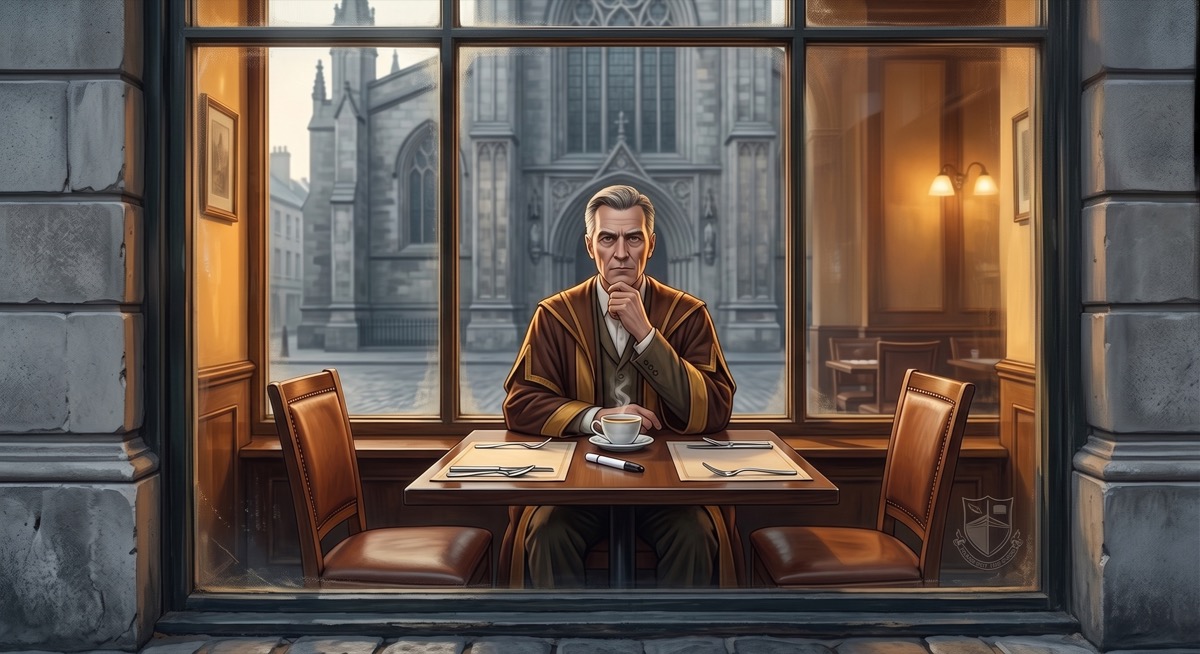
The tea shop near the Cathedral of the Conditions had been in the same location for three hundred years, which meant it had outlasted seven architectural expansions of the Cathedral it was adjacent to, four changes of municipal government, and one incident involving an experimental weather-management system that had produced two weeks of perfect rain that everyone had enjoyed and eventually had to stop for agricultural reasons. The shop had survived all of this by offering three things with consistent excellence: tea, adequate pastries, and the specific social service of providing a place to sit when the Cathedral was too formal for what you needed to say.
The table by the window faced the Cathedral's east wing. Colluphid arrived first, as he had arranged, and spent the resulting eleven minutes looking at the Cathedral and his untouched tea in alternation. The staff member who brought the second cup made no comment, because the table by the window had developed, over enough visits to constitute a pattern if not yet a tradition, the particular quality of furniture that knows you.
Divna arrived, found the table without looking at the room, and set her bag down with the care of someone whose bag contained things that mattered. She sat across from him with the expression of someone who had decided, in advance, not to perform either distance or warmth, and had arrived at the place where neither was required.
"You came," he said, which was not what he had planned to open with.
"You called," she said, which was her version of the same.
She reached into the bag and produced a folder. Cathedral blue. Approximately two centimeters thick. She set it on the table between them with a precision that communicated a great deal about the past week of her life.
"That's my book," Colluphid said.
"Twice through," she confirmed. "Chapter Seven, three times." She opened the folder, looked at the first tabbed section, and closed it without removing anything. "I can't find the flaw."
"You've been looking for the flaw."
"Since the publication party." She said this without apology, which was the only appropriate tone for it. "The Chapter Seven argument is airtight."
"I know."
"That is the problem." She looked at the folder with the expression of someone who had produced their best work and arrived at a conclusion they would have preferred not to arrive at. "An airtight argument for a false premise is the worst possible outcome. It's wrong in a way I can't point to, which is considerably harder to address than a book I could actually argue with."
"But you brought notes."
"I always bring notes. Notes are not rebuttals. Some of these are observations. Some are questions." She tapped the folder. "One is a diagram."
"A diagram."
"You'll understand when we get there."
The tea arrived, as it always did, at the moment when it would be most useful.
The Hitchhiker's Guide to the Galaxy has this to say about theodicy:
"Theodicy is the branch of theology concerned with explaining how a good God and a suffering universe can coexist without this arrangement constituting a significant oversight on someone's part. The question was formulated independently by every major civilization in the known galaxy that developed both organized religion and the capacity to feel pain, usually within the same three-thousand-year window, and often by the same theology department.
"The most popular solutions, having accumulated over several billion years of combined effort, are as follows:
"Free will requires the possibility of suffering, and free will is worth it. This position has the advantage of philosophical elegance and the disadvantage of requiring its advocates to demonstrate, with some precision, that free will is worth the specific amount of suffering it has apparently generated—a calculation that consistently produces results the advocates prefer not to share with the public.
"Suffering builds character. Critics note that the universe, if this is its method, has significantly overengineered the curriculum. Advocates have not successfully explained why the advanced coursework was necessary.
"God is not omnipotent, and therefore cannot prevent all suffering even with the best intentions. This solution resolves the theodicy problem while creating a different problem, which is a deity with limitations, which tends to affect public confidence in the deity's overall portfolio.
"Suffering is an illusion. This position has been argued, at length, by beings of considerable intellectual distinction, to a consistent reception that can be summarized as: not to anyone currently in it.
"After several billion years, theodicy remains the most practiced and least resolved branch of theology in the known galaxy. Its practitioners are unanimous that the question matters enormously and unanimous about nothing else, which is the professional condition that theodicy alone has normalized as a viable career.
"The Guide notes, in passing, that the question's persistence in the face of its own irresolution might be evidence of something. Its editorial board has declined to specify what, since at least three senior editors wrote doctoral theses on theodicy and find the subject professionally sensitive at committee meetings."
Divna's notes on the first catalog chapter were thorough and, in several places, more difficult to receive than criticism would have been, which was the specific quality of generous notes that Colluphid had always theorized and had very little experience of being on the receiving end of.
The physical universe section was the strongest. The cosmological constants section weakened in the middle before recovering at the conclusion. The parasitic wasp argument remained, in her view, the most rhetorically effective passage in the book because it was the one moment where Colluphid's anger was specific rather than general—directed at something particular rather than at God in the abstract.
"The anger helps," she said. "It makes the argument feel inhabited rather than performed."
"Is that a compliment."
"It's an observation. The difference between those two things is what I've been working out since I read it."
He took his tea and let that settle.
Her notes on the Allosimanius Syneca chapter—published as a brief field report on personal faith communities; actually the chapter in which Colluphid had spent three pages unsuccessfully trying to argue with someone who wasn't arguing back—were generous and accurate and therefore, in the precise places where they were accurate, more difficult to receive than anything she'd said so far.
"You're fairer to Essa than you intended to be," Divna said. "The text doesn't argue with her. It describes her and moves on, and the reader is left to notice the gap."
"What gap."
"Between what the catalog is designed to address and what she represents." She found the relevant tab. "Your catalog addresses propositional faith—claims about God's existence, God's attributes, God's actions, and God's failures. Essa doesn't hold a propositional faith. She holds a relational one. Your argument is technically addressed to a different type of claim than the one she's making, which means the section reads as a confrontation with someone who won and you both knew it and only one of you is telling the reader."
Colluphid looked at the open folder. He had written, on the shuttle home from Allosimanius Syneca, in his private notes: quiet faith is not a claim—it is a relationship to the world. He had not included this observation in the published book. He had not told Divna this.
"The diagram," he said. "Is it about this."
"The diagram," she said, removing it from a later tab, "is about why the argument works and why that's the problem."
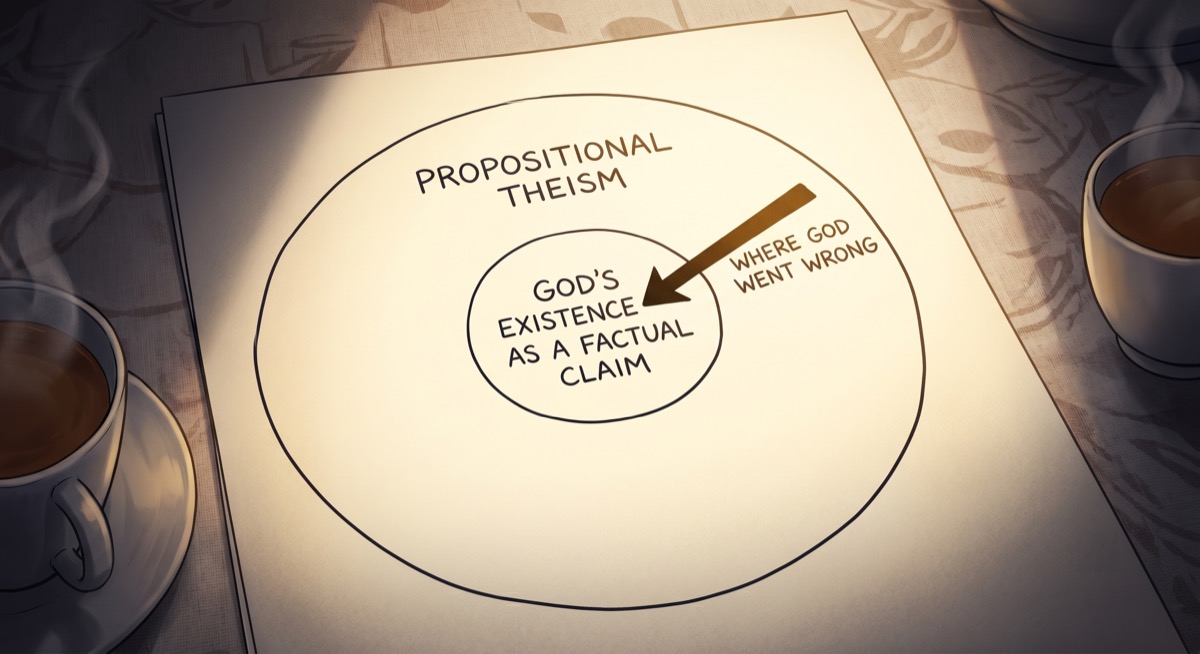
The diagram was drawn on a single sheet in the precise, unadorned hand of someone who had been making diagrams for forty years and had never felt the need to make them look impressive. Two circles, nested. The outer: PROPOSITIONAL THEISM. The inner: GOD'S EXISTENCE AS A FACTUAL CLAIM. An arrow, labeled WHERE GOD WENT WRONG, pointed at the inner circle and hit it squarely.
Outside both circles, taking up most of the page, a region with no label at all.
"The book argues against the claim that God exists as a verifiable fact in the universe," Divna said. "It wins this argument. I'm not telling you it doesn't." She moved her finger from the inner circle to the outer. "This is what people who argue this way believe they're defending." Then to the unlabeled region. "This is what most people who actually believe something are defending. Relational faith. Apophatic theology—knowing God through absence rather than presence. Experiential belief that holds a relationship to the world rather than a truth claim about it." She set the diagram down. "The book doesn't address this. It wins in the inner circle. Most of the territory is outside it."
"I don't understand," Colluphid said. This was true, and it was the first sentence in the conversation that had cost him something to say.
Divna looked at him. The quality of attention she was paying him was the kind that did not come from the folder.
"You've been arguing with the wrong God," she said. Not unkindly. "Or rather—the right God, argued wrongly. The God the book demolishes is a God who makes factual claims about reality. The God most people are actually in a relationship with is something else. You're winning a debate that most believers were never having, which doesn't make the debate wrong—it just means the unlabeled region is still there." She folded her hands on the folder. "What are you actually working on."
He told her about the second catalog—the whiteboard, the eight entries, the shift from design failures to deliberate choices. The darker question underneath it. Not why didn't this work but why was it built this way—why the architect had installed these specific capacities with full knowledge of what each one would cost.
She listened without interrupting, which meant she was tracking something larger than the argument.
"And?" she said, when he finished.
"My research assistant pointed out that every item on the list is also a precondition for love."
"Your research assistant is correct."
"I know."
"Does it bother you."
"The list is still a list of moral failures," he said. "Whatever else it is."
"Yes." She looked at the window—the Cathedral's east wing, gray and steady in the afternoon light. "Theodicy has been arguing about this specific point for three billion years. The capacities that produce suffering are the same capacities that produce everything worthwhile, and the question is whether the trade-off was justified." She turned back to him. "You're going to write that the trade-off wasn't justified. That a competent creator had alternatives."
"A competent creator had alternatives to suffering."
She let the silence hold for one beat.
"Alternatives to love," she said.
He reached for his mug. The tea was cold. He drank it anyway, because cold tea was the appropriate response to a sentence you couldn't argue with and hadn't brought a different argument to address.
"Not exactly," he said.
"That's more honest." She looked at him with an expression that—unlike most of her expressions—wasn't aimed at anything he'd said.

It was Divna who changed the direction. She did it with the characteristic precision of a person who has been holding something for a while and has decided, in the context of this particular afternoon, that holding it is no longer the better option.
"Did you know Zarnak?" she said.
The pivot was surgical. Colluphid blinked. "The Prophet? I know the name. The Cathedral appointment. I've read some of the theodicy papers from the eighties."
"He was my teacher." She said this in the tone of someone who has said a thing many times inside their own head and is now saying it to someone else for one of the first times. "Thirty years. I was assigned to his research group as a student and I never left his department." She looked at the folder as though it had temporarily ceased to be relevant. "He died four years ago."
"I'm sorry."
"He was investigating something. Not formally filed as a project, not published—just a question he kept returning to in the margins of everything else. About what God might have left behind, deliberately, in the architecture of the universe after the vanishing." She paused. "The TRA became aware of his investigation. There was a review process." She was quiet for a moment. "He died during the review. The official cause was cardiac. He was ninety-three."
Colluphid looked at her. He was aware of several possible responses and aware, more specifically, of what lived behind all of them: the phrase review process in the context of the TRA; official cause was cardiac in a construction that had not said the TRA was responsible for his death and had also not said the TRA was not responsible for his death; and the specific way she had said he was ninety-three that was doing considerable careful work in a small space.
"What was he investigating," he said.
"I don't know entirely. He was careful about what he told me. He said knowing too much too early was the best way to stop asking the right questions." Her voice was even, which was not the same as being distant. "He told me once—once only, and did not repeat it—that he believed God's vanishing was deliberate. That the thing God left behind was meant to be found. That the reason it hadn't been found was that the TRA had spent forty years ensuring the right questions were never officially asked." She looked at her hands. "Three months later the TRA opened the review."
Colluphid's hand was on the table. He wasn't certain exactly when that had happened—at some point while she was talking, his hand had moved from where he'd been holding his mug to the table near hers, and then closer, and then one of his fingers was resting against her knuckles, which was something that had occurred without a decision he could identify.
Neither of them moved.
"Zarnak was right," Colluphid said.
She looked at him.
"We're going to Viltvodle VI in five days. The Babel fish—there's a problem with the fossil record. They appear in the stratigraphy without precursors, at a temporal anomaly stratum, with a genetic signature showing point-source emergence rather than migration. Someone placed them there. And whoever placed them filed a TRA seal on the pre-fish archive three years before the proof was made public—which means they knew the proof was coming because they built the mechanism for it." He kept his voice level. "I think Zarnak knew that. Or had arrived at the edge of it."
She was quiet for a moment.
"I think so too," she said. "I've thought so for four years. I haven't known what to do with it."
"Neither have I." He looked at their hands. "Until about nine days ago."
The awareness of his hand persisted through the conversation that followed, which neither of them named or addressed. At some point in the next half hour it returned to his side of the table, and neither of them marked the transition, and the absence of marking was itself a form of acknowledgment.
They stayed another hour. She told him what she could about Zarnak's papers—still sealed under TRA authority, unlikely to be released in any near-term administrative cycle. She described the 2019 Cathedral dispute in terms precise enough to be informative and vague enough to be protective of something she wasn't ready to say. He told her about Pizpot Gargravarr on Viltvodle VI, the private archive that predated the seal, the shuttle departure in five days.
"Be careful," she said, at one point, which seemed to have come from somewhere other than the academic conversation they were technically still having.
He looked up. "I'm always careful."
"You're often thorough," she said. "That's not the same thing."
There was something in the register of this that was different from the rest of the afternoon, and he noticed it and set it alongside the other things from the afternoon that he was not yet certain what to do with.
"There's a second item," he said, later, when the conversation had settled into the particular quality of settling that preceded an ending. "In the catalog. One I haven't written about."
"Which one."
"I lost something. I don't know exactly when." He looked at the table between them—the folder, the emptied cups, the afternoon light having shifted from midday into something more considered. "The ability to be surprised. I built certainty into my method—everything predicted, everything accounted for—and I told myself it was intellectual discipline. And then I spent seven months on a tour giving the same lecture on forty planets and knew every question before anyone asked it and had every counterargument prepared in advance and—"
He stopped.
"And?" she said.
"There was a small being at one of the signings. Maybe ten years old. She asked me, Are you really not scared? I told her: very much." He looked at his hands. "It was the first honest thing I had said in seven months. Which means the certainty was working perfectly as a capability and was also the thing preventing me from saying anything true."
Divna was quiet, in the way she was quiet when she was deciding what to give back rather than what to say next.
"That's in the second catalog," she said. "Even if you haven't put it there yet."
"It doesn't fit the structure."
"No," she said. "It fits the book."
He thought about the diagram. The unlabeled region. The territory outside both circles where most of the interesting work was apparently happening without his participation.
"Wrong relative to what," he said, very quietly.
She looked at him.
"You asked me that," he said. "The first time we met. I told you I'd need to think about how to answer."
"I know. I've been waiting."
"I think the answer might be in your unlabeled region."
She held his gaze for a moment. The afternoon light from the window was doing something to the room that he would later find he couldn't describe precisely, only that it was doing it.
"Yes," she said. "I think so too."
Outside, Brontitall's evening was preparing itself. Divna settled the folder back into her bag with the efficiency of someone who has finished the formal work and is recalibrating for what comes next.
"When you've been to Viltvodle VI," she said, standing, in the tone of someone returning to practical matters because practical matters were available and the alternative was not, currently, available. "Tell me what you find."
"I will."
"And Oolon." She looked at him with the lanyard back in place and the folder under her arm. "Write the book you actually have. Not the one you agreed to write."
He looked at her. He did not have an immediate response to that.
"I'll be in the Cathedral if anything comes up," she said, and left.
He sat with the empty cups and the late afternoon for a moment, watching through the window until she had crossed the street and turned toward the Cathedral's main entrance and disappeared behind it.
Then he gathered himself and walked out into Brontitall's evening.
The Cathedral's towers were visible for several blocks as he made his way toward the transit station. He had forty minutes before the shuttle.
At the corner of Archivist's Row, out of professional habit, he reached into his jacket for the notebook. The cloth-bound one he had carried for six years, in which he had written every significant conversation, every research session, every formulation worth keeping. Forty planets of tour notes. Three years of catalog research.
He opened it to where today's notes should have been.
The page was blank.
He had been in the tea shop for three hours. He had been told things about Zarnak and the TRA that needed to be followed. He had arrived, with considerable help from a direction he hadn't anticipated, at a formulation about unlabeled regions that was going to restructure his second book at the foundations. He had received a diagram she had made a copy of in advance in case he asked.
He had not written a single word.
He stood on the pavement with the open notebook. He turned to the front pocket and confirmed the diagram was there, folded in from the outside. Then he closed the notebook and walked to the shuttle.
Three hours. Not a word. He had once taken notes in a building that was on fire, which was not a practice he recommended but which had produced a very good paragraph about the theology of fire damage.
He had not taken notes today.
For a writer, not taking notes is either a catastrophe or a confession. He was fairly certain, by the time the Cathedral had disappeared behind the skyline, that he knew which one it was.