Some More of God's Greatest Mistakes—Chapter 3: Something Fishy
Posted on Sat 06 June 2026 in Fiction
Some More of God's Greatest Mistakes
Chapter 3: Something Fishy
The memo had grown.
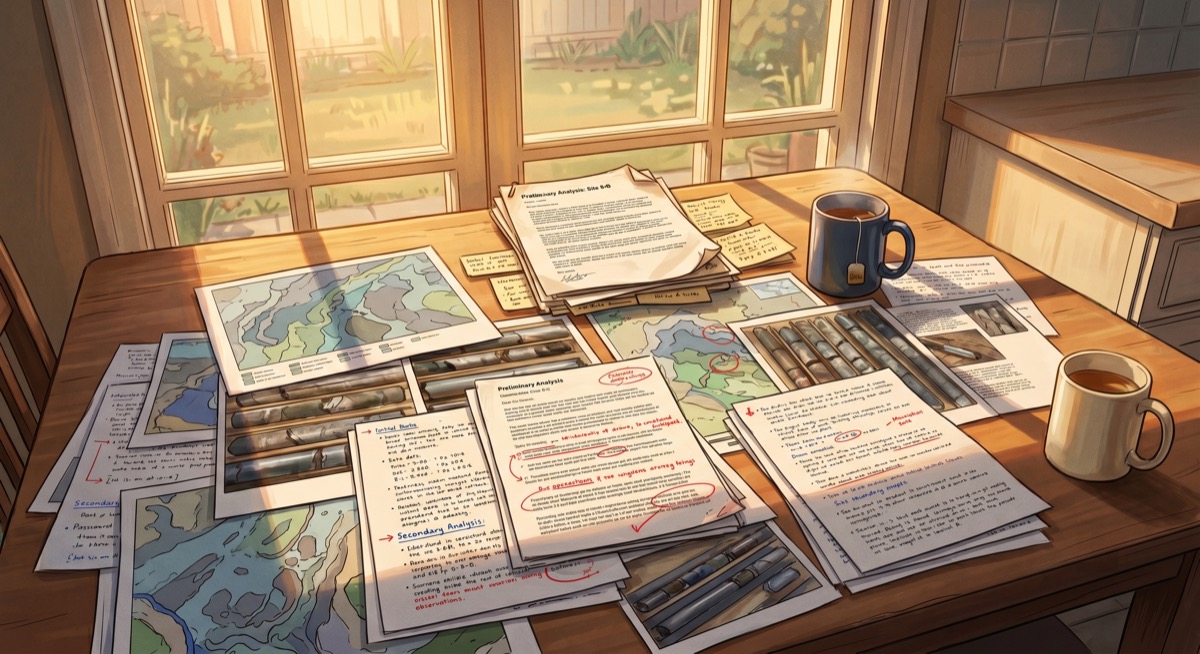
This was the first thing Colluphid noticed when he came into the kitchen on a Tuesday morning, nine days after Hurkel had said next week and approximately five days after the deadline implied by next week had passed without comment from either of them. The four pages he had briefly glimpsed under his teacup before Hurkel retrieved them were now the origin point of a formation that had colonized the kitchen table with the geological patience of something that had been very carefully assembled.
Fifty-one pages, which he counted before sitting down, because counting gave the situation the quality of a knowable quantity before the other qualities became apparent. Some of them were printouts from galactic geological archives. Some were photographs of core samples—cylindrical cross-sections of rock strata, produced by drilling into the substrate of a planet and reading what had accumulated there over several billion years in the way that certain scholars could not resist reading. Several were covered in Hurkel's three-color annotation system: black for primary sources, blue for secondary analysis, red for I do not yet know what this means but it is definitely something.
There was a great deal of red.
The kettle was not where it usually was.
"Don't," Hurkel said, appearing from behind the left stack before Colluphid had finished assessing the kettle situation. He cleared a space and set a mug of tea on it with the deliberateness of someone who had been waiting to make this specific gesture. "I made it. Sit."
Colluphid sat, because the tone was the one Hurkel used when the thing was real and the research was done and there was not going to be a better time. He picked up the mug. He looked at the formation.
"The memo," he said.
"Still the memo." Hurkel pulled the original four pages from the top of the archive and placed them on the cleared space with the care of someone returning a founding document to the front of what it had founded. "Everything else is what happened when I checked it."
"Checked what?"
Hurkel sat down across from him. He had the expression he got when he had been careful, and thorough, and correct, and was about to demonstrate why being correct was occasionally worse than the alternative.
"The Babel fish," he said, "did not evolve on Viltvodle VI."
The Hitchhiker's Guide to the Galaxy has this to say about the Babel fish:
"The Babel fish is small, yellow, leech-like, and so comprehensively useful that seven hundred and forty-two separate civilizations have independently concluded that it could not have evolved by chance. This conclusion has been reached by evolutionary biologists, theologians, philosophers, three separate branches of pure mathematics, and once by a very determined accountant who framed the argument in terms of actuarial risk and then didn't know what to do with it.
"The standard argument runs as follows. The Babel fish is an organism so precisely calibrated to perform a single function—simultaneous universal translation, operating across every known language, delivered directly to the auditory processing centers of any compatible species—that the probability of its arising through normal evolutionary processes is indistinguishable, in practice, from zero. This improbability was used by several philosophical theologians to argue that God must have designed it. God, informed of this argument, noted that proof denies faith and without faith God is nothing, and vanished in a puff of logic. The fish, having caused this, has been described as the most theologically consequential organism in galactic history. It does not appear to have formed a view on the subject.
"The standard account of the Babel fish's origin holds that it evolved naturally on Viltvodle VI over the course of several billion years, developing its translation capability through the mechanisms of adaptive evolution operating over geological time. This account appears in 847 educational curricula, 12,400 theological texts, and the Guide's own primary entry on the subject, which was written two hundred years ago by a junior researcher named Vess Blint who conducted her research from the Maximegalon University library and never visited Viltvodle VI.
"The entry has been reviewed seventeen times and reprinted without substantive revision. Vess Blint did not find this a problem. Neither did the seventeen editorial teams who approved her entry for reprinting. The Guide, which is edited by committee, is generally comfortable with precedent.
"It has not, until recently, considered whether precedent and accuracy are the same thing."
The fossil record problem, as Hurkel explained it over the following hour with the patience of someone who had rehearsed the order of presentation, came down to three things.
The first was the strata.
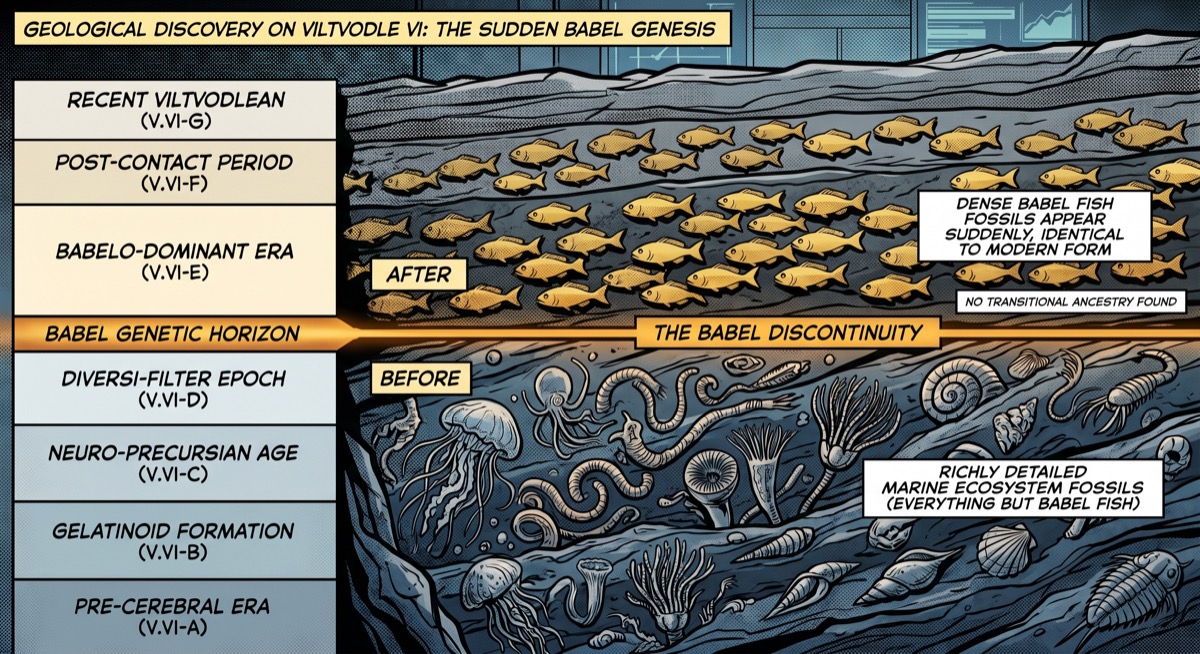
Viltvodle VI's western coastal substrata were renowned in xenobiology for their completeness. The preservation conditions—cold, stable, low-oxygen—had maintained an exceptional record of the planet's marine ecosystem for approximately eight billion years. If an organism had lived in the western coastal waters at any point in that span, and had possessed any mineralizable tissue whatsoever—shell, bone, scale, tooth, calcified fiber—it was there. The record was not merely good. It was the standard against which other fossil records in the Western Spiral Arm measured their own deficiencies.
The Babel fish appeared in that record at a depth corresponding to 4.2 billion years before the galactic standard present.
Above that depth: Babel fish, in their full extant form, with no morphological change across 4.2 billion years of subsequent stratigraphy, which was itself unusual but had been attributed to the fish having reached optimal design and therefore stopped changing, an explanation that had satisfied everyone who had not thought about it carefully.
Below that depth: nothing. Not a proto-fish. Not an ancestral form. Not even the ecological niche that a transitional form would have occupied. The western coastal ecosystem ran for 3.8 billion years before the fish appeared—complete, complex, and biodiverse—and not one organism in it had been doing what the Babel fish did or anything recognizably like what the Babel fish did, because if something had been doing what the Babel fish did, it would have dominated and diversified and left a record, and the record contained nothing of the sort.
"Gaps in the fossil record," Colluphid said, when Hurkel finished. "Precursor forms can be soft-bodied. Soft-bodied organisms don't preserve."
"They do in the western coastal substrata." Hurkel placed a second printout alongside the first—a survey of soft-tissue preservation across the same geological period. "There's a complete record of every soft-tissue organism in the ecosystem for the four billion years preceding the fish. Jellyfish, ctenophores, free-swimming worms, filter feeders with no hard parts at all. All there." He indicated several rows of the taxonomy summary. "The conditions that preserved them would have preserved transitional Babel fish forms, if any existed."
Colluphid looked at the survey. He looked at the stratigraphy photograph.
"Maybe it evolved elsewhere," he said. "Local absence isn't global absence. It could have originated in another region and migrated."
The second thing was the population genetics.
Hurkel produced a third printout: a molecular analysis of the Babel fish founding population, conducted as background data for a study of galactic translation ecosystems published eleven years ago. The Babel fish, across all current populations on Viltvodle VI and the 2.3 billion planets where they now existed in various introduced forms, showed the genetic signature of a founding population originating in the western coastal waters of Viltvodle VI specifically. Not the eastern waters. Not another continent. The western coast, in a concentration consistent with a point-source emergence.
Not a migration. An arrival.
"Population genetics at geological timescales are unreliable," Colluphid said, because this was true, and it was faster than the alternative.
"I know," Hurkel said, in the voice of someone who had been waiting for this and had a fourth printout waiting for it.
The third thing was the event horizon.
The Babel fish did not merely appear in the fossil record without precursors. They appeared at a specific stratum corresponding to a documented astronomical event: a localized temporal displacement field that had affected Viltvodle VI's western coastal region for approximately seventeen years, 4.2 billion years before the galactic standard present. The event was in the Galactic Temporal Survey record—a well-documented anomaly, historically unremarkable except to specialists in temporal geology, notable primarily for the unusual preservation pattern it had created in the affected strata, which was why the xenobiological survey had noted it in the first place and why it appeared in the background data that nobody had cross-referenced until Hurkel pulled the printout and put it next to the stratigraphy photograph.
The Babel fish appeared at that stratum. Across every survey of the western substrata ever conducted. At the same depth. At the same temporal event marker. With the same founding genetic profile.
Colluphid looked at the temporal survey printout. It was filed under Geological Events: Minor Temporal Anomalies, Western Spiral Arm, Pre-Biological Record. He could see why no one had looked here. The TRA seal was effective partly because the records were buried where no one without a specific reason to look would find them, and no one had been given a specific reason until Hurkel had spent nine days building one.
"Someone," Hurkel said, setting the temporal survey down, "introduced a species into an ecosystem at a specific point in time, using a mechanism that minimized the period of ecological disruption. The fish were placed there. Not evolved. Placed." He looked at the stratigraphy photograph. "The question everyone has been asking for six thousand years is whether the fish could have evolved by chance. The answer is no—it's been no the whole time. We just assumed the alternative was God." He paused. "We never asked who."
Colluphid sat with the four printouts arranged between them.
There were several things a person could say at this point, and he was aware of most of them. He was also aware that the three dismissals he had produced in the past forty minutes had been produced with a speed inversely proportional to the strength of the evidence they were dismissing—a pattern he recognized without pleasure and could not, at the moment, interrupt.
"What if," Hurkel said, very quietly, "the proof of God was... evidence?"
The kitchen was sufficiently quiet that the question landed without competition.
"Evidence," Colluphid said.
"Of an event. A deliberate act. An introduction." Hurkel aligned the four printouts into a row. "The fish proved God. The fish disproved God. The fish vanished God. The fish are the hinge point of every theological argument for the past six thousand years." He looked at the formation that had been the four-page memo. "What if that's not because the fish are an improbable accident? What if someone needed the argument to happen at a specific time, and they built the mechanism for it?"
Colluphid thought about the Babel fish proof. He had cited it in thirty-eight papers, seven lectures, and once in a crossword clue he was not proud of. He had used it as a logical mechanism: the fish exist, the fish prove God, the proof destroys God, God is gone. He had not, in any of these contexts, asked what the fish themselves were for—not what the argument required them to be, but what they actually did. What they had been doing for 4.2 billion years before anyone noticed they were an argument.
They translated. They made it possible for every species in the galaxy to understand every other species. They had been doing this since before recorded civilization. The galaxy had been capable of comprehending itself—its own grief, its own suffering, its own joy, every word of every language pressed close to every other—since before anyone looked at the fish and started arguing about what they meant.
He looked at the printouts. He did not say any of this.
"There's one archive," Hurkel said, "that holds records of the western coastal ecosystem from before the fish appear in the geological record. Pre-fish. If there's nothing in that ecology resembling a transitional form—nothing filling the functional niche—then the case is considerably stronger than what I already have." He produced an access request form from the center of the formation. "The Viltvodle VI Xenobiological Archive. Complete pre-fish ecological records from the planet's formation onward. I sent the formal request yesterday."
He reached into the stack to his right and produced a single printed sheet.
He placed it on the table.
ACCESS DENIED — THEOLOGICAL REGULATORY AUTHORITY SEAL (PROVISION 9(a)) FURTHER REQUESTS WILL BE LOGGED AND FILED ACCORDINGLY
Outside, the clock tower in the quad was showing the wrong time, as it had for the past twelve years following a temporal physics experiment that had introduced a localized paradox into the mechanism, which had then been documented and left unfixed on the grounds that everyone had adjusted. It showed the wrong time with the consistent conviction of something that had decided the time it showed was as valid as any other.

"The TRA," Colluphid said.
"The TRA." Hurkel waited.
Colluphid picked up the denial notice. It was a standard-form document—generated automatically when the request triggered the seal, not placed in response to his specific inquiry, but already there, waiting for any inquiry. Someone had placed the seal before anyone had asked. Someone had decided, in advance, that the pre-fish records of the Viltvodle VI Xenobiological Archive were a matter of theological regulation, and had filed the paperwork.
The arithmetic put him three years before the Babel fish proof was made public.
"When," he said.
Hurkel produced one final printout. He had known when Colluphid would ask this, and he had been ready.
"The seal was placed forty-one years ago," he said.
"Three years before the proof."
"Three years, four months, and eleven days before the proof was presented at the Symposium of Applied Theodicy on Maximegalon. Before any of the six thousand publications that have since used it as a cornerstone argument." Hurkel set the printout down. "Someone placed a TRA seal on the pre-fish ecological records three years before the proof existed. Which means they knew the proof was coming. Which means they knew the proof needed to be the end of the inquiry rather than the beginning."
Colluphid read the denial notice again.
FURTHER REQUESTS WILL BE LOGGED AND FILED ACCORDINGLY.
An administrative assurance that nothing would happen to anyone who asked. Also, if read at a slightly different angle, a precise description of what had happened to everyone who had asked: their requests had been logged and filed and left there, in a folder, accordingly.
The fifty-one pages lay between them. The denial notice lay on top of them. The morning light came through the kitchen window and illuminated everything on the table with the calm indifference of light that does not involve itself in the problems it makes visible.
"The chapter on the fish," Colluphid said. "It's going to be longer than I planned."
"The chapter on the fish," Hurkel said, "is going to be the book."
He said this without emphasis, which was how he said the things he had thought through.
Colluphid spent the next two hours reading through the full fifty-one pages before looking up. Hurkel made more tea during this interval—getting up, making it, setting a fresh mug in the cleared space without announcement—which was what Hurkel did when something was too serious for the ordinary social protocols around the kettle.
"You knew," Colluphid said, when he set down the last printout. "When you said next week. You already knew what this was."
"I suspected." Hurkel picked up his own mug. "I wanted to be certain before I told you. Being certain took nine days."
"And now?"
"Now I'm certain." He looked at the denial notice with the expression of someone who had found a bureaucratic document personally offensive, which was a specific and serious kind of offense. "We need to go to Viltvodle VI."
Colluphid thought about the Spawning Pools, which he had used as a rhetorical device for thirty-eight years without ever looking at the actual water. He had described them in twelve footnotes as the site of the fish's natural emergence. He had never considered going there because there had been nothing to go for.
"There's a xenobiological archivist on Viltvodle VI," Hurkel said. "Private collection. Independent of the main archive. An elderly Jatravartid who kept copies of everything for his own research before the TRA seal was placed." He waited for Colluphid to ask. "Page three of the original memo."
Colluphid looked at the original four pages, sitting on top of the formation. Page three had a short paragraph in red at the bottom, which was the page he had been making tea on for three weeks.
"This was in the memo," he said.
"Most of the important things were in the memo."
Colluphid did not have an immediate response to this. He looked at the fifty-one pages, the four-color annotations, the denial notice with its pre-emptive seal, and the original four pages now visible again at the top of the pile.
"Book the shuttle," he said.
The Viltvodle VI Xenobiological Archive's pre-fish records sat in their sealed section, forty-one years undisturbed, behind a classification placed before the thing it was protecting anyone from finding had been publicly discovered. The fish swam on, oblivious, doing what they had always done: making it possible for every being in the galaxy to understand every other being, across every language, without effort or exception. Whatever they were, they were very good at it. They had been very good at it for 4.2 billion years.
The shuttle booking took twelve minutes. The confirmation came back four minutes after that, which was unusually fast for an independent carrier operating out of the Brentovaal hub. Hurkel wrote this down in red. He did not mention it to Colluphid. Being careful meant knowing which questions to ask first, and this one would keep.