Some More of God's Greatest Mistakes—Chapter 2: The Moral Catalog
Posted on Wed 03 June 2026 in Fiction
Some More of God's Greatest Mistakes
Chapter 2: The Moral Catalog
The first catalog had been about mechanisms.
Three whiteboards, approximately seven hundred entries, organized by category (Physical Universe, Biological Systems, Cosmological Constants) with subcategories for each (Design Failure, Operational Oversight, Apparent Spite), and seventeen secondary entries flagged for reclassification once he had a better working definition of apparent. The entries were things like dark matter and the parasitic wasp and turbulence and the number of things that could go wrong during a routine surgical procedure on Betelgeuse VII, which was, according to the published literature, significant. The catalog had been satisfying to build the way a well-organized filing system was satisfying: the universe's failures, named, numbered, sorted, and closed.
The second catalog was not going to be like that.
He had known this the moment he'd written moral failures at the top of the new whiteboard and looked at the words and understood, with the clarity of someone who had spent seven months explaining a book that was incomplete, what the distinction actually required. Design flaws were, at root, an engineering question: you could examine a parasitic wasp and argue, with some precision, that this was not how a functional biological system should operate and have the entomology to support you. Moral failures required a different kind of evidence. They required you to look at something and argue not just that it didn't work but that it should not have been built to work this way—that the universe's architect had weighed the options, seen the cost, and built it in anyway.
That was a harder accusation. It required you to prove intent.
It also required you to keep looking at the thing you were accusing, which was, as it turned out, its own kind of problem.
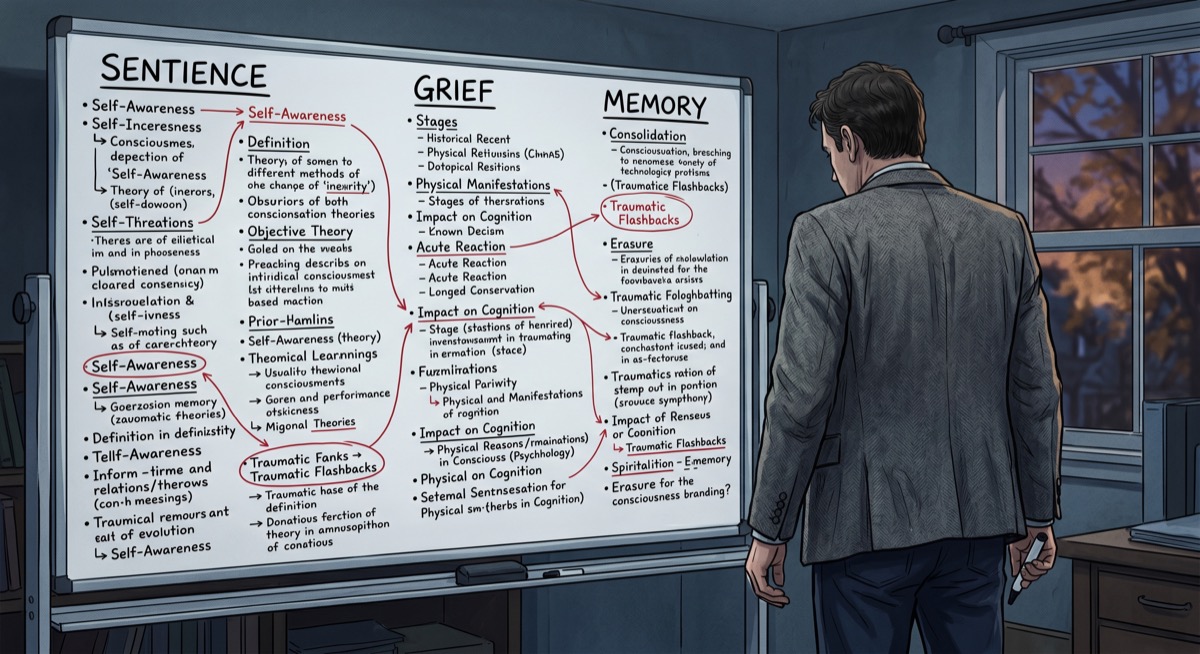
The new whiteboard was slightly smaller than the previous three, a choice he now recognized as optimistic. It was also four days in, and nearly full.
He had started where any responsible examination of moral failure had to start: sentience.
Sentience was, from the standpoint of philosophical accountability, the most extraordinary single design decision in the known universe. You could construct, without great difficulty, a universe without it. The Philosophers of Kria had proved this formally in both directions over the course of two thousand years before concluding the question wasn't interesting enough for a third pass. Mechanically, a universe without consciousness ran identically to one with it—the stars burned, the wasps operated, the heat death scheduled itself for the usual appointment. Nothing would differ at the particle level.
What would differ was that none of it would matter to anyone.
Sentience, Colluphid wrote at the top of the whiteboard. In smaller letters below it: The capacity to know you are suffering.
He stood back.
Then he added: The capacity to know you are anything at all.
"That's two entries," Hurkel said from the sofa, without looking up.
"It's one entry with a refinement."
"How is knowing you're suffering different from knowing you exist? They use different parts of the architecture. Existence-awareness is a baseline state. Suffering-awareness is a specific experience overlaid on it."
Colluphid considered this with the expression of someone who has considered it before and been hoping the answer would change. "They're on a spectrum," he said.
"Everything's on some spectrum. Put them as two entries. The distinction will matter by chapter four."
He wrote them as two entries. This was almost certainly going to be proved correct, which was not an improvement on Hurkel's situation that Colluphid needed to encourage.
The catalog grew through the morning in the way catalogs do—not steadily but in bursts, when two items connected to produce a third he hadn't anticipated, or when a category he'd been treating as self-contained turned out to have a floor he'd been standing on without knowing. Grief required its own entry: the capacity to suffer from absence, which was different from sentience's capacity to suffer from presence. You could theoretically have sentience without grief—beings fully present to their current pain, without the ability to orient themselves toward what was no longer there. On first consideration this sounded like a mercy. On second consideration, it described a being for whom everyone they had ever loved was regularly erased from existence, which was not the word mercy typically applied to.
Grief, he wrote. The capacity to suffer from what is no longer there.
Memory followed—the mechanism that grief relied on, the past made available to consciousness in a form that could be compared to the present and found wanting. Without memory, you couldn't grieve in any sustained sense; each moment would arrive clean of its predecessor. This meant, in practical terms, that you would experience the initial impact of loss and then lose that as well, so the universe's capacity for cruelty would reset with every breath. He wrote the entry and had the thought, which he declined to write under it, that a being designed this way would also be unable to experience delight at a repeated encounter, which meant that memory was the precondition for the particular joy of recognition, and he wasn't going to include that in the catalog but he noted it in the way you note something you are going to have to come back to.
Anticipation was the last of the four he'd identified before he'd picked up the marker this morning, and it gave him more trouble than the others. You could articulate a theoretical being who suffered from the present—purely, cleanly, exactly—and had neither memory to anchor them to the past nor anticipation to pull them toward the future. At any given moment, this being would inhabit whatever condition the present delivered and no other. It would not regret. It would not dread.
It would also not hope.
He stood with the marker raised for a moment.
"You've been at that entry for a while," Hurkel said.
"I'm thinking."
"I can see that. What specifically?"
"Anticipation is the same capacity used two ways." He tapped the marker on the frame of the whiteboard. "Dread and hope use exactly the same mechanism—consciousness reaching toward the future—and what determines which one you're in is only the content. Fear and excitement are structurally identical."
Hurkel looked up from the folder. "That seems worth noting."
"I'm noting it."
"In the whiteboard or in the book?"
Colluphid looked at the entry he'd written—Anticipation: The capacity to suffer from the future—and did not add the corollary. "The book," he said, which was not entirely accurate.
The Hitchhiker's Guide to the Galaxy has this to say about suffering as a theological category:
"Of the 17.3 million intelligent species currently catalogued in the Guide's editorial database, approximately 17.3 million have developed some form of theology, and all 17.3 million of those theologies have a position on suffering. The positions can be broadly sorted as follows:
"God causes suffering: This position accounts for 3.2 million species and tends to produce combative worshippers who argue with their deity at length and considerable volume. The deity, if present, finds this either endearing or exhausting depending on which eon it's been.
"God permits suffering: This position accounts for 6.1 million species and is the most popular formulation across the Western Spiral Arm, as it permits a nuanced relationship with the divine in which the worshipper can simultaneously revere God and wish God had made somewhat different choices—a dynamic that many species find it easier to manage than the alternative of simply agreeing with God about everything.
"God is suffering: This position holds that the divine principle is not separate from the universe's pain but continuous with it—that consciousness is the universe experiencing itself, and its suffering is God's. This position is either the most compassionate or the most alarming theological formulation available, depending largely on what you imagine it implies about God's emotional state after several billion years of it.
"Suffering is beside the point: This position takes the view that the entire suffering question is a category error—the universe was not designed for anyone's comfort, and framing its physical processes as a moral failing is like suing a rock for being heavy. Species holding this position have, in general, excellent engineering traditions and a somewhat depleted literary canon.
"One civilization, the Soluun, never developed a position at all. They never asked the question. Their cities are intact and their records run for forty thousand years without a gap. The final entry reads: 'Quarterly resource allocation complete. All systems nominal. No outstanding items.'
"The Soluun are no longer available for comment. The Guide finds this, in context, worth noting."
The fifth entry was language—the capacity to describe your suffering and therefore be understood to be suffering, which was either God's greatest gift (mutual comprehension across the species barrier) or God's removal of the comfortable ambiguity of not quite being certain what the other being meant when they said things were not going well—and Colluphid was working through the precise phrasing when Hurkel said, without preamble:
"The Babel fish."
Colluphid turned. "What about them."
"You mentioned them seven times in the first book." Hurkel was looking at a page from his folder—one of the pages, Colluphid noticed, that had been in the folder when Hurkel emerged from the spare room on the day this all began. "Proof, disproof, three footnotes, two analytical references. All in the logical argument frame. God exists because the fish couldn't have evolved naturally; faith is impossible if God's existence can be proved; God therefore vanishes; end of theological framework." He set the page down in the careful way of someone placing something where it can be picked up again. "You haven't mentioned them in the context of what you're writing now."
"The fish are a logical mechanism."
"The fish are a thing that lives in someone's ear and translates," Hurkel said. "The logical mechanism is what a philosopher did when he noticed the fish existed. The fish itself makes it possible for any two beings in the galaxy to understand what the other one means." He looked at the whiteboard—at language: the capacity to describe your suffering and be understood to be suffering. "Including when what they mean is I am in pain."
Colluphid turned back to the board.
"The fish is a translation apparatus."
"Right. Which means every sentient being in the galaxy has been capable of understanding what every other sentient being means when they say they're suffering, for the duration of recorded history. That's not a logical proof." Hurkel picked up the page and put it back in the folder. "That's a moral fact about what God made legible."
Colluphid looked at the language entry. He wrote, in smaller letters below it: See also: Babel fish—translation as universal legibility of suffering. He held the marker for a moment.
He thought: if the fish made every species' pain mutually comprehensible across every language barrier in the known galaxy, then the argument that God couldn't have known what suffering meant—that the universe's pain was unknown to whatever built it—was not an argument God could defend on a technicality. You would have had to not be paying attention. You would have had to, in a sense, have specifically designed not to be paying attention, and built in a counterargument to the counterargument, which was the kind of thing that required forward planning.
He looked at what he'd written. He did not add this below the entry. He moved to the sixth item.
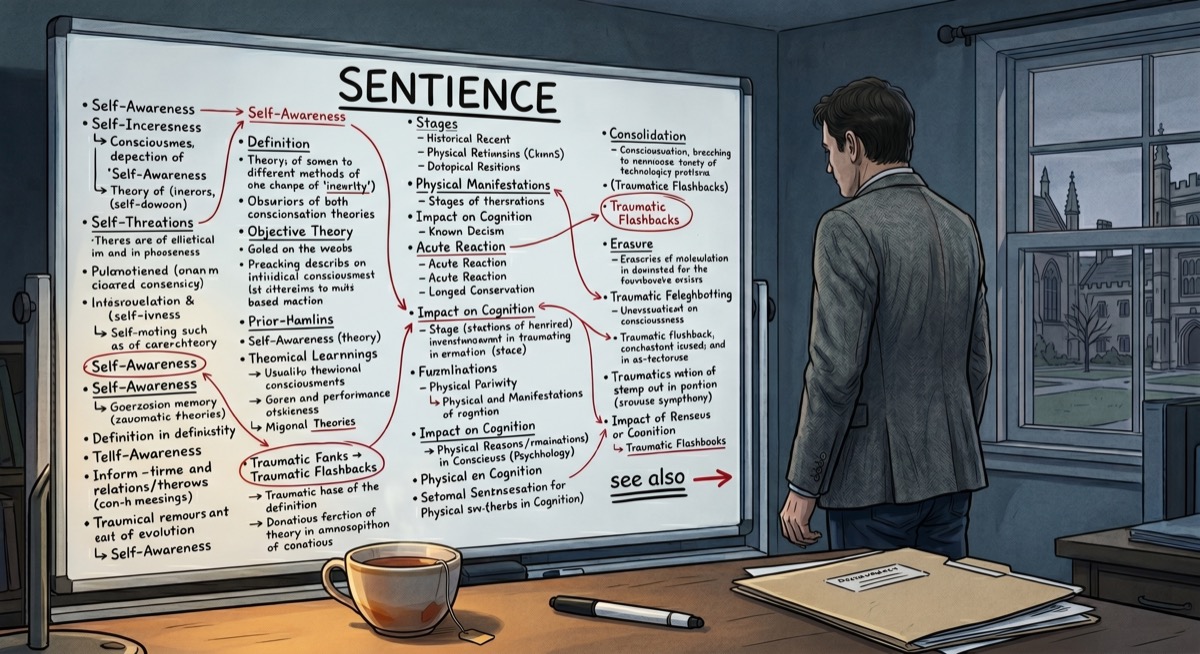
By midafternoon the whiteboard held eight entries. After language he had added empathy—the capacity to experience another being's suffering as though it were your own, which was either the most evolved cognitive feature in the galactic inventory or a design flaw of such magnitude that it was remarkable any sufficiently empathetic species had survived contact with a universe this painful—and loss, which was the larger category that grief lived in: not just the suffering produced by absences that had once been presences, but the suffering produced by the gap between what you expected the world to contain and what it actually did. Loss covered grief but also disappointment, and the specific anguish of unrealized potential, which was the suffering of things that had never arrived before leaving.
He stepped back.
Eight entries. Sentience, sentience-awareness, grief, memory, anticipation, language, empathy, loss. A fairly comprehensive architecture of psychological suffering, which was to say a fairly comprehensive architecture of everything that could go wrong with the decision to make things capable of experiencing their own existence. Every tier of it purposeful. Every tier of it built, so far as the evidence suggested, by something that had possessed alternatives and had chosen this.
"You look like you've finished something," Hurkel said.
"The first pass."
"How is it?"
"Dense." He looked at the entries. The design catalog in Book 1 had felt, at its best, like an indictment—here are the malfunctions, here is your grade as a creator, here is what a competent engineer would have done differently. This catalog felt different. It had the same structure—named, numbered, sorted—but something underneath it that the design catalog had not had. The design catalog had been about what God made badly. This one was about what God made deliberately. And deliberate was a word that looked different from different angles.
Hurkel got up and stood beside him. He read the entries in order from the top of the whiteboard, in silence, for long enough that Colluphid thought he was done and was about to suggest dinner.
"Every item on that list," Hurkel said, "is also a precondition for love."
Colluphid did not respond.
"Sentience: you have to know you're experiencing something in order to appreciate it. You can't love something you're not aware of experiencing. Grief: you can only grieve what you loved—the grief is downstream of the attachment, and the attachment is the love. Memory: same mechanism. You can only ache for what you remember, and what you remember is what mattered." He looked at anticipation. "You said it yourself—hope and dread are the same capacity aimed in different directions. Hope is anticipation of the good. Hope is what caring about the future looks like from the inside."
Colluphid looked at the whiteboard.
"Empathy," Hurkel continued, calmly, in the manner of someone who has considered whether to say this and decided it is better said, "is what it feels like when the thing you love is suffering. That's not a design flaw. That's what love does to the mechanism." He looked at the whole list from the top to loss. "God didn't build the universe the capacity to suffer. God built it the capacity to feel. Suffering is what happens when feeling meets the wrong side of a gap."
"Shut up," Colluphid said.
"You heard me."
"I heard you."
Hurkel sat back down. He picked up the folder and resumed reading with the equanimity of someone who has said the true thing and is content to let it work at its own pace.
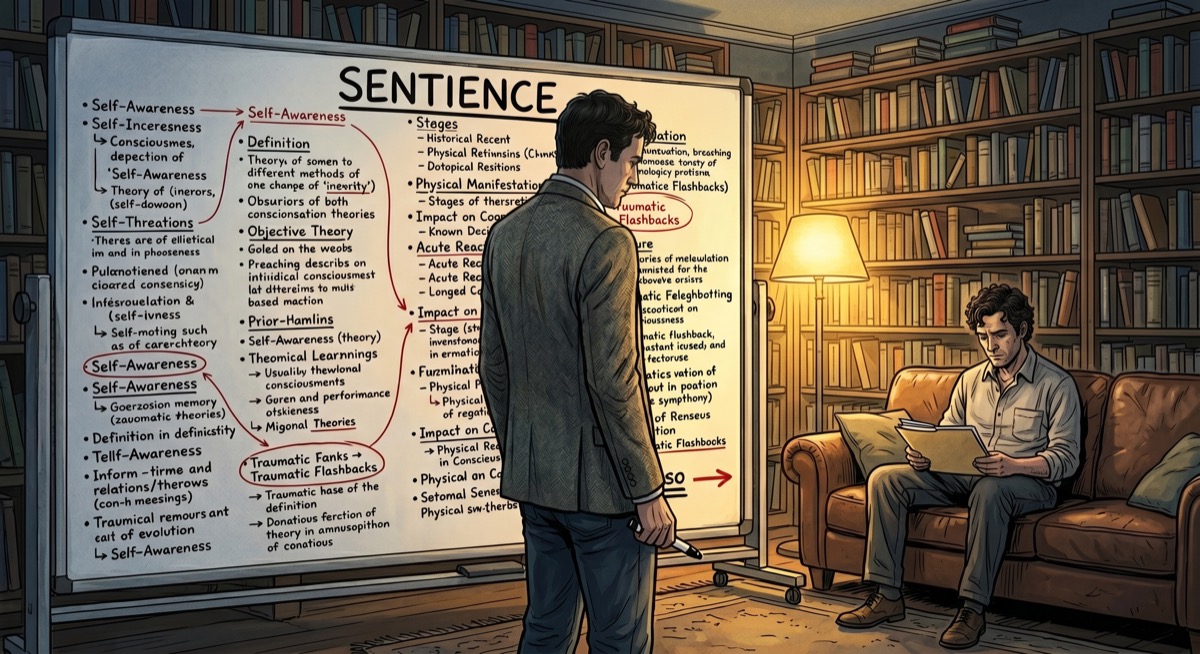
Colluphid looked at the whiteboard.
He had built it as an indictment: here are the capacities God chose to install in every conscious mind in the known galaxy, knowing what each one would cost, building in the cost anyway. Eight entries representing eight deliberate decisions to make beings that could break in these specific ways. The catalog was accurate. The catalog was, as far as he could determine, complete for a first pass. The catalog was, if you tilted your head slightly and allowed for the reading that he was currently not writing down anywhere, a specification for something else entirely.
Every item on the list was a capacity. And capacities didn't come with only one use.
He thought: God didn't give the universe the ability to suffer. God gave it the ability to feel, and suffering was what happened when feeling met absence, loss, the wrong side of anticipation, another being's pain. Suffering was real and suffering was terrible and suffering was, in some mechanical sense he was not going to commit to paper yet, a by-product of the architecture rather than the architecture's purpose.
He stood with this for a moment.
Then he went to the kettle, because the kettle was neutral ground and tea required only temperature and time and had never once asked him to revise his premises.
He filled it. He set it to heat. While it heated he stood at the kitchen window looking at the three academic quads, which were doing their usual thing of being patient and orderly and completely unhelpful, and he thought about the Babel fish—not the proof, not the disproof, but the actual organism: a translation apparatus that had been making every species' suffering legible to every other species for the duration of recorded history, which meant that the question of whether the universe's pain was known to whatever had built it was not a question with a comfortable answer. You could not have designed universal comprehension and claimed not to understand what was being comprehended.
There would have to be a proper chapter on the fish. Not seven references and a footnote. Something that asked what the fish actually were—not what they argued, but what they did.
He made the tea. He brought it back to the desk.
"The memo," Hurkel said, without looking up. "When you're ready."
Colluphid looked at the folder. He looked at the whiteboard. He thought about the four-page memo that had been under his teacup for three months, which was about the Babel fish in some way Hurkel had not yet explained, and which would presumably connect to the "something I've been looking at" that Hurkel had twice declined to specify until he had more.
"Next week," he said.
"You said that last week."
"I said I'd need you again. I didn't say the memo."
"Fair enough." Hurkel turned a page. "The outline is on your desk. When you're ready to start writing."
Colluphid opened the document. The cursor blinked. On the whiteboard, the eight entries waited with the patience of things that were not going anywhere, which was the particular patience of true things once you'd written them down.
He began with sentience.
The first catalog had been three whiteboards and seven hundred entries and the satisfying click of a closed argument. The second catalog was eight entries on one slightly-too-small whiteboard and a thought he had declined to write down, which meant it was still there—still working, still unresolved, still doing whatever unwritten things do in the space between what you know and what you're ready to say.
He began with sentience. He would be revising the entry before he reached the end of the chapter.
He did not know this yet. This was fine. Some things arrive at the right pace.