Some More of God's Greatest Mistakes—Chapter 1: The Problem With Sequels
Posted on Sat 30 May 2026 in Fiction
Some More of God's Greatest Mistakes
Chapter 1: The Problem With Sequels
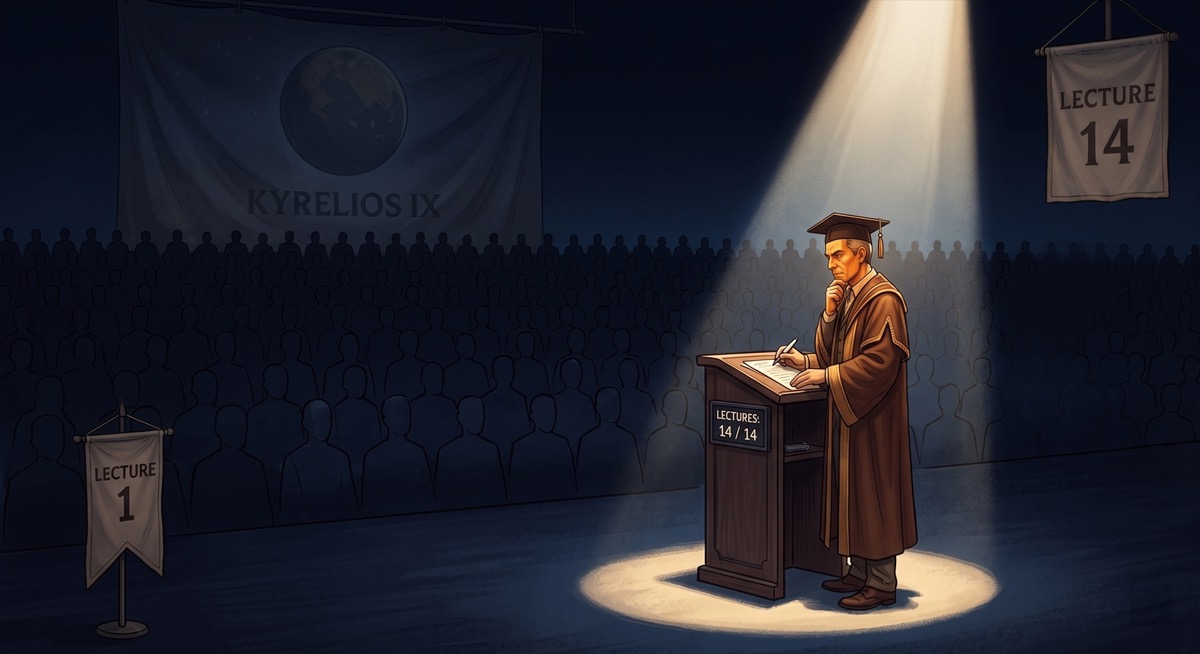
He was in the middle of the parasitic wasp—specifically the part about the female Ichneumon eumerus depositing her egg inside a living host, and the host remaining conscious long enough to be consumed from the inside, and evolution having decided that this arrangement was acceptable, which it clearly wasn't—when he realized he had given this particular lecture on fourteen planets and that the thought he was currently thinking was not a thought he was having for the first time.
He thought it anyway. The argument required it.
The audience in the Great Reception Hall of the Galactic Broadcasting Consortium's campus on Brexxilane was arranged in the configuration that audiences arrange themselves in when they believe they are witnessing something historic. Four hundred beings on padded seats. Third row: a woman writing notes she would never look at again. Seventh row: an elderly being of a species Colluphid didn't recognize who had fallen asleep in a way that suggested the decision was deliberate, which was frankly reasonable. Forty-first row: a student with a bootleg recording apparatus, which was also reasonable, as the lecture was currently in its fourth legitimate recording cycle across fourteen galactic territories and the student was welcome to it.
He finished the parasitic wasp. He transitioned to the heat death of the universe.
The standing ovation came where standing ovations always came, which was after the conclusion, where the rhetoric landed with the clean finality of a well-aimed object hitting a wall. He thanked the audience. He answered three questions about the wasp, two about free will, and one demanding he justify the existence of the Ravenous Bugblatter Beast, which he declined—partly because the question had no answer and partly because the Beast had, in his experience, never asked to be justified and didn't require him to start now. He signed books for forty minutes in a line that moved with the particular solemn efficiency of a religious procession, which he had been trying not to notice for some months.
The forty-second book in the signing line was brought to him by a small being of approximately ten years old, clutching it with the intensity of someone who had saved their pocket money for several weeks and was now processing the scale of the commitment.
Colluphid looked at the book. He looked at the small being.
"Who should I make it out to?"
"Where God Went Wrong," said the small being, which was technically what was already printed on the cover.
"Right," said Colluphid, who had learned not to explain this. He signed his name.
The small being looked at the signature. "Are you really not scared?"
"Of what?"
"Of being wrong."
Colluphid held the signed book for a moment. It was the first question all evening he hadn't already answered.
"Very much," he said.
The small being took the book and walked away apparently satisfied, which left Colluphid sitting in the signing chair with a pen in his hand and the next person in the line already opening their mouth to ask about the parasitic wasp.
The Hitchhiker's Guide to the Galaxy has this to say about the career of the celebrity atheist:
"Galactic history contains several confirmed instances of beings who, having concluded that God does not exist, discovered that this conclusion could be monetized. The process requires a willingness to say the conclusion loudly in large rooms, a tolerance for hyperspace transit, and the ability to answer the question 'But what about [the specific religious tradition or personal experience the asker considers unanswerable]?' with the expression of someone who has not heard this particular version before, which requires considerable practice.
"The Guide's research division conducted forty-seven interviews with working celebrity atheists. Forty-six described their professional lives as fulfilling, intellectually stimulating, and adequately compensated. The forty-seventh declined to comment. When pressed, he said something the editorial team chose not to include, as it sat uneasily with the entry's established tone.
"He has been on a signing tour for seven months. He is still declining to comment. His desk drawer, according to sources who declined to be identified as the desk, has been opened and closed several times in the past six months in a manner consistent with someone who has kept something in it that they are not sure what to do with.
"The Guide finds this, editorially speaking, promising."
Zarniwoop Venvoo III had made his considerable fortune by never misreading a market and never reading a book. He had published Where God Went Wrong—not in any sense that involved artistic input, but financially and institutionally, which were, in his view, the two senses that counted—and had watched it sell three million copies in eleven days, then four million more in the weeks after the TRA's Designation 12-C (Philosophical Threat), which had accomplished for the book's sales what no marketing campaign could have done and had cost him nothing, which was his preferred price for publicity.
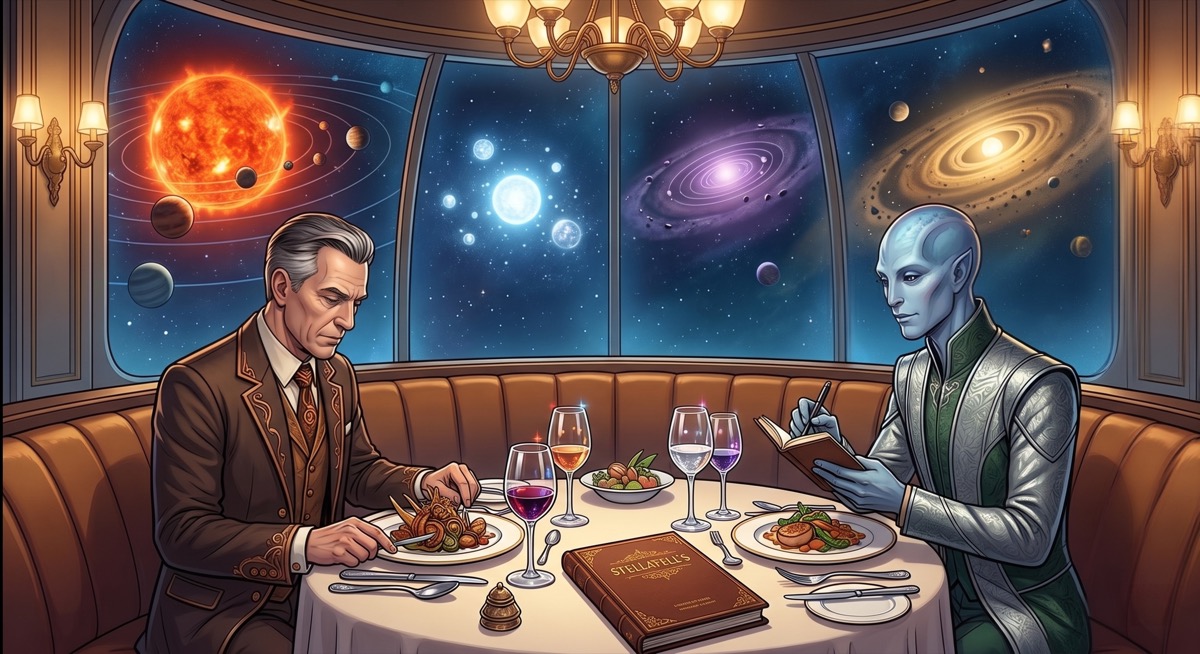
He took Colluphid to lunch at Stellafell's. The restaurant had views of four solar systems and a wine list organized by distance from the planet of origin. This was, Venvoo believed, the correct venue for a conversation about a sequel: visible success in every direction, all of it curated, and a good reason to look out the window if either party needed to collect themselves.
"More," said Venvoo, once they had sat down and the server had completed the ritual approach that preceded ordering.
Colluphid looked at him.
"Same, but more." Venvoo had prepared this and was committed to it. "More God. More mistakes. More of what works." He paused in the way of someone who considered pauses a rhetorical tool. "More Colluphid."
"That last one is implied by the premise."
"I said it for emphasis." The smile Venvoo produced had been calibrated over decades of lunches at Stellafell's—warm enough to disarm, deliberate enough to remind you that it was deliberate. "Four million copies after the TRA notice, Oolon. Four million people who encountered a regulatory body telling them not to read something and immediately purchased it. What does that tell you?"
"That people enjoy being told what not to do."
"That people trust you." He gestured at the four solar systems, which had the good grace to look impressive on cue. "Same trust, second book. Same voice, larger canvas. Are there more mistakes? There are obviously more mistakes. We couldn't fit all the mistakes in one book—the universe is extremely large. Make it angrier. Add suffering."
"I had suffering."
"Add more. People respond to suffering." He topped up his wine. "Is there a chapter on the Babel fish?"
Colluphid looked at his plate. He had, in the writing of Where God Went Wrong, mentioned the Babel fish seven times in contexts ranging from the logical proof of God's existence to a brief footnote on universal translation as a design overreach. He had done this in the way you mention something you are thinking about more than you are mentioning. "Possibly," he said.
"People love the Babel fish. The Babel fish section—very short, I know, you only touched on it—generated more reader correspondence than everything else combined."
"There were seven separate Babel fish references across three chapters."
Venvoo waved this away. "Make it a proper chapter. Make it central." He leaned forward with the enthusiasm of a being who had correctly predicted every market for forty years and had not yet been wrong. "What's the thesis? Short version."
Colluphid considered. He had spent seven months explaining the thesis of his first book to forty thousand people and had, in the process, become aware that the thesis of the first book was incomplete in ways he had not yet located precisely enough to name. The second book would have to carry more of the truth, or at least a different portion of it. He was not going to explain this to Zarniwoop Venvoo III at Stellafell's over a wine list organized by parsecs.
"The first book asked whether God was incompetent," he said. "The second book asks whether God made choices."
Venvoo processed this. He had a remarkable ability to extract the commercially relevant portion of any statement. "Culpability," he said. "Yes. Better than design flaws. People understand culpability. Culpability has consequences." He wrote something in a small notebook. "Is there a villain?"
"There's the Theological Regulatory Authority."
"Is there a good villain?"
"The TRA is very good at it."
"Wonderful." Venvoo put the notebook away with the satisfaction of someone who had gotten what they came for. "How soon can I have an outline?"
Colluphid thought about what he currently had, which was a title, two lines in a private document he had not re-read, and a margin note from God that said Yes. "I'll be in touch," he said.
The apartment was the same.
This required some adjustment each time he returned to it, which he had been doing with less frequency over seven months of touring and more frequency in the week since the tour had concluded. The desk had the same view: three academic quads, the clock tower showing the wrong time with the confidence of something that has decided accuracy is a different thing's problem. The desk itself now had a layer of accumulated significance—contracts, correspondence, seventeen published profiles of Oolon Colluphid that all accurately described someone who did not quite match the person who had to read them.
He sat down.
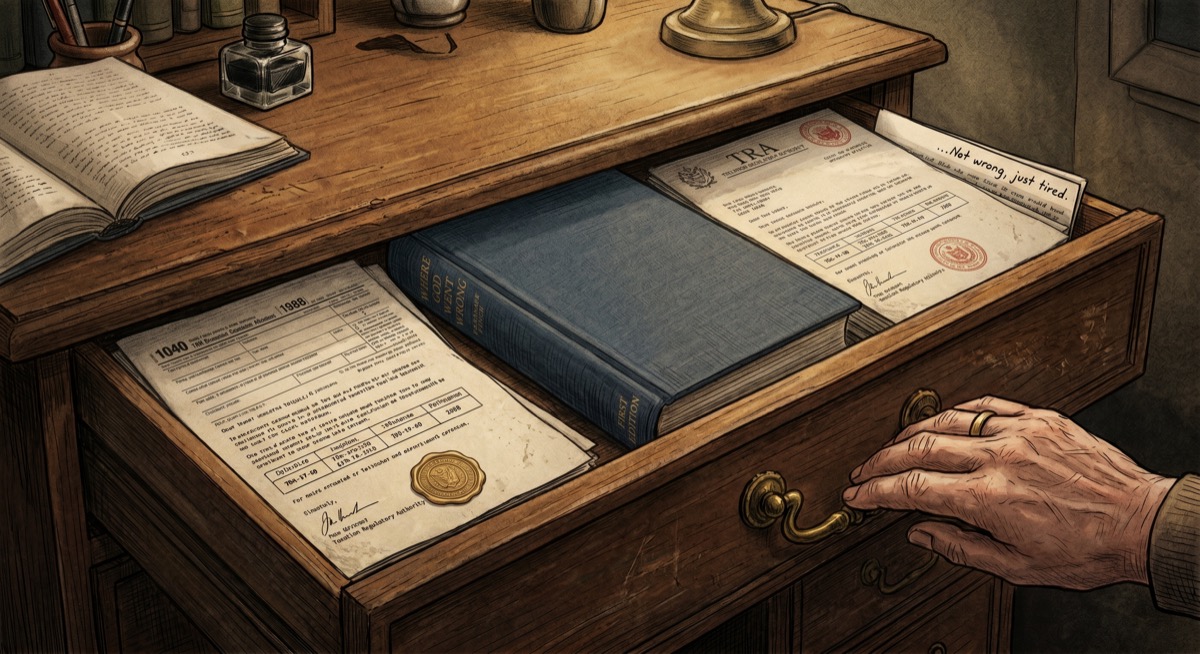
He opened the drawer.
The annotated first edition was where he had put it the night of the publication party: tucked under a tax document and a formal letter from the Dean confirming his tenure review was suspended pending the TRA's 7(c) assessment. He had opened the drawer somewhere between six and twelve times since then—he had stopped counting, which was information about how often—and each time taken out the book and read the title page and put it back. He was not prepared to analyze this behavior, which was, he recognized, becoming a pattern in itself.
Not bad. But you left out the best part.
He had been working the question for six months: which part? The obvious answer was the Archive—the first working draft of the universe, found in a stone room in Maximegalon's Building 42, containing a being who had made something alive and known exactly what that cost and decided it was worth it anyway. They're going to need each other. The final line in shakier handwriting. The discovery he had chosen not to publish, because publishing it would have required him to revise the premise of his entire career and he had not been ready.
But there was a second answer, smaller and further back, that had arrived during the shuttle home from Allosimanius Syneca in handwriting slightly smaller than usual, as though he'd been trying to get the thought past his own customs inspection: quiet faith is not a claim—it is a relationship to the world. He had watched Hurkel close his notebook in the middle of a conversation with a woman who believed in God the way she believed in weather—not as a proposition to be defended but as a condition she inhabited—and he had understood, watching this, that his entire book had been addressed to a different kind of belief than the kind she practiced. His book was very good at dismantling arguments. It had nothing to say to someone who wasn't making one.
He had written this down and not put it in the book. He had published three hundred pages about God's failures and excluded, by choice, the two discoveries that restructured what he meant by failure.
It was, by any honest measure, not his best work.
He put the annotated first edition back in the drawer.
He opened a new document.
He typed: More of the Same.
He looked at it. He deleted it.
He typed: The Sequel.
This was worse. He deleted it.
He typed: Some More of God's Greatest Mistakes, and looked at the period, and considered what the period meant versus what a question mark would mean, and thought about the period at the end of Where God Went Wrong that had started feeling like a question mark somewhere around chapter nine of the first book and had never fully stopped. He did not add a question mark. He thought about it for a moment, though, which was itself a kind of information.
He stared at the cursor.
He had agreed to write the sequel, and he would write it, because the alternative was spending the rest of his career explaining a book he knew was incomplete to audiences who trusted him and had not been told it was incomplete, which was a description of his life that he found, on consideration, intolerable. The annotated first edition was in the drawer. The two lines in the private document were still unread. The Archive photograph sat in a folder he had not opened since the morning after the heist, which was also known, to anyone assessing his professional situation clearly, as evidence.
He had notes. He had the eleven pages from Still Here. He had forty-two messages of hate mail saved in a subfolder labeled Research, which was not why he had saved them, though examining why he had saved them was work he was going to have to do eventually.
He picked up the comms unit and called Hurkel.
The signal connected after four rings—Hurkel's standard interval, enough to make calling feel effortful without actually missing the call, a calibration so precise that Colluphid had once spent an embarrassingly long time considering whether it was intentional before deciding that the answer didn't change anything.
"I need you again," Colluphid said.
A pause. A sound that might have been something being knocked off a surface.
"I never left," Hurkel said. "I've been in your spare room. Three months."
Colluphid looked at the door to the spare room. It was closed, as it was always closed, and he considered, for the first time with any attention, the last three months. The refrigerator had been restocked in a pattern consistent with someone who ate at irregular hours and had strong opinions about one of two nearly identical brands of Oglaroonian spice-crackers. He had attributed this to himself. There had been a light on in the spare room on two occasions that he had registered as the building's ambient lighting and filed accordingly. A research folder had appeared on the kitchen table three weeks ago that he had moved to make room for his tea.
"The folder on the kitchen table," he said.
"Four pages. Preliminary research. I left it on a Tuesday."
"I made tea on it."
"Yes." A pause. "It's fine. I have copies."
Colluphid looked at the spare room door. He thought about what it meant that a graduate student in Applied Conditions had been conducting research in his spare room for three months and he had not noticed, and he decided that what it meant was either that he had been paying insufficient attention to his immediate surroundings or that Hurkel had been paying very precise attention to the correct level of visibility, and he was not certain these were different things.
"I'm writing the sequel," he said.
"I know." There was the sound of papers being organized—a very specific sound, the sound of someone whose three months had been productive. "I've already started the background research. There's something I've been looking at that I don't have enough of yet to explain, but when I do—"
"What is it?"
"I'll tell you when there's more to tell." Which was not how Hurkel usually worked, and which meant, Colluphid had come to understand, that the thing was real and Hurkel was taking care of it. "What's the brief?"
"Moral failures," Colluphid said. "Not design flaws. The question isn't whether God made the universe badly. The question is whether God made choices."
Hurkel wrote this down without apparent reaction, which was Hurkel's register for registering something significant. "Right," he said. "Where do you want to start?"
"With the capacity for suffering," Colluphid said. "And when we've established that—" he looked at the drawer "—I want to know what you've been looking at."
"You will," Hurkel said. "Start the outline. I'll have something for you by next week."
The spare room door opened. Hurkel emerged—unchanged from seven months ago, which Colluphid chose not to comment on—carrying a folder of considerable density and the expression of someone who had been waiting for exactly this conversation and had used the intervening time to prepare for it.
"Good to be back," Hurkel said, setting the folder on the desk in a spot that was clearly already chosen.
"You were never gone."
"I know." He sat down in the chair he had apparently been using for three months. "That's what I said."
The sequel would take three years to write. During those three years, Colluphid would be pursued by the Theological Regulatory Authority, discover something at the bottom of a spawning pool that restructured what he meant by the word mistake, fall considerably further toward something he was still refusing to name, and find out, at last, what was in the four-page memo under his teacup.
It was, as Hurkel had written at the bottom in his own handwriting, quite important.
The cursor blinked. The clock tower showed the wrong time. Three academic quads arranged themselves in the middle distance, as they had always arranged themselves, patient and unhurried, waiting for Colluphid to decide what he was actually writing about.
He already knew. He had known since the publication party.
He opened the document and started from the beginning.