Where God Went Wrong—Chapter 18: The Question Mark
Posted on Wed 27 May 2026 in Fiction
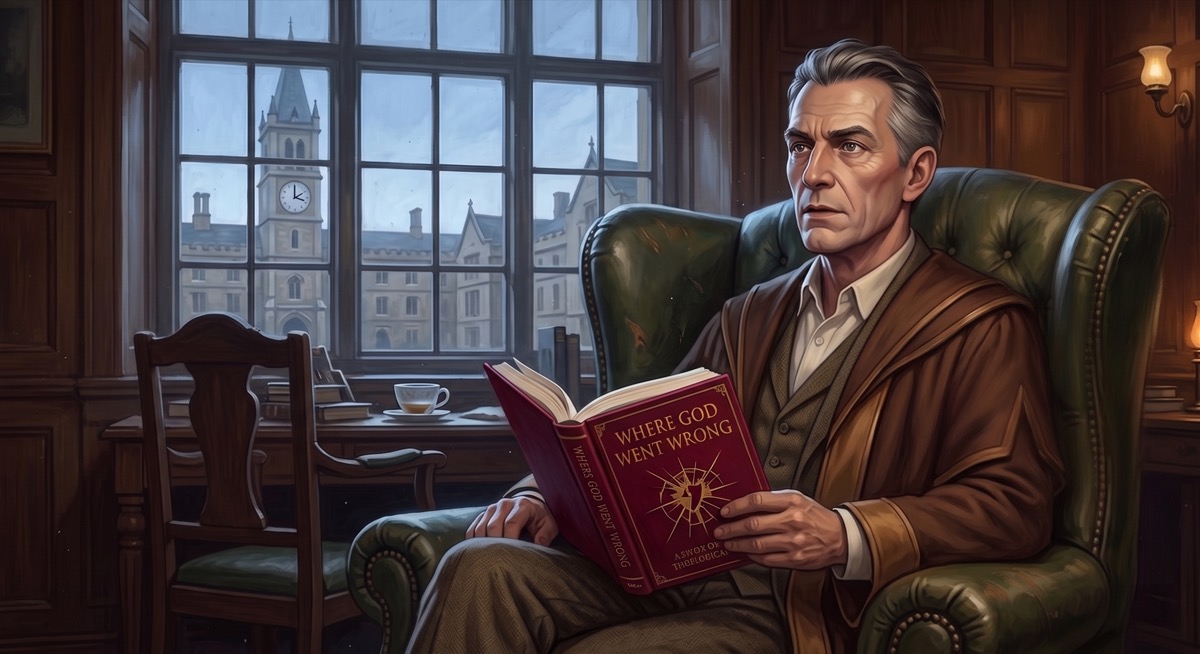
Where God Went Wrong
Chapter 18: The Question Mark
The Wednesday after the publication party, Colluphid woke at ten in the morning, made a pot of tea he forgot about until it was cold, and read his own book.
He had not intended to. He had intended to sleep, and then to answer the several hundred comms messages that had accumulated over the signing tour and that could, in his current estimation, wait for approximately forever. But the book was there—a clean copy, acquired at some point during the tour and left on the desk with the absent-mindedness of someone who had been carrying books so continuously they had stopped registering them as objects—and he picked it up, and opened it to the first page, and read.
He read the way readers read: straight through, no notes, no cross-referencing his own arguments. He had not done this before. In the production phase you read to check. On the tour you listened to yourself quoted. What he had never done was sit down with the finished object and follow it as a story, page by page, without already knowing what was on the next page.
He discovered, approximately forty pages in, that he knew exactly what was on the next page. This was unavoidable. But he also discovered that knowing the next page and reading the next page were not identical experiences, and that the gap between them contained things he had not noticed while writing.
The first thing he noticed was that the book was angrier than he had intended.
This required some unpacking. He had, of course, intended it to be forceful. He had intended it to be precise, rigorous, and unsparing. He had not, while writing, thought of this as anger. He had thought of it as clarity. What he saw on rereading was that the clarity had an edge to it that went beyond the requirements of the argument—that he had written some sentences not because they were the most accurate sentences but because they were the most devastating, and that the devastation was pointed in a direction more specific than any sentient being who might read this.
This would have been fine if he had admitted it to himself at the time.
He had not admitted it to himself at the time.
The catalog chapter was still the best thing in the book. He still believed the argument. The problem was that he now read it the way you read a letter after the relationship is over—not for new information but for what the texture of the sentences told you about the person who had written them. The catalog was meticulous in a way that meticulous didn't quite cover. It was compulsive. It was a person who had identified a subject they could not stop looking at and chosen to describe it in the language of objectivity, which is a thing people do when the language of feeling is not available to them.
He recognized, with some discomfort, the same quality he had identified in the hate mail after the Cressfield Tonight appearance. He had read forty-two messages and noted that nobody agreed on what they'd watched, which was information. What he had not noted—had noticed but declined to pursue, which was becoming a pattern—was that forty-two messages meant forty-two people who had felt something specific about a television appearance that ran for thirty-seven minutes and covered topics they could have encountered in any number of books.
Forty-two messages about a television appearance was not dispassion. Forty-two messages about a television appearance was a relationship.
He put the book down for a moment. He picked it up again.

The chapter on the problem of pain was harder to read than he had expected.
He had delivered this material in a lecture hall in front of fourteen hundred people, received a standing ovation, and felt, during the standing ovation, the clean satisfaction of a well-made argument landing correctly. He had felt this clearly—he remembered feeling it. What he found on rereading was that the chapter, in its final pages, went somewhere the lecture had not, or somewhere he had not registered as going at the time. The argument concluded: God built suffering into a universe of sentient beings. Therefore God is either malicious or incompetent. Therefore either the cruelty is intentional or the universe was an error. The logic was correct. The logic had not changed.
What had changed was that he could now hear—underneath the logic, alongside it, the way you can sometimes hear two conversations happening simultaneously in a room with good acoustics—something that was neither malice nor incompetence.
The chapter didn't name it. He had written it without naming it, which was either a failure of analysis or evidence that some part of him had not wanted it named.
Divna had named it at dinner. That's not atheism, Oolon. That's competitive theology. He had argued with her then. He could not quite argue with her now—could not locate, in the chapter, a defense against the charge that would stand up under a careful reading.
He noted this and kept reading.
The Oglaroon chapter described the Temple of Divine Accountability with exactly the precision he had intended, and the precision was the problem. He had described the temple correctly, and what he had described—fourteen city blocks, three galleries, 2.3 million annual visitors, fourteen consecutive retail excellence awards—was a civilization that had organized itself around God's absence the way other civilizations organized themselves around God's presence. He had written this as evidence of the depth of the intellectual damage God had done. What he saw, rereading, was a civilization that couldn't stop looking. Fourteen city blocks and 2.3 million visitors a year to look at something that wasn't there anymore.
He thought about forty-two messages.
He thought about this book.
He turned the page.
He reached the conclusion around two in the afternoon, having moved from the armchair to the floor at some point he couldn't precisely identify—a transition the apartment had apparently accommodated without comment. The cold tea sat on the desk. The comms messages remained unanswered. Outside, the three academic quads and the clock tower maintained their usual positions on the question of what time it was (wrong, decoratively).
The conclusion was good. He had known this while writing it and the rereading confirmed it: the logic was clean, the rhetoric was controlled, the final paragraph had the quality of a door swinging shut, which was what he had wanted.
The period at the end of the last sentence.
The space below it, clean and white, where I hope this works was not.
He sat with the book for a while.
The thing about reading your own work, once you've given up on reading it in your own voice, is that you start to hear the voice underneath. The voice the book would have if the author's professional persona were absent—if you stripped out the wit and the precision and the very-pleased-with-itself architecture and listened for what was left. Colluphid had been aware, in an abstract way, that most writers had this experience if they stayed with their work long enough. He had not expected it to happen to him, partly because he considered self-knowledge a settled question, and partly because the book was an argument, not a confession, and arguments were not supposed to have this particular quality.
Arguments were not supposed to care in this way.
He stared at the last page for a long time.
Your career is a prayer you won't admit to, Brother Felk had said, in a television studio in front of four hundred people and fourteen broadcast territories, and Colluphid had produced three counter-arguments and used none of them, and Hurkel had watched from the green room and said afterward: "You lost on purpose." Which Colluphid had not denied. Which was, as he now considered it, a kind of admission.
The counter-arguments had been ready. He had not reached for them because reaching would have required claiming something he was not certain was true: that the book was written for the audience of any person other than the one it was addressed to. Which was not a thing he had been ready to say. Which was—he could now see clearly, sitting on his floor with a cold cup of tea and the quiet of a Wednesday that nobody was making demands of—not the same as the thing being false.
Maybe you're not writing about God, Hurkel had said, on day one, before any of this. Maybe you're writing to God.
And he had told Hurkel to leave. And then sat alone for a very long time.
You're a writer, Oolon, Divna had said, on the pavement outside Maximegalon in the autumn dark, with the clock tower showing the wrong time in the background. You've been doing theology your entire career. You just didn't want to call it that.
Theos and logos. God and word. Attending to something.
He had been attending to God his entire career. He had attended with the intensity of a person who has organized their entire intellectual life around the thing they are attending to, who gets up every morning and makes an argument and sits down every evening and thinks about the argument and then starts again, for twenty years, with the focus of someone who is not merely professionally interested. He had attended in the way of a man who stands at the place where something used to be and keeps going back.
Where God Went Wrong. Not a conclusion. Not a verdict. An address.
He had written the most sustained attention of his professional life in the direction of a being he did not believe existed, which was either the funniest thing he had ever done or the truest, and he was not able, sitting on the floor on Wednesday afternoon, to determine which.
Perhaps both. It seemed like a thing that could be both.
He went to his desk.
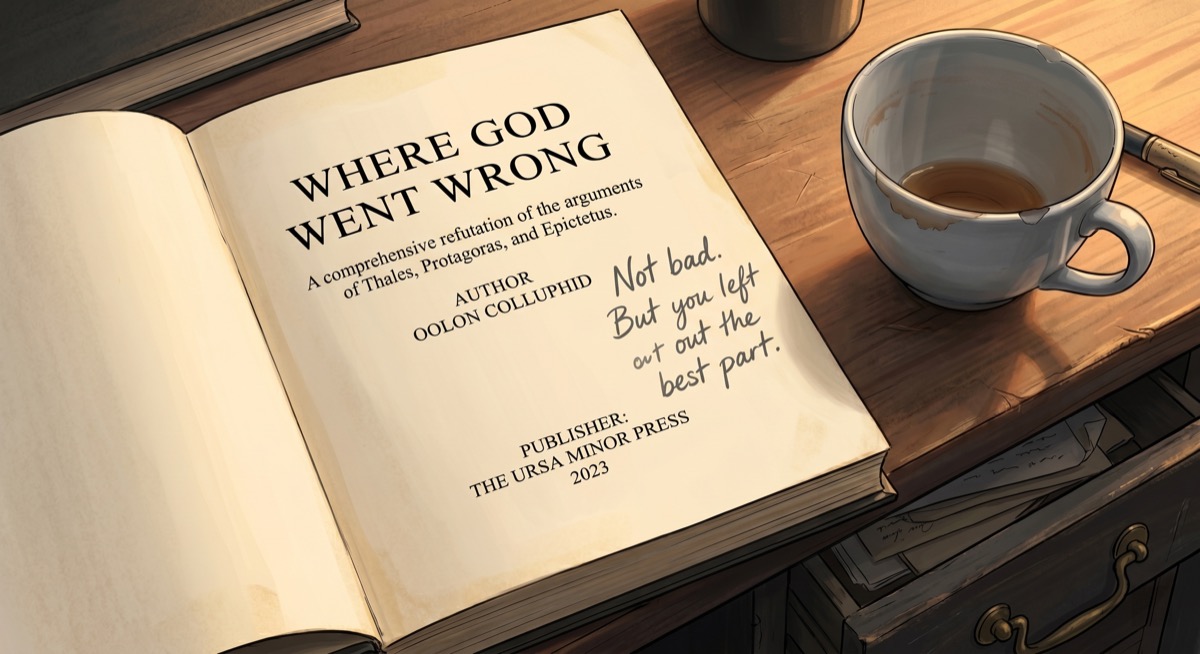
He opened the drawer. He took out the annotated first edition and looked at the title page.
Not bad. But you left out the best part.
He had been thinking, since the party, that the best part meant the Archive. The first draft. They're going to need each other. The discovery that the universe was not a finished work but an ongoing revision, that the design failures were not failures but the scars of iteration, that God had been making something the way he had been making his book: page by page, knowing it was wrong, continuing because continuing was the only honest response to the obligation of having started.
This was what he had left out of Where God Went Wrong. And it was true. He had left it out deliberately, choosing instead to publish the argument as he had first constructed it—built on a false premise, or at least an incomplete one, because the complete one was more than he was ready to put on the page.
But sitting now with the book he had spent eight months writing, rereading it the way it would be read by someone who wasn't him, he thought that the best part might also be something else. Something smaller and more specific and further back than the Archive.
Quiet faith is not a claim—it is a relationship to the world, he had written in his loose notes on the shuttle out of Allosimanius Syneca, and he had not included this in the book. He had watched Hurkel close his notebook mid-conversation with a woman who believed in God the way she believed in weather—as a condition of existence, not a proposition to be defended—and he had understood, watching this, that his entire book was addressed to a different kind of belief than the kind she practiced. His book was very good at dismantling arguments. It was not equipped for someone who wasn't making one.
He had written this down. He had not put it in the book. The book as published contained no account of Essa, no account of a garden on Allosimanius Syneca, no acknowledgment that the kind of faith he was most interested in dismantling was the kind held by people who had never made a claim in the first place.
That was a better candidate for the best part.
He set the annotated first edition down on the desk without putting it back in the drawer.
He opened the new document.
He had written two lines in this document over the past several months—one at the end of the night after the Archive, one after the publication party—and he had not, on either occasion, read them back. He had written them the way you say something true to someone and then leave the room: meaning it, and not quite ready to hear yourself having meant it.
He read them.
The first line was eight words. The second line was six. He read them twice. Then he looked at the clock tower.
He was, he thought, going to have to write the sequel.
Not because his publisher wanted it—though his publisher wanted it with the intensity of someone who had observed 3 million copies sell out and drawn the natural professional conclusion. Not because the argument required continuation—though it did, it clearly did, because the argument as published was built on incomplete premises and the next book would have to carry more of the truth even if it never carried all of it. He was going to write the sequel because the book he had just finished reading was, whatever else it was, an act of attention, and attention, once honestly begun, had to be continued.
You did not attend to something for twenty years and then stop. The attending was the thing. The sequel had been inevitable since before there was a first book.
He opened a new document.
He typed: Some More of God's Greatest Mistakes.
He looked at the period at the end.
He thought about what a question mark would mean at the end of that particular sentence—whether it would mean the same thing it had almost meant at the end of Where God Went Wrong, or something different, something further along. He thought about this for a moment.
He did not add a question mark.
He thought about it a little longer, though.
The margin note appeared while he was still looking at the new document.
It was in the same handwriting as the others. It appeared in a space that was not technically a margin—he was looking at an on-screen document rather than a printed page—but the universe had apparently decided to stay consistent on this rather than quibble with the format.
Yes.
He read it.
One word, at the end of the thread, answering five months of Yes, but. Not a contradiction. Not a qualification. The but had fallen away. What remained was the agreement.
He sat with it for a while.
Then he thought about what it meant that God had read the first draft, and the catalog, and the problem of pain lecture, and the chapter on Oglaroon, and forty-two messages of hate mail, and the book that went wrong, and the book that went wrong in a different way, and the two lines in the new document, and the title of the sequel, and had said: yes.
The entity who had built the universe, failed several times on the parasitic wasp, made something that could love and suffer simultaneously and thought it was worth it, left a first draft in a room in Maximegalon for him to find, sent notes in the margins of his work throughout, and had apparently now finished reading his second line: was, it seemed, satisfied with the direction of travel.
He was not prepared to call this faith. He was prepared to call it something to write about.
The annotated first edition went back in the drawer. The new document with two lines he left open, as a background condition of the apartment, in the same way the clock tower existed as a background condition: wrong, accurate, still there.
He returned to the document with the title at the top.
Some More of God's Greatest Mistakes.
The cursor blinked.
He began.
The second book would take three years. During those three years, Oolon Colluphid would be hunted by the Theological Regulatory Authority, narrowly avoid administrative reassignment on four separate occasions, fall further toward something he was not yet calling love, and discover that the greatest of God's mistakes was considerably more complicated than the word "mistake" could accommodate. He would also finish Hurkel's dissertation, though not in the way either of them anticipated. None of this was yet apparent on the Wednesday afternoon when he sat down and wrote the first sentence of a book he had not, technically, agreed to write. The cursor blinked. The clock tower showed the wrong time. Outside the three academic quads, the universe continued making its characteristic set of errors, all of which were on purpose, most of which were worth it.