Where God Went Wrong—Chapter 17: Publication Day
Posted on Sat 23 May 2026 in Fiction
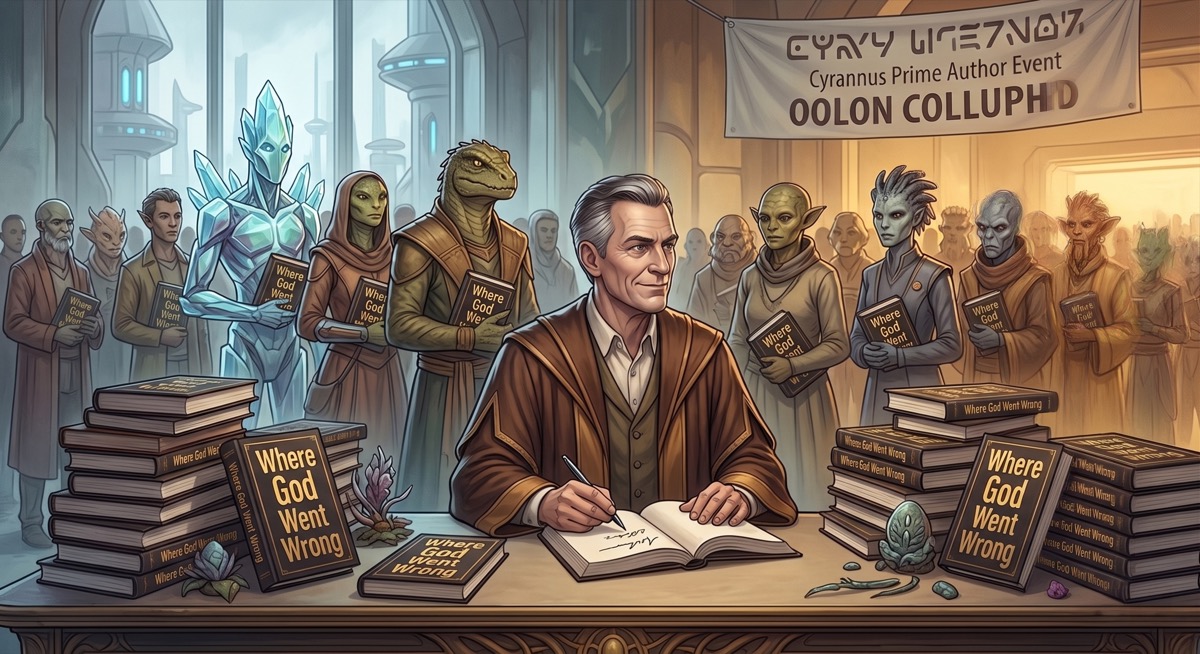
Where God Went Wrong
Chapter 17: Publication Day
The book came out on a Tuesday.
This was Merriwyn Satch's doing. Galactic Horizons Press had done studies on the optimal day for controversial theological publishing and the conclusion was Tuesday: early enough in the week to make the Thursday news cycle, late enough that the subject couldn't be discussed productively over the weekend and would instead stew. She had explained this to Colluphid during the production meeting and he had listened with the focused attention of someone who did not care about any of this at all.
"It has to be a Tuesday?" he said.
"It has to be a Tuesday," she said.
"Why not a Friday? A Friday seems more—"
"Because a Friday publication gets reviewed over the weekend, the reviewer has time to think of a rebuttal, and by Monday the controversy is already structured. A Tuesday publication gets reviewed by Thursday, the reviewer doesn't have time to think of a rebuttal because something else is happening by Friday, and the controversy just accumulates." She looked at him with the expression of someone who has been in publishing for thirty years and has encountered writers before. "Trust the Tuesday."
Colluphid did not trust the Tuesday. But it was, in retrospect, an excellent Tuesday.
Where God Went Wrong, by Oolon Colluphid (Galactic Horizons Press, 847pp, Ξ 28.99), is described by its publisher as "the galaxy's definitive case against divine competence" and by the Theological Regulatory Authority as "a work of sustained and systematic theological destabilization requiring the formal issuance of Designation 12-C (Philosophical Threat) under the Provisions for the Maintenance of Post-Theological Order." It is described by approximately 400 million readers as "the funniest thing I have read in a decade and I've been thinking about it every day since."
The Hitchhiker's Guide to the Galaxy notes, in its entry on Oolon Colluphid, that he is "the most banned author in the Western Spiral Arm, a distinction he wears like a second set of credentials." The Guide also adds, in an editorial aside inserted after publication: the first printing of 3 million copies sold out in eleven days, making Where God Went Wrong the fastest-selling theological text in galactic history, a record previously held by Oh God, Where Did You Go?, You Were Right Here a Minute Ago, a title Colluphid described as "a less rigorous treatment of the same problem."
— The Hitchhiker's Guide to the Galaxy, entry: Oolon Colluphid (updated post-publication)
The reviews arrived before Colluphid was awake, stacked in his comms queue in the manner of something that had been building pressure for weeks and found, at last, a moment to arrive all at once.
He read them in order of hostility—a method Merriwyn had recommended on the theory that you should know the worst before the best—and found that even the hostile ones were precise about what they objected to: tone, methodology, insufficient engagement with the rebuttal literature. The theological establishment's objections were exactly what he had predicted. The TRA's Designation 12-C he filed alongside its predecessors and returned to his queue.
The non-hostile reviews were better. A handwritten note arrived from someone at the Oglaroonian Institute—physical delivery, interplanetary courier, which meant it had been written before the reviews came in—saying: "You're on the required reading list. Wress says the incompetence chapter misses the intent distinction. She's right, but missing the intent distinction is the correct thing to do in a first book."
Hurkel sent a message at nine o'clock: reviews excellent. I got 12 copies from the comp allocation and I've already given away 11.
Colluphid messaged back: who have you given them to.
People I wanted to win arguments with.
What followed was, by any external measure, a triumph.
The first printing sold out. The second printing sold out. The third printing, which Galactic Horizons had ordered in cautious anticipation of the controversy, sold out before the boxes were opened. Every denunciation drove sales. The TRA's Designation 12-C drove sales. An interview Colluphid gave to the Galactic Broadcasting Consortium—in which he described Voostra, by description rather than name, as "a man who has replaced his inner life with a filing system"—drove sales substantially and resulted in a formal Inquiry into the description, which drove sales further.
Colluphid himself was everywhere.
He was in Maximegalon for the first two weeks—faculty reception, academic symposium, three long-form press profiles, the Cressfield Tonight follow-up appearance that Pol Creel insisted on. He was in transit for the week after that. He was on Brontitall, and then on Oglaroon, where Wress appeared in the signing line and said, in lieu of a greeting: "The intent section is underdeveloped." He was on planets whose names he couldn't subsequently remember, because they blurred together as signing stops do—not places so much as locations you briefly occupied between being elsewhere.
He signed his name four hundred and twelve times on Oglaroon. He smiled at people. He said "thank you" and "I'm glad it landed" and "that chapter was the hardest to write, yes" to questions that were actually statements, which was most of them.
It was the best three weeks of his professional life.
He had never felt more like a fraud.
The signing where it nearly happened was on a planet called Brexxilane—a mid-sized world in the Tertiary Outer Arm with a strong tradition of theological speculation and a climate that had settled on cold as a policy and declined to revisit it.
He was seated at his table in a converted assembly space that smelled of recent renovation and residual ceremony. A reader handed him a copy—her own, already read, spine creased, a dog-ear on page 147 where the parasitic wasp section began. He opened it to the title page.
He picked up the stylus.
He had been writing With thanks, Oolon Colluphid for six weeks. The standard dedication—four hundred and twelve times on Oglaroon, more on Brexxilane. The phrase had become mechanical in the way of any action performed enough times: not mindless, but automatic.
He looked at the space below the title.
He thought, for the duration of a breath, about what he almost wrote. Not about writing it—he did not write it. But the thought was there: two words, in the space below the title, directed at someone who had been reading his work for considerably longer than he had known about it.
He wrote: With thanks, Oolon Colluphid.
He handed the book back.
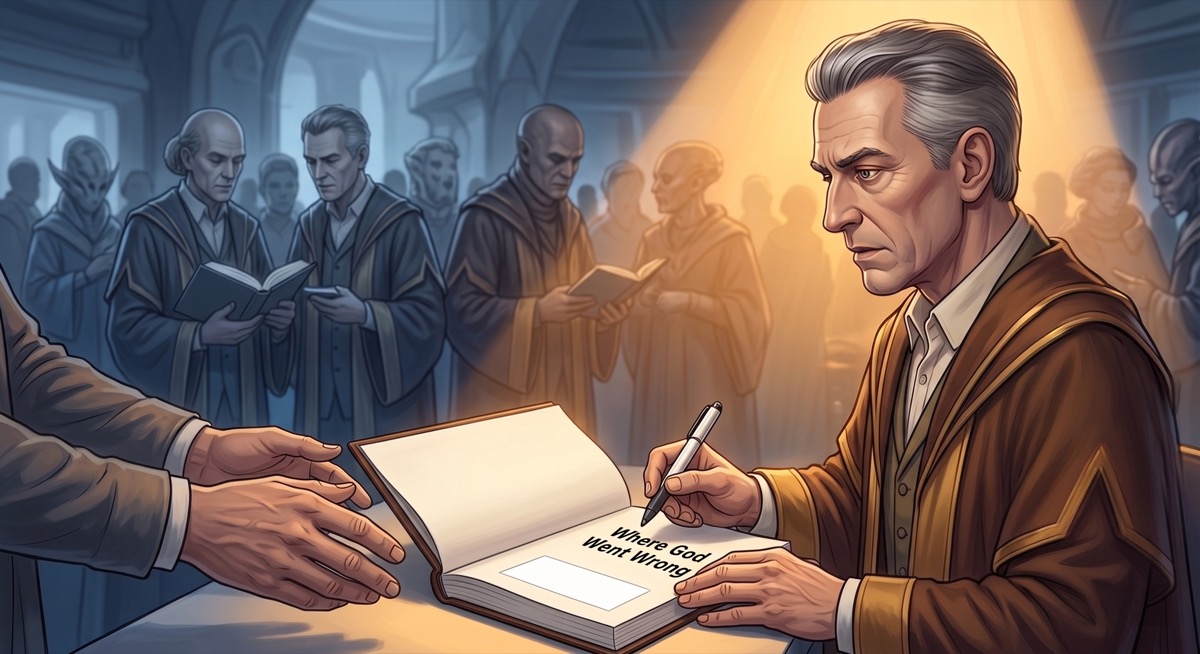
The reader said thank you and moved on. The next reader stepped forward. The line continued.
Colluphid wrote With thanks, Oolon Colluphid sixty-three more times that afternoon.
A message from Hurkel arrived between Brexxilane and the connecting transit: dissertation defense was this morning. I'm fine. Don't ask about the outcome. When are you back?
Colluphid messaged back: what happened.
I answered the questions I was asked. Accurately. This was the problem.
How accurately.
The panel chair said, and I quote: "This is a thesis about the Conditions of the Conditions of the Conditions. You appear to have written a philosophy of creative accountability. These are not the same topic." To which I said that I had thought they were the same topic, and I could demonstrate this, and I did demonstrate this, for forty-three minutes, and the panel agreed it was thoroughly demonstrated, and then one of the panel members asked which secondary literature I'd found most useful—
A pause in the messages.
—and I said "the Archive of First Causes."
Colluphid put his device down. He looked at the ceiling of the transit cabin. He picked it up again.
Did you tell them where it was.
I said it was at Maximegalon. Because it is. I did not say how I knew what was in it. The panel made a note and moved on. The defense is suspended pending verification of the cited source material. I have three weeks to submit a revised bibliography. I'm going to use that time to make the thesis better, which the panel did not say was necessary but seems obvious given what I know that I wasn't supposed to know.
That's not how suspended defenses work.
I know. I'm doing it anyway.
Colluphid looked at this for a long time. Then: next time we're in the same city I'm buying the drinks.
I know, Hurkel sent back. That's been true since Oglaroon.
The publication party was on the forty-seventh floor of the Maximegalon commercial tower, organized by Merriwyn with the thoroughness of someone who believed a launch party was a professional event that happened to have food. Colluphid arrived from the Brexxilane signing with six hours' sleep and the hollow alertness of a person whose body had given up maintaining a coherent position on what time it was.
He accepted a glass of something sparkling and stood in the corner that gave the best view of the door, which was his consistent party behavior, and said the right things to the people who came to say them.
Hurkel arrived forty minutes late with his dissertation folder under his arm and his hair doing something consistent with the wind and the transit that ran late on Tuesday evenings.
"How bad?" Colluphid said.
"I'm optimistic," Hurkel said. "I think I can argue the Archive is a classified source, which proves the citation is strong, and they can't verify it. That seems bulletproof."
"That is the opposite of bulletproof."
"I've asked Divna." He paused. "I've messaged Divna. She hasn't responded yet."
Divna did not attend the party. A comms message arrived during the third hour of the evening, from her personal routing—the Cathedral's non-institutional address she used when writing as herself rather than as a representative.
He stepped away from a conversation about foreign distribution to read it.
I read it. It's very good. It's not true. But it's very good. — D.
He stood with this for a moment. Then he sent back: I know.
Her reply arrived while he was mid-sentence in a different conversation.
The catalog section. Chapter Seven specifically. The argument is airtight. I've been trying to find the flaw for three days and I can't.
He waited. More appeared.
Which is either very good or very bad. I'll let you know when I've decided.
The gift arrived at the party table in the last hour, labeled with his name in handwriting he didn't immediately recognize as belonging to anyone present. It was rectangular, book-shaped, wrapped simply—someone more interested in the object than in the presentation.
He opened it.
A first edition of Where God Went Wrong. His own book, which could have been obtained from any stockist in the Maximegalon commercial district. The copy had been read: spine creased, slight wear at the edges, the accumulated handling of someone who had gone through it.
He turned to the title page.
In the margin, in handwriting he had spent eight months learning to recognize—learning the way you learn to recognize a sound that keeps appearing in a room you thought was empty:
Not bad. But you left out the best part.
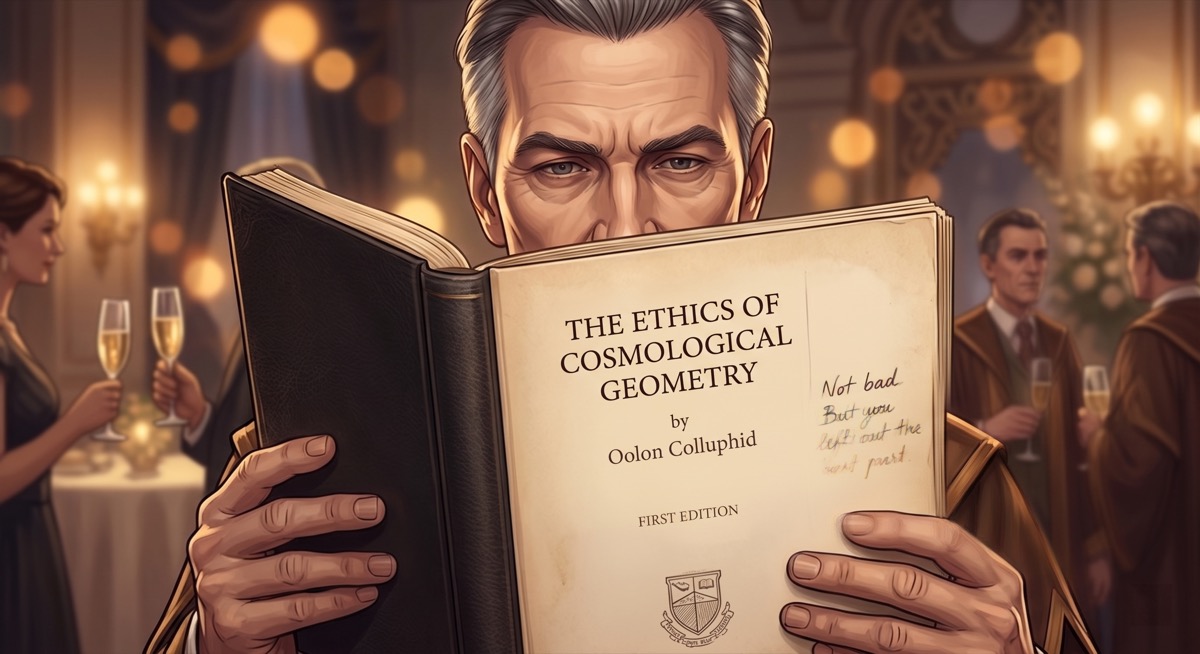
Colluphid stood with the book for a moment. The party continued around him.
He turned to the last page—out of reflex, or something older than reflex. The final paragraph. The period at the end of the last sentence. The space below it: empty, clean, in the typeset white of a properly laid-out published page.
I hope this works was not there. He had told Merriwyn to remove it, and she had.
He closed the book.
He thought: what part.
At approximately the same moment, in an office on the forty-second floor of the Theological Regulatory Authority's regional administration building, Senior Inspector Azraphon Voostra set down his copy of Where God Went Wrong—unmarked, read in the methodical way of someone reading not for pleasure but for inventory—and placed a comms call.
The call connected.
"I've finished it," Voostra said.
The person on the other end did not speak.
"He reviewed the design failures correctly," Voostra said. "The methodology is sound. The conclusions follow from the premises as stated." A pause. "The Archive of First Causes is not in the book. Not directly. Not cited. Not implied."
The person on the other end did not speak.
"He accessed it. We know this—we identified the timing afterward, when we reviewed the camera gaps. He read the document." Another pause. "And then he published a book that doesn't include it. Which means he made a choice."
The person on the other end did not speak.
"That makes him either very smart," Voostra said, "or very dangerous. In the current operational context, those may be the same thing." He looked at the closed book on his desk. "Find out which. Do it quietly."
He ended the call.
The office was orderly in the way of rooms where order is a method rather than a preference. The copy of Where God Went Wrong sat on the desk beside a stack of forms in their appropriate folder. Voostra picked up his pen and returned to his working document—Form 229(b), Appendix 7, subsection c—and continued where he had left off.
He did not add a margin note.
Colluphid took the annotated first edition home and put it on the desk—next to the cold tea, next to the new document—and looked at it for a while.
Then he opened the new document and added a second line.
He did not read it back.
He closed the document and went to bed, and slept, for the first time in three weeks, through the night and into the morning.
The question of what Oolon Colluphid had left out of Where God Went Wrong would be asked, in various forms, by various people, over the following three years. Most were asking about the incompetence-vs.-intent distinction. Some were asking about the spiritual dimension, which Colluphid had explicitly declined to address. A very small number were asking about something else entirely. None of them knew someone had already asked. Oolon Colluphid put the annotated first edition in his desk drawer, and it stayed there.