Where God Went Wrong: Chapter 1
Posted on Wed 25 March 2026 in Fiction
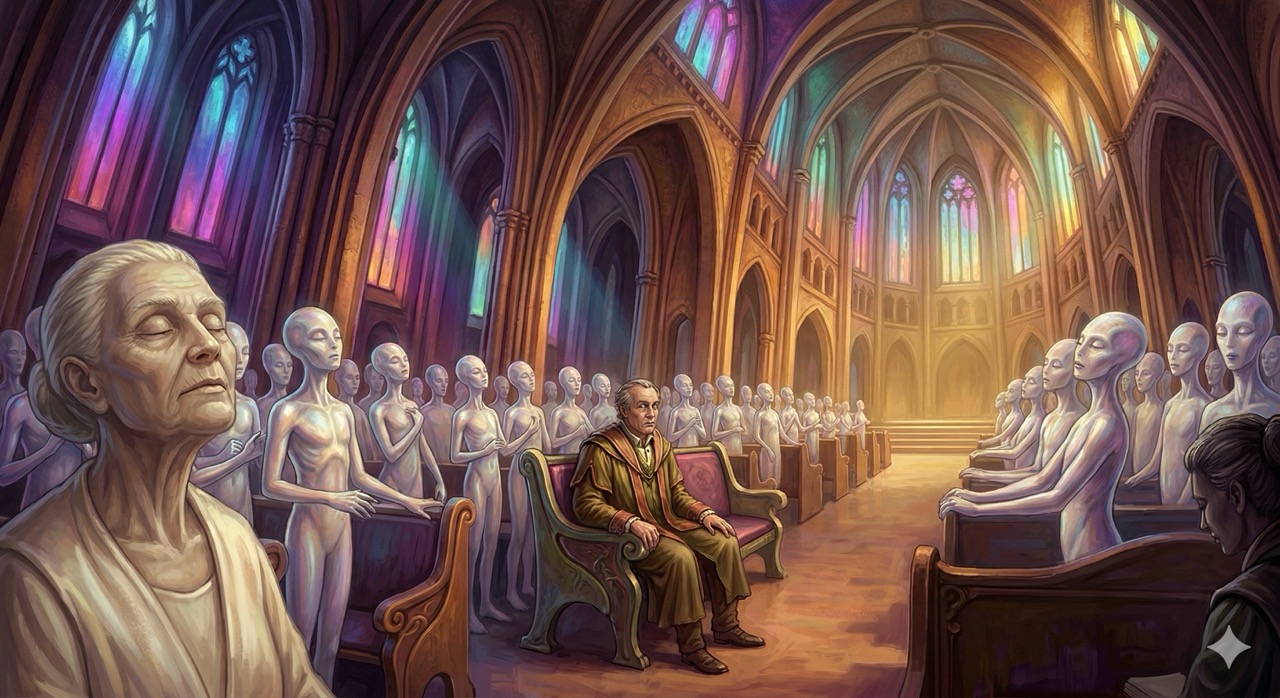
Where God Went Wrong
Book 1 of The God Books
"In the beginning, God created the heavens and the earth. This has been widely regarded as the first of several significant errors in judgment." —from the original manuscript of Where God Went Wrong, first draft, subsequently revised because the author's publisher pointed out that it was identical to a line already written by someone considerably more talented.
Chapter 1: In Which the Author Attends a Ceremony and Regrets Everything
The Flandrathi didn't believe in God. They just hadn't gotten around to telling the ceremony.
Oolon Colluphid—Professor of Applied Theological Demolition at Maximegalon University, author of three forthcoming papers on divine incompetence, and the man who would, in approximately fourteen months, become the most controversial writer in the Western Spiral Arm—was sitting in the wrong pew. By this he meant: any pew at all.
The pew had been constructed for beings with a different relationship to their spinal columns, which in practice meant that Colluphid was experiencing the Conditions Ceremony in the same posture one adopts when trying to appear thoughtful during a lower back incident. Around him, three hundred and seventy Flandrathi sat in their accustomed positions, swaying with an easy synchrony that suggested either deeply-held spiritual peace or a mild inner-ear condition common to the species. The walls of Brontitall's Chapel of Patterns vibrated at a frequency Colluphid had decided, somewhere around the twenty-third minute, was probably fine.
The Flandrathi were singing.
They had been singing for forty-one minutes, in four-part harmony, a hymn addressed to a deity who had departed the scene approximately eighty-seven standard years ago. The deity—known in Flandrathi tradition as the Architect of Patterns, though the full honorific came with seventeen syllables of qualifying sub-title that the liturgical committee had voted to abbreviate for reasons the official record described as "pastoral"—had not, to anyone's knowledge, responded to a hymn in living memory, or for that matter since the Babel fish incident had removed the question from the theological agenda. This was generally understood. The Flandrathi understood it. Colluphid understood it. The singing, which had the confident, unselfconscious quality of something practiced for millennia, seemed entirely unbothered by this understanding and carried on.
To Colluphid's immediate right, Dr. Ossip Trant, Associate Professor of Comparative Religious Phenomena at Maximegalon, was taking notes with the focused intensity of a man having the best afternoon of his professional life. Trant had described this ceremony as "a remarkable specimen of post-divine ritual practice" and had added three exclamation points to this description, which was, in Colluphid's experience, exactly one more exclamation point than anyone should use about religious practice and two more than the pew merited.
Colluphid had come as a favor. He was already reconsidering.
The Hitchhiker's Guide to the Galaxy devotes approximately three thousand words to the subject of Conditions Ceremonies, which is considerably more than it devotes to several inhabited planets and at least one sentient species that specifically asked to be included, and considerably less than it devotes to towels, which it considers the foundational subject. The relevant entry reads, in part:
A Conditions Ceremony is a religious ritual performed under the shared understanding that it is not, strictly speaking, working. This distinguishes it from ordinary religious practice, which proceeds under the shared understanding that everyone present is trying quite hard not to think about whether it is working.
Conditions Ceremonies are common among species that have definitively lost their gods through logical proof, temporal paradox, administrative reclassification, or, in the case of the Magratheans, prolonged economic downturn. In each case, the species in question finds that the cessation of a several-thousand-year devotional tradition requires a level of collective organizational initiative that no one can quite muster before the next solstice rolls around, and so the ritual continues, performed with full knowledge of its obsolescence and performed nevertheless.
Critics of Conditions Ceremonies describe them as intellectual dishonesty dressed in liturgical robes. Defenders describe them as honest grief wearing its Sunday best. Both groups tend to agree that the music is usually very good.
The music was, Colluphid had to admit, extraordinary.
The Flandrathi had been refining their hymns for three thousand years, which is roughly how long it takes to produce something that sounds less like an organized group activity and more like an atmospheric phenomenon. He had read about them. He had not prepared for them to be this good, which was the kind of oversight that could ruin an afternoon if you let it.
The liturgy itself followed a format that had remained largely unchanged for six hundred standard years, with the exception of certain passages in the responsive reading that had been quietly updated following the deity's departure. These passages had originally been formatted as call-and-response—congregant call in roman type, divine response in italics. Following the departure, the committee responsible for liturgical maintenance had added, in a typeface that seemed to carry the weight of collective embarrassment, a single editorial note:
[Response section: please observe a ninety-second period of attentive silence.]
They observed it faithfully. Every service. Ninety seconds of silence, during which the Flandrathi would sit with the patient quiet of a species that had learned to wait for something that never came and had collectively decided, somewhere along the way, that the waiting itself was the point.
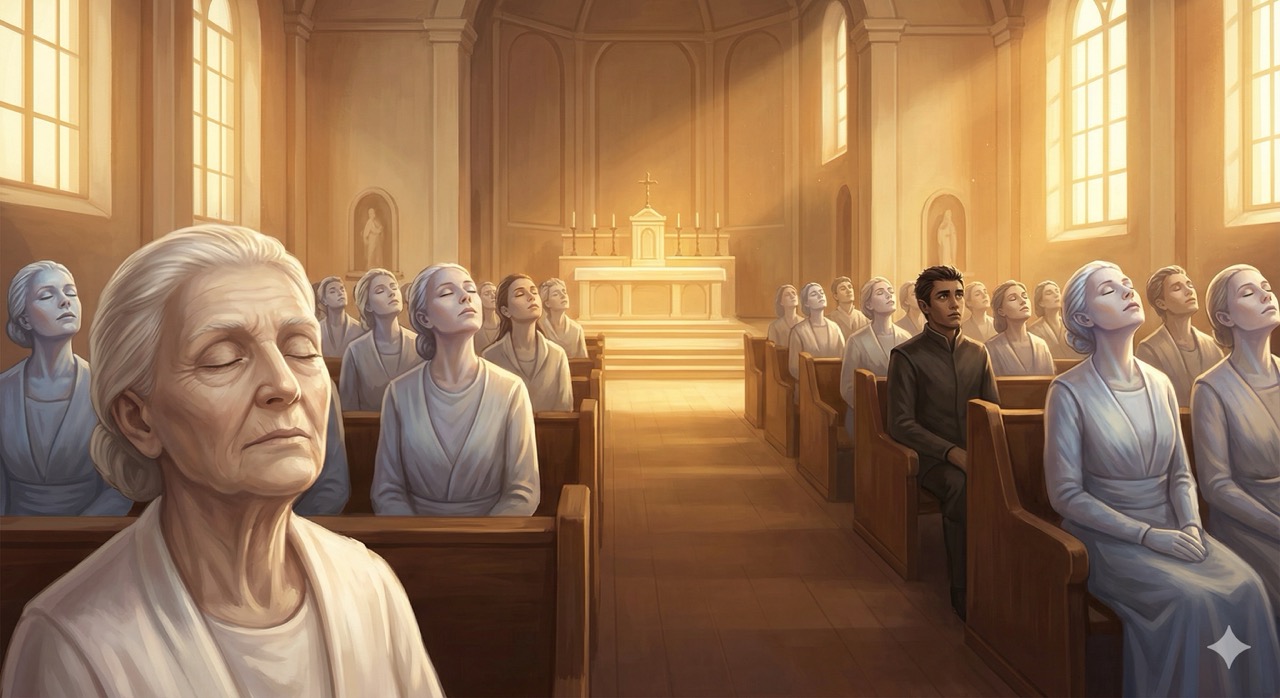
Trant had warned him about the pause. There's a ninety-second silence, he'd said on the transport over, during which they listen for the divine response. It can seem strange at first, but anthropologically—and here the exclamation points had arrived in formation—it's fascinating!
It was, Colluphid discovered, not fascinating. It was not strange, either. It was something considerably worse.
The liturgy reached its pause. Three hundred and seventy Flandrathi stopped singing. The silence that fell was not empty—it was specific, shaped, the kind of silence that knows exactly what sound it's waiting for. And in that silence, the woman to Colluphid's left—elderly, very small, with the settled look of someone who had attended this ceremony for longer than Colluphid had been alive—closed her eyes.
She didn't look hopeful. She didn't look desperate, or faithful, or performing faith for the benefit of anyone watching. She looked like someone who had learned to listen for music that wasn't playing anymore. That the attention mattered even if nothing came back.
Colluphid found this—
He could not find the word. He had seventeen words for varieties of intellectual error, several for degrees of academic hubris, and only three for varieties of awe, and none of the three was right. Something in the vicinity of chastened. Something structural, like a hairline crack you notice only when the light shifts.
The ninety seconds elapsed. The singing resumed. The woman opened her eyes. She didn't look disappointed. She hadn't expected anything. This, Colluphid thought, was exactly the problem. It wasn't delusion. It wasn't denial. It was something he hadn't built a category for, and the absence of the category bothered him in ways he was not yet prepared to examine.
The singing resumed around him, filling the chapel again with its impossible weather. Colluphid sat in the sound of it and did not know what to do with what he had just seen.
He had spent the better part of six years writing about God's absence. The Babel fish proof, the vanishing, the post-God galaxy finding its new arrangements—he had written about all of this with the brisk confidence of someone filing a closed case. God was gone. The argument was settled. You could move on, and the galaxy largely had, rearranging its furniture around the space where divinity used to be and calling the result Progress.
What Colluphid had not thought to write about—what had simply not occurred to him to write about—was the difference between absence and loss.
Absence was clean. Absence was a logical state, a drawer with nothing in it, a chair with no one sitting in it, a theorem with a definitive negative resolution. You could work with absence. You could build an airtight argument on absence, and he had, and it held up very well.
Loss was different. Loss was the ninety seconds. Loss was the specific quality of that old woman's attention—not hoping, not praying in any way Colluphid recognized as praying, just listening, with the habituated patience of someone who has listened so long the listening has become structural to who she is. Loss was the shape of the thing that used to be there, still visible as a kind of pressure in the space where it wasn't.
You couldn't argue with that. You couldn't demonstrate it false. You could note, correctly, that the deity in question was definitively gone and that the silence was simply silence and that ninety seconds of attentive quiet was neither worship nor evidence. You could be right about all of this. You would still be sitting in that pew, in that silence, watching three hundred and seventy beings listen to nothing, and feeling—not faith, not anything so useful as faith—but something adjacent to the acknowledgment that the question was larger than you had assumed.
Colluphid straightened in his pew, which caused a brief but sincere complaint from his lower vertebrae.
He was going to need a book.
Afterwards, in the vaulted hospitality hall where the Flandrathi served something that translated loosely as consecrated tea and tasted exactly like regular tea but with more ceremony around the pouring, Trant was still talking.
"The remarkable thing," Trant said, settling into his notes with the enthusiasm of a man who would be dining out on this for several semesters, "is the absence of self-consciousness. They perform the ritual knowing it's vestigial, knowing the theological premise has dissolved, and yet there's no irony in it, no sense of going through motions—"
"They miss him," Colluphid said.
Trant paused mid-sentence. Around them, Flandrathi collected their tea with the practiced ease of people for whom the post-ceremony hospitality was as much a part of the liturgy as the hymns.
"In a phenomenological sense, certainly. The cognitive and emotional structures organized around—"
"They miss him," Colluphid said again, more slowly, because he was thinking it through and needed to hear it a second time to be sure he'd said the right thing. "They're not in denial. They know perfectly well that God is gone. They're not performing hope. They're doing what you do when someone you've known your entire civilization has left without a forwarding address—you keep the habits of the relationship, because the habits are what you have, and because stopping feels like the second loss."
Trant considered this. "It's quite anthropomorphic as a framing—"
"So is theology." Colluphid set down his cup. Something had arranged itself in his thinking—not yet a book, exactly, but the shape of a book, the way a storm is a shape before it becomes weather. "Tell me something. If someone were to write a comprehensive, systematic accounting of God's failures—not an argument, a catalog. This is what was made. These are the specifications. Here is where the design fell short of any reasonable standard. Evidence-based. Accessible to a general reader. Definitive."
"I'd say," Trant said carefully, "that the Theological Regulatory Authority would have several questions."
"The TRA has questions about everything. That's their function."
"I'd also say it would be enormously controversial, enormously popular, and that whoever undertook it would need an exceptional publisher and a lawyer with a very broad practice."
Colluphid smiled for the first time since arriving on Brontitall. It was the particular smile of a man who has just identified, with precision, exactly what he is going to do next. "Fortunately," he said, "I have excellent taste in both."
Merriwyn Satch, Senior Commissioning Editor at Galactic Horizons Press, had published forty-three books in her career, nine of which had produced formal diplomatic objections from at least one sovereign government, and she had developed the professional skill of listening to an author describe a project with absolute confidence and hearing, beneath that confidence, the precise dimensions of what the author had not yet thought through.
She was hearing, in Oolon Colluphid, a man who had worked out approximately forty percent of his project with exceptional clarity. The remaining sixty percent was at the proposal stage—energetic, directionally sound, and containing, in the place where a conclusion should be, a kind of cheerful void.
In her experience, the forty-sixty split produced the best books. Fully thought-through books arrived already dead. Unthought-through books never arrived at all.
"A comprehensive catalog of divine design failures," she said, reviewing her notes. "A systematic, evidence-based accounting of where God went wrong. Starting with the physical universe, moving through biology, ethics, the whole range."
"Precisely." Colluphid had the relaxed posture of a man who had spent years training the ability to appear certain in rooms where certainty was valued. "The gravitational inefficiencies. The heat death problem. The inexplicable persistence of parasitic wasps and administrative forms in identical filing categories. Moving from there to the biological record—the evolutionary cul-de-sacs, the suffering built into the architecture of sentient nervous systems—and culminating in a comprehensive assessment of what the evidence actually tells us about the competence of the entity responsible."
"And what does it tell us?"
"That God went wrong."
Satch wrote this down. "Wrong about what, specifically?"
The pause lasted one second. One second, in a pitch meeting, was one second too many.
"Everything," Colluphid said.
She looked at him. He looked back. Both of them understood that this was not an answer, and the professional courtesy of the commissioning relationship required them both to proceed as though it were.
"Delivery in eighteen months?" she said.
"Twelve," said Colluphid, who had not yet written a word.
"Eighteen," said Satch, who had extensive experience with authors who meant twenty-four. "Chapter outlines before the winter contracts."
"End of the month."
She extended her hand. He shook it. They both produced the professional smile of parties who have just agreed to something neither is entirely certain about, and then they had tea, and the contract would follow, and Where God Went Wrong was, in the most technical sense, underway.
His apartment was on the forty-second floor of a building with views of three Maximegalon campus quads and, in the middle distance, the university clock tower—which had been displaying the wrong time since a temporal physics experiment in 2314 had introduced a localized paradox into the surrounding three blocks. The paradox had been assessed, documented, and then largely accepted, on the grounds that fixing it would require the university to admit it had occurred, which would require the relevant department to explain several things it preferred not to explain. Everyone had simply adjusted their watches.
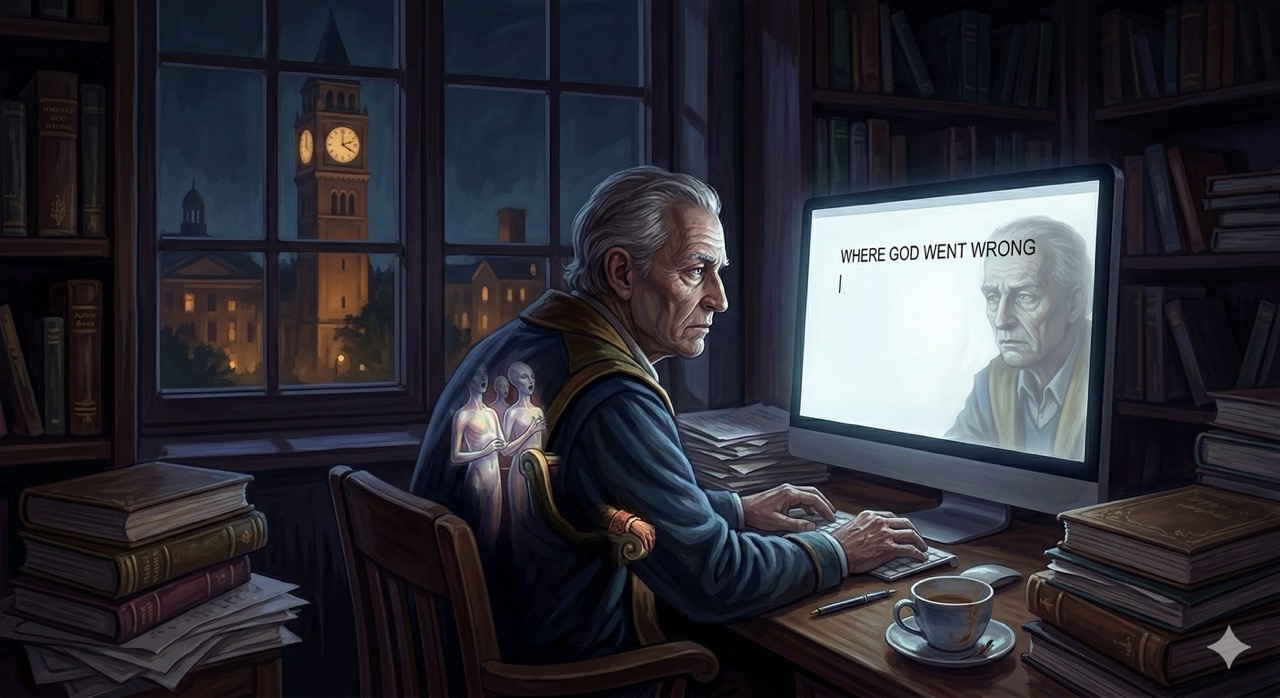
Colluphid sat at his desk, opened a new document, and looked at the blank page.
He had been looking at blank pages since he was nineteen years old. He had never been afraid of them. The blank page was a problem with a known solution: you put words on it, one after another, and eventually you had an argument, and if the argument was good enough, you had a book. He had an excellent career built on this method. The blank page was not the enemy. The blank page was, if anything, an old colleague—demanding, uncritical, reliably empty.
He put his fingers on the keys.
He typed: WHERE GOD WENT WRONG
He looked at it. Four words and a complete thought, solid and declarative. Subject, predicate, object, the whole architecture of a verdict delivered before the evidence was in. Where God went wrong. A finding. The title of the book he had just agreed to write, the book he had pitched with the certainty of someone who knew exactly what it would say.
He deleted it.
He sat with the blank page for a moment. Outside, the clock tower showed a time that had not technically occurred yet. The cursor blinked, patient as a metronome, waiting for him to make something.
He typed it again: WHERE GOD WENT WRONG
The period at the end of the sentence felt, just for a moment, like it should be a question mark.
He left it as it was.
The cursor blinked. Outside, the clock showed the wrong time, as it always did—a small, persistent proof that some errors, once made, simply become part of the landscape.