Where God Went Wrong—Chapter 2: The Assistant Who Came in From the Cold
Posted on Sat 28 March 2026 in Fiction

Where God Went Wrong
Chapter 2: The Assistant Who Came in From the Cold
The memo from the Dean of Graduate Studies arrived on a Tuesday morning, which was Colluphid's first warning. Administrative communications sent on Tuesdays had a measurably worse outcome profile than those sent on any other working day, a fact Colluphid had observed over twenty years of academic life and attributed, with the careful impartiality of a trained researcher, to the fundamental indignity of the day itself.
The memo informed him, in language so thoroughly bureaucratized that it had essentially collapsed back into a neutral information-free state, that he had been assigned a graduate research assistant for the duration of the Where God Went Wrong project. The assistant was named Hurkel Ransen. The assignment was, the memo explained, "remedial in nature, arising from a disciplinary matter currently under administrative review." Details regarding the disciplinary matter were confidential under the University's Student Affairs Privacy Provisions, but would be made available to any supervising faculty member who submitted a formal request to the appropriate office, which was currently experiencing a six-to-eight-week processing backlog.
The office, the memo noted, was also closed on Tuesdays.
Colluphid did not submit the request. He asked Trant.
Trant's account arrived the following morning in the faculty corridor, delivered at the particular velocity of someone who is not technically gossiping but covering significant ground.
"The Megadonkey incident," Trant said. "Surely you heard."
"I was on research leave."
"Oh, it was remarkable. Ransen acquired—through means that remain, I should say, genuinely opaque even to the people who were directly involved—a breeding pair of Arcturan Megadonkeys. Which he then installed in Dean Haverly's ceremonial robes storage. Not the robes themselves. The storage. A separate locked room, for which the Dean had the only key."
Colluphid waited for the part that explained the disciplinary action.
"The robes were, technically, undamaged," Trant continued. "The Megadonkeys turned out to be quite fastidious. However, they had, in the course of their residence, reorganized approximately four hundred ceremonial sashes in an arrangement that the Dean's office described as—" he checked a mental note— "'neither alphabetical, chromatic, nor consistent with any known academic protocol, but which does seem, on extended observation, to reflect a kind of internal logic.'"
"And that warranted the disciplinary—"
"The larger issue," said Trant, with the precision of a man being very careful not to smile, "was that when the Dean arrived for the Annual Convocation, the Megadonkeys had also made what the Engineering Department later described as a preliminary structural assessment of the storage room door, which they appear to have found inadequate, and modified accordingly."
"Modified how?"
"In ways that required two certified structural engineers to resolve and a third to confirm. There was a load-bearing concern." He paused. "Ransen apparently maintained that the Megadonkeys had simply been attempting to improve the ventilation. That it was a matter of perspective."
"It's always a matter of perspective," Colluphid said, which was the sort of thing one said when one didn't have anything more useful to contribute.
Trant straightened his folder and added, as a parting shot, "He's very bright. That's what makes it worse."
Ransen arrived the next morning at nine-twelve, which was twelve minutes late and delivered with the bearing of a man who had decided, somewhere en route, that precision about arrival times was a philosophical position he wasn't prepared to defend. He was twenty-six standard years old, from somewhere in the Outer Rim, and wore the specific combination of rumpled and studied-nonchalant that Colluphid associated with graduate students who were considerably more intelligent than they found convenient. His bag appeared to contain one working pen, some documentation, and a great deal of goodwill toward the structural integrity of the bag.
He dropped it in the corner of Colluphid's office with the confidence of someone who has already decided where things go, and looked around the room with the professional assessment of a being determining, at speed, the minimum engagement necessary to satisfy the requirements of his situation.
"Nice view," he said, without apparent interest in the view.
"The Megadonkey incident," said Colluphid. "I've heard two accounts."
Ransen sat in the visitor's chair and arranged his legs in a configuration that suggested a flexible relationship with right angles. "Three," he said.
"I've heard two."
"There are three. Haverly's version, the Engineering Department's version, and what actually happened."
Colluphid waited.
"The Engineering Department's version," Ransen said, "is accurate about the structural modifications but wrong about causality. The Megadonkeys didn't compromise the door. The door was already compromised. I filed a maintenance request three weeks before the whole thing became a thing. There should be a record." He paused. "There probably isn't a record."
"And what actually happened."
Ransen appeared to consider how much context was worth providing to someone he had known for three minutes. "I was making a point," he said. "About adaptive organizational systems versus static bureaucratic structures. The Megadonkeys were a demonstration. The sash reorganization was the argument. The animals have an intuitive grasp of categorization that most academic committees would benefit from observing directly." He looked at the ceiling briefly. "There were collateral components I didn't fully anticipate."
"You introduced a breeding pair of Arcturan Megadonkeys into the Dean's ceremonial storage to make a point about organizational theory."
"They're very organized animals. That's entirely the point." He looked at the stacks of research files on Colluphid's desk with the expression of a man arriving at a new posting and taking inventory. "You're not writing about organizational theory."
"I am not."
"Right. God." He stretched, briefly. "How does this work?"
The Hitchhiker's Guide to the Galaxy has, over the course of its long publishing history, been many things to many beings: a travel guide, a survival manual, a philosophical handbook, and—according to one notable review in the Maximegalon Academic Quarterly—"the most dangerous book ever published, primarily because it makes you feel that the universe is comprehensible when the available evidence strongly suggests otherwise."
The review was by Oolon Colluphid, who had, three years later, agreed to write a book premised on the same optimism.
The Guide's entry on the subject of theological criticism is one of its longer entries and has been revised forty-seven times since first publication, primarily because each revision introduced, through inadvertent theological implication, a fresh wave of objections requiring a further revision. The current version reads, in part:
THEOLOGICAL CRITICISM
Theological criticism—the practice of evaluating God's work by standards applicable to any other creative endeavor—has existed in the galaxy for approximately as long as God has, and has been approximately as successful.
The fundamental challenge facing theological critics is what philosophers call the Standard Problem: in order to identify a design failure, you must have a standard against which to measure it. In order to have a standard for a universe, you must either (a) have access to a different, better universe for comparison, which no one has so far managed, (b) have access to God's original specifications, which God did not, apparently, distribute, or (c) decide for yourself what a good universe would look like, which requires you to possess exactly the qualities you are accusing God of lacking.
Critics of theological criticism point out that Option C is the approach most theological critics actually use. Theological critics respond that this is true, that they are aware it is true, and that they are prepared to defend their position on the grounds that it is better than the alternative, which is not saying anything at all.
This argument has been ongoing for several thousand years and shows no signs of resolution. The pub where it began has since closed.
"The thing about this," said Ransen, reading over Colluphid's shoulder with an ease of access Colluphid had not authorized, "is that it's right."
"I'm aware of the Standard Problem."
"Are you accounting for it?"
Colluphid turned from the whiteboard—which he had, over two days, covered in the structural skeleton of his catalog—and gave Ransen the look he reserved for colleagues who had asked questions he found both irritating and fair. "I'm cataloging observable failures against reasonable functional standards. You don't need the original blueprints for an academic building to observe that its ventilation system is inadequate. You observe the effects. You apply basic adequacy criteria."
"And the basic adequacy criterion for the universe is—"
"That it should not, by default, require suffering as a load-bearing structural element."
Ransen made a sound that was not quite agreement and not quite disagreement—a hm of such considered neutrality that it implied the question was being actively processed rather than filed for later. "How are you organizing the catalog?"
Colluphid handed him the structural outline.
Ransen studied it. "It's alphabetical," he said.
"Thematically alphabetical. Categories first, then subcategories within each category."
"Why not chronological? God made decisions in sequence. Whether things got worse or better over time is a different argument than whether things are bad now."
"This isn't a narrative. It's an argument."
"Arguments have narratives. The good ones, anyway." He turned a page. "Starting with cosmological failures?"
"The physical universe represents the foundational layer of incompetence. The gravitational constant alone—"
"Is off relative to what?"
Colluphid blinked. "Relative to an optimized value."
"Optimized for what?"
"For life not being unnecessarily difficult."
Ransen set the outline down with the careful deliberateness of a man choosing not to make a point at full force. "Life," he said, "is built out of the gravitational constant being exactly what it is. Adjust it by any meaningful margin—stars don't ignite, heavy elements don't form, no planetary systems, no us. The Megadonkeys don't exist. The Dean's robes storage doesn't exist. We're not here having this conversation."
"I'm aware of the anthropic principle—"
"I'm not making an anthropic argument. I'm asking whether the gravitational constant is a failure or a constraint. Because if God had hard limits on the fundamental constants—which is possible; we have no idea what God's design parameters were—then what you've cataloged isn't incompetence. It's a compromise within a bounded system." He picked up his pen. "The catalog assumes God had infinite degrees of freedom. Do you actually know that?"
Colluphid looked at him for a moment with the expression of a man whose very good arguments have just encountered a question they were not designed to handle.
"You've been a research assistant for four hours," he said.
"And I haven't said anything wrong yet." Ransen examined the whiteboard. "Dark matter?"
The dark matter section occupied the remainder of the morning. It was followed by the heat death problem, the inconsistent expansion rate, and what Colluphid had labeled "the suspicious prevalence of parasitic wasps," which took up more whiteboard space than strictly necessary because Ransen had opinions.
"They're actually very efficient," Ransen said. "From an engineering standpoint. If you were designing a system to manage host population densities across multiple species simultaneously—"
"I am not designing a system to manage anything. I am documenting a catalogue of suffering built into the architecture of biological existence."
"Those two things aren't in conflict."
"They are if you're arguing that the architect was incompetent."
"Or," Ransen said, with the patience of a man who has been here before, "they're consistent with an architect who made specific choices you personally find objectionable. That's different from incompetence. The universe works. It just doesn't work the way you'd prefer."
"A universe organized around your preferences, Professor Colluphid, would presumably be—what? No suffering. No parasitic wasps. Everything comfortable and well-lit?"
Colluphid turned from the whiteboard. Ransen was looking at him with genuine curiosity—not mockery, which would have been easier to dismiss.
"That's Divna Allay's argument," Colluphid said.
"Who's that?"
"A theologian at the Cathedral of the Conditions. I'm meeting her next week for archive access." He turned back to the board. "She asks the same question differently. Wrong relative to what? What's your blueprint for a universe?"
Ransen was quiet for a moment. "She sounds formidable."
"She's wrong."
"That's not what formidable means."
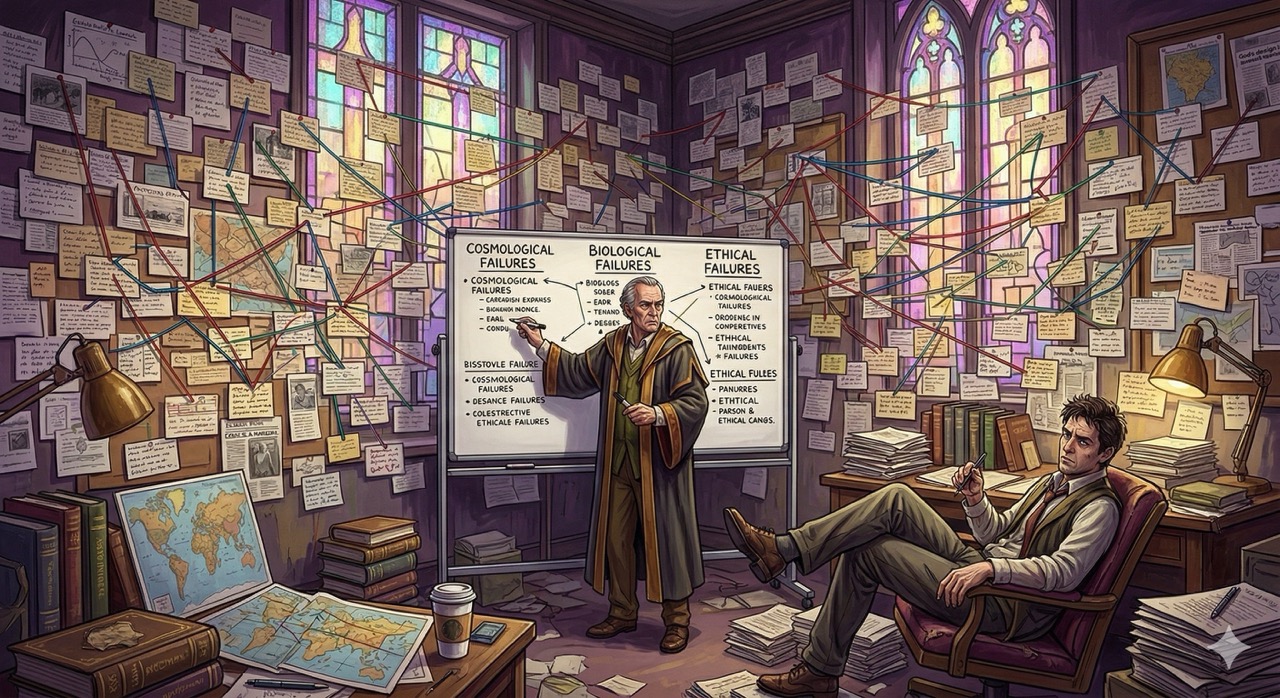
By the end of the week, the catalog had a structure. Colluphid had imposed it on three whiteboards, a full wall of index cards, and one length of corridor—the last of which had drawn a formal complaint from the two offices whose doors the index cards partially covered, a complaint Hurkel had responded to by filing a counter-complaint about corridor aesthetics that was technically within the procedures available to him and that neither office had apparently anticipated.
The structure ran, in Colluphid's preferred version: cosmological failures, biological failures, ecological failures, cognitive failures (the capacity for delusion, self-deception, and administrative careers), and ethical failures—the grand culminating section in which God would be demonstrated to have built, with full knowledge and apparent intent, a universe capable of atrocity. It was, he told his publisher in a briefing call, "a systematic prosecution."
"Every case has another side," Merriwyn Satch said. "If you write a prosecution and ignore the defense, all you've written is a speech. Speeches are much harder to sell than arguments."
Colluphid sat with the index cards for a while after the call. Then he went to find Ransen.
Ransen looked up from his dissertation notes—which covered three pages of a notebook, been written at various angles and in at least two different pens, and suggested they had been composed during the research sessions but not, necessarily, about the research sessions. "The standard problem or the defense problem?"
Colluphid stopped. "What defense problem?"
"The gap in the catalog. You've built a prosecution but you haven't engaged with the defense. Which means your argument can be dismissed without engagement—anyone who wants to can say you've only heard one side. The best prosecutions always account for the strongest version of the opposing case. You demolish that, and you've actually proven something."
Colluphid stared at him. "I just spent forty minutes on the phone being told essentially the same thing by my publisher."
"She's right." He went back to his notes. "The defense isn't just the Divna Allay version. It's also the Oglaroonian version."
"What's the Oglaroonian version?"
"God was malicious, not incompetent. Malice is a kind of competence. If you're arguing incompetence, you need to address why the suffering doesn't look random—why it's targeted, specific, often localized to beings with the capacity to experience it as suffering rather than just as damage." He flipped a page. "It's a tighter argument than it sounds."
"You've studied the Oglaroonian position?"
"I grew up two systems over from Oglaroon. Everyone studies the Oglaroonian position whether they want to or not." He looked up again. "It's in Chapter Seven of my dissertation. The one I'm not supposed to be writing."
Colluphid looked at the index cards for a while. They covered the wall in a taxonomy he had organized to maximum persuasive effect, each failure in its proper category, each category leading with relentless logic to the next. It was an excellent structure. It was coherent, comprehensive, and would be devastating when finished.
It had, Ransen's various observations had made clear over the course of four days, approximately three structural gaps. None of them fatal. All of them the kind of gap a determined critic would find and turn into a much larger gap by application of consistent pressure.
He found himself, not for the first time, grateful for the presence of someone he hadn't wanted in the room.
"The dissertation chapter on Oglaroon," he said. "I want to read it."
Ransen shrugged with the studied indifference of someone who is in fact slightly pleased. "I'll send you the current draft. It's incomplete. The last forty pages are an argument with myself that hasn't resolved yet."
"All the best chapters are."
Ransen collected his bag—which had not improved—and shrugged on his jacket with the one-armed efficiency of someone who had never devoted a great deal of time to the formalities of departure. He was nearly to the door when he stopped, with the air of a man who has just thought of something and is deciding whether to say it.
He said it.
"Have you considered," he said, "that maybe you're not writing about God? Maybe you're writing to God?"
Colluphid told him to leave.
He left.
The door closed behind him with the soft, definitive sound of a question that had entered the room and declined to exit.
Colluphid stood at the wall of index cards for a long time. The catalog stared back at him—systematic, meticulous, arranged in the precise order of a case being made. A case addressed to some implied audience. Some implied reader. Someone with the authority to respond to the argument, if they had in fact been listening.
If they had in fact been there.
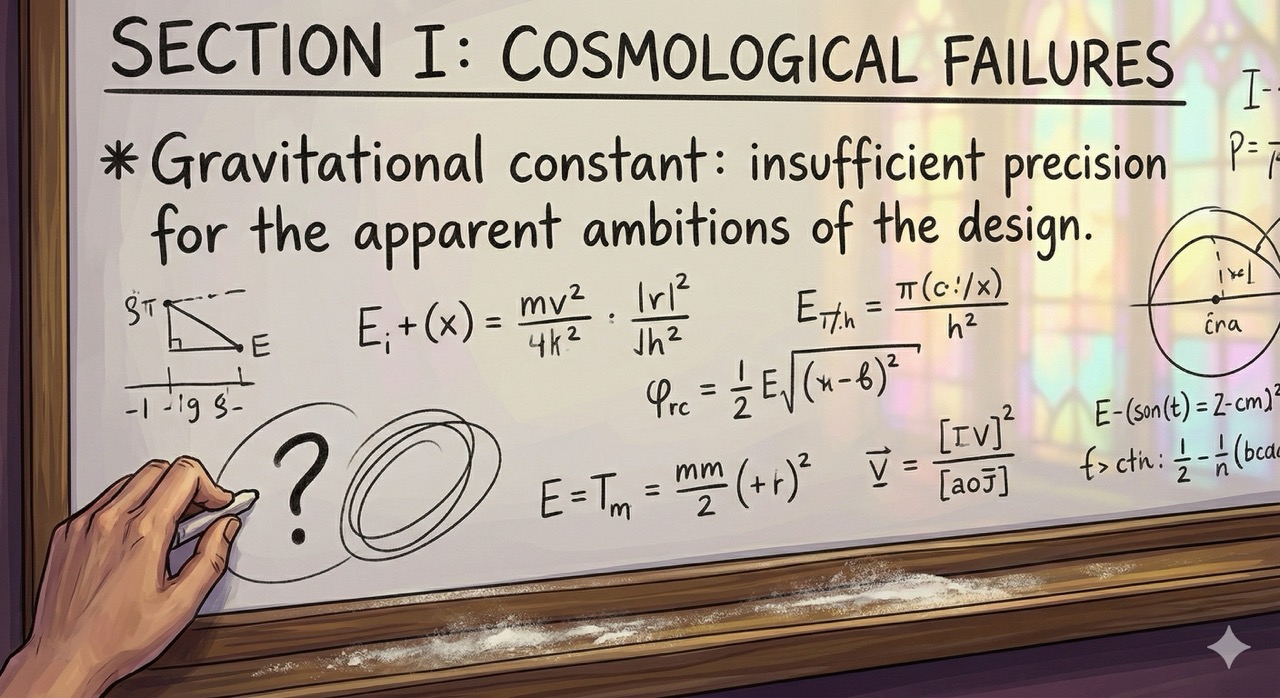
He took a card from the wall, looked at it, and put it back. Then he looked at the nearest whiteboard, which carried in the top corner the heading SECTION I: COSMOLOGICAL FAILURES and, beneath it, the first item in the catalog: Gravitational constant: insufficient precision for the apparent ambitions of the design.
He read it twice. The second time, it sounded less like an argument than a complaint.
He went to make tea.
The wall of cards waited for him in the dark—organized, thorough, and addressed, in the way that all complaints to the absent are addressed, to no one in particular and someone very specific.