Where God Went Wrong—Chapter 4: The Woman Who Believed Things on Purpose
Posted on Thu 09 April 2026 in Fiction
Where God Went Wrong
Chapter 4: The Woman Who Believed Things on Purpose
The Cathedral of the Conditions had, at last count, forty-seven separate departments, none of which agreed on what any of the others were for.
This was not, the Cathedral's official history was careful to explain, a design failure. It was a feature. The Cathedral had been constructed over eight hundred standard years by a succession of architectural firms, none of whom had seen the plans for the previous stage of construction, on the premise that a building devoted to the divine ought to possess, at minimum, the quality of mystery. The result was a structure that covered approximately eleven city blocks, rose to seventeen stories in places (and to four stories in a different arrangement of the same places, depending on where you entered), and which had produced, since its completion, thirty-four scholarly papers on the question of how it was simultaneously load-bearing and impossible.
The Cathedral managed this through a combination of structural ingenuity, generous interpretation of the relevant building codes, and a quiet institutional certainty that God, if still present in any meaningful capacity, would presumably not want the ceiling to fall in.
The Hitchhiker's Guide to the Galaxy devotes more column inches to the Cathedral of the Conditions than to any other single religious building in the known galaxy, partly because its entry was written by an editor who had spent three days trying to leave and found the experience too formative to omit, and partly because the Cathedral also houses the galaxy's largest collection of Conditions Forms—of which the most frequently filed is Form 7-B (Request for Theological Variance), and the least frequently filed is Form 42-A (Divine Accountability Inquiry), which has never been successfully completed due to the difficulty of identifying a responsible party for the field labeled "party to be held accountable," and which archivists describe, with a humor that is technically dark but has been applied for so long it has become load-bearing, as sharing that condition with several of the divine acts it was designed to investigate. The relevant entry reads, in part:
CATHEDRAL OF THE CONDITIONS (THE)
The Cathedral of the Conditions on Brontitall is the galaxy's foremost center for post-divine theological administration—which is to say, the place where questions about God go to become questions about filing procedures.
It was founded in the immediate aftermath of the Babel fish incident, when it became apparent that several thousand years of theological infrastructure—shrines, orders, ceremonial calendars, endowment funds, complaints procedures—required an administrative home that could manage them in the absence of the entity they were organized around. The Cathedral was that home. It has since expanded to fill whatever space is available, which is considerably more space than was originally anticipated, primarily because grief, unlike most administrative functions, does not naturally consolidate over time.
The Cathedral's forty-seven departments include the Bureau of Conditions Maintenance, the Office of Applied Liturgical Continuity, and the Department of Applied Divinity—which should not be confused with the Department of Theoretical Divinity, a distinction both departments have been explaining to each other for sixty years without reaching a satisfactory resolution, a process several observers have described as itself a form of applied divinity. There is also the Theological Archive, which contains every known record of divine activity, interaction, or suspected activity or interaction, organized according to a classification system that was logical when introduced and has since become a species of institutional folklore passed from archivist to archivist through a process resembling apprenticeship but described by at least one participant as "hazing, but with better lighting."
Visitors to the Cathedral should note: the building has four main entrances, of which three are correct depending on the department you are visiting, and one is correct only for deliveries. All four look identical. A map is available at the visitors' desk. The visitors' desk is not near any of the entrances.
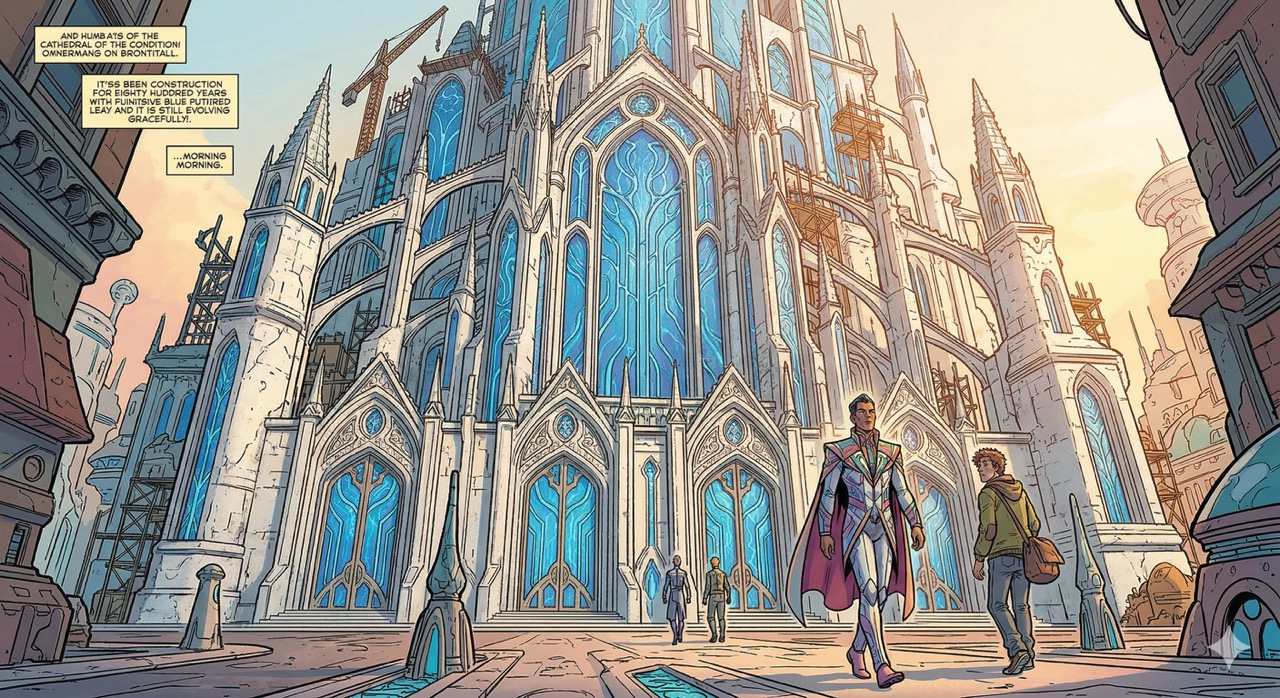
"It's beautiful," Hurkel said, looking up at the Cathedral's main facade, which was, in the morning light, a genuine feat of architectural ambition—white stone and blue-veined glass arranged in a configuration that suggested either deep spiritual intent or an unusually ambitious sudoku.
"It's also," said Colluphid, consulting the letter from Professor Divna Allay's office, "twenty minutes late receiving us."
"We're the ones who are late."
"We were three minutes early. That was twenty-three minutes ago."
"I think," Hurkel said, with the diagnostic calm of someone who has recently emerged from a building that defied ordinary navigation, "we came in the delivery entrance."
They found the visitors' desk eventually. It directed them to the Annex, which was a building adjacent to the Cathedral connected by a glass corridor that had been roofed over sometime in the last century, giving it the quality of a space that could not decide whether it was inside or outside and had reached a practical accommodation with both conditions. The corridor contained three benches, a public announcement board last updated in 2301, and a small fountain that was either a devotional installation or something an architect had added because the corridor needed something and fountains tend not to cause complaints.
The Annex was smaller, quieter, and smelled of old paper and something warm—the accumulated output, possibly, of eight hundred years of deliberate thought.
Professor Divna Allay's door had her name on it, which was more than could be said for most of the doors they had passed. Colluphid knocked. A pause followed of the specific duration that indicates the person inside has heard and is finishing a sentence before acknowledging it.
"Come in," she said.
Colluphid had prepared for this meeting with care. He had reviewed her publication record—extensive, rigorous, wrong about the central thesis—and identified the three points where her framework was most vulnerable to challenge. He had prepared a version of his project that emphasized scholarly rigor and minimized the portions she would find objectionable. He had dressed, Hurkel had observed during the transport over, like a man who expected to win.
He had not prepared for her to be warm.
Professor Divna Allay was perhaps fifteen years his senior, with the particular quality of stillness that comes from having spent a long time thinking seriously about serious things and arriving, at the far end of the process, at something resembling peace—though it was more accurately described as perspective, which is a different and more durable thing. She had close-cropped dark hair and the kind of attention that was focused without performing its focus: the best students had it, and occasionally people who had learned something Colluphid hadn't yet, which he found more irritating than the students.
She stood when they entered—not formally, just the natural motion of someone genuinely glad for company—and extended her hand.
"Professor Colluphid. I've been looking forward to this."
The warm version. He had prepared for the hostile version.
"Professor Allay." He shook her hand. "My research assistant, Hurkel Ransen."
Hurkel shook her hand. "Nice fountain," he said. "The corridor one. Is it theological?"
"It's a fountain," she said. "We find it useful to leave some things undetermined." She gestured toward two chairs facing her desk, which was covered in the orderly chaos of someone who knew exactly where everything was and could prove it if pressed. "Please sit. Tea?"
"That would be—" Colluphid began.
"Yes," said Hurkel, who had learned over several weeks that Colluphid's relationship to tea was primarily a mechanism for buying thinking time, and had decided to streamline the process on his behalf.
She poured from a pot that was clearly already made, which meant she had either timed their arrival precisely or simply kept tea permanently available as a matter of professional principle. Colluphid, settling into his chair, decided the second option was the more unsettling one.
"I've read your previous books," she said. "All three."
"And?"
"The methodology in the second one was genuinely interesting, even where I disagreed with the conclusions. The third I thought was rushed." She said this without apology—the way one says things that are true and more useful said than omitted. "But the project you're proposing is different in character from the first three. More ambitious."
"Considerably."
"Tell me what it actually is," she said. "Not the pitch version."
Colluphid paused. It was an unusually direct opening from someone who presumably wanted something from him—archive access came with conditions, and conditions usually arrived after pleasantries.
"A systematic accounting of where God went wrong," he said. "The design flaws in the physical universe. Biological failures. The ethical contradictions inherent in the architecture of sentient existence. Comprehensive. Evidence-based."
"And the conclusion?"
"That any sufficiently rigorous examination of the available evidence is incompatible with the hypothesis of a competent divine designer."
She nodded with the expression of someone who had expected this and was not surprised. "And the defense case?"
He looked at her. "I'm sorry?"
"Every serious argument accounts for the strongest opposing position. What's the defense case you're engaging with?"
Something moved in his expression that he controlled quickly. The question again—from his publisher, from Ransen, and now from her, arriving with the regularity of something determined to be heard. "I'm addressing that section."
"But you haven't yet."
"I'm in the early stages."
"Of course." She wrapped both hands around her cup and looked at him with the focused patience of someone who had navigated a great many of these conversations and found them, on balance, worthwhile. "Can I tell you what I think the project actually is? Not what you've described—what I think it is?"
"By all means."
"You're not writing a prosecution of God," she said. "You're writing a grief document. The prosecution framing is how it presents to the outside—clean, arguable, good for reviews. But the question underneath—where did this go wrong, and whose fault was it—that's not a legal question. It's a personal one. And the reason the defense case keeps surfacing, from multiple people reading the early stages, is that a grief document without the defense case is incomplete. It's only half the conversation." She tilted her head slightly. "Does that seem wrong to you?"
Colluphid looked at her. Across the room, Hurkel had turned to examine the spines of her bookshelves with elaborate casualness.
"Yes," said Colluphid. "It seems wrong."
"All right."
"It seems wrong because you've reframed the entire project as emotional rather than intellectual, which makes whatever I say next sound defensive. It's a move I've seen before."
"That's true," she agreed. "Though I'd note that 'it sounds defensive' and 'it is defensive' are different things, and the move only works if something personal is actually there. Which I could be wrong about." She looked at him steadily. "Am I wrong?"
He did not answer.
Hurkel pulled a book from the shelf, looked at the spine, and put it back. "She's not asking if the argument is personal," he said without turning around. "She's asking if the question is."
The silence that followed had the specific quality of a true thing being given the room it required.
"The question," Colluphid said, carefully, "is intellectual."
"Of course," said Divna Allay.
She let it rest there for a moment. Then she set down her cup.
"There's a second problem," she said. "Setting aside the emotional architecture entirely—the argument depends on a standard you've never stated. You keep saying God went wrong. Wrong relative to what? You've catalogued failures against a criterion of basic adequacy, but you haven't defined what adequacy means for a universe. Not in any form you'd be willing to defend." She leaned forward slightly. "What does the well-designed universe look like? In your view. Specifically. Because until you can answer that, you haven't identified failures—you've identified preferences. And preferences are not a basis for a verdict."
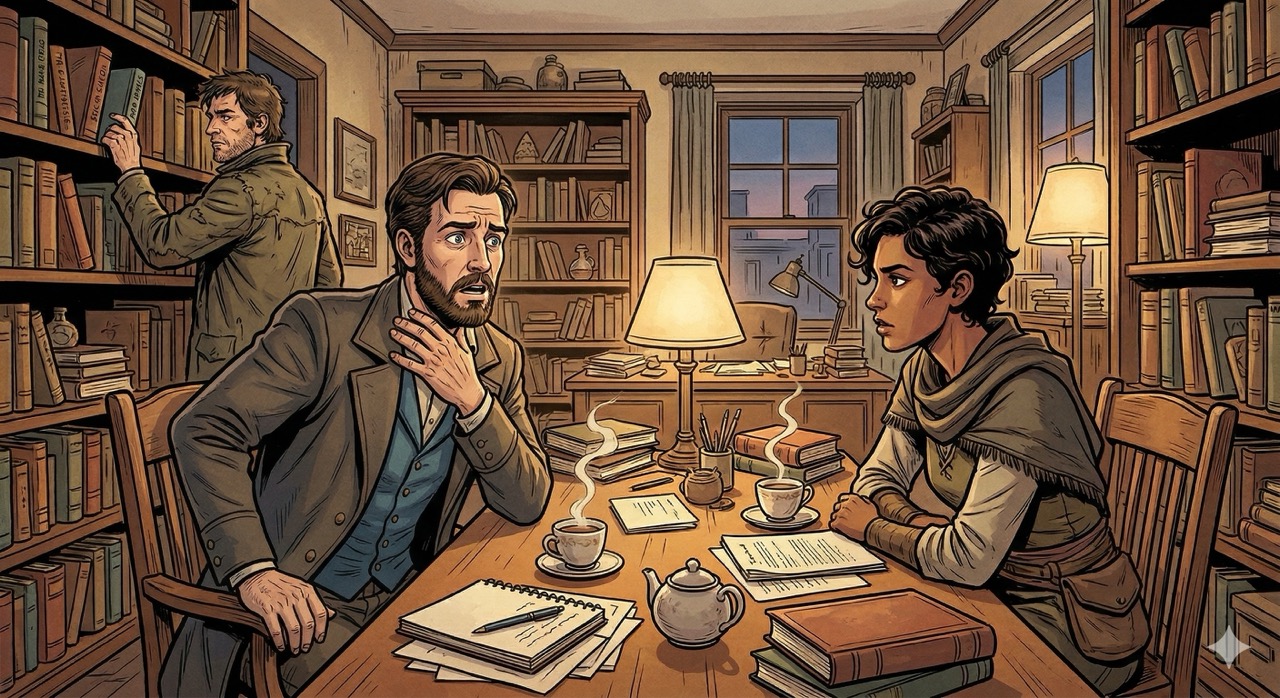
Colluphid felt the shape of the question settle over the room. He had an answer to it—several, in fact, each carefully prepared—and he opened his mouth to deliver the best one.
"I'll need to think about how to answer that," he said instead.
It was the most honest thing he had said since arriving on Brontitall.
Divna Allay looked at him for a moment with something that was not quite surprise and not quite satisfaction—the expression of someone who has been patient for a long time and has just been given a reason to continue.
"Good," she said. "Shall I show you the archive?"
The tour came after tea, as promised, conducted by Professor Allay with the ease of someone who had long-held opinions about the building's worst features and no longer felt the need to introduce them gradually.
"The Theological Archive covers the fourth through seventh floors of the main building," she said, leading them down a corridor of dark wood and settled quiet—the specific quiet of a place that takes its own weight seriously. "The sections relevant to your research—the pre-Vanishing activity records, the design correspondence, the incident logs—are on the sixth floor, along with the counter-literature: everything the Theological Critical tradition has produced, and the responses from within the Cathedral tradition. It will take you several weeks at minimum."
"And the Preliminary Materials?" Colluphid asked. He had read about them in the archive catalogue: records that predated the formal theological record. First causes. Working notes. The phrase working notes had sat in the back of his mind since he had encountered it and declined, thus far, to leave.
"They're at the far end of the sixth floor." She stopped at a junction where two corridors met at an angle that suggested an unresolved conversation between architects. "The Preliminary Materials require a supervising archivist to be present during any research. The materials have been misread before—not through carelessness, but through context. A researcher who approaches a working document without understanding its tradition reads a different document than the one that's there."
"And you're the supervisor."
"I'm the one available who understands the collection." She did not phrase this as modesty or as authority. It was simply a fact about the situation. "I also want to make sure you see the context materials before the headline item. The Preliminary Materials are not the place to start."
"What is the headline item?"
The lift arrived with the unhurried confidence of a mechanism that had been functioning since before any of them were born and saw no particular reason to alter its pace on their account. They entered. The doors closed.
"You'll know it when you see it," she said.
The sixth floor of the main archive was long, high-ceilinged, brass and wood and the faintly mineral smell of materials that had been old for long enough that their age had become a quality rather than a condition. Colluphid felt the familiar comfort of a research library—the satisfaction of a room that contains what you need and knows where it is—and then something else underneath that comfort he could not immediately name. Something in the scale and the silence that felt less like a repository than a correspondence kept, as though the materials here had been gathered not to be studied but to be remembered, which was not quite the same thing.
He filed the impression and followed Divna to the far end of the floor.
The door there was slightly different from the others: heavier, with a different kind of latch—not trying to seem significant, simply being it. She produced a key from a lanyard he hadn't noticed she was wearing.
"The Preliminary Materials room," she said, and opened it.
The room inside was small. A single long table. Two reading chairs with the settled look of furniture that has done this work for a long time. Brass lamps already lit against the overcast light from the single high window. And along the walls, in glass-fronted cases that had been cleaned recently enough to still carry the ghost of the cloth: materials.
The cold came first, then the smell—something older than paper, older than the building, older than the classification system that had named it Preliminary. The air had the quality of a held breath.
"Don't touch anything without the cotton gloves," she said. "They're on the table. I'll leave you to orient yourself. Take your time with the cases on the left wall before you move to the center." She paused at the door. "Professor Colluphid."
He looked up from the nearest case.
"I haven't agreed with anything you've said about this project," she said. "I think the framing is wrong in ways that will show in the book, and I think the conclusion you've already written will survive contact with the evidence only if you avoid the evidence most likely to complicate it. And I think you're too careful a researcher not to find it eventually." She looked at him with something that was not warmth exactly, but was related to it—the attention of someone who has decided to stay honest at some personal cost. "But I want you to do the research. I want you to look at everything. Not because I believe it will change your conclusion—you may be too committed to it for that. But because I think the process will matter. For you personally."
She left. The door stayed open. Through it, from the main archive: the quiet sounds of her settling at a table. Chair, papers, a cup set down. The sound of someone who intends to stay.
Hurkel appeared at Colluphid's elbow with the quiet efficiency of someone who had been paying careful attention throughout and chosen his moment.
"Well," he said.
"Don't."
"I wasn't."
Colluphid put on the gloves.
The cases on the left wall contained the earliest materials in the collection—older than the building, older than several things he had always assumed were very old. He moved through them slowly, as Divna had instructed, reading the context before the center. Notes on method. Early frameworks, some abandoned. Evidence of revision at a scale he hadn't expected: not the revision of a bureaucratic record, not the cautious emendation of official history, but the revision of something in progress—a mind working through a problem too large to get right in the first attempt.
He moved, eventually, to the center case.
It contained a single document, distinguished from the others by its position and by a label in the careful handwriting of an archivist who had been given the task of cataloguing the unknowable: CREATION: PRELIMINARY NOTES — First Draft.
He lifted the cover.
The first page was blank.
Not damaged. Not faded. Blank with the intentionality of a page that had been left that way—the space before the beginning, held open. In the upper right corner, in a hand slightly different from everything else in the collection—quicker, as though written in the urgency of a start—was a single sentence.
I hope this works.
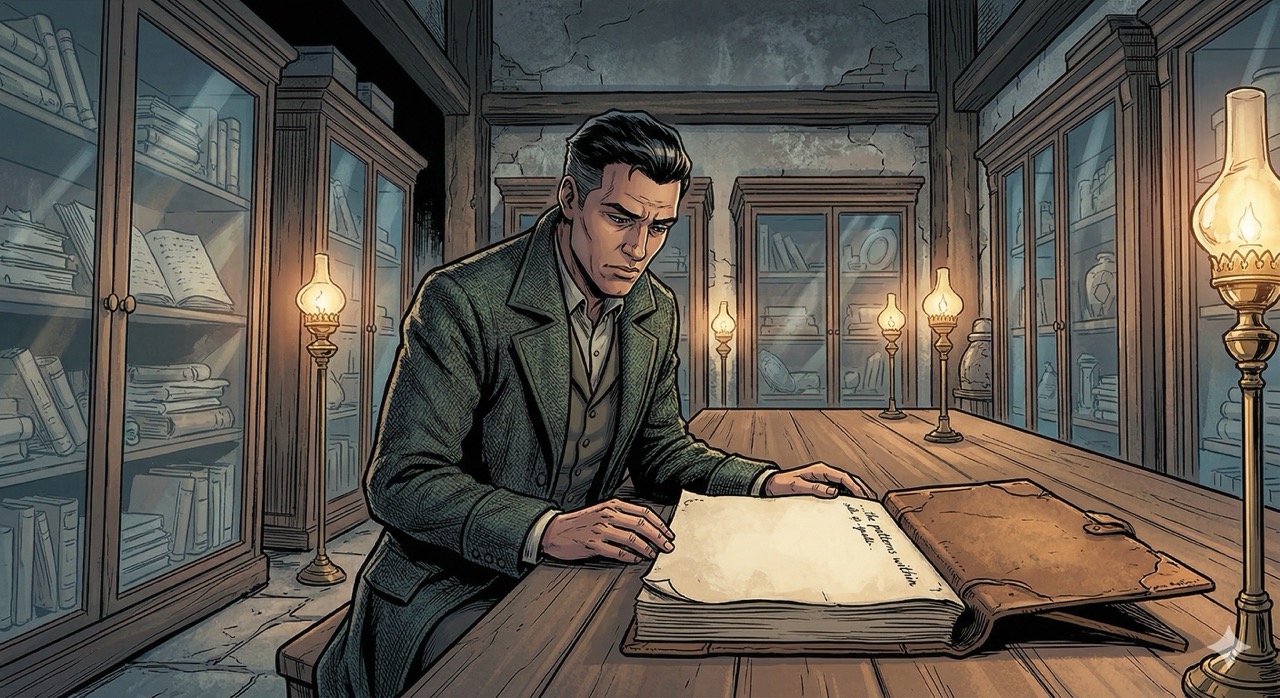
Colluphid stood in the small cold room with the brass lamps and the old cases and the handwriting that predated everything, and read those four words for a long time.
He had been writing about God's failures for months. The gravitational constant. The heat death problem. The suspicious persistence of parasitic wasps. Each entry in the catalog built from the premise of a designer who had been given unlimited freedom and produced, without apparent reason, a universe requiring suffering as a structural component. That was the argument. It was sound. It held.
I hope this works.
Four words in the handwriting of someone who had not known, at the moment of starting, whether it would.
Behind him, from the main archive, he could still hear her. The sounds of someone working: a page turned, a pen set down. She had not left. She was, apparently, staying.
He turned to the second page.
The second page contained a great deal more. The first page contained only the beginning.
-
The forty-seven departments of the Cathedral of the Conditions have, over the course of eight hundred years, produced a combined total of approximately two hundred and forty thousand internal memos, of which an estimated twelve percent addressed actual theological questions and the remaining eighty-eight percent addressed questions about the jurisdiction of the other forty-six departments. Scholars of ecclesiastical administration have described this ratio as either unusually high or unusually low, depending on which institutions they are comparing it to. ↩
-
Divna Allay's position—Professor of Applied Divinity—distinguished her from the Theoretical Divinity Department in ways that had been formally documented in a joint paper produced in 2289, subsequently retracted following a dispute about co-authorship credit, and then re-litigated in three subsequent papers, the most recent of which concluded that the distinction was "meaningful in practice, contested in theory, and likely to remain so for the foreseeable future, which both departments agreed was consistent with their respective methodologies and for entirely different reasons." The paper was cited forty-one times, primarily by people making other points. ↩
-
The question wrong relative to what? has been asked of theological critics since the first theological critic produced the first theological criticism, and has been answered with varying degrees of success in the four thousand years since. The best answer in the scholarly literature, widely cited and never improved upon, was produced by the philosopher Grent of Kria approximately eight hundred years before the present, who wrote: "Wrong relative to what we would have done, which is to say: wrong relative to a standard we cannot define, applied by beings who could not have done it, to work we cannot replicate. The question is unanswerable. We ask it anyway. This is not a flaw in the methodology. This is the methodology." Grent was subsequently proved wrong about seventeen unrelated things, all of which he acknowledged with reasonable grace. ↩
-
"I hope this works" is the first annotation Colluphid encounters in the Preliminary Materials. It is not the last. The handwriting, over subsequent visits, will become familiar to him in the way that certain voices become familiar—not through repetition, exactly, but through the accumulation of a particular quality of attention. He will not, for a long time, know what to do with this familiarity. The not-knowing will, in the end, matter more than the knowing would have. ↩