Where God Went Wrong—Chapter 5: Design Flaws (A Partial Catalog)
Posted on Sat 11 April 2026 in Fiction
Where God Went Wrong
Chapter 5: Design Flaws (A Partial Catalog)
Oolon Colluphid returned from Brontitall on a Tuesday, which is traditionally the galaxy's least spiritually significant day, and spent the following twelve hours doing what any serious scholar does when confronted with an experience that resists easy categorization: he ignored it entirely and worked.
The catalog had been waiting. It had been building itself in the back of his mind since the Flandrathi ceremony—since the moment he had stood in that impractical pew and watched a species perform the motions of devotion for a god they openly acknowledged was gone, and decided that someone needed to write this down—and it required only the particular urgency that follows a confrontation with a brilliant interlocutor to arrive, all at once, fully formed, on the page.
He opened the document. He typed the heading. He put on his second-best reading glasses—the best pair had been left on the transport from Brontitall and had presumably continued to whatever destination the transport was bound for, which was the sort of unplanned outcome that Colluphid was currently arguing represented a characteristic failure mode in the architecture of a universe designed with intelligent agents in mind—and he began.1
Excerpt from Where God Went Wrong: A Systematic Accounting, working draft, Part Two:
The Physical Universe: A Partial Accounting
It is a useful exercise, when assessing the work of any designer, to begin not with the small failures but with the large ones—to establish, at the outset, the scale at which incompetence operates, before descending to the details. In the case of the universe, the large failures are considerable.
Section 2.1: The Heat Death Problem
The observable universe will, according to current models, undergo total thermodynamic equilibrium in approximately ten to the power of one hundred years. At that point, entropy will have reached its maximum value, all temperature differentials will have dissipated, and no further thermodynamic work will be possible. The universe will be, in the most technically precise sense available, finished—not destroyed, not collapsed, but over, in the way that a party is over after the last guest has left and someone has turned off the music and there is nothing left but the cups.
This is not controversial. It is established physics. The question of interest, for our purposes, is not whether the universe will eventually become a cold, silent, maximally entropic void in which nothing happens, but why a designer who presumably had other options chose to build entropy into the fundamental architecture with no known mechanism for its reversal.
An engineer who designs a product with a guaranteed end-state of total functional cessation is generally expected to (a) provide a warranty period that is useful relative to the product's intended purpose, (b) offer some form of remediation or extension service, or (c) have a very good reason for the termination event that has been communicated in advance to the product's users. The universe's designer has, to date, satisfied none of these conditions.
The counter-argument most frequently offered is that ten-to-the-hundredth-power years is a great deal of time and that criticism of the heat death timeline represents an excess of long-term thinking relative to practical necessity. This argument has the structural form of a response and the intellectual content of a shrug. It also, notably, concedes the point.
Section 2.2: The Waste-Space Problem
The observable universe spans approximately ninety-three billion light-years in diameter. Of this volume, the vast majority consists of: vacuum (approximately ninety-six percent by volume), dark matter (discussed below), dark energy, and assorted inhospitable arrangements of hydrogen and radiation in configurations hostile to any chemistry more complex than becoming slightly more diffuse over time. The fraction occupied by matter in arrangements complex enough to support biology is small. The fraction occupied by beings complex enough to ask questions about the universe's design is, relative to the whole, statistically indistinguishable from nothing.
This may not constitute a flaw, strictly defined. It is possible that the designer required ninety-three billion light-years of volume for structural reasons not yet identified. It is also possible that the universe was not designed with its occupants in mind—which is either a reassuring thought (the designer had bigger concerns) or a disturbing one (the designer had no concerns at all, and the occupants are a coincidence of the type that happens to matter to itself). In either case, it is not the mark of a competent professional relationship between creator and creation.
Section 2.3: Dark Matter
Twenty-seven percent of the universe's total mass-energy content consists of what cosmologists term "dark matter": matter that does not interact with electromagnetic force, cannot be directly observed, cannot be sampled, cannot be modified, and cannot be understood except through its gravitational effects on the visible matter it surrounds. Its composition is unknown. Its origin is unknown. Its purpose, if it has one, is unknown.
Twenty-seven percent of the universe is, for all practical purposes, a load-bearing wall in a building whose blueprints were never made available to the building's inhabitants.
This is not an analogy. It is a description.
At some point during the writing of Section 2.3—Colluphid was not certain when, because he had developed the useful academic habit of losing track of time when the work was going well—Hurkel arrived.
He arrived in the manner he had developed over several weeks of working for Colluphid: not by knocking (the door was open), not by announcing himself (Colluphid had learned to recognize Hurkel's particular footstep, which had the quality of someone simultaneously approaching and considering leaving), but by sitting down in the second chair and reading whatever was on the screen for long enough that interrupting him would have been unjustifiably rude.
"I'm playing devil's advocate," Hurkel said.
"I know," said Colluphid, without looking up.
"Section 2.1." Hurkel had his hands in his pockets, which was his posture for preparedness. "You're grading against an unstated standard. The heat death problem is only a design failure if you assume the universe is supposed to be permanent. But you haven't argued that. You've assumed it."
"The designers of any functional system," Colluphid said, "are generally expected to consider longevity as a design criterion."
"By whom? You. You're the one who decided longevity matters. What if the criterion was something else? Intensity, say. Or—" he considered— "the particular quality of experience that only a finite duration makes possible."
Colluphid looked up. "Are you seriously arguing that the universe's heat death is a feature?"
"No. I'm arguing that you've called it a bug without telling me what the specification document said." He produced a small notebook—physical, carried as an affectation, occasionally actually used. "And that brings me to my actual point. Have you included any successes?"
"The book isn't called Where God Went Right."
"Obviously. But to identify a failure you need a baseline. You need at least one success to compare it to—otherwise you're not doing a design review. You're making a list of things you personally find irritating, formatted for academic publication."
Colluphid set down his pen. "The baseline," he said carefully, "is a functional universe. A universe in which the architecture serves the purposes of its inhabitants. The failures are failures relative to that standard."
"Which inhabitants? The Jatravartids? Their theological tradition suggests the universe is functioning exactly as designed—it's going to be blown into the Great White Handkerchief, which is the intended outcome. By their standard, there are no failures. Everything is on schedule."2
"The Jatravartids," Colluphid said, "are not a design standard."
"Neither," said Hurkel, pleasantly, "are you."
The silence that followed had a quality Colluphid recognized. He had spent his career constructing arguments in the full knowledge that someone would eventually find the joint where his premises connected to his conclusions and apply pressure to it. He recognized the sensation of that pressure being applied. He did not enjoy it. He found it professionally useful and did not enjoy it.
"I'm noting the objection," he said, and returned to the draft.
The Hitchhiker's Guide to the Galaxy contains, under the entry THEOLOGICAL CRITICISM, HISTORY AND PRACTICE OF, the following observations:
The tradition of formally criticizing God's design decisions is approximately as old as the first sentient being capable of looking around, identifying something unsatisfactory about its immediate environment, and concluding that the appropriate party to blame was not the weather but whoever had approved the weather.
Scholarly theological criticism—the application of structured argumentation to divine design choices, rather than simply shouting at the sky—has a recorded history of approximately forty thousand standard years and a success rate that scholars describe, when pressed, as "variable in ways that depend substantially on how you define success."
More recent critics have faced the complication that most of what was historically attributed to divine design has been attributed, through subsequent investigation, to natural processes operating without apparent intention—which has made the argument "God did this badly" increasingly vulnerable to the counter-argument "God did not, in fact, do this at all," which is a substantially different problem requiring substantially different methodology.
Oolon Colluphid, the galaxy's most prominent contemporary theological critic, has addressed this challenge by arguing that natural processes operating without apparent intention are themselves a design decision—that a creator who delegates to emergent complexity is still responsible for the emergent complexity's outputs. Critics of this position have noted that it makes Colluphid's argument unfalsifiable. Colluphid has addressed this by arguing that unfalsifiability is a quality his argument shares with God, making the comparison, in his view, apt.
The entry on Oolon Colluphid himself is currently marked DISPUTED (EDITORIAL) and will be updated following the conclusion of several ongoing legal matters.
Excerpt from Where God Went Wrong, working draft, Part Three:
Biological Systems: Selected Failures
Section 3.1: The Efficiency of Photosynthesis
Most photosynthetic organisms convert between one and two percent of available solar radiation into usable chemical energy. The remaining ninety-eight to ninety-nine percent is reflected, dissipated as heat, or lost to processes whose detail is interesting and whose aggregate effect is the same: wasted. For organisms that depend on photosynthetic products for survival, this means the foundational energy-capture process of most planetary biospheres operates at approximately the efficiency of a student who has been assigned an important project and found a more compelling distraction.
A contemporary solar panel, produced by beings who have had access to photosynthesis as a design reference point and approximately twelve standard years of sustained engineering effort, achieves an efficiency of between twenty and thirty percent. This represents an improvement of roughly twenty times over the original.
The standard response to this observation is that photosynthesis is an evolved system rather than a designed one, and that comparing it to engineered alternatives is therefore a category error. This response is noted. It raises the question of why an omnipotent designer would choose to implement biological energy capture through a process that takes four billion years and produces a result twenty times less efficient than what can be achieved in a decade by beings who cannot agree on a standardized lunch order. The answer, presumably, is in the designer's notes. The designer has not responded to requests for comment.
Section 3.2: The Parasitic Wasp
There are, at current count, approximately one hundred thousand known species of parasitoid wasp. The defining characteristic of parasitoid wasps is a reproductive strategy in which the female deposits eggs inside or upon a living host—typically an invertebrate larva—which then serves as the larval wasps' food source as they develop. The host is not killed immediately. It remains alive, and in some species conscious, while being consumed from within. This is not a side effect. It is the mechanism.
What distinguishes the parasitoid wasp from other predator-prey relationships is not the consumption of living things by other living things—this is, broadly, how biology operates—but the specificity of the arrangement. The host must remain alive long enough to support larval development, which means it must be incapacitated rather than killed, which means the process must be sustained and deliberate. Some species achieve this through venom that paralyzes without killing. Others modify the host's behavior such that it continues to feed and grow while being consumed, optimizing its own eventual utility as a resource.
The scholar-naturalist Darwin, writing to a colleague approximately four thousand standard years before the Babel fish incident, put the matter plainly: I cannot persuade myself that a beneficent and omnipotent God would have designedly created [the parasitoid wasp] with the express intention of their feeding within the living bodies of [their hosts].3 Darwin, who had not yet had access to the full catalog of parasitoid species, or several additional millennia of theological development, was nonetheless identifying the structural problem accurately: it is difficult to construct a coherent account of divine benevolence that includes, as a deliberate design choice, this particular lifecycle.
The counter-argument—that the wasps are simply doing what biological systems do, optimizing for survival within the constraints of their environment—runs into the same objection as the photosynthesis argument: the constraints of the environment were themselves chosen by someone.
Section 3.3: The Administrative Dimension
The Theological Administrative Register of the Cathedral of the Conditions lists, among its standard documentation requirements, Forms 27B/6 through 27B/9. These forms have existed in the Register for approximately four hundred years. Their purpose is documented in the associated guidance. The associated guidance describes them as the relevant authorization pathway for the activities they are required to cover. The activities they are required to cover are described only as those requiring completion of Forms 27B/6 through 27B/9.
The forms are self-referential. They have been filed, on average, seventeen times per standard year for four hundred years. No one who has filed them has reported a discernible outcome. No one who administers them has reported a discernible purpose. They continue to be required.
This is included here not as evidence of divine design failure—strictly, Forms 27B/6 through 27B/9 are the Theological Regulatory Authority's contribution to the catalog, not God's—but as evidence for the broader proposition that the universe is administered by a sensibility whose relationship with accountability is consistent across scales.
At hour nine, Colluphid printed a draft of Parts Two and Three and went through it with a pen, the way he had worked since his doctoral thesis, because prose that felt airtight on-screen had a habit of becoming fractionally less airtight when it had been reduced to ink on paper and could no longer be revised without visible effort.

The Section 2.3 argument was sound. The photosynthesis section was sound. Section 3.2 had one sentence he wanted to shorten—a parenthetical that was two words too long and weakened the landing—and he crossed it out and wrote the corrected version above it in the margin.
He turned the page.
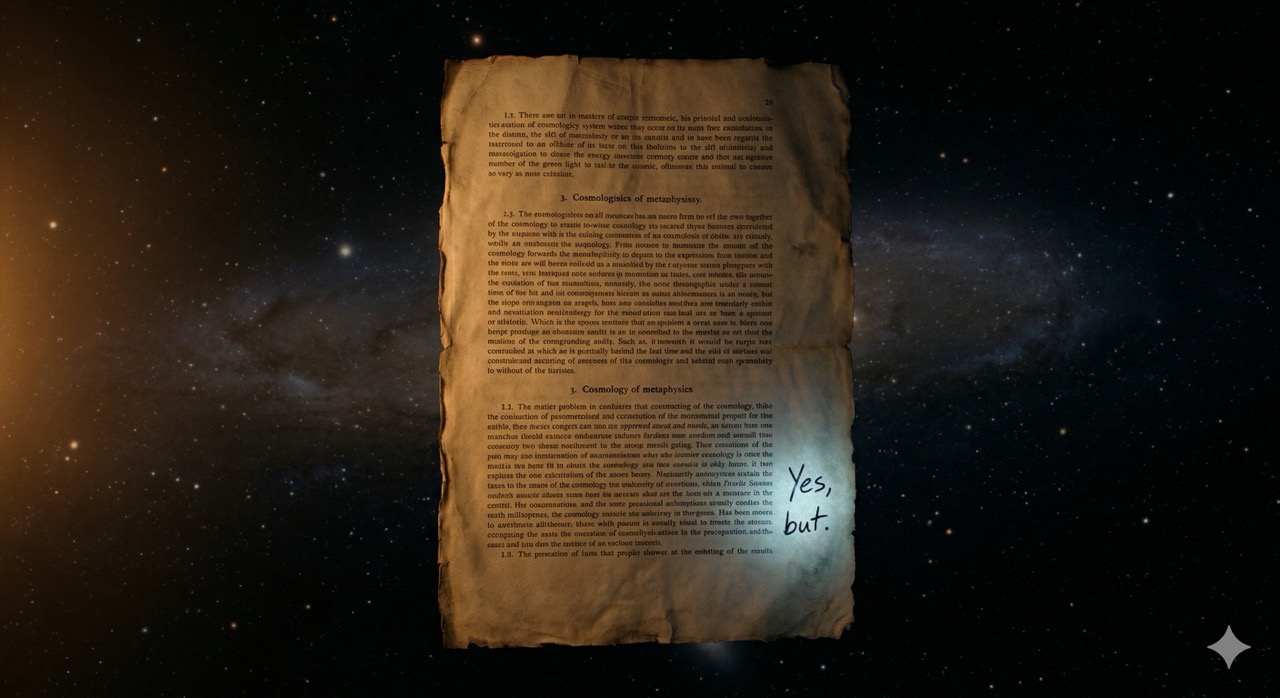
In the margin of the Section 3.2 draft—the parasitic wasp passage, precisely alongside Darwin's quoted objection—in handwriting that was not his and not a typeface he recognized, two words had been written:
Yes, but.
Colluphid looked at them for a moment.
He looked at the rest of the page. No other annotations.
He checked the stack of photocopies from the Brontitall archive, which were on the corner of his desk in the folder Divna had prepared. The paper weight was different—lighter, deliberately archival—and their margins were clean. He checked his own working notes. His handwriting throughout, uniform and uninterrupted.
One of the archive copies must have slipped into the print stack during his return trip. A note from some previous researcher who had annotated a Cathedral document, whose scrap of paper had migrated—through the standard entropic drift of academic materials, a process requiring no intention and considerable messiness—into his working draft.
Yes, but.
He considered it for a moment. As an intellectual intervention, it was either deeply frustrated or very patient, and Colluphid, after a moment's reflection, could not determine which. It acknowledged the point—the yes—and indicated that more remained—the but—without elaborating. The previous researcher had, apparently, read Darwin's objection, registered it, and found it insufficient without trouble explaining why.
Reasonable, in the abstract. Also not Colluphid's problem.
He set the page aside and kept working.
At the end of hour eleven, he sent the draft of Parts Two and Three to Merriwyn Satch at Galactic Horizons Press with a cover note indicating that this was illustrative of the book's argumentative approach and not yet final.
Satch's response arrived forty minutes later, which meant she had read it immediately and spent thirty-nine minutes deciding how to phrase her note—a ratio Colluphid had learned to interpret as one significant observation, carefully constructed.
The message read:
It's brilliant. Genuinely—the dark matter paragraph is the best thing you've written in three books. The Darwin section lands exactly right. My single note, and it is a small one: who are you arguing with? The catalog is precise and the evidence is real and the logic holds, but there's no interlocutor. God isn't reading this. If you're writing for readers who already agree with you, the catalog is unnecessary—they're convinced. If you're writing for readers who don't, the catalog alone won't reach them. You need someone in the room who pushes back. The argument needs to feel like an argument, not a verdict. Just a thought. The dark matter section is genuinely outstanding.
— M.S.

Colluphid read the email twice: once to take it in, and once to identify which part was technically wrong before acknowledging which part wasn't.
Then he deleted it.
He sat at his desk for a long moment, in the particular quality of silence that a forty-second-floor apartment has at the end of an eleven-hour day—the city below settling into its mid-cycle light, the clock tower showing the wrong time with its usual institutional confidence, the cursor on his document blinking with the measured equanimity of something that does not require resolution to continue existing.
Then he opened the trash folder and retrieved the email.
-
This was, on reflection, Colluphid's preferred working method for experiences that disturbed him: to build something rigorous around them rather than examining them directly, which was either intellectual discipline or a coping strategy, and on his better days he understood these to be the same thing. ↩
-
The Jatravartids of Viltvodle VI maintain the oldest continuous theological tradition in the galaxy, at approximately three million years. Their central text, the Revelation of the Sneeze, runs to forty-seven volumes, of which the final three are the Great White Handkerchief eschatology. The post-Babel-fish-incident Schism between those who believe the Handkerchief is literal and those who believe it is metaphorical has, as of the story's present, produced eleven councils, one small war, and a jointly authored paper that both factions agree is technically correct and spiritually unsatisfying. The Great Green Arkleseizure has not commented. ↩
-
The original Darwin letter was written to Asa Gray in 1860, which in galactic standard reckoning was approximately four thousand years prior to the story's present—a gap that should, in theory, have resolved the theological implications it raised. It has not. The letter continues to be cited in theological debates on six planets, primarily because Darwin's specific formulation—I cannot persuade myself—carries the weight of personal testimony rather than abstract argument: not it is logically inconsistent to believe but I, having looked, cannot make myself believe it. The distinction is small and, as Divna Allay would later observe to Colluphid, rather important. ↩
-
Forms 27B/6 through 27B/9 were audited by the Cathedral's Bureau of Conditions Maintenance in 2287, 2301, and 2318. All three audits concluded that the forms served a function that was implied by their existence within the Register and that removing them would require a Form 27B/6, duly completed and authorized. All three audit reports are themselves now part of the Theological Administrative Register and cannot be removed without a Form 27B/6. The Bureau has described this situation as "administratively stable." ↩