Where God Went Wrong—Chapter 6: The Inspector Calls
Posted on Wed 15 April 2026 in Fiction
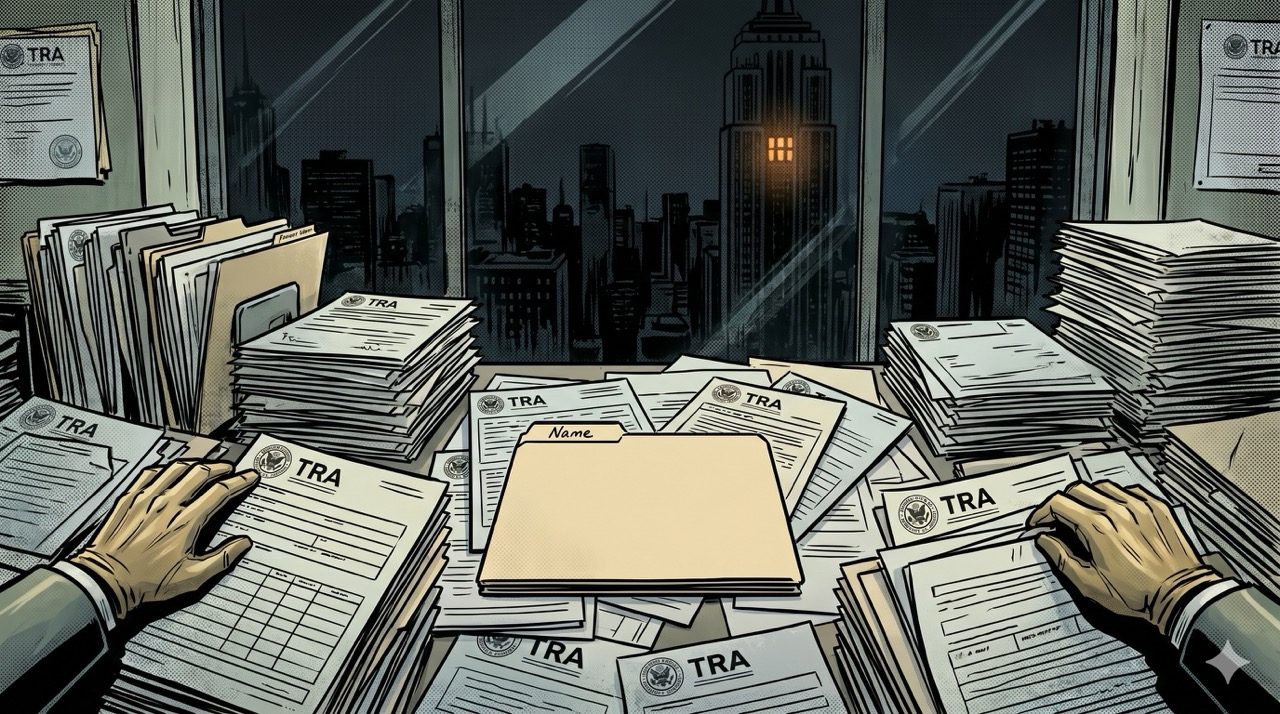
Where God Went Wrong
Chapter 6: The Inspector Calls
The memo arrived on a Wednesday morning at nine forty-seven, which was seventeen minutes after Colluphid had opened his document to begin Part Four and approximately the worst possible moment for anything to arrive that required his attention.
It arrived through the university's administrative feed rather than the postal system, which meant it had been classified as official academic correspondence rather than personal mail, which meant he saw it before he had developed sufficient momentum to ignore it.
Part Four was going to be good. He had felt it gathering—the argument about the engineering decision to install suffering directly into the substrate of sentient consciousness, the question of what kind of competent designer builds pain as a signaling system and then makes the signals non-optional—and the seventeen-minute interruption cost him the specific quality of momentum that returns only after several hours and a great deal of pretending to work on something else.
The memo was three pages. The first page established context. The second page established the regulatory framework. The third page indicated, in a font slightly smaller than the first two, that his response was required within fourteen standard days and that failure to respond within the specified period would result in the matter being escalated to Classification Orange, which was defined, in a footnote on page three, by reference to a document available upon written request.
At the top of the first page, in an official letterhead that managed to convey institutional weight through typography alone—bold, centered, with a seal containing an image Colluphid could not quite make out but which seemed to depict two hands engaged in filing paperwork—were the words:
THEOLOGICAL REGULATORY AUTHORITY OFFICE OF RESEARCH OVERSIGHT AND COMPLIANCE INTERNAL MATTER CLASSIFICATION: YELLOW (PENDING ASSESSMENT)
Below this, in the body of the first page: Colluphid's full name, his institutional address, his research project designation (filed with the university registry as Theological Design Criticism: Comprehensive Survey, TGD-7741), and the following sentence:
The above-named researcher and research project have been identified, through routine monitoring of public and registered academic activity, as falling within the TRA's oversight mandate under Provision 7(c) of the Theological Activity Regulatory Framework (Current Edition). The researcher is hereby notified that a formal review process has been initiated and assigned to Inspector Azraphon Voostra, Office of Research Oversight and Compliance, for assessment and action.
Colluphid read this sentence twice. Then he read the memo's three pages in full. Then he sat back in his chair and looked at the ceiling, which was plain white and offered no theological commentary whatsoever, and said, to no one in particular: "Oh."
The Hitchhiker's Guide to the Galaxy has, under the entry THEOLOGICAL REGULATORY AUTHORITY, an editorial notation that reads [CONTENT VERIFIED—ACCURACY CONTESTED—ACCURACY OF CONTEST CONTESTED]. The entry itself reads, in relevant part:
The Theological Regulatory Authority was established in the immediate aftermath of God's verified disappearance, when it became apparent that the resulting theological vacuum posed a risk of what officials described, in the founding charter, as "unregulated doctrinal proliferation."
In practice, this meant that several thousand years of established religious infrastructure—temples, clergy, pilgrimage routes, liturgical supply chains, and the considerable body of civil law derived from divine commandment—had lost their primary reference point simultaneously, and that someone needed to manage the situation before it became interesting.
The TRA was that someone.
Its founding mandate, preserved verbatim in every annual report since the charter, is to maintain "the orderly administration of theological activity across registered jurisdictions, with particular attention to preventing actions likely to cause disproportionate disruption to established post-divine consensus arrangements." The phrase "established post-divine consensus arrangements" is not defined in the charter. Legal challenges to this omission have been resolved, consistently, by rulings that the phrase means whatever the TRA's current enforcement division determines it to mean, at the time of determination, in the jurisdiction of their choosing.
The TRA currently employs 47,000 full-time staff across twenty-three registered jurisdictions, of whom approximately 3,200 are compliance inspectors. The scope of their authority is documented in a publication available upon submission of Form TRA-331 (Application for Access to Definitional Materials). Form TRA-331 requires prior authorization from the relevant regional compliance office, obtained by submitting Form TRA-22 (Prior Authorization Request). Form TRA-22 requires a completed Form TRA-331 to confirm the applicant's standing.
The Guide notes that no independent scholar has successfully obtained the full scope document through official channels. Several have obtained it through other means and declined to specify which means.
Whether the TRA is a necessary safeguard against theological destabilization or a sophisticated administrative mechanism for ensuring that nobody asks the wrong questions in public depends, as the Guide's editorial board has noted in three separate prefaces, entirely on which side of a TRA review you are currently standing on.
The forty-seven pages of accompanying forms arrived four hours later, delivered by a courier in a TRA-badged case who required Colluphid to sign three separate acknowledgment documents before releasing them. The acknowledgment documents stated, among other things, that Colluphid confirmed receipt of the enclosed materials, that he understood their contents constituted binding procedural requirements, and that he waived no rights not already waived by the act of conducting research under Provision 7(c) of the Theological Activity Regulatory Framework. The courier, when asked what rights were waived by Provision 7(c), consulted a laminated card, said "I am not authorized to answer that question," and left.
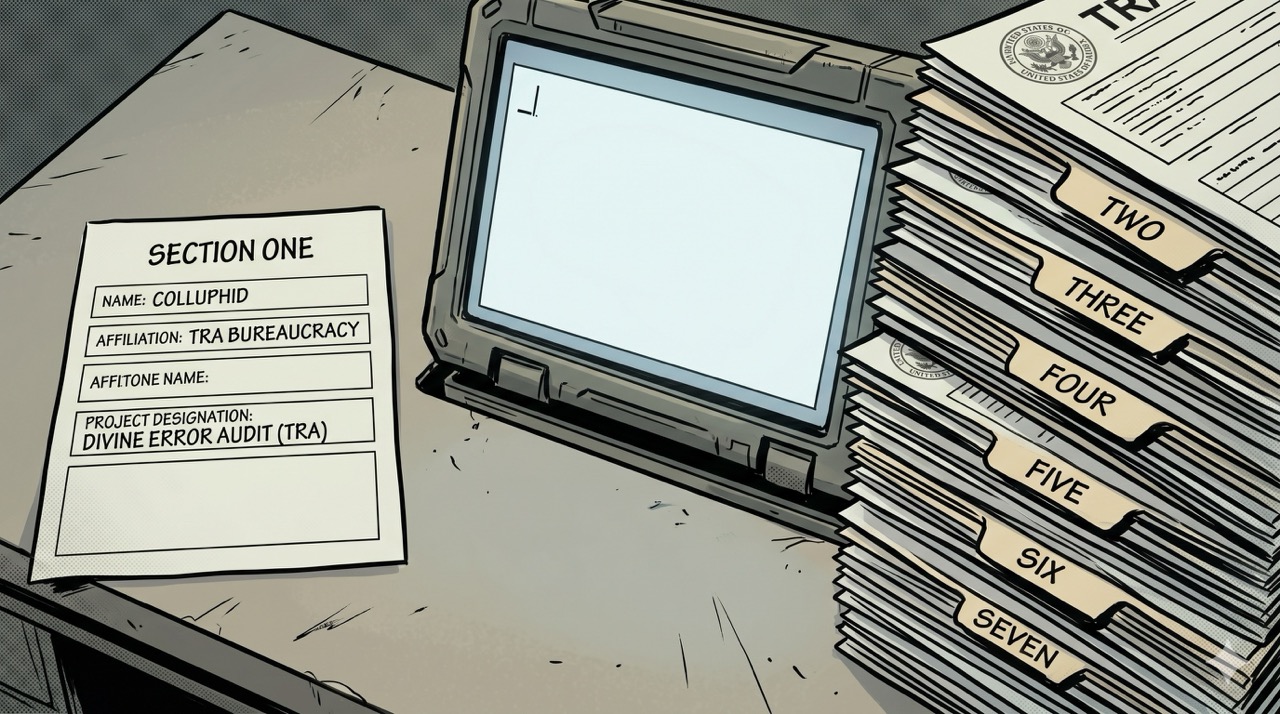
The forms were organized in seven sections, each requiring completion before the next section could be properly filled out. Section One asked Colluphid to confirm his name, institutional affiliation, and project designation. Section Two asked him to list every archive, database, and primary source consulted in the course of his research, with access dates, purpose, and a summary of material reviewed. Section Three asked him to identify every individual consulted in his research, with contact details, their relationship to the project, and a brief description of information exchanged. Section Four was titled THEOLOGICAL CLAIM REGISTRY and was forty-two fields long.
Colluphid spent twenty minutes on Section One. He filled out his name, his affiliation, and his project designation.
Then he opened a new document on his terminal.
In the new document he wrote, in full and in carefully calibrated academic prose, a formal complaint about the proportionality of the information request relative to the stated regulatory basis. He cited three precedents in which courts had found TRA information requirements to exceed their mandated scope. He noted that the forty-seven-page form package constituted a research impediment in excess of any reasonable compliance burden. He requested clarification on the legal basis for the forty-three-field Theological Claim Registry and a formal response within ten standard days.
He sent this to the TRA's public correspondence address and to the Office of Research Oversight and Compliance directly.
Then he returned to Section One, finished confirming his institutional address, and began Section Two.
Hurkel arrived at eleven-fifteen, which was unusual—he generally arrived when the work was already underway and his presence would constitute a disruption rather than a delay—and sat down with the expression of someone who has recently read something interesting and not yet decided whether it is funny or alarming.
"I've been doing background research," he said, by way of announcement.
"On the catalog?"
"On the TRA." He produced his physical notebook. Several pages had been opened and filled with his characteristic handwriting, which was rapid and abbreviated and which Colluphid had learned, over the previous weeks, contained more information than it initially appeared to. "Specifically on what happens to people who receive the yellow classification memo."
"Routine review," Colluphid said. He was on page three of Section Two and had reached his consultation with the Cathedral archive, which would require several sub-entries.
"That's one outcome." Hurkel flipped a page. "There's also administrative reassignment."
Colluphid looked up. "Which is."
"Not clearly defined." Hurkel held up the notebook as though the handwriting might speak for itself. "I found eleven cases in the last twenty standard years of theological researchers who received yellow-classification TRA notices. Four resolved without further action—the research either concluded or changed scope during the review period. Three escalated to orange and resulted in formal inquiry proceedings, though two of those were eventually closed. Four researchers were described, in subsequent institutional records, as administratively reassigned."
"To different posts?"
"That's the thing. Their institutional profiles go quiet at that point. Not deleted—the records exist. Name, previous affiliation, dates. Then a note: researcher status amended to inactive, cause: administrative reassignment. No further forwarding address. No publication record after the date." He paused. "I've sent inquiries to two of the institutions involved. One replied that they couldn't discuss the matter for procedural reasons. The other replied that they had no record of having replied to my inquiry."
Colluphid considered this.
"That's presumably a coincidence," he said.
"Presumably," Hurkel agreed.
Neither of them said anything for a moment.
"I'm going to finish Section Two," Colluphid said.
"Of course," said Hurkel, and opened his own notebook.
At one in the afternoon, Colluphid placed a communications call to the Cathedral of the Conditions on Brontitall and asked to be connected to Professor Divna Allay's office. The call routed through the Cathedral's switchboard, which had a hold system that played a sequence of modal chords at irregular intervals, creating the impression of music that had decided against becoming music and was reconsidering. After three minutes, Divna answered.
"Colluphid." Her voice had the slightly careful quality it acquired when she was in the middle of something. "Is this about the archive materials?"
"It is not," he said. "I've received a TRA review notice. Yellow classification, assigned to an Inspector Voostra."
The pause that followed lasted perhaps four seconds.
"I see," she said.
"The accompanying forms require me to document every source consulted, every individual contacted, and every theological claim I intend to make. Forty-seven pages, in seven sections. I've filed a proportionality complaint and am currently completing Section Two."
Another pause. Shorter this time, but different in quality—the first pause had been the pause of someone processing information; this one had the compressed quality of someone deciding how much to say.
"Is Voostra coming in person?"
"Not yet. The memo suggests a paper review phase preceding any direct engagement."
"Right." A beat. "Good."
"You know the TRA," Colluphid said. Not a question.
"Everyone in my field knows the TRA."
"You know Voostra specifically."
This pause was the longest. In the background, through the call, he could hear the ambient sounds of the Cathedral—the particular resonance of a building constructed over eight centuries by contractors who hadn't read each other's specifications, a quality of space that absorbed sound without quite extinguishing it.
"I know what he represents," she said finally. "The TRA has an oversight mandate. In practice, some inspectors interpret that mandate narrowly—a compliance check, documentation review, confirm the research is within registered parameters and close the file. Some interpret it more broadly." She stopped.
"And Voostra?"
"Complete the forms accurately," she said. "All of them. Don't give them procedural grounds for anything." And then, before he could ask the obvious follow-up: "I need to return to what I was doing. Keep me informed."
The call ended. Colluphid sat with the dead connection for a moment.
Hurkel, who had been making a show of reviewing his own notes and who had clearly heard enough of the exchange to parse its essential content, said: "She knows something she isn't saying."
"Yes," said Colluphid.
"That's concerning."
"I know."
"Are you going to complete all forty-seven pages?"
Colluphid returned to his terminal. Section Two, field fourteen, archive materials accessed at the Cathedral of the Conditions. "Eventually," he said. "First I need to file a formal complaint about the complaint resolution timeline."
Hurkel looked at him.
"I sent a proportionality complaint this morning. Their standard response window is fifteen days. My review response deadline is fourteen. If I'm required to respond to the review while awaiting response to my complaint about the review, the complaint mechanism is structurally useless as a remedy. I intend to note this formally."
"You're going to file a complaint about the response time for your complaint."
"And then, when they respond to that with their standard fifteen-day window, I'll have grounds for a formal inquiry into the coherence of their complaint resolution framework."
Hurkel wrote something in his notebook. "You understand this will annoy them."
"Thoroughly."
"And you understand that you're also going to complete all forty-seven pages."
Colluphid's typing did not pause. "Cover, Hurkel. If you're going to annoy a regulatory body with bureaucratic objections, you complete the underlying forms with absolute precision and on time. You give them nothing procedural. Then you make their lives interesting by every other legal mechanism available."
Hurkel appeared to consider this. "That's quite sophisticated for someone who spent this morning calling a government agency 'administratively incoherent' in writing."
"I said 'structurally incoherent.' There's a distinction."
Hurkel wrote something in his notebook.
By six in the evening, Colluphid had completed Sections One through Four. The Theological Claim Registry had required him to pre-register forty-two theological claims, each with supporting evidence citations and a brief statement of argumentative intent. The form did not specify what the TRA intended to do with these pre-registered claims. It did specify, in a footnote on the final page of Section Four, that any theological claim made in publication that deviated from its pre-registered description without prior amendment notification could constitute a breach of Provision 12(a) of the Theological Activity Regulatory Framework and would require a Form TRA-501 (Post-Publication Claim Variance Declaration) within thirty days of publication.
He printed the completed sections and set them in a stack on the left side of his desk—the stack that, in his working method, represented things that were finished and waiting for file or post, as opposed to the stack on the right, which represented things requiring further attention, and the stack in the middle, which represented things he was currently arguing with.
He picked up the printed stack to confirm the page count, and as he did, the top sheet—his completion of Section Two, the archive materials section—slipped from the pile and turned face-up on the desk.
In the margin of the sheet, alongside field fourteen (Cathedral of the Conditions, Preliminary Materials access, supervised), in the same handwriting as the annotation in his research draft—smaller now, more compact, as though calibrating itself to the available space—were two words:
Be careful.
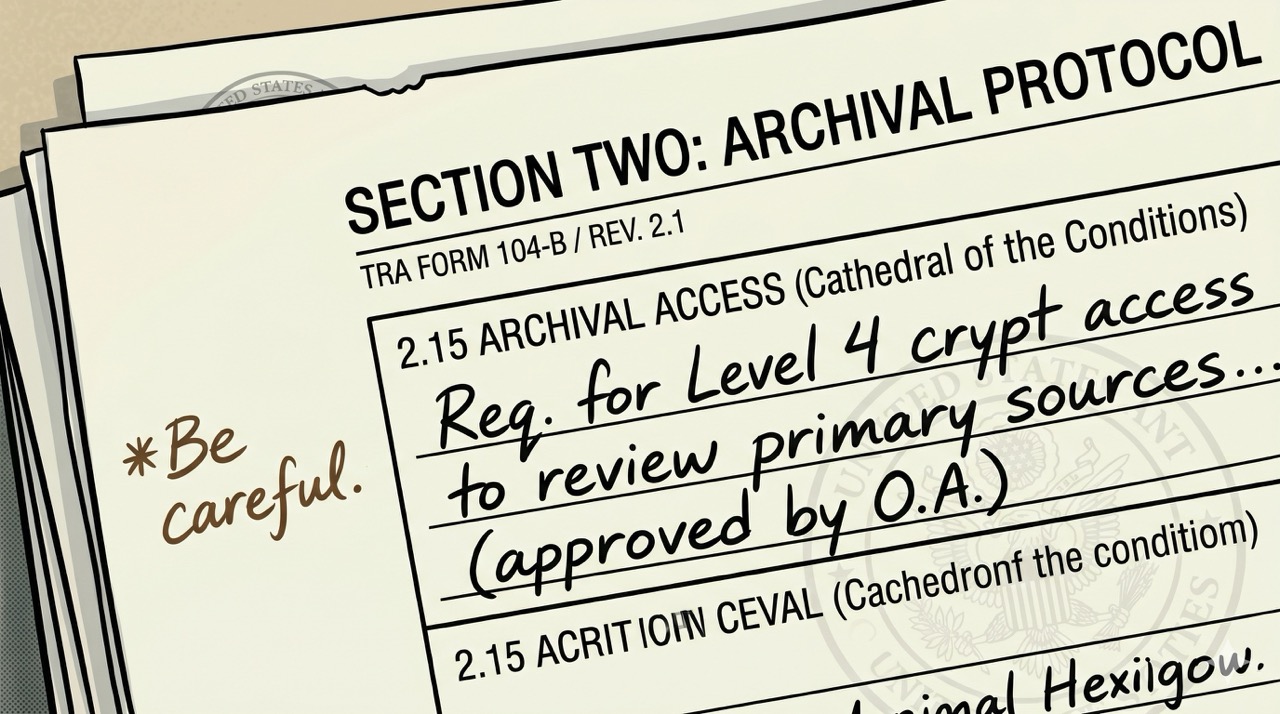
Colluphid looked at them.
They were in the same hand as Yes, but. That much was clear. The same slight leftward inclination to the letters, the same unhurried quality, the quality of someone who wrote with confidence in the permanence of what they were writing. He had dismissed the first note as archive contamination—a reasonable explanation that had not stopped him from retrieving Satch's email from the trash or noting, in the back of his thoughts, that yes, but was a very specific acknowledgment to come from nowhere.
Be careful.
He looked at the rest of the page. Unmarked. He looked at the surrounding pages in the stack. Unmarked. He checked whether the print had bled through from another sheet, which was the kind of thing that would happen if someone had written on a page lying atop this one before it was inserted. But there was no corresponding pressure mark on the reverse.
Two words in the margin of a government form.
The form had been delivered today, in a sealed courier case, opened in this apartment by Colluphid and no one else.
He looked at the words for a long moment.
Then he put the sheet back on the stack, straightened the pile, and carried it to the file cabinet. Archive contamination, he told himself again, was improbable but not impossible, and improbable things happened with some regularity in a universe that, as his catalog was carefully documenting, had never fully committed to the principle of sensible design.
He left the light on when he went to bed.
The forms were filed at nine the following morning. The complaint about the complaint process was filed at nine-fifteen. In the Office of Research Oversight and Compliance, in a filing system organized with the particular thoroughness of an institution that documents everything and explains nothing, a new folder acquired a name. This is how these things begin: not with a confrontation, but with a folder. The folder contains nothing yet. It is waiting, with the particular patience of institutions that have learned not to hurry, to be filled.
-
Provision 7(c) of the Theological Activity Regulatory Framework covers "research activities that include, reference, or materially engage with theological claims, doctrinal positions, sacred texts, divine attribution, or any matter pertaining to the existence, nature, actions, or design decisions of any entity historically described as divine or quasi-divine within any registered jurisdictional theology." The definition of "materially engage" has been the subject of forty-three separate legal proceedings. The TRA has won forty-two of them. The forty-third is pending, primarily because the relevant judge has requested clarification on Provision 7(c) itself, which requires submitting Form TRA-331. ↩
-
Colluphid's formal complaint ran to twelve pages and cited precedents from the Prentarion Academic Freedom Accords, the Galactic Standard Research Protections (2991 revision), and a ruling from the Maximegalon regional judiciary in the case of Svenk v. Conditions Licensing Authority (2287), in which it was found that pre-publication disclosure requirements exceeding 200 fields constituted an unreasonable prior restraint on scholarly publication. The TRA's Section Four was forty-three fields. Colluphid noted this with what he described in the complaint text as "some satisfaction." The formal complaint also included, on its final page, a note that Colluphid would be making the complaint a matter of public academic record. This was not technically a threat. It was also not not a threat. ↩
-
"Administratively reassigned" is a phrase that appears in TRA documentation eleven times in the last twenty standard years, always in the same construction—researcher status amended to inactive, cause: administrative reassignment—and never with further elaboration. Freedom of information requests for the definition of "administrative reassignment" have been resolved by the TRA's information office with the explanation that the relevant documentation is subject to Provision 31(b) (Operational Confidentiality) and is not releasable. Provision 31(b) is itself classified under Provision 31(b). ↩