Where God Went Wrong—Chapter 7: Fieldwork (Or: The Trouble With Omniscience)
Posted on Sat 18 April 2026 in Fiction
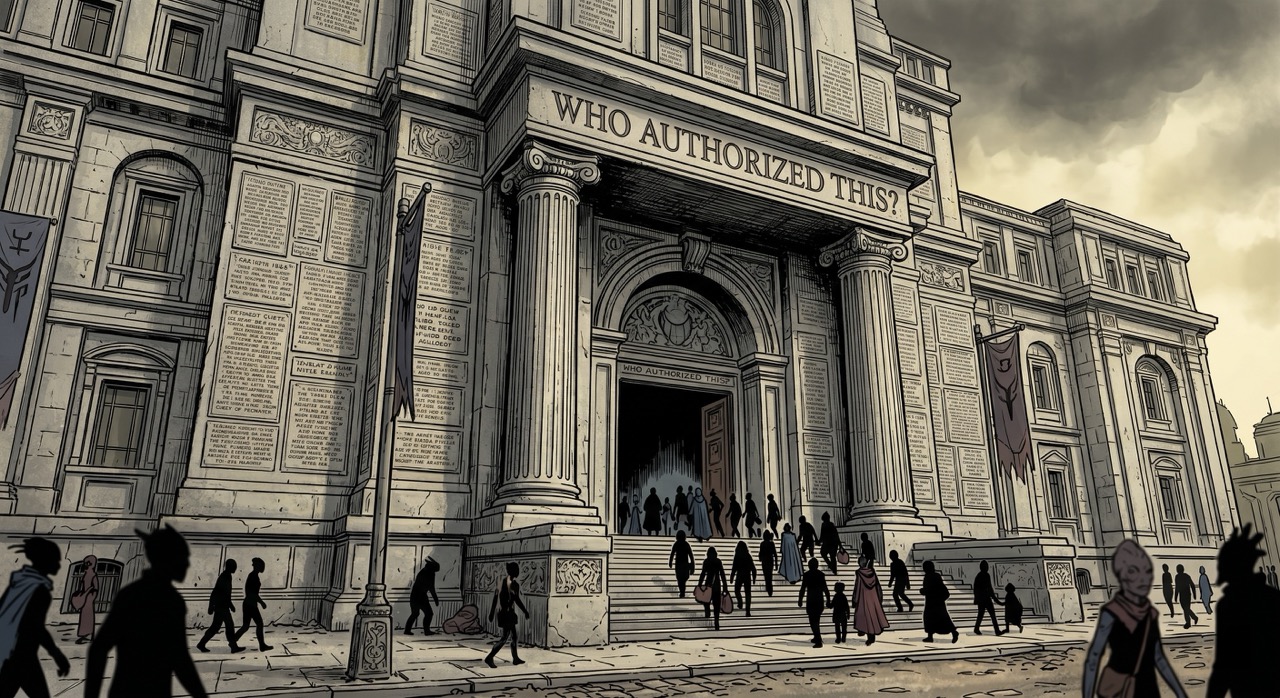
Where God Went Wrong
Chapter 7: Fieldwork (Or: The Trouble With Omniscience)
The forms were filed on a Thursday. Colluphid had the shuttle booked for Friday.
This was not coincidence. He had booked the shuttle during the forty-minute stretch in which he was completing Section Three of the TRA review forms—specifically the portion requiring him to describe his consultation with Divna Allay in terms provided by a drop-down menu that included "Expert Consultation," "Adversarial Interview," "Collaborative Research Partnership," and "Other (please specify)." He had selected "Expert Consultation," which was accurate in the way that describing a controlled explosion as "some heat was generated" is accurate. He had then opened a second window and researched available transit options to Oglaroon.
The fieldwork portion of his research plan had been pending since week three. He had deferred it twice—once for the Brontitall trip, once for the catalog writing—and had been about to defer it a third time for what he was now thinking of simply as the Forms. But forty-seven pages of TRA review had, paradoxically, clarified his thinking. The Authority had identified him as a researcher engaged in problematic theological inquiry. The least he could do was go and do some.
Hurkel, when informed of the travel schedule on Thursday evening, said "Oh good" in the tone of someone who has been waiting to say exactly that for several weeks.
The Hitchhiker's Guide to the Galaxy has this to say about OGLAROON:
Oglaroon is a mid-sized planet in the Pansel System, known primarily to galactic tourists for its museums and to galactic scholars for having developed, independently and in parallel with twelve other civilizations in the Western Spiral Arm, the concept of divine accountability.
The Oglaroonians arrived at the conclusion that God was responsible for the flawed state of the universe approximately 4,000 years before God's verified disappearance, which they have since described as "the least surprising development in recorded history" and, in a second published opinion, "frankly overdue."
Having established, to their satisfaction, that the universe was improperly designed and that someone was therefore responsible, Oglaroonian civilization has devoted the subsequent four millennia to the question of accountability: how to assign it, document it, and—in the absence of the responsible party—how to maintain an institutional record so thorough that if God ever returns, the appropriate paperwork will be ready.
The planet's most visited attraction is the Temple of Divine Accountability, colloquially known as the Temple of Failures. It receives 2.3 million visitors annually. The gift shop has won fourteen consecutive awards from the Pansel System Retail Excellence Initiative and sells, among other items, a mug that reads DESIGN FLAWS ARE NOT OPINIONS.
The Guide notes that one elderly man living in a house not far from the Temple has reportedly spent years sitting under a nut tree on a hillside observing that the universe is not quite what he had been led to expect. He has not specified who did the leading. This is, the Guide's editorial board has noted in a preface, the correct question to decline to answer.
Their contact on Oglaroon was a scholar named Fressik Tanoor, Professor of Applied Accountability at the Oglaroonian Institute of Divine Studies, who met them at the transit terminal with the slightly stunned expression of someone who has anticipated a celebrity encounter and is discovering that the celebrity is shorter in person than expected.
"Professor Colluphid." He extended all three of his forearms at once, which Colluphid recognized from his preparatory reading as an Oglaroonian gesture of exceptional professional respect—used, the etiquette guide had noted, for visiting heads of state, recipients of the Pansel Prize in Applied Philosophy, and authors whose work had materially advanced the field. "We have your first book on the Institute's required reading list. Also your second. And the monograph on Babelian proof theory."
He paused.
"We had your third book on the list briefly, but the faculty voted to reclassify it as supplementary. You concluded that God's disappearance was logically inevitable rather than a moral failing, which is technically accurate but doesn't quite capture the emotional dimension of the situation."
"I appreciate the nuance," Colluphid said.
"The student body were particularly firm on it."
Hurkel, behind Colluphid's left shoulder, wrote something in his notebook.
Oglaroon was not, at first glance, a planet organized around the documentation of divine failure. It was green in the places where it wasn't grey, moderately populated, and possessed of a climate that the shuttle's environmental briefing described as "temperate with theological overtones"—either a mistake by the writer or a very efficient summary of the atmosphere. The transit terminal smelled of stone and mild disinfectant, the particular combination of public institutions everywhere in the known galaxy, as though institutional purpose itself had a scent.
The Institute was a four-story building of local pale stone, with a long inscription carved above the entrance: THE UNIVERSE IS BROKEN. THE EVIDENCE IS INSIDE. WE ACCEPT GROUP BOOKINGS.
"That's the motto," Tanoor said.
"I see," said Colluphid.
"We've considered updating it. But it keeps testing well."
The Temple of Divine Accountability was a twenty-minute walk from the Institute, which Tanoor used to explain its history. The building had been begun in the second century of Oglaroonian theological scholarship as a repository for evidence—physical, documentary, and testimonial—of divine design failures. It had been expanded seven times. Its current form occupied fourteen city blocks and contained exhibits covering the physical universe, the biological record, the ethical framework of sentient consciousness, and a permanent collection of what the Oglaroonians called "the specifics"—individual documented instances of divine negligence, with names, dates, and causal chains.
"The specifics wing is the most visited," Tanoor said. "People like to see the individual cases. It makes it personal."
"I imagine it does," said Colluphid.
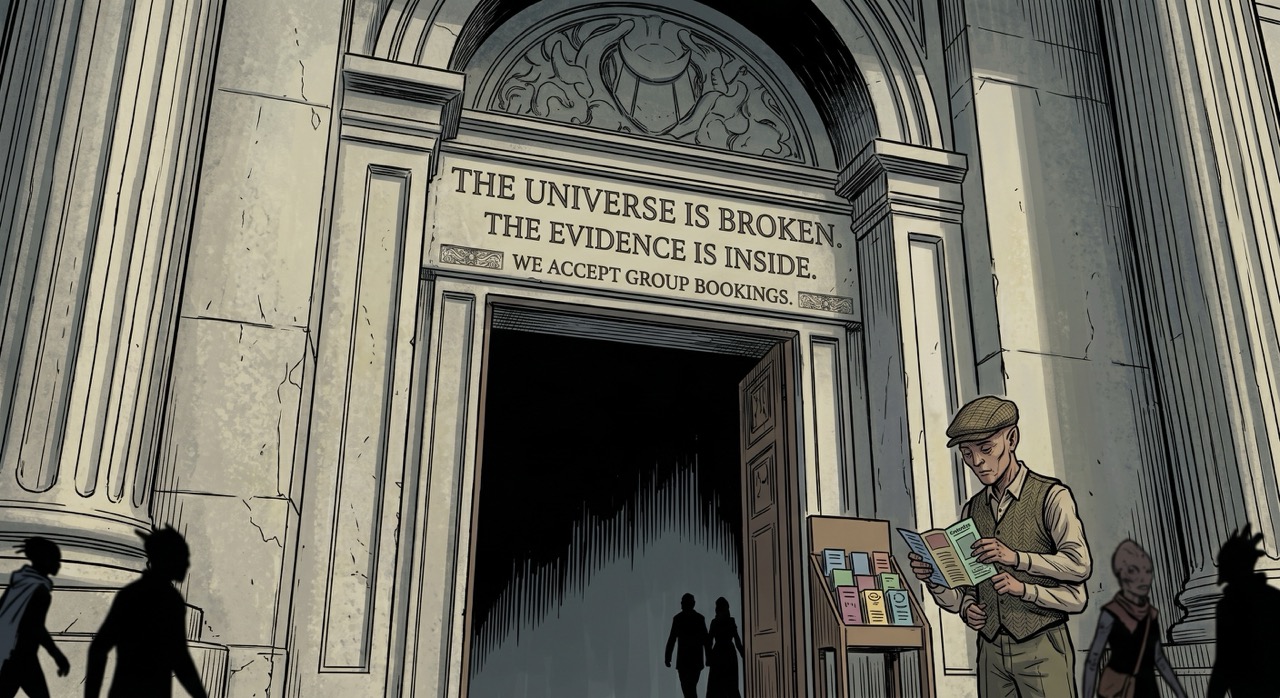
The Temple of Failures was, objectively, everything Colluphid had been trying to build in prose.
The entrance hall was vaulted and cool—fifteen degrees, Tanoor said, for the preservation of the documents, though Colluphid noticed that the cold had the secondary effect of making everyone who entered stand slightly straighter, as though the temperature itself was insisting on gravity. The walls were lined with timeline panels documenting the history of the universe from the Big Bang to the present day, with annotations marking every decision point at which a different design choice would have produced a less catastrophically flawed result. The annotations were thorough. The timeline was long.
He breathed in carefully. There was something in the air here that all serious archives share—paper, and time, and the particular dryness of rooms that have been kept at a controlled temperature for so long that moisture has given up trying. It smelled like the Cathedral, and like the archive at Maximegalon, and like the future of his own office if he kept printing drafts and never filed anything.
The first gallery was the Physical Universe collection: dark matter distribution, the heat death problem, the fine-tuning controversy presented from the perspective of why fine-tuned constants had nevertheless produced so many inhospitable worlds relative to habitable ones. Colluphid had covered all of this in his catalog, and he recognized the arguments with the particular satisfaction of encountering one's own thinking rendered permanent and institutional. There was an exhibit on photosynthesis efficiency that was nearly word-for-word his Section 3.1. He stopped to read the placard.
"We developed that argument independently," Tanoor said.
"I don't doubt it," said Colluphid.
"But we were pleased to see your version. You express the cellular respiration inefficiency argument with particular clarity."
Colluphid registered, somewhere below the level he was currently examining, that he was being flattered in a way that should have been uncomplicated.
It was not quite uncomplicated.
The second gallery was the biological record. The parasitic wasp was its centerpiece: a life-size diorama, three-dimensional, technically precise. The exhibit label described what was happening in the clinical language of entomological documentation. The caterpillar conveyed no particular opinion on the matter. The lighting was excellent.
Colluphid had written about the parasitic wasp extensively, and with care. He had approached it as Darwin had—the organism that, if God exists, constitutes the clearest argument that something in the design brief had gone profoundly wrong. He had written about it with controlled precision: the biological fact, the theological implication, the logical conclusion. He had found the argument satisfying in the way strong arguments are satisfying, clean and inevitable, the kind of proof that closes a door.
Standing in front of the exhibit, under the cool lights of a building constructed specifically to prove his point, he felt something he did not immediately identify.
It wasn't satisfaction. It wasn't the opposite of satisfaction, either. It was something that arrived without a label and occupied space in his chest.
He did not examine it.
"Shall we continue?" he said.
The third gallery was the Ethical Framework collection: consciousness, the relationship between intelligence and suffering, the question—explored with Oglaroonian rigor across two hundred meters of exhibition space—of whether sentient awareness was a gift or an infliction. Colluphid navigated it with efficiency, recognizing the conceptual territory.
He was almost through it when he stopped at a small case set into the wall at the far end of the second corridor. It contained a single handwritten document under glass. The placard described it as a personal testimony collected from the last surviving member of a species called the Arvanthi, approximately eight hundred years ago, by a scholar who had made a three-year journey specifically to record it. The Arvanthi were now extinct.
The testimony was short. In translation, it read:
I have spent my life studying what went wrong. In the last year of my life, I find myself wondering whether the one who made it is also studying what went wrong. Whether the maker grieves, as we grieve. Whether grief, in the one who made everything that can be grieved, is larger than the universe it fits inside.
I think it might be.
I think I am sorry for thinking so.
Colluphid read it.
Then he read it again.
The thing in his chest, which he had not identified in the previous gallery and had filed with reasonable efficiency, came back now with considerably more conviction. He recognized it this time. Sympathy. Not for the Arvanthi—their situation was documented and their extinction had causes unrelated to this particular question—but for something else. For a creator standing at the edge of what it had made, looking at the caterpillar in the case two rooms back, and finding no clean argument available.
It passed. He was practiced at this: registering the unwanted thing and placing it in the section marked for later examination, which had been a growing section since Brontitall. He straightened, looked at the exit, and walked toward it.
He did not mention the testimony to Tanoor or to Hurkel. He would not think about it again until several hours later, by which point pretending otherwise would no longer feel like an available strategy.
The bar was two streets from the Temple, and had been there, according to the sign above the door, since the third century of Oglaroonian theological scholarship—which made it approximately as old as the movement that had built the Temple, and considerably better at providing a comfortable chair.
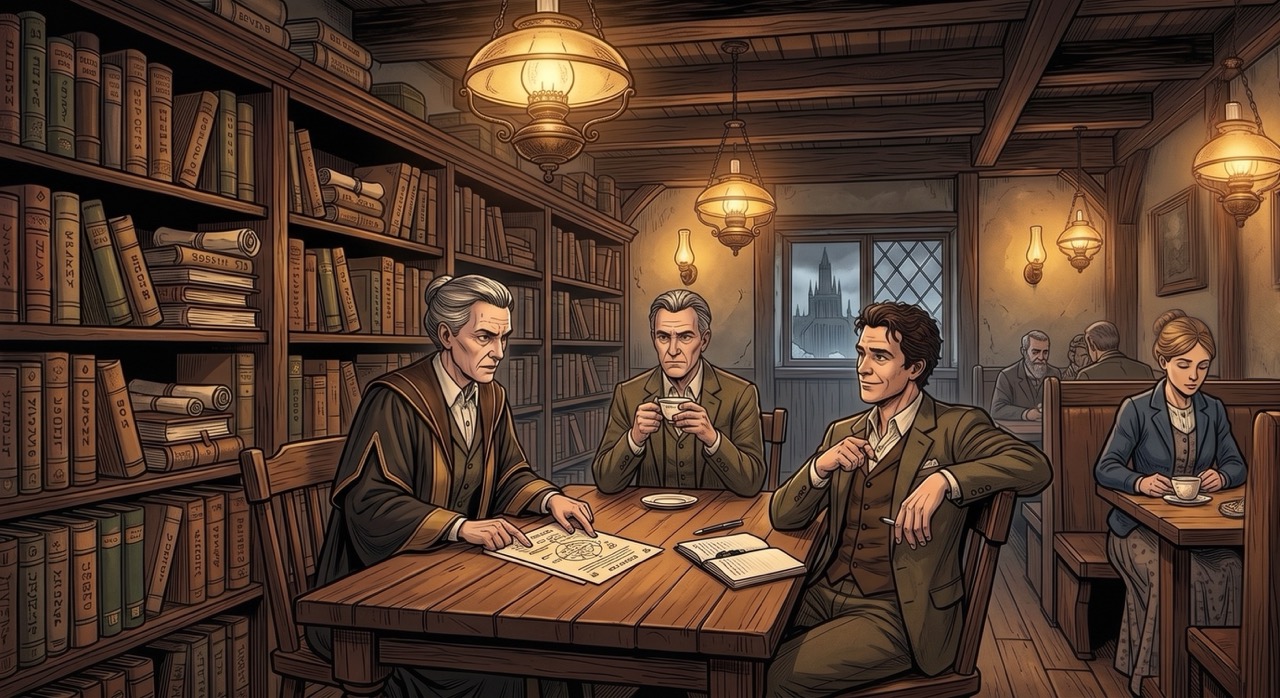
They had gone there at Tanoor's recommendation. The bar was warmer than the Temple—warmer than anything they'd been in all day—and smelled of the local spirit and old wood and the kind of accumulated conversation that leaves a residue. Hurkel had been quiet through most of the gallery tour in the watchful way Colluphid associated with him storing observations. He had taken his notebook but written very little in it, which was unusual—he generally wrote more when he was thinking harder, not less. The quiet had a quality to it, a slight pressure, like the atmosphere before a shift in weather.
He broke it twenty minutes into the meal, in the context of a larger conversation about the catalog's methodology, with the particular casualness he used when he had thought something through and was now pretending to think of it for the first time.
"The incompetence frame is fine as far as it goes," he said. "But I keep getting stuck on the malice possibility."
A woman at the adjacent table—a senior lecturer in Theological Ethics named Wress, who had been introduced at the Institute and whom Colluphid had assumed was absorbed in her own reading—set down her drink. "The malice question is not in serious dispute."
"It is in my head," Hurkel said.
"The evidence supports incompetence over malice in every case the Institute has documented."
"The evidence supports both hypotheses with equal adequacy in roughly a third of the cases," Hurkel said. "I read your department's publication archive on the shuttle."
This was the sort of thing Hurkel said that Colluphid found simultaneously irritating and impressive. He had been assigned as a research assistant as a disciplinary measure and had apparently read the entire scholarly output of a planetary theology institute in a seven-hour transit.
Wress looked at Hurkel with the expression of someone re-evaluating a previously dismissed variable. "You read the Wress-Tanoor categorization study?"
"The 2287 one, yes. And the 2301 update. Your borderline cases—consciousness, suffering-persistence, and the specific question of Forms 27B/6 through 27B/9—should be reclassified."
"As malice?"
"As intent. Which isn't the same thing."
"Intent covers both competent malice and incompetent negligence," Wress said, with the precision of someone who has had this conversation before and found most versions of it inadequate. "It doesn't resolve the question. It expands it."
"Yes," Hurkel said. "That's why it's better." He picked up his drink. "Incompetence means the designer didn't know what they were doing. Malice means the designer knew and did it anyway. Intent—deliberate choice that produced this outcome—leaves open the possibility that the designer knew, didn't want this result, tried to prevent it, and couldn't. That's different from both."
"That's an excuse," Wress said.
"It's an explanation. Explanations aren't excuses. They're how you find out what actually happened."
The argument continued for forty minutes. It grew briefly heated when Wress produced a paper from her jacket—this was, Colluphid had the sense, a thing Oglaroonian theologians kept with them at bars as a matter of professional habit—and it concluded without resolution, which was perhaps its own kind of resolution.
Colluphid had listened. He had spoken very little. He had noted, against his better inclinations, that the incompetence-malice-intent distinction was one he had not made in his catalog. He had used "incompetence" throughout because it was the most devastating available word, because it located the failure precisely and without mitigation. Because a designer who doesn't know what they're doing has no defense.
Hurkel had introduced motive. Which meant introducing the possibility of a defense. Which meant the argument Colluphid had spent three months building had a structural gap he had not examined because he had not wanted to.
He looked at his tea.
This was going to require a Section 3.2b.
They left Oglaroon on the second morning, after a day of Institute meetings in which Colluphid absorbed arguments he would need to answer. He had collected more evidence in support of his thesis than anywhere else on his research itinerary. He had the exhibits. He had the categorization studies. He had two days of uninterrupted access to a civilization that agreed with him completely.
He also had, in a separate document on his personal device rather than his research terminal, a note that read: Arvanthi. Last testimony. Library ref.
He had not decided what the note was for.
On the transport platform, in the thin early light that Oglaroon's sun produced through a cloud layer of notable underperformance, Colluphid asked Hurkel what he had thought of the Temple.
He expected the incompetence-malice-intent argument, elaborated. Or a list of exhibits requiring counter-analysis. Or one of Hurkel's characteristically casual observations that turned out, under pressure, to be precise.
Hurkel was quiet for a moment.
"I thought it was the most religious place I've ever been," he said.
Colluphid looked at him. "The Temple of Failures."
"Yes."
"A monument to divine incompetence. Every exhibit in the building is an argument against God."
"Yes," said Hurkel.
Colluphid waited.
"What do you mean?" he said.
Hurkel looked out at the transit platform, where a family of Oglaroonians was consulting the departure board with the mild focused energy of people who have a shuttle to catch and a theology to maintain.
"I don't know yet," he said.
The shuttle arrived. They boarded it. Colluphid found his seat, opened Part Four of his manuscript, and wrote four paragraphs on the suffering-substrate problem that were, by any measure, the sharpest he had produced. Then he sat back and read them.
They were correct. He was certain they were correct.
He saved the document. He did not delete anything.
He opened the second document and looked at the note: Arvanthi. Last testimony. Library ref.
He closed it without adding anything. Then he retrieved it from the trash.
On Oglaroon, in the third gallery of the Temple of Failures, the case containing the last Arvanthi testimony stood in its alcove under controlled light. Eight hundred years of storage had not degraded the handwriting. The letters were still even, still unhurried, still possessed of the quality of someone writing for permanence. Thousands of visitors had read the testimony. Most found it moving. Some found it troubling. A few found both things at once, and those were the ones who stood in front of the case a little longer than they'd planned, and left the gallery through the wrong door, and had to be redirected by the docent who had seen it all before and always let them have a moment first.
-
The Oglaroonian Institute of Divine Studies was founded in the 40th year of the post-Schism theological reform period, when the existing Oglaroonian Academy of Natural Philosophy determined that theology required its own institutional home specifically because mixing it with natural philosophy had repeatedly caused the natural philosophers to have what the administrative minutes describe as "episodes." The Institute's founding charter specifies that its mandate is to study divine accountability "without mercy, without sentiment, and with at least two independent citations." The third requirement was added after an incident in the Institute's second year involving an unsubstantiated claim about the structural integrity of divine attention spans that the founding committee felt had not adequately served the institution's scholarly reputation. ↩
-
The incompetence-malice distinction in Oglaroonian theological scholarship has a documented history of 3,200 years and has generated more academic literature than any other single methodological question in the field, with the exception of the question of what the correct method is for generating academic literature about methodological questions. Wress's 2287 categorization study is considered the definitive modern treatment, though Wress herself has stated on record that she considers it incomplete in ways she has not yet fully identified, which the Institute's promotional materials describe as "an admirably honest position" and which Wress's students describe as "not reassuring." ↩
-
The Arvanthi were a species of the Outer Rim's Cressidan Expanse, extinct for approximately 800 years. They had a theological tradition of some 12,000 years and are notable among galactic civilizations for having never, in their recorded history, attempted to resolve the question of whether God existed. They considered the question less interesting than the question of what God, if present, would owe them—and what they, in turn, would owe God. Their final census was conducted approximately three years before their extinction. It recorded 4.2 million individuals, all in reasonable health, with no indication of any threatening condition. No cause of extinction has been established. Their personal archives—diaries, correspondence, philosophical notebooks—are preserved in the Oglaroonian Institute's special collections and have never been fully translated. ↩